
Why Most Subscription Content Apps Fail Within Two Years

Why Most Subscription Content Apps Fail Within Two Years
 Sachin Sharma
Last Updated on September 29, 2025
Key Takeaways
What You’ll Learn:
-
Why nearly 80% of subscription apps fail within two years.
-
The biggest hurdles: weak market fit, high acquisition costs, poor content strategies, ineffective retention, pricing mistakes, and technical flaws.
-
How different tactics like niche targeting, strong retention features, and optimized pricing can turn failure into long-term growth.
Stats That Matter:
-
Median subscription apps convert only 1% of downloads into paying users by day 35.
-
Half of subscription apps fail to reach even that 1% benchmark.
-
Health & fitness apps perform better with a 2.7% median conversion rate and up to 12.1% for the top 10%.
Real Insights:
-
Exclusive content alone isn’t enough; market validation is critical.
-
Retention strategies like community features, loyalty perks, and personalization reduce churn.
-
A well-planned, niche-focused subscription app has a far higher chance of thriving than generic, broad platforms.
Everyone loves the idea of recurring revenue, but the subscription app game is brutally unforgiving. Nearly 80% of subscription apps fail within two years, and even those that survive struggle to convert free users into paying subscribers. The biggest problem? Most people download out of curiosity, not commitment. By the time reality sets in, that users expect consistent value, flawless tech, and pricing that feels fair, it’s already too late.
That’s why so many apps quietly disappear before they’ve even had a chance to grow. If you’re planning to build one, understanding why they fail isn’t optional; it’s the difference between burning cash and creating something that actually lasts.
The Challenge of Subscription Conversion
Subscription-based apps like OnlyFans face a unique challenge: convincing users to pay for content they could otherwise access for free. Unlike ad-supported apps, these platforms rely entirely on recurring revenue from paying subscribers, which makes conversion the biggest hurdle for long-term success.
The median-performing subscription app converts only 1% of downloads into paying subscribers by day 35. In other words, even if an app attracts 10,000 downloads on day 1, only about 100 users will become paying subscribers within the first month. More concerning is that half of all subscription apps fail to achieve even this 1% conversion rate, highlighting the difficulty of convincing users to commit financially.
Some categories perform better. Health and fitness apps, for example, are among the top-performing subscription apps. The median health and fitness app achieves a 2.7% conversion rate, while the top 10% reach 12.1% by day 35, demonstrating that success depends heavily on content type, perceived value, and execution quality.
This data underscores a key reality: even apps with compelling content struggle to convert users into paying subscribers. Entrepreneurs need to understand the underlying reasons why subscription apps fail and take proactive steps to address them.
Reasons Why Most Subscription Apps Fail
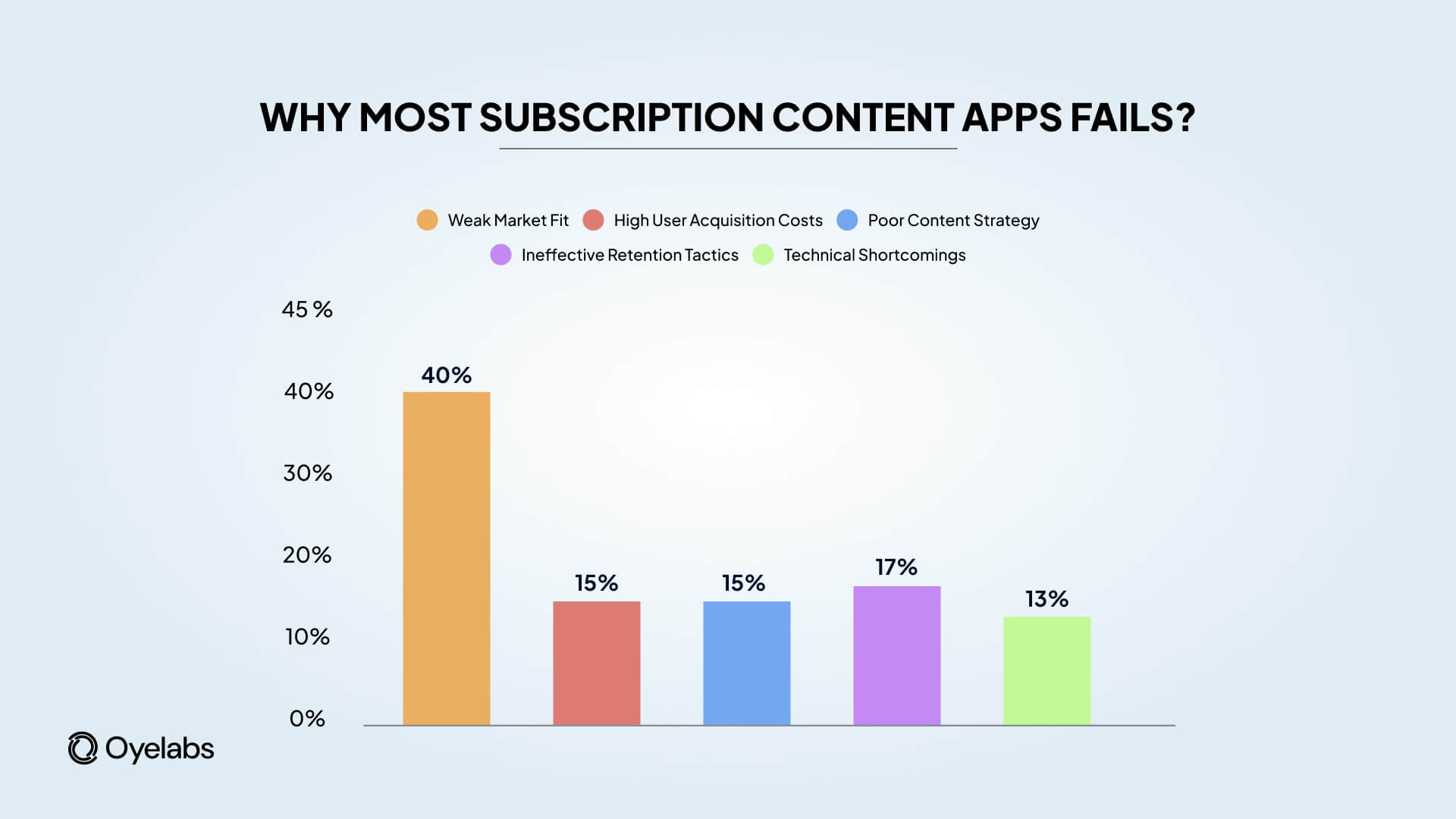
Subscription-based apps offer creators and entrepreneurs an opportunity to generate recurring revenue. Yet, the reality is harsh: most of these apps fail within two years. Analysis of industry trends shows that six key factors consistently contribute to failure. Addressing these issues is critical for building a sustainable platform.
Weak Market Fit
A subscription app can only succeed if it addresses a real need for its target audience. Many apps fail because they enter markets that are either too small, overly competitive, or uninterested in paying for the content provided. Entrepreneurs often assume that simply offering exclusive content will attract paying users, without validating whether there is genuine demand. Oversaturation in popular niches makes differentiation challenging, and ignoring cultural or regional preferences can limit adoption. Successful niche subscription platforms prove that focusing on specific audiences with unique needs often delivers higher engagement and retention compared to broad, generic approaches.
Challenges:
- Assuming exclusive content alone is sufficient to attract subscribers.
- Competing in oversaturated markets without a unique value proposition.
- Ignoring niche, regional, or cultural differences in audience preferences.
Solution:
- Conduct market research and validation to ensure the product meets a real demand.
- Run surveys, beta tests, and focus groups to measure willingness to pay.
- Identify niche audiences where subscribers are more likely to pay for premium content.
For example, a client from the USA approached us wanting to build a subscription platform for online fitness coaching. Initially, they assumed that offering standard workout videos would be enough to attract subscribers. After analyzing the market and user preferences, we identified a niche of busy professionals seeking short, high-intensity workouts that fit their schedules. Together, we designed features tailored to this audience, including interactive live sessions, progress tracking, and personalized workout plans.
The platform launched with strong engagement and a higher-than-expected conversion of free users into paying subscribers, demonstrating how crucial market validation and targeted audience research are for subscription app success.
High User Acquisition Costs
Acquiring subscribers is often the most expensive part of running a subscription app. Many apps fail because the cost of acquiring users exceeds revenue, especially in the early stages. Paid advertising can be costly and often fails to target the right audience. New users may also hesitate to pay when similar free or established platforms exist, making organic growth alone insufficient to achieve scale.
Challenges:
- Paid ads are expensive and not always effective.
- Users prefer established platforms, limiting conversion.
- Organic growth may not reach the volume needed for profitability.
Solution:
- Focus on organic growth strategies, including social media, SEO, and partnerships with creators.
- Implement referral programs to leverage existing users in attracting new subscribers.
- Target high-quality leads, prioritizing those more likely to convert rather than chasing volume.
Poor Content Strategy
Content is the core of any subscription app. Without high-quality, engaging, and consistent content, apps fail to attract or retain subscribers. Irregular posting schedules lead to disengaged users, while offering only one content format can make the app feel repetitive. Ignoring trends, feedback, and niche preferences also reduces the perceived value of the subscription.
Challenges:
- Irregular posting schedules and inconsistent updates.
- Limited content formats reduce engagement.
- Ignoring audience feedback and trends lowers perceived value.
Solution:
- Develop a content roadmap with scheduled updates.
- Offer diverse content formats: videos, live streams, interactive workshops, articles, and downloadable resources.
- Monitor engagement metrics and collect subscriber feedback to continuously refine content.
Ineffective Retention Tactics
Acquiring subscribers is not enough, keeping them is critical. High churn is a major reason subscription apps fail. Without ongoing engagement, users cancel subscriptions, leading to unstable revenue. Lack of community features, personalization, or incentives can make subscribers feel unvalued.
Challenges:
- Absence of community or personalized experiences reduces engagement.
- No loyalty rewards or subscriber perks.
- Subscribers forget to engage without reminders or notifications.
Solution:
- Implement push notifications and email reminders for new content.
- Offer loyalty programs, exclusive perks, and subscriber-only content.
- Build community engagement features, such as forums, chat rooms, and interactive events, to foster loyalty.
Pricing Mistakes
Subscription pricing can significantly influence acquisition and retention. Overpricing deters new users, while underpricing reduces revenue and may lower perceived content value. Confusing subscription tiers can frustrate potential subscribers, making them less likely to convert.
Challenges:
- Overpricing discourages potential subscribers if value isn’t clear.
- Underpricing reduces revenue and perceived value.
- Confusing or unclear tiers frustrate users.
Solution:
- Test different pricing models to find the optimal balance.
- Clearly communicate value for each subscription tier.
- Adjust pricing based on regional purchasing power and market demand.
Also Read: Opportunities for Subscription Apps in Non-Western Markets
Technical Shortcomings
Technical issues can quickly erode subscriber trust. Even minor glitches, such as slow load times, crashes, or payment errors, lead to churn. Security vulnerabilities are especially damaging for adult or paid content platforms, while poor infrastructure prevents scalability as subscriber numbers grow.
Challenges:
- Slow load times, app crashes, and payment failures.
- Security vulnerabilities reduce trust.
- Poor infrastructure limits scalability and reliability.
Solution:
- Prioritize robust, scalable development from the start.
- Implement secure payment systems and strong data protection.
- Conduct regular testing, updates, and performance monitoring to ensure a smooth user experience.
Get Your Own Subscription Content App Today
Failure doesn’t have to be part of your subscription app story. Many platforms fade within the first two years, but you can break the pattern with a smart, well-built OnlyFans clone app. We help you create apps that engage users, deliver consistent value, and scale seamlessly as your audience grows. From niche creators to broader communities, our solutions focus on user retention, secure payments, and smooth content delivery, ensuring your platform converts and keeps subscribers.
Don’t let your idea join the ranks of short-lived apps. Partner with us to build a subscription platform that not only launches successfully but thrives long-term, turning your vision into a sustainable and profitable reality.
Conclusion
Subscription content apps offer immense potential, yet most fail within the first two years due to common, avoidable pitfalls. The primary reasons include weak market fit, high user acquisition costs, poor content strategy, ineffective retention tactics, pricing mistakes, and technical shortcomings. Entrepreneurs can dramatically improve their chances of success by validating the market before launch, delivering consistent high-quality content, implementing effective retention strategies, optimizing pricing, and ensuring technical reliability.
Making data-driven decisions, actively engaging the audience, and continuously improving the platform are crucial for building a sustainable, profitable subscription app. By addressing these challenges proactively, creators can turn their apps into trusted, long-lasting platforms that provide real value for both subscribers and themselves.