
Building an App like BlaBlaCar: A Complete Guide
Building an App like BlaBlaCar: A Complete Guide
 Anuraag Jain
Last Updated on November 22, 2025
Key Takeaways
What You’ll Learn:
- BlaBlaCar is the world’s biggest and most trusted long-distance carpooling platform.
- BlaBlaCar connects verified drivers and riders traveling in the same direction.
- BlaBlaCar uses a cost-sharing model, not traditional commercial pricing structures.
- BlaBlaCar’s strong trust features make every ride safer and easier for new users.
- Startups can study BlaBlaCar’s proven model to launch similar successful carpooling platforms.
Stats That Matter:
- BlaBlaCar has over 100 million registered users worldwide.
- BlaBlaCar operates in more than 20 countries globally.
- Carpooling demand grows by over 20% every year worldwide.
- The shared mobility market may cross $675B by 2030.
Real Insights:
- BlaBlaCar succeeds because trips are cheaper than normal travel.
- Ratings and verification make BlaBlaCar safe for strangers.
- Long-distance routes work best for BlaBlaCar-style carpooling.
- Carpooling apps cost less to build than ride-hailing apps.
- BlaBlaCar’s model helps startups grow without owning vehicles.
Building an App like BlaBlaCar: A Complete Guide
Launching a carpooling app in 2025 isn’t just a cool idea anymore – it’s smart business. With Gen Z pushing for cheaper travel, cleaner cities, and “why own a car when you can share one?” logic, platforms like BlaBlaCar have turned simple ride-sharing into a global mobility ecosystem. And that’s exactly why founders, CEOs, and early startups are exploring how to build an app like BlaBlaCar with enterprise-grade reliability, real-time routing, dynamic pricing, and identity-verification layers baked in from day one.
The shift is clear: shared mobility is no longer a trend – it’s a scalable, asset-light model backed by data, adoption, and unit economics that actually make sense. If you’re planning to enter the market, this guide breaks down the technology, market potential, feature architecture, development cost, and the exact roadmap you need to build and launch a trusted carpooling platform. Let’s get started.
What Exactly Is BlaBlaCar and How Does Its Model Work?
BlaBlaCar operates on a simple yet highly efficient framework: connect verified drivers who have empty seats with passengers traveling along the same route. What makes the model powerful is not the idea itself but the structure that enables trust at scale. BlaBlaCar uses identity verification, community ratings, route-matching algorithms, and structured cost-sharing rules to ensure transparency and safety.
The business model is built on three pillars that any founder should understand before creating an app like BlaBlaCar:
- Peer-to-peer cost sharing: Drivers do not profit in a commercial sense but share travel expenses, making the model compliant in most regions.
- Trust infrastructure: Verified profiles, ratings, and transparent trip details help users make informed choices.
- Efficient matching: Algorithms ensure that ride listings reach the right passengers with minimal friction.
This blend of technology, compliance discipline, and community design is the reason the platform has remained relevant for over a decade.
How Does an App Like BlaBlaCar Function From End to End?
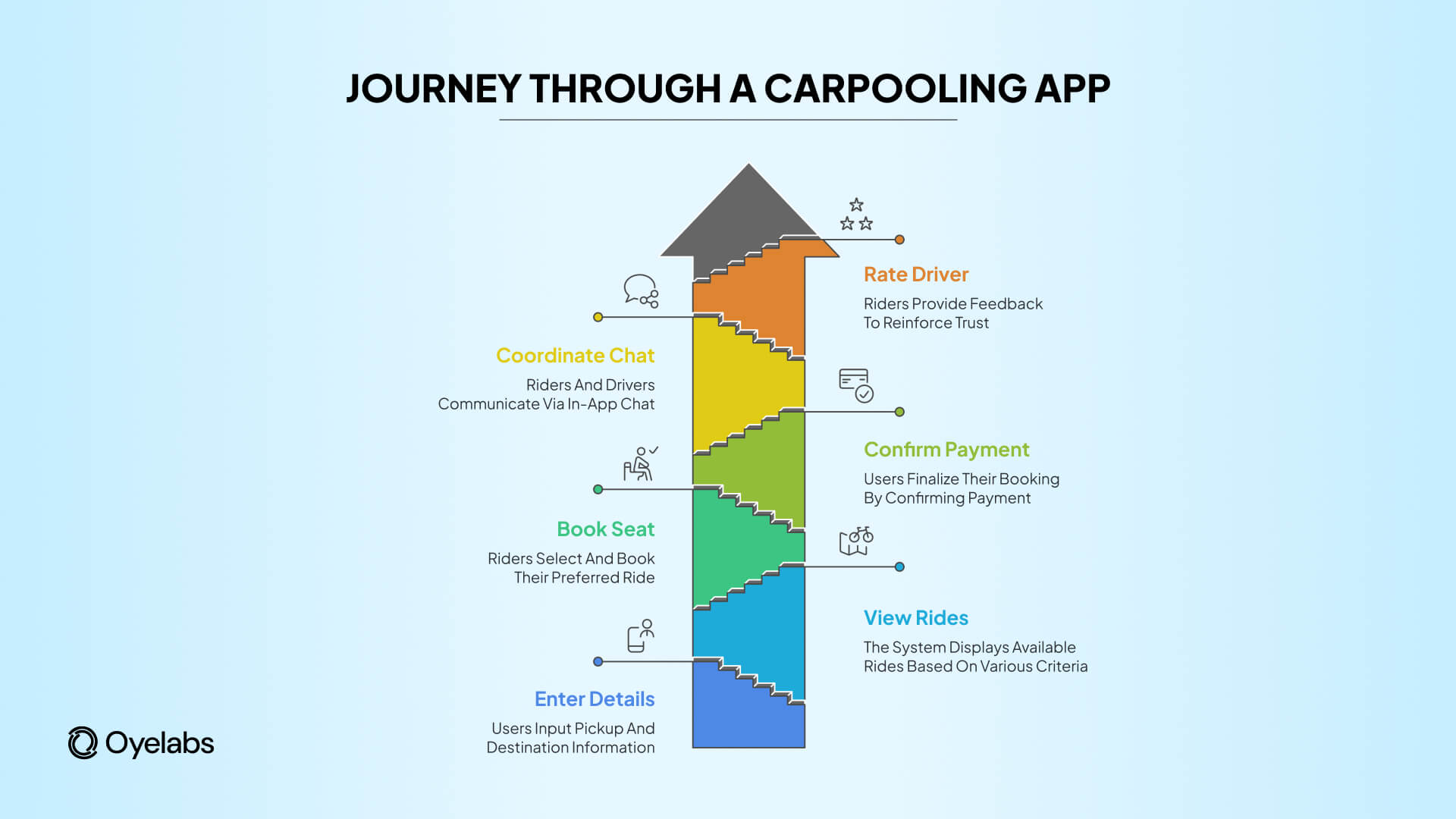
Understanding the workflow is essential before investing in design or development. The journey inside a BlaBlaCar-like app is built around a predictable interaction pattern that minimizes cognitive load for users. The flow remains consistent across markets, which is why retention rates tend to be higher than other mobility solutions.
Rider Journey
- Users enter their pickup and destination.
- The system displays available rides based on timing, price contribution, detours, and driver reputation.
- Riders book seats and confirm payment.
- In-app chat enables coordination without sharing personal numbers.
- After the trip, riders rate the driver, reinforcing the trust loop.
Driver Journey
- Drivers publish a route, define available seats, and specify travel costs.
- The system matches relevant passengers, prioritizing proximity and timing.
- Drivers review passenger profiles before accepting.
- Earnings and shared-cost summaries appear in their driver dashboard.
The Trust and Value Loop
A BlaBlaCar-like app grows when three feedback loops stay healthy:
- Transparency: Clear profiles and verified identities.
- Predictability: Accurate ETAs, reliable communication, low no-show rates.
- Reputation: Continuous ratings that reward good behavior and discourage risky actions.
This end-to-end functionality forms the backbone of every successful carpooling platform.
Is the Market Still Growing for Apps Like BlaBlaCar?
The answer is yes – significantly. Shared mobility continues to rise across the United States, Europe, the Middle East, India, and emerging African markets. Economic pressures, remote work patterns, and fuel cost volatility have pushed consumers toward cost-sharing alternatives. Simultaneously, cities and governments are promoting congestion reduction and sustainability, directly benefiting carpooling platforms.
Recent industry research highlights several drivers supporting rapid growth:
- Rising demand for economical travel: Cost-conscious users are choosing shared mobility over traditional options.
- Urban congestion pressures: Cities increasingly encourage ride-sharing over single-occupancy travel.
- Sustainability mandates: Environmental goals make shared mobility more attractive to both policy makers and investors.
- Asset-light scalability: Investors favor models that scale without vehicle ownership, lowering operational burden.
- User adoption in mid-tier and non-metro regions: Carpooling fills transportation gaps where public transit is limited.
For founders, the market remains wide open – especially in regions where BlaBlaCar has not yet established dominance. With a strategic launch, a strong tech stack, and the right trust framework, new entrants can still capture substantial market share. Specifically for car-pooling, one research firm estimates growth from about US$ 19.7 billion in 2021 to nearly US$ 79.4 billion by 2028 – a CAGR of over 21.9%.
Which Features Should Your App Have to Compete With BlaBlaCar?
A carpooling platform succeeds when its feature set creates clarity, ease, and trust in every interaction. An app like BlaBlaCar is not just a ride-matching tool – it is a structured environment where users feel safe sharing a car with someone they have never met. Your feature architecture should mirror that standard.
A strong foundation includes three key groups of features: rider-side, driver-side, and admin-side capabilities. Each contributes to reliability, compliance, and smooth operations at scale. While design choices and interface layouts may vary, the functional intent remains universal across all high-performing mobility apps.
What Do Riders Expect Inside the App?
Riders want a clean, predictable experience that minimizes uncertainty before, during, and after a trip. The following features define the baseline for a modern carpooling app:
- Ride Search: Search rides by date, time, route, price contribution, and driver details.
- Advanced Filters: Options for detours, luggage capacity, preferred languages, and comfort levels.
- Seat Booking: Clear seat selection with instant booking confirmation.
- In-App Chat: Secure messaging without exposing phone numbers.
- Digital Payments: Support for credit/debit cards, wallets, and region-specific gateways.
- Ratings and Reviews: Transparent feedback to evaluate drivers and fellow passengers.
- Trip History: Access to past rides for quick rebooking and recordkeeping.
These features address what riders value most – safety, clarity, affordability, and convenience.
What Do Drivers Need to Manage Rides?
Drivers rely on streamlined tools that make it easy to share rides while maintaining control over their schedules and preferences. Essential features include:
- Trip Publishing: Create routes, define stops, and set seat availability.
- Cost Contribution Calculator: Helps drivers set fair, compliant pricing.
- Passenger Review Access: The ability to evaluate passenger profiles before accepting.
- Driver Dashboard: Summaries of upcoming trips, past trips, and earnings breakdown.
- Availability Management: Toggle ride visibility and seat modifications in real time.
- ID Verification: Ensures credibility and reduces fraudulent accounts.
These tools empower drivers to manage trips confidently while maintaining safety and compliance.
What Tools Does the Admin Panel Require?
A BlaBlaCar-like system cannot scale without a robust admin backend. This is where platform governance, compliance checks, revenue controls, and dispute handling occur. A strong admin suite typically includes:
- User Management: Access to rider and driver profiles, verification data, and behavior patterns.
- Trip Monitoring: Visibility into live and upcoming rides, route adjustments, and flagged activity.
- Pricing and Commission Controls: Set platform fees, taxes, and region-specific contributions.
- Fraud Detection: Automated alerts for unusual routes, multiple failed verifications, or suspicious behavior.
- Dispute Resolution: Tools for managing complaints, refunds, and policy enforcement.
- Analytics Dashboard: Real-time insights into growth patterns, user segments, and revenue metrics.
This administration layer is what transforms a functional app into a sustainable marketplace ecosystem.
Which Advanced Features Help You Stand Out From BlaBlaCar?
If you want to compete in the mobility category, advanced capabilities matter. These are the differentiators that influence user retention, driver onboarding, and platform reputation.
- AI-Driven Matching: Algorithms that analyze time windows, route overlaps, user ratings, and travel history to improve match accuracy.
- Dynamic Pricing: Automated adjustments based on distance, demand, and seasonal fluctuations.
- Multi-City and Multi-Country Support: Control regional rules, currencies, and compliance parameters from a centralized admin.
- Safety Stack: SOS buttons, real-time tracking, emergency contact alerts, and incident logs.
- Identity Intelligence: Multi-layer verification using ID scanning, face matching, or trusted digital IDs.
- Gamification: Loyalty tiers, badges, and activity milestones to promote good behavior and long-term usage.
These features create a competitive edge while improving user confidence and engagement.
What Business Models Work Best for an App Like BlaBlaCar?
When planning your platform, the business model determines your long-term sustainability. Carpooling businesses rely on predictable, defensible revenue streams that don’t compromise user trust. Several models have proven effective:
- Commission-Based Model: A percentage fee charged per seat booked. This remains the most widely adopted structure.
- Subscription Model: Monthly or yearly plans allowing drivers or riders enhanced visibility, reduced fees, or premium features.
- Freemium Listings: Basic trips are free to publish, while enhanced visibility or priority listings require payment.
- Corporate Carpooling: Partnerships with organizations to offer employee commuting solutions.
- Hybrid Models: Combination of commissions, subscriptions, and premium features based on market needs.
Choosing the right model depends on your geography, target audience, and regulatory environment. The highest-performing platforms often blend two or more models to balance revenue and user satisfaction.
If you want to understand which mobility model offers the best margins and scalability, see the comparison in our Ride Hailing vs Ride Sharing vs Carpooling analysis.
What Tech Stack Should You Use to Build a BlaBlaCar-Like App?
A carpooling platform must be engineered for reliability, low latency, and long-term scalability. The tech stack you choose shapes performance, user experience, and operational costs. High-volume platforms like BlaBlaCar rely on a stable, resilient architecture that can manage millions of concurrent searches, route calculations, and transactions.
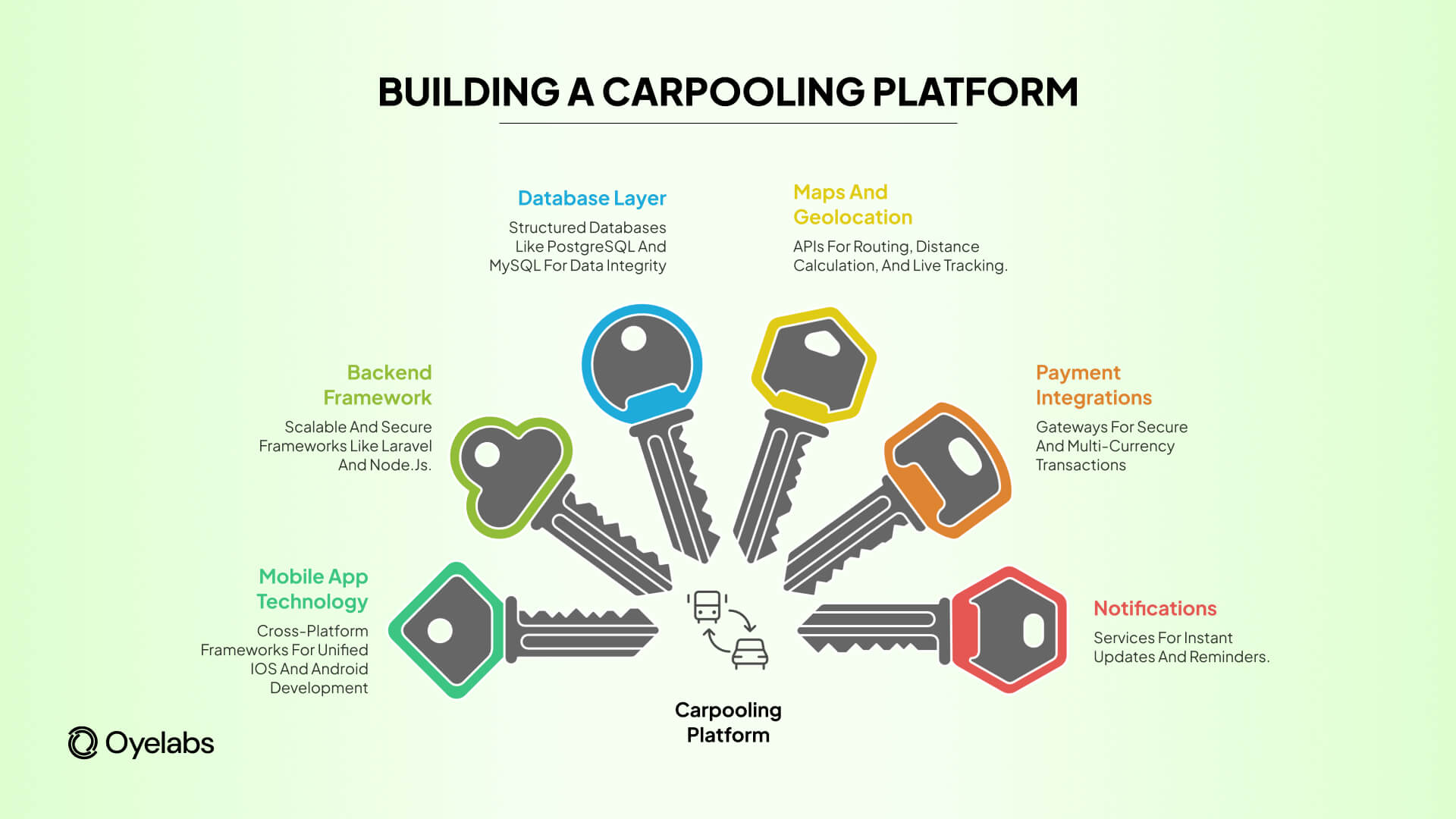
A startup building an app like BlaBlaCar typically needs the following layers:
- Mobile App Technology: A cross-platform approach reduces costs and speeds up launch. Frameworks such as Flutter or React Native help maintain a unified codebase for both iOS and Android without compromising performance.
- Backend Framework: Stability and maintainability are crucial. Laravel and Node.js are two dominant choices due to their scalability, strong package ecosystems, and predictable security patterns.
- Database Layer: A structured database like PostgreSQL or MySQL ensures data integrity, fast queries, and smooth handling of relational data such as routes, trips, and user profiles.
- Maps and Geolocation: APIs such as Google Maps, Mapbox, or OpenStreetMap provide routing, distance calculation, and live location tracking.
- Payment Integrations: Stripe, Razorpay, Paystack, Braintree, and region-specific gateways support card payments, wallets, and multi-currency handling.
- Notifications: Firebase Cloud Messaging or Apple Push Notification Service powers instant updates for trip confirmations, chat messages, and reminders.
When these technologies work together, they create the foundation for a mobility platform that is fast, secure, and ready for scale.
What Is the Step-by-Step Process to Build an App Like BlaBlaCar?
Building a mobility marketplace requires structured execution. Each phase contributes to platform stability, user trust, and operational predictability. A typical blueprint includes the following steps:
- Market Research: Identify regional demand, pricing expectations, legal rules around carpooling, and gaps left by existing competitors.
- UX/UI Design: Translate the user flow into simple, intuitive interfaces. Wireframes, prototypes, and interactive mockups form the base for a seamless user journey.
- Backend Development: Set up user authentication, ride management, matching logic, payment flows, notification systems, and identity verification modules.
- Mobile App Development: Develop the rider and driver apps, integrating real-time updates, map interactions, chats, bookings, and ratings.
- Testing and Quality Assurance: Functional testing, security checks, performance simulations, and device-level testing ensure there are no bottlenecks or system conflicts.
- Compliance and Verification: Integrate safety protocols, privacy policies, and identity verification tools to meet regional and platform-specific standards.
- Pilot Launch: Release the platform in a limited region to observe user behavior, detect friction points, and validate the business model.
- Scaling: Expand to new cities or countries, refine pricing engines, and optimize server performance as user volume grows.
This structured approach reduces risk and shortens time to market while keeping the platform stable from day one.
How Much Does It Cost to Build an App Like BlaBlaCar?
The cost to build an app like BlaBlaCar depends on your development approach, the depth of your feature set, your compliance needs, and where your engineering team is located. Most founders compare two clear paths: custom development or a white-label solution.
Custom Development Costs (Built From Scratch)
Creating a full BlaBlaCar-like platform from the ground up usually ranges between $20,000 and $80,000, depending on the complexity of the rider app, driver app, admin panel, backend infrastructure, and integrations such as maps, payments, and chat. This path is typically chosen when you need a highly specific architecture or advanced workflows that require extensive engineering.
White-Label Solution Costs (Fastest and Most Cost-Efficient)
White-label mobility solutions reduce the cost significantly because the core system is already engineered, tested, and scalable. Most high-quality white-label mobility platforms on the market range between $10,000 and $35,000, depending on the vendor and required feature enhancements.
Well-known marketplace platforms and mobility frameworks often price higher due to add-ons, licensing, or hosting requirements, and many “template-only” systems compromise scalability and long-term reliability.
Where Oyelabs Provides a Clear Advantage
Oyelabs offers a complete, ready-to-launch BlaBlaCar-like solution for just $5,999, including rider app, driver app, backend, admin panel, and full ownership of the core system. This is significantly lower than most vendors because Oyelabs has developed a flexible, reusable mobility infrastructure that fits early-stage founders and fast-scaling teams.
Additional Cost Considerations
Regardless of where you build, you should factor in essential operational costs such as:
- Hosting and server usage
- Map API consumption
- SMS and notification credits
- Payment gateway fees
- Optional maintenance and support packages
- Scaling costs when expanding into new regions
A mobility platform is a strategic investment. When launched with the right architecture and cost structure, it can grow rapidly and deliver strong returns as user adoption increases.
How Long Does It Take to Build a BlaBlaCar-Like App?
Timeline is one of the first questions founders ask because it directly impacts user acquisition, investor confidence, and competitive advantage. Building an app like BlaBlaCar generally follows one of two paths: custom development or white-label deployment, each with its own timeline.
Custom Development Timeline (From Scratch)
A fully custom-built carpooling platform typically takes 18–28 weeks depending on complexity.
Breakdown of major phases:
- Market Research & Discovery: 2–3 weeks
- UX/UI Design: 3–5 weeks
- Backend Architecture & APIs: 6–8 weeks
- Mobile App Development (iOS + Android): 6–10 weeks
- Integrations (Maps, Payments, Chat): 2–3 weeks
- Testing & QA: 3–4 weeks
- Deployment & Launch: 1–2 weeks
Total: 4.5 to 7 months for a full-featured platform.
White-Label Deployment Timeline
A white-label solution compresses the timeline dramatically to 7–20 working days.
Breakdown of activities:
- Branding & UI Adjustments: 3–5 days
- Hosting & Server Setup: 2–3 days
- Feature Customizations (if any): 3–7 days
- Testing & Deployment: 2–5 days
Total: 1 to 4 weeks for a market-ready MVP.
Can You Launch Faster With a White-Label BlaBlaCar-Like Solution?
For many founders, time-to-market is the deciding factor between success and missed opportunity. A white-label BlaBlaCar-like solution offers a practical, low-risk path that balances cost, speed, and full ownership. Instead of building every component from zero, you leverage an existing, battle-tested framework that already includes ride management, location services, payments, verification flows, and admin controls.
A white-label platform also gives you flexibility to:
- Rebrand and relaunch in multiple markets
- Add or remove modules without breaking the system
- Scale user load with minimal architectural changes
- Maintain ownership of your core product and data
Since the heavy engineering work is already complete, your focus shifts to market strategy, onboarding, partnerships, and localized improvements. This approach creates a smoother pathway to revenue without compromising long-term scalability.
How Did Oyelabs Help a Founder Launch a BlaBlaCar-Like Platform?
A recent example illustrates how speed and precision translate into real market impact. A founder approached Oyelabs with a vision to introduce a regional carpooling platform inspired by the BlaBlaCar model. Using Oyelabs’ white-label mobility framework, the team deployed a stable, feature-rich version in a short window. After launch, the platform saw measurable growth in user engagement, daily impressions, and trip activity. The rapid setup and reliable infrastructure allowed the founder to establish market presence early, build trust with new users, and position the brand as a credible mobility solution in their region.
This case reinforces a simple point: when execution aligns with timing, founders gain a meaningful advantage in competitive markets.
What Does the Future Look Like for BlaBlaCar-Like Platforms?
The future of shared mobility is shaped by economic pressure, environmental mandates, and shifts in how people view transportation. Carpooling platforms that follow the BlaBlaCar model are positioned to grow as cities encourage congestion reduction and consumers look for cost-effective alternatives to traditional travel.
Several trends are accelerating the category:
- Sustainability Priorities: Governments and enterprises are promoting shared travel as part of long-term climate goals.
- Rising Travel Costs: Fuel prices and maintenance expenses push more users toward shared rides.
- Expansion of Intercity Mobility: Mid-sized cities and non-metro regions have limited public transit, creating space for carpooling services.
- Digital Identity Verification: Advances in ID scanning and trust technology make community-driven mobility safer and more appealing.
- Integration With Public Transport: Many regions are moving toward hybrid models that combine ride-sharing with trains, buses, or micro-mobility options.
This momentum creates a clear opportunity for founders. With the right technology and launch strategy, new platforms can capture untapped demand and grow rapidly across underserved markets.
What Should You Do Next If You Want to Build an App Like BlaBlaCar?
If you have a vision for a carpooling platform, the next step is to validate your market, choose the right development approach, and move quickly before competition closes the gap. A strong starting point is reviewing your routes, users, compliance needs, and revenue model. Once these elements are defined, you can begin building with a white-label foundation or custom architecture.
Oyelabs offers a proven system that helps founders go live fast, refine their product, and scale into new regions without rebuilding from scratch. With full source code ownership, a stable backend, and the ability to customize any feature, the platform is designed for long-term growth.
If you are ready to explore what your version of a BlaBlaCar-like app could look like, request a personalized demo and consultation. A structured roadmap can help you launch faster and carve out a strong position in the mobility landscape.
Conclusion
The demand for shared mobility continues to rise, and platforms modeled after BlaBlaCar remain one of the most scalable, asset-light opportunities in the transportation sector. With the right feature set, a strong trust framework, and a stable technical foundation, founders can enter the market confidently and grow across multiple regions. Whether you choose custom development or a white-label foundation, execution speed determines your competitive edge.
If you are ready to validate your market, onboard early users, and scale without unnecessary delays, Oyelabs can help you launch faster with a proven, reliable, and customizable BlaBlaCar-like platform.
Start your journey today and bring your mobility vision to life with precision and speed.
FAQs
Q: What is the key operational difference between ride hailing, ride sharing, and carpooling for startups?
A: Ride hailing serves immediate trips, ride sharing matches similar routes, carpooling focuses on planned cost-sharing.
Q: Which mobility model offers early-stage startups the most affordable and scalable entry into the market?
A: Carpooling typically requires lower investment, scales faster, reduces operational complexity, and attracts consistent user demand.
Q: How should founders evaluate whether ride hailing, ride sharing, or carpooling fits their business objectives best?
A: Compare unit economics, route density, market readiness, regulatory requirements, platform complexity, and long-term growth goals.
Q: What technology considerations differ when building ride hailing, ride sharing, or carpooling platforms today?
A: Ride hailing needs real-time dispatch, ride sharing requires route matching, carpooling focuses on scheduling and verification.