
Autonomous Robots Set the Food Delivery Trend for 2026
 Sachin Sharma
Last Updated on December 22, 2025
Key Takeaways What You’ll Learn: Stats That Matter:
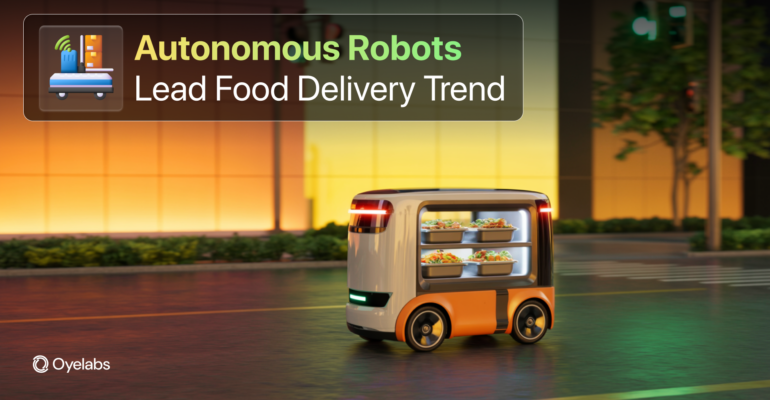
The food delivery industry is changing as technology makes it easier to get meals to customers. What once seemed like science fiction, robots delivering food, is now becoming a reality. With 2026 approaching, more food delivery platforms are preparing to use autonomous robots in their daily operations. Rising delivery costs, fewer delivery workers, and higher demand for fast, contactless service are driving this shift. In the United Kingdom, UberEats has already started deploying autonomous sidewalk robots in Leeds, showing that robot deliveries are moving from experiments to real-world use. Today, let’s see and learn the details of how autonomous robots change food delivery. Food delivery companies usually work with very small profit margins. The most expensive part of delivery is getting food from the restaurant to the customer. Robots are becoming a practical solution because they can deliver food at a lower cost and require less ongoing effort compared to traditional delivery methods. The autonomous delivery robot market is also growing very fast. The global market is expected to be valued at USD 737.6 million in 2025 and is projected to reach USD 6,497.3 million by 2034, growing at a compound annual growth rate of 27.3 percent. This rapid growth shows that many companies trust autonomous robots as a long-term solution for food delivery and last-mile logistics. Rising Delivery Costs and Profit Pressure In 2025, delivery costs are rising because of fewer workers and higher wages. Studies show that using robots could save 40 to 60 percent of delivery costs compared to human delivery. These savings are important for food delivery companies as they plan for 2026. Demand for Faster and Contactless Delivery Customers want deliveries that are fast and safe. This trend started during the pandemic and continues today. Robots can deliver food safely, track orders in real time, and reduce human contact, which customers prefer. Autonomous delivery robots are best suited for short and predictable routes, which are common in city food delivery. These robots use artificial intelligence, sensors, cameras, and mapping systems to navigate sidewalks safely and avoid obstacles. Most robots operate at Level 4 autonomy, meaning they can complete deliveries independently within defined areas. According to UberEats and Starship Technologies, the robots used in the UK launch are capable of delivering meals within 30 minutes across distances of up to two miles. This makes them ideal for dense urban neighborhoods. Robots Navigating Cities Level 4 robots are designed to handle busy city environments. They can detect pedestrians, manage crossings, and adjust routes in real time. This reduces delays that human couriers often face due to traffic, parking, or route inefficiencies. AI and Smart Routes Advanced AI and real-time navigation allow robots to choose the most efficient routes and respond to changes instantly. This technology improves delivery accuracy and reliability and continues to evolve as robots operate at scale. Food delivery robots are becoming part of everyday operations for many major platforms. They help reduce costs, improve delivery speed, and support contactless service. UberEats has launched autonomous delivery robots in Leeds, United Kingdom, through its partnership with Starship Technologies. The company plans to expand these robot deliveries across multiple European countries, followed by the United States. Starship’s robots have already completed more than nine million deliveries across seven countries, giving UberEats access to proven, large-scale autonomous delivery technology. DoorDash has completed over 100,000 deliveries using autonomous robots during pilot programs. By working with partners such as Coco and Serve Robotics, DoorDash has shown that robots can reliably handle high delivery volumes during peak hours. Serve Robotics has also carried out more than 100,000 autonomous deliveries from over 2,500 restaurants in major U.S. cities. These deployments demonstrate that robot courier networks can operate effectively in real urban conditions. Regional Adoption North America currently leads in robot delivery adoption, with cities like San Francisco, New York, and Austin actively using autonomous delivery systems. At the same time, the Asia-Pacific region is growing quickly, with countries such as Japan, Singapore, and South Korea investing heavily in robot delivery for urban environments. These developments show that robot delivery is no longer limited to pilot programs. Robots are now working alongside human couriers, forming a hybrid delivery system that improves efficiency and customer experience. Also Read: How Can AI Cut Costs in Your Food Delivery Business? Autonomous delivery robots are bringing strong benefits to both food delivery companies and customers. These benefits go beyond convenience and are helping reshape how food delivery works on a daily basis. Lower Delivery Costs One of the biggest advantages of delivery robots is cost savings. Robots do not require hourly wages, fuel reimbursements, or shift management. After the initial setup, they can complete deliveries at a much lower ongoing cost. This allows food delivery platforms to reduce delivery fees, offer better deals, or maintain profit margins even as operational costs rise. Lower delivery costs also make it easier for smaller restaurants to stay competitive on delivery platforms. Reliable and Consistent Service Robots provide a level of reliability that is difficult to achieve with human-only delivery systems. They do not get tired, call in sick, or stop working during long hours. Robots can operate continuously throughout the day, including during peak lunch and dinner times. This consistency helps reduce late deliveries, improves order accuracy, and builds customer trust over time. Environment-Friendly Delivery Most delivery robots are powered by electricity, which means they produce little to no emissions. This makes them a cleaner alternative to petrol-powered scooters or cars. Using robots also helps reduce traffic congestion, especially in busy city areas where delivery vehicles often slow down roads. For companies, this supports sustainability goals and helps meet local environmental regulations. Also Read: Business Models for Food Delivery App For restaurants, delivery robots bring better control over order flow. During busy hours, robots help reduce dependence on human couriers, who may not always be available. Faster pickups and deliveries mean food reaches customers while it is still fresh, which improves overall service quality. Restaurants can also handle more orders without overwhelming kitchen staff, leading to smoother operations and higher customer satisfaction. For customers, robot delivery offers a better overall experience. Orders arrive faster and with fewer delays. Customers can track deliveries in real time and know exactly when their food will arrive. Delivery costs are often lower, making frequent ordering more affordable. Robot delivery also improves access to late-night food and makes delivery more reliable in crowded urban neighborhoods. Looking to launch the best food delivery app that keeps up with the latest trends, including autonomous delivery robots? At Oyelabs, we specialize in building advanced, scalable food delivery platforms that are fast, reliable, and designed for maximum user engagement. Whether you want to create a platform like UberEats, DoorDash, or a unique food delivery solution, we bring your vision to life with cutting-edge technology. Step into the future of food delivery today and offer your customers faster, smarter, and more convenient service. Contact us now to get started! Autonomous delivery robots are transforming the food delivery industry and setting the trend for 2026. By reducing delivery costs, improving speed, and offering reliable, contactless service, these robots are becoming a practical solution for both companies and customers. Major delivery apps are already using robots successfully, proving that large-scale deployment is possible. As technology continues to improve and cities adapt to autonomous delivery, robots will become a normal part of urban food logistics. The future of food delivery is moving toward a hybrid system where robots handle short, predictable routes while human couriers manage complex or longer deliveries. 1. Can robots deliver in bad weather like rain or snow? 2. Are autonomous delivery robots safe around pedestrians and pets? 3. Do robots require supervision during deliveries? 4. Can robots carry hot or cold food safely? 5. Are robot deliveries more expensive for customers? 6. How far can autonomous robots travel per delivery?
Why Food Delivery Companies Are Using Autonomous Robots
How Autonomous Robots Work in Food Delivery
How Companies Are Using Robots Around the World
Benefits for Companies and Customers
What Robot Delivery Means for Restaurants and Customers
Launch Your Next-Gen Food Delivery App Today
Conclusion
FAQs
Most delivery robots slow down or pause; extreme weather limits safe operation.
Yes, sensors and AI help robots detect obstacles and avoid collisions.
Level 4 robots operate independently but are monitored remotely for safety.
Yes, most robots have insulated compartments to maintain food temperature.
No, robots reduce delivery costs, often making fees lower than human delivery.
Most robots handle distances up to 2–3 miles efficiently in urban areas.