
How Founders Shape User Choices in Food Delivery Apps
How Founders Shape User Choices in Food Delivery Apps
 Anuraag Jain
Last Updated on December 17, 2025
Key Takeaways
What You’ll Learn:
- Food delivery founders shape user choices through platform design, AI-driven recommendations, personalization, and structured decision pathways.
- Food delivery apps grow faster when the ordering experience feels quick, simple, and relevant for each user.
- Food delivery platforms increase repeat orders by using personalization, smart menus, and habit-forming behavioral loops.
- Food delivery app UX determines which restaurants, items, and offers users see first and ultimately choose most.
- Food delivery startups can succeed by designing their platform around real user behavior from the very first version.
Stats That Matter:
- The food delivery market may reach $1.79T by 2030 globally.
- Personalized recommendations increase conversions by up to 30%.
- Poor app experience causes 88% of users not to return.
- Real-time tracking increases customer satisfaction by 24%.
- 60% of people order food delivery at least once a week.
Real Insights:
- Simple designs help users choose food faster and stay loyal longer.
- Personalization increases order value and improves user satisfaction immediately.
- Trust features like tracking and accurate ETAs create stronger habit loops.
- Behavioral nudges guide choices without users noticing the influence.
- Regional food apps grow quickly when they match local tastes and expectations.
How Founders Shape User Choices in Food Delivery Apps
Ever wondered why you open a food delivery app “just to look” and somehow end up ordering a burrito at 11 PM? That’s not an accident. It’s the result of deliberate decisions founders make – every layout, filter, recommendation, and micro-interaction is engineered to shape what users choose and how fast they choose it.
Today’s food delivery platforms run on a mix of behavioral psychology, predictive algorithms, and UX architecture. Founders who understand these forces don’t just launch apps; they influence user behavior at scale. And in a market where Uber Eats and DoorDash set the benchmark, the ability to guide user decisions is now a competitive advantage, not an optional skill.
For CEOs, entrepreneurs, and early-stage founders planning to launch their own food delivery platform, this guide breaks down how user choices are formed – and how product strategy, design, and data science give you the power to shape them.
What Drives User Decisions in Food Delivery Apps Today?
User decisions inside food delivery apps are rarely spontaneous. Research, including the EBAI (Experience–Behavior–Attitude–Intention) conceptual model, shows that a user’s final choice is shaped by a mix of emotional, behavioral, and contextual triggers. While price and speed remain important, modern decision-making is driven by perceived convenience, trust in the platform, personalized relevance, and the overall cognitive load of using the app.
Users tend to choose platforms that make ordering feel predictable and effortless. If an app reduces mental friction – by offering familiar recommendations, clear menu hierarchy, or precise delivery timelines – users are more likely to continue using it. This behavioral pattern stays consistent across geographies, age groups, and cuisine preferences.
Which Key Factors Influence How Users Choose What to Order?
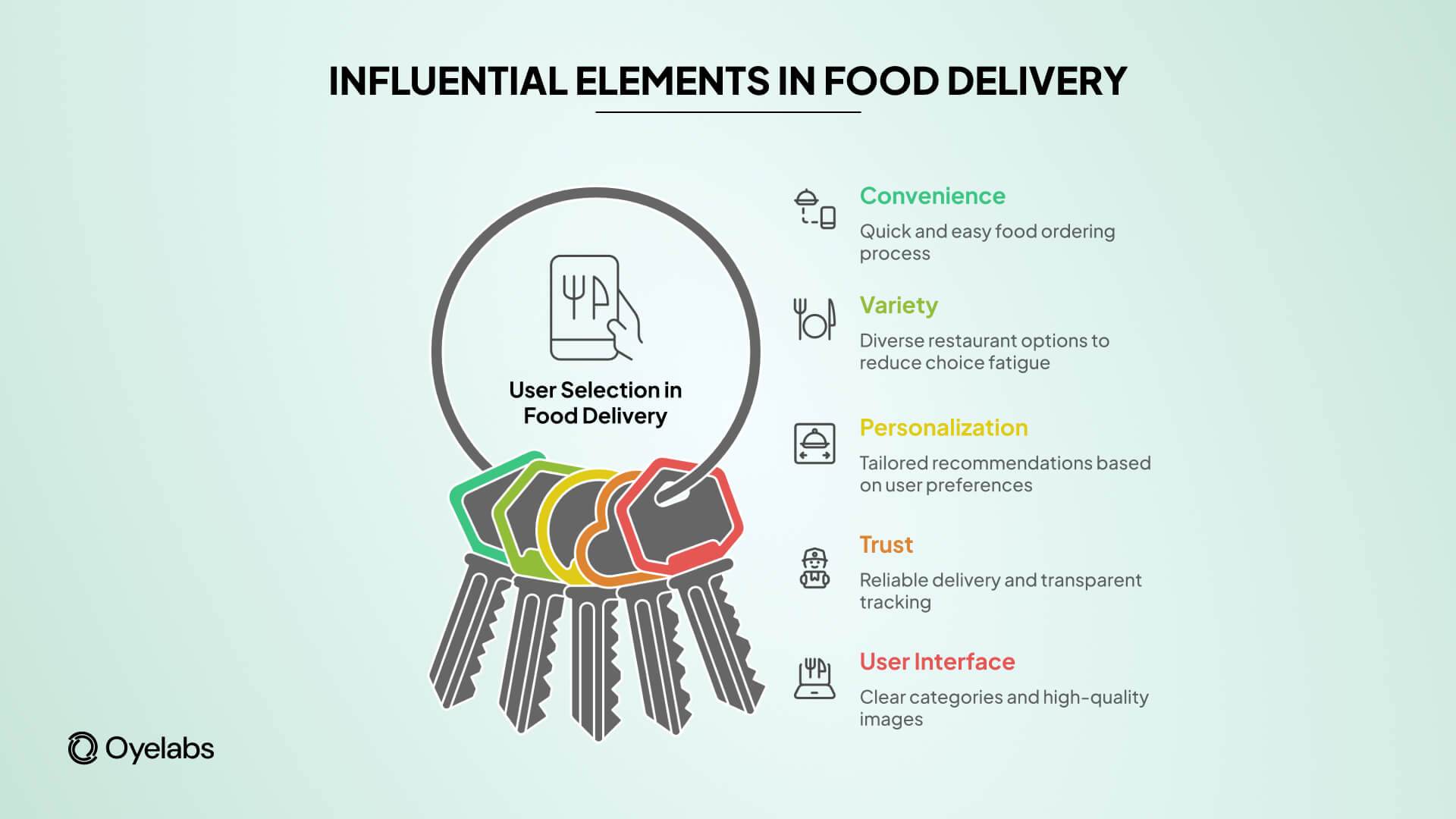
Below are the most influential elements that guide user selection inside food delivery platforms:
- Convenience: users prefer apps that allow them to find and order food quickly without excessive navigation.
- Variety: a platform offering diverse restaurant options increases perceived value and reduces choice fatigue.
- Personalization: tailored recommendations based on past orders or time of day help users make faster decisions.
- Trust: accurate delivery estimates, reliable order completion, and transparent tracking build long-term confidence.
- User interface: clear categories, high-quality images, and simplified flows directly impact conversion behavior.
These factors collectively shorten decision time, stabilize expectations, and push users toward repeat ordering patterns.
Why Do Founders Often Misjudge User Behavior in Food Delivery Platforms?
Many founders assume that users make rational decisions exclusively based on price or restaurant popularity. However, research across digital marketplaces shows that behavior is heavily influenced by emotional comfort, interface design, and frictionless UX. Founders sometimes focus too narrowly on feature checklists instead of understanding how small design moments – such as reorder prompts, offers placement, or restaurant grouping – drive measurable user actions.
The gap between assumed behavior and real behavior typically emerges from insufficient behavioral analytics. In early-stage builds, founders may overlook the value of event tracking, session heatmaps, or funnel metrics. Without these inputs, decision-making becomes assumption-driven rather than insight-driven, creating a misalignment between product investment and user needs.
How Does a Founder’s Product Vision Influence User Choices?
A founder’s early product decisions determine how users navigate and interact with the platform. The way menus are structured, how discovery pathways are set, and how recommendations surface all influence user flow. If the product vision prioritizes speed and clarity, users naturally lean toward quick reorders and top-selling items. If the vision prioritizes exploration, the interface will guide users toward browsing, tasting, and experimenting with new cuisines.
Founders who establish a strong UX and behavioral philosophy at the beginning create a more predictable environment for user decision-making. This reduces friction and drives consistent usage patterns.
What Design & Feature Decisions Help Founders Guide User Behavior?
- Default recommendations: surface items based on popularity to reduce decision time.
- Smart categorization: Organize cuisines and dishes in a way that aligns with user thinking rather than restaurant menus.
- Clear visual hierarchy: direct attention to actions that increase conversions, such as “Order Again” or “Fast Delivery.”
- Streamlined checkout: reduce steps and mental load to improve completion rates.
- Contextual relevance: adapt suggested items based on time of day, user history, or local trends.
Each of these choices influences not only what users select but how quickly they reach a decision.
How Do Micro-Interactions Inside the App Affect What Users Select?
Micro-interactions – such as how a button animates, how a recommendation appears, or how a prompt surfaces – shape user choices more subtly than major features. These elements create momentum within the ordering journey. A responsive interface creates trust; a slow or unstable interaction creates exit intent.
Designing micro-interactions with intention helps founders ensure that their preferred behavioral outcomes, such as repeat orders or promoted items, gain higher visibility and response.
What Can Founders Learn From Uber Eats and DoorDash About Choice Architecture?
Uber Eats and DoorDash rely heavily on structured choice architecture, a technique that organizes options to influence decisions without restricting freedom. Their approach includes:
- Recommendation layers: suggest what users are most likely to order.
- Time-based pathways: highlight breakfast, lunch, or late-night categories depending on demand cycles.
- Featured promotions: anchor user attention to specific restaurants or bundles.
- Optimized reorder flows: encourage repeat purchases by placing prior orders prominently.
- Delivery precision: showcase reliable ETAs to reduce uncertainty.
The consistency of these strategies is what helps these platforms scale predictable behavior patterns across millions of users.
How Does AI Improve User Decision-Making in Food Delivery Apps?
AI enables platforms to anticipate user intent by analyzing purchasing history, browsing behavior, cuisine preferences, and contextual signals such as time or weather. Predictive models help shorten decision-making time by offering hyper-relevant suggestions. This reduces choice overload, which is a major point of friction in food ordering.
AI also enhances operational accuracy – improving delivery estimates, optimizing driver routing, and aligning restaurant display orders with real-time availability. The result is a smoother, more reliable experience that reinforces trust.
How Can Early-Stage Founders Use Personalization Without Overcomplicating Their App?
Early-stage founders often assume personalization requires complex infrastructure, but modern systems allow a staged approach:
- Behavior-based suggestions: recommend items based on repeat orders.
- Contextual cues: surface dishes suitable for specific times (breakfast items in the morning).
- Preference clustering: group users by taste patterns to tailor recommendations.
- Simplified segmentation: categorize users into basic cohorts (e.g., quick-order users, explorers, budget-sensitive users).
Founders can implement foundational personalization early and expand once user volume supports deeper modeling.
Why Is AI No Longer Optional for Founders Competing With Big Delivery Platforms?
AI-driven personalization is now a baseline expectation rather than a differentiator. Users accustomed to platforms like Uber Eats and DoorDash expect tailored recommendations, consistent ETAs, dynamic sorting, and intelligent prompts. Without AI, a new delivery platform often feels static, which increases bounce rates.
For founders, AI enables three measurable benefits:
- Higher conversion rates: users reach decisions faster.
- Improved retention: personalization encourages repeat behavior.
- Operational efficiency: delivery and restaurant management become more predictable.
In competitive markets, these advantages determine whether a new platform gains traction or becomes overshadowed by established players.
Which UX Principles Most Strongly Influence User Ordering Behavior?
UX determines how efficiently users can move through the app, and subtle design choices significantly affect what they select. Strong UX is built around cognitive ease – users should understand what to do without thinking. The most influential principles include visual hierarchy, predictable navigation, fast-loading components, and clear restaurant-to-item pathways.
Users tend to abandon apps when interfaces feel dense, slow, or disorganized. On the other hand, a streamlined interface simplifies discovery, reduces fatigue, and increases order frequency. The purpose of UX in food delivery platforms is not just aesthetics; it’s behavioral direction. Each layout decision either eases or complicates the user’s intent, and this directly impacts purchase outcomes.
Why Should Founders Follow the “Three-Tap Rule” for Food Delivery Apps?
The “Three-Tap Rule” suggests that a user should be able to browse, select, and proceed toward checkout within three taps. Although not a rigid mandate, it serves as a design benchmark that encourages simplicity.
Reducing the number of actions required enhances user satisfaction and minimizes friction. When users consistently reach the checkout quickly, they associate the app with convenience, which is a major driver of repeat orders. This rule also discourages unnecessary screens, excessive filtering steps, or design elements that slow the decision journey.
How Does Good Design Increase Conversions and Order Frequency?
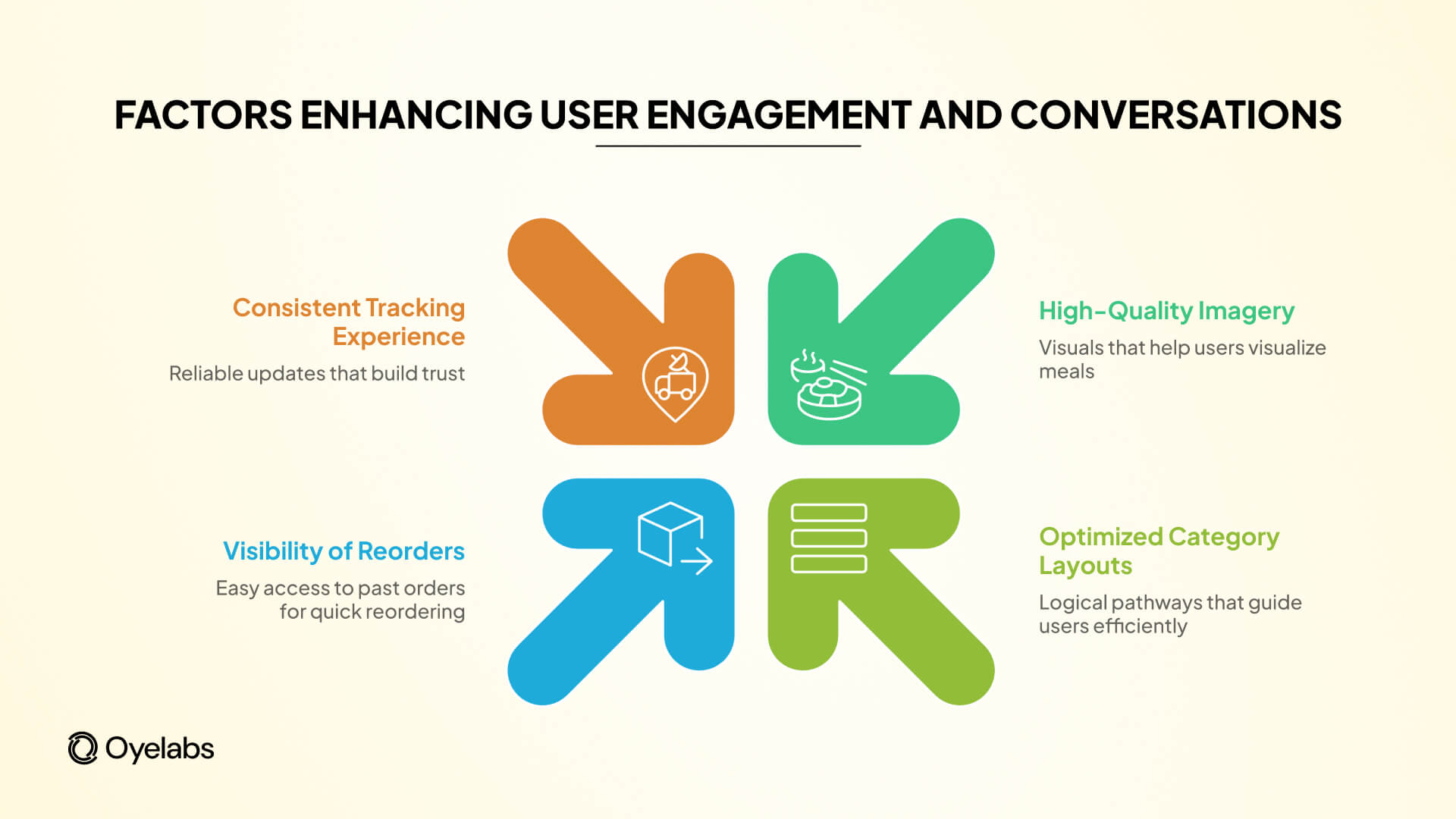
Strong design improves conversions by reducing cognitive load, improving clarity, and enabling users to reach decisions faster. When users feel in control of their experience, they continue using the platform regularly.
- High-quality imagery: helps users visualize meals, creating stronger purchase intent.
- Optimized category layouts: guide users through logical pathways, decreasing browsing fatigue.
- Visibility of reorders: shortens decision-making time and increases habitual ordering.
- Consistent tracking experience: builds trust by reducing uncertainty about delivery status.
A well-designed system is not merely visually appealing – it is fundamentally persuasive, influencing both immediate conversions and long-term engagement.
What UX Mistakes Should Founders Avoid When Building a Food Delivery App?
- Overcomplicated navigation: forces users to take too many steps to find basic items.
- Irregular or unpredictable layouts: create confusion and lower trust.
- Slow-loading components: lead to abandonment, especially at peak ordering times.
- Poor restaurant grouping: makes it difficult for users to locate relevant options.
Founders often invest heavily in backend features yet overlook the behavioral implications of their interface. Avoiding these pitfalls ensures a more consistent user experience.
What Behavioral Nudges Can Food Delivery Apps Use to Guide User Choices?
Nudges are subtle design elements that influence user actions without limiting their freedom. Food delivery apps frequently use nudges to direct attention, simplify decisions, and increase order completion rates.
- Anchoring: presenting higher-priced items first to influence users’ perception of value.
- Social proof: highlighting popular dishes or bestsellers to build confidence in selection.
- Scarcity cues: limited-time offers encourage faster decision-making.
- Default recommendations: placing curated options in the primary viewing area to reduce choice overload.
These nudges create a structured decision environment that benefits both users and platform operators.
Why Is Trust the Foundation of Every Successful Food Delivery App?
Trust is directly tied to user retention. When users believe the platform will deliver what it promises – accurate ETAs, correct orders, and reliable service – they develop a sense of predictability. Predictability is critical in reducing perceived risk, especially in markets where alternatives are abundant.
Trust is built through consistent performance, transparent communication, and dependable service quality. Even small lapses, such as inconsistent delivery updates or poorly handled cancellations, erode trust quickly.
Which App Features Help Founders Create Long-Term User Stickiness?
- Loyalty programs: reward users for repeated orders, creating recurring incentives.
- Customized deals: use personalization to enhance perceived value.
- Reliable delivery visibility: Reduce uncertainty by offering real-time tracking.
- Reorder shortcuts: shorten the path to purchase, reinforcing habitual behavior.
These features create an environment where users feel understood, valued, and confident – three conditions essential for long-term app engagement.
What Are the Must-Have Features for a Modern Food Delivery Platform?
- Restaurant discovery system: supports category grouping, filters, and relevance-based sorting.
- Personalized recommendations: reduce browsing time and improve conversions.
- Real-time tracking: builds trust through transparency.
- Optimized checkout flow: ensures efficient order completion.
- Reorder and favorite lists: reinforce habitual behavior.
- Operational dashboards: help founders analyze user patterns and refine experience design.
These components lay the groundwork for a competitive product that meets modern user expectations.
What Common Early-Stage Mistakes Should Founders Avoid?
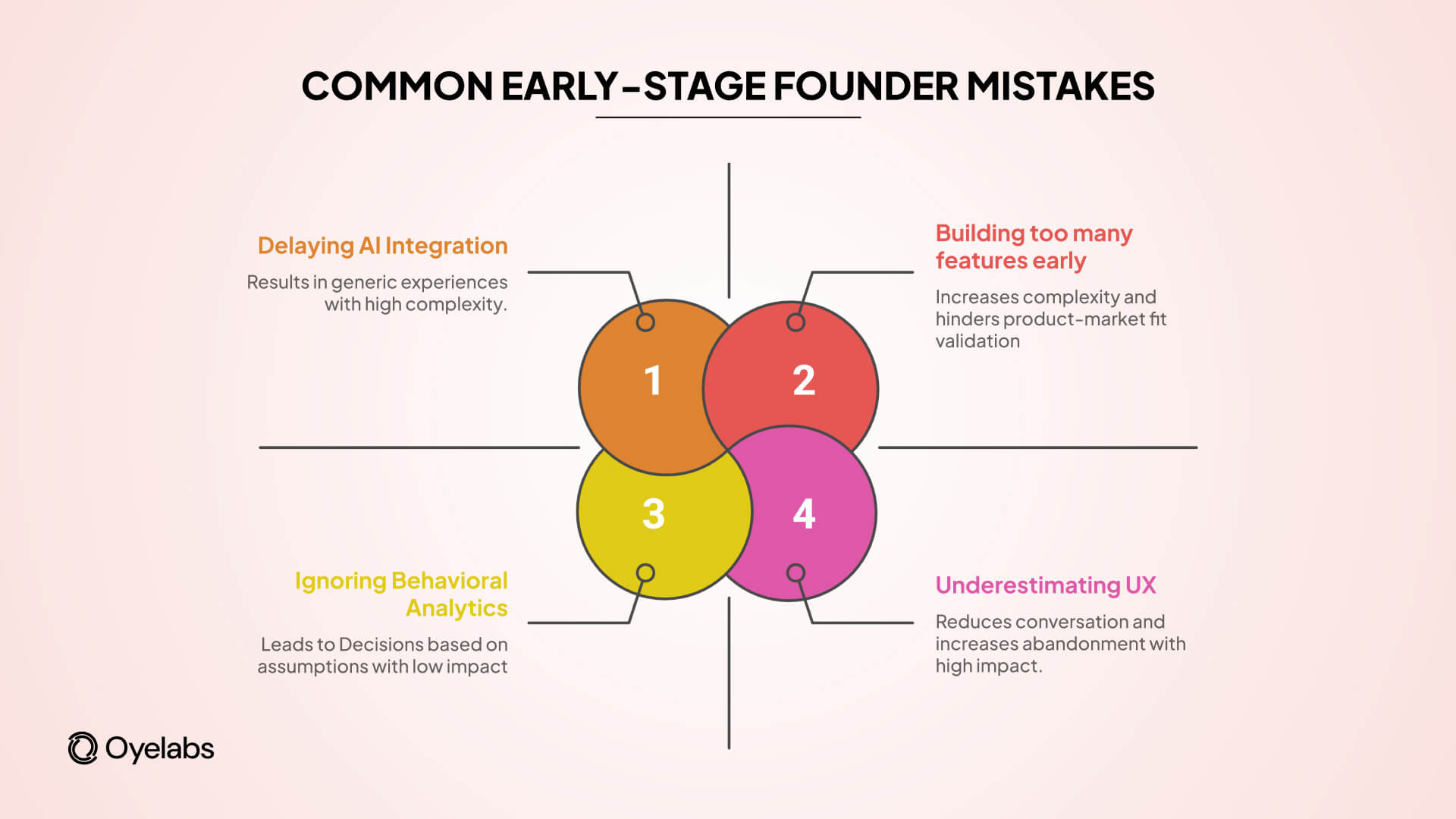
- Building too many features early: increases complexity before product–market fit is validated.
- Ignoring behavioral analytics: leads to decisions based on assumptions instead of data.
- Underestimating UX: reduces conversion and increases abandonment.
- Delaying AI integration: results in generic experiences that fail to compete with major apps.
Avoiding these mistakes creates a stronger foundation for scalable growth.
Which Metrics Should Founders Track to Understand User Behavior?
- Time to order: indicates how quickly decisions are reached.
- Conversion funnel progression: measures where friction occurs.
- Repeat order frequency: reflects habit strength.
- Abandonment rates: show where the experience breaks.
- Response to recommendations: reveals the effectiveness of personalization.
These metrics help founders refine their decision-shaping strategies with precision.
What Market Shifts Are Creating Opportunities for New Delivery Platforms?
The food delivery industry continues to expand due to changes in user behavior, rising demand for convenience, and the growth of digitally enabled consumption. Users now expect seamless, hyperlocal delivery experiences, and the overall market is shifting toward regionally focused platforms that understand local cuisine patterns and customer expectations. These conditions create opportunities for emerging founders to enter the market with targeted value propositions.
The global online food delivery market is projected to reach $1.79 trillion by 2030, a growth curve that highlights how user demand continues to accelerate across regions.
Additionally, digital adoption rates continue to rise across both metropolitan and non-metropolitan regions. Users have become comfortable relying on mobile-first services, increasing the total addressable market for new platforms. This shift ensures that founders with clear positioning can establish a foothold even in competitive environments.
AI Impact on User Decisions in Food Delivery Apps
| AI Function | How It Shapes User Choices |
| Personalized Recommendations | Suggests meals users are most likely to order, reducing browsing time. |
| Predictive Ordering Patterns | Identifies user habits to surface high-intent items quickly. |
| Dynamic Menu Sorting | Reorders restaurants based on relevance, speed, and user preference. |
| Delivery Time Optimization | Provides accurate ETAs, increasing trust and decision confidence. |
How Did Oyelabs Help a Founder Build an Uber Eats-Style Platform That Boosted Engagement and Brand Value?
A recent project demonstrated how strategic product design directly shapes user behavior. A founder approached Oyelabs with the goal of creating a regional food delivery platform capable of competing with large incumbents. By integrating AI-driven recommendations, optimized UX flows, and a structured choice architecture, Oyelabs helped the client launch a platform that made ordering faster, more intuitive, and more predictable for users.
Within months of launch, the platform recorded measurable improvements in engagement metrics – higher session durations, increased repeat orders, and stronger restaurant visibility. The brand gained traction in its market because the product experience aligned with user expectations of speed, clarity, and relevance. This positioned the founder not just as a service provider but as a local category leader. The outcome demonstrated how deliberate product decisions, supported by Oyelabs’ technical execution, transform a simple delivery idea into a recognized digital brand.
Conclusion
Launching a food delivery platform today requires more than software – it demands a deep understanding of user behavior, decision psychology, personalization, and scalable experience design. Oyelabs helps founders bring all of these elements together with a ready-to-deploy foundation, advanced user experience frameworks, and data-driven personalization capabilities.
If you are planning to launch your own Uber Eats– or DoorDash-style platform, our team can help you build a product that is fast, intuitive, and architected to influence user choices from the first interaction.
To discuss your vision and explore the right approach, you can connect with our product team at Oyelabs and begin shaping a market-ready delivery experience.
FAQs
How can founders influence user decisions inside food delivery apps effectively and consistently?
Founders influence decisions through personalization, simple design flows, relevant recommendations, and clear behavioral pathways.
What features help shape user choices in Uber Eats- or DoorDash-style food delivery platforms?
Smart recommendations, streamlined checkout, accurate tracking, and structured category flows guide user decisions efficiently.
Why is personalization essential for shaping user behavior in food delivery apps today?
Personalization reduces browsing time, increases relevance, and helps users make quicker, confident ordering decisions.
How do design and UX impact user decision-making across modern food delivery apps?
Good UX reduces friction, improves clarity, builds trust, and encourages faster, more predictable food choices.