
Psychology Elements That Boost Food App Retention

Psychology Elements That Boost Food App Retention
 Sachin Sharma
Last Updated on January 8, 2026
Key Takeaways What You’ll Learn: Food delivery apps turn hunger, stress, and boredom into automatic ordering habits. Convenience removes decision-making, making apps the default food solution. Psychology, not hunger alone, drives repeat food delivery app usage. Design choices guide users to order faster with less thinking. Habit loops make opening food delivery apps feel automatic. Stats That Matter: Over 53% of users order food through apps at least once weekly. Around 34% of users order multiple times every month. Menu items with photos get up to 30% more orders. Nearly half of users decide orders within 10 minutes.
You don’t always open a food delivery app because you’re hungry. Sometimes it happens when you’re tired, bored, stressed, or simply don’t feel like making a decision. Before you realize it, you’re scrolling through menus, checking offers, and placing an order. This isn’t a coincidence. Popular food delivery apps like UberEats are intentionally designed to fit seamlessly into everyday moments, turning casual usage into habit. Through psychology-driven design, emotional triggers, and subtle rewards, these platforms influence how users think, feel, and act. Understanding what makes food delivery apps addictive reveals why they feel so easy to open and so hard to stop using. Food delivery apps tap into one of the most basic human needs: food. When combined with speed and convenience, this need becomes incredibly powerful. Over time, these apps have become a regular part of everyday life. More than 53.4% of users order at least once a week, and another 34% use them a few times per month, highlighting just how integrated these platforms have become in daily routines. However, hunger alone does not explain why users repeatedly open the same app multiple times a week, even when similar alternatives exist. The real reason lies in how these apps remove friction from everyday decisions. Instead of thinking about what to cook, where to eat, or how long it will take, users are presented with instant solutions. The app feels reliable, familiar, and comforting. Over time, the brain begins to associate the app with relief, pleasure, and control. As this association strengthens, ordering food shifts from being a conscious decision to an automatic response. The app becomes the default option whenever hunger, stress, or boredom appears. Also Read: How Does the Food Delivery App Make Money? Food delivery apps have become more than just tools for ordering meals. For many users, opening the app is almost reflexive, whether they are tired after work, bored at night, or seeking comfort during a stressful day. This behavior is intentional by design. Successful food delivery platforms rely on well-established psychological principles that influence habits, emotions, and decision-making. From instant rewards to emotional reassurance, every interaction is crafted to keep users engaged and returning frequently. Below are the core psychological reasons that make food delivery apps so addictive. Instant gratification is one of the strongest psychological drivers behind addictive food delivery apps. Humans naturally prefer immediate rewards over delayed outcomes, and these platforms are designed to satisfy that instinct with minimal effort. When users open an app like DoorDash or UberEats, they are immediately shown popular dishes, estimated delivery times, and transparent pricing. There is no waiting, no preparation, and no uncertainty. Compared to cooking at home, which requires planning, shopping, and cleanup, ordering food offers a near-instant reward. For example, a user coming home late after work may feel mentally exhausted and unwilling to cook. Opening UberEats provides an immediate solution, often with delivery promises of 20 to 30 minutes. This quick relief reinforces the association between the app and convenience. Over time, the brain begins to crave this instant payoff, making the app the first response whenever hunger or fatigue sets in. Visual design plays a critical role in shaping user behavior. Food delivery apps rely heavily on high-quality images that present food in its most tempting form. Close-up shots, rich colors, and glossy textures are deliberately used to trigger appetite and draw users deeper into browsing. These visuals stimulate dopamine release, the neurotransmitter associated with pleasure and desire. As a result, even users who were not initially hungry may feel compelled to order after scrolling through visually appealing dishes. This effect is not just theoretical. Grubhub has reported that menu items with professional food photos receive up to 30% more orders than those without images, highlighting how powerful visual cues are in influencing decision-making. For instance, a slow-motion cheese pull, a sizzling burger, or a freshly baked dessert image can create instant cravings. Many apps take this further by personalizing visuals based on past orders, showing familiar cuisines or favorite meals first. This combination of appetizing imagery and personalization significantly increases impulsive ordering and reinforces habitual app usage. Personalization makes users feel understood and valued. Food delivery apps use past behavior to suggest restaurants, cuisines, and dishes that align with individual preferences. Sections like “Your favorites” or “Order again” reduce the mental effort required to decide what to eat. Psychologically, this creates a sense of comfort and familiarity. Users trust the app because it consistently shows options they like. This approach is especially effective because nearly half of online shoppers decide what to order within just 5–10 minutes, meaning faster decisions depend heavily on relevant, pre-filtered choices rather than exploration. At the same time, apps limit the number of visible choices. While it may feel like users have endless options, what they see is carefully curated. This controlled selection prevents overwhelm and decision fatigue, keeping users engaged without feeling stressed by too many options. Variable rewards are a powerful psychological technique commonly used in gaming and social media, and food delivery apps apply the same principle. Users are rewarded unpredictably, which keeps them coming back. Surprise discounts, limited-time offers, and free delivery notifications appear at random intervals. Because users never know when the next reward will show up, they are more likely to check the app frequently. For example, a user might open the app just to browse and unexpectedly find a special discount on a favorite restaurant. This surprise reinforces the habit of opening the app regularly, even without an immediate intention to order. Push notifications are carefully crafted to trigger emotional responses rather than simply provide information. They are timed to align with moments when users are most likely to order, such as lunch hours, late evenings, or weekends. Messages like “Your favorite restaurant is offering 30% off” or “Late-night cravings? We’ve got you covered” tap into hunger, convenience, and fear of missing out. These notifications feel personal and timely, increasing the chances of engagement. When done correctly, push notifications feel helpful rather than intrusive, making users more likely to open the app and place an order. Habit loops are at the core of addictive app behavior. Each loop consists of a trigger, an action, and a reward. The trigger might be hunger, stress, boredom, or a notification. The action is opening the app and placing an order. The reward is food delivered quickly with minimal effort. Over time, the brain links the trigger directly to the app, skipping conscious decision-making. For example, feeling tired may automatically lead to opening a food delivery app without considering other options. This automatic behavior is what makes the habit so strong. Social validation strongly influences decision-making. Food delivery apps display ratings, reviews, and labels like “most ordered” or “trending now” to guide user choices. Seeing that thousands of people have ordered a specific dish reassures users that they are making a good decision. This reduces hesitation and speeds up ordering. For example, a user unsure about trying a new restaurant may feel more confident after seeing high ratings and frequent orders. Social proof removes doubt and encourages repeat behavior. Gamification plays a crucial role in keeping users engaged with food delivery apps over the long term. Loyalty points, cashback rewards, and membership programs motivate users to place repeat orders by making progress feel tangible. Popular platforms like Zomato, Swiggy, and UberEats use subscription-based programs such as Zomato Gold, Swiggy One, and Uber One to reinforce this behavior. Unlocking benefits like free delivery, exclusive discounts, or priority support creates a sense of achievement rather than just savings. Psychologically, these rewards activate the brain’s motivation system, encouraging users to maintain their membership status or maximize its value. Once users have paid for a subscription or accumulated rewards, switching to another app feels like losing progress or wasted value. This emotional investment significantly strengthens long-term retention and brand loyalty. Food is deeply tied to emotions, and food delivery apps leverage this connection effectively. They position themselves as solutions not just for hunger, but for comfort and emotional relief. Late-night ordering, comfort food categories, and mood-based collections create a sense of emotional support. For example, users may associate ordering food with relaxation after a long day or comfort during stressful moments. Over time, the app becomes a coping mechanism, increasing both emotional attachment and long-term loyalty. A smooth user experience removes barriers that might interrupt habitual behavior. Food delivery apps prioritize fast load times, simple navigation, and easy checkout. Features like one-tap reorders, saved payment methods, and real-time delivery tracking keep users engaged throughout the process. The less effort required, the more likely users are to repeat the behavior automatically. When ordering feels effortless, it becomes a routine rather than a decision. Also Read: Plan Food Delivery Startup with UberEats Clone Model Food delivery apps succeed because they combine multiple psychological triggers into one seamless experience. Convenience appeals to logic, emotional comfort appeals to feelings, and rewards appeal to behavior. Instead of forcing users to act, these apps gently guide decisions through thoughtful design, timing, and personalization. Over time, this creates strong habits that feel natural rather than engineered. This is why many users open a food delivery app without consciously deciding to do so. Want to create a food delivery app that users can’t put down? With Oyelabs, you can design a platform that combines convenience, engagement, and habit-forming features to keep customers coming back. From personalized recommendations and push notifications to loyalty programs and seamless one-tap ordering, we help you craft an app that taps into what drives user behavior. Whether you envision a best delivery platform like UberEats, Zomato, or Swiggy, Oyelabs ensures an intuitive experience and scalable backend to support growth. Turn your idea into a high-performing, addictive food delivery app that delights users and builds long-term loyalty. The addictive nature of food delivery apps is not accidental. It is the result of carefully applied psychological principles that influence how users think, feel, and behave. From instant gratification and visual appeal to habit loops and emotional comfort, every element is designed to increase engagement and retention. Understanding this psychology is valuable not only for users, but also for businesses and entrepreneurs looking to build successful food delivery platforms. When applied responsibly, these strategies can create experiences that feel intuitive, satisfying, and genuinely useful, while keeping users coming back again and again. 1. How long does it take to launch a food delivery app? 2. How do food delivery companies make money? 3. What are the top three most used food delivery apps globally? 4. What factors increase food delivery app development costs?
Why Food Delivery Apps Are So Habit-Forming
Psychology Behind Food Delivery Apps
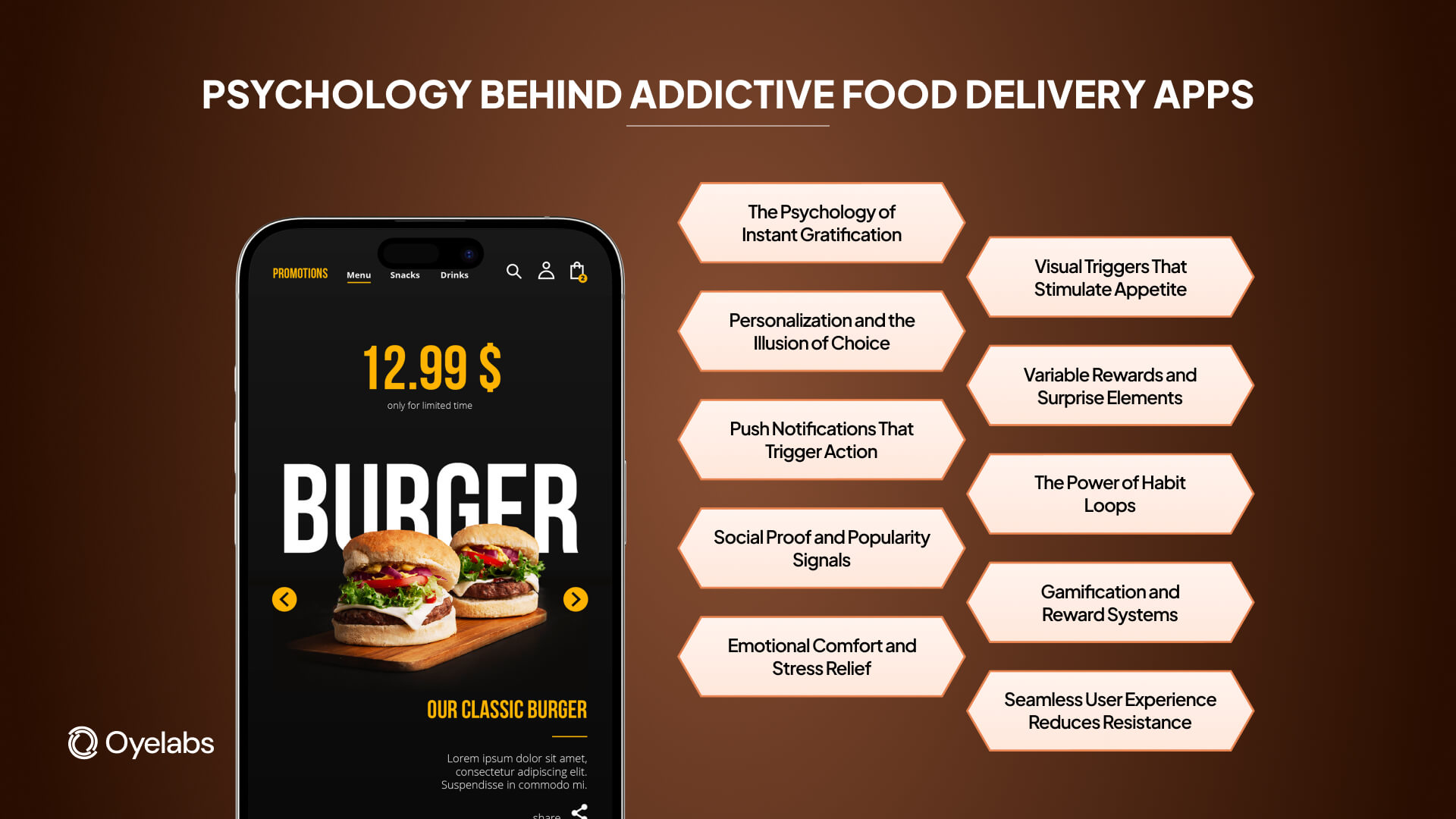
The Psychology of Instant Gratification
Visual Triggers That Stimulate Appetite
Personalization and the Illusion of Choice
Variable Rewards and Surprise Elements
Push Notifications That Trigger Action
The Power of Habit Loops
Social Proof and Popularity Signals
Gamification and Reward Systems
Emotional Comfort and Stress Relief
Seamless User Experience Reduces Resistance
Why These Psychological Tactics Work So Well
Launch Your Own Food Delivery App with Oyelabs
Conclusion
FAQs
Launching a food delivery app takes three to six months, depending on features, integrations, testing requirements, and regional compliance needs.
Food delivery companies earn money through commissions, delivery fees, subscriptions, ads, surge pricing, and partnerships with restaurants and brands globally.
The top three food delivery apps worldwide are UberEats, DoorDash, and Meituan, based on user numbers, order volume, and global reach.
Building a food delivery app typically costs more with real-time tracking, driver apps, advanced analytics, and high-volume infrastructure requirements included.