
B2B Service Marketplaces: The Opportunity Nobody’s Talking About

B2B Service Marketplaces: The Opportunity Nobody’s Talking About
 Anuraag Jain
Last Updated on February 11, 2026
Key Takeaways
What You’ll Learn:
- B2B service marketplaces support repeat business and long-term relationships.
- Service marketplaces solve real procurement and operational service problems at scale.
- Marketplace infrastructure beats consumer novelty in enterprise adoption.
- Curated supply and trust frameworks boost platform credibility fast.
- Founders can launch niches before expanding industry focus.
Stats That Matter:
- Global B2B ecommerce is projected to be over $57 trillion by 2030.
- B2B marketplaces doubled their year-over-year growth recently.
- 750+ vertical B2B marketplaces exist today.
- 59% of B2B buyers use online marketplaces.
- B2B marketplace revenue expected to be over $350B.
Real Insights:
- Digital procurement is replacing manual sourcing.
- Repeat service demand makes B2B marketplaces sustainable.
- Vetted supply drives buyer trust and retention.
- Early niche focus accelerates product-market fit.
- Marketplace growth often outpaces standalone service models.
B2B Service Marketplaces: The Opportunity Nobody’s Talking About
Everyone’s busy chasing the next flashy consumer app. Another food delivery clone. Another social platform. Same noise, smaller margins.
Meanwhile, something far more durable is growing quietly: B2B service marketplaces.
These platforms don’t rely on virality or hype. They solve real operational problems for businesses – on demand, at scale. Think verified service providers, structured workflows, recurring contracts, and predictable revenue. No gimmicks. Just infrastructure.
From field services to professional outsourcing, B2B marketplaces are becoming the backbone of how companies buy work. Analysts, operators, and enterprise founders see it clearly: higher lifetime value, lower churn, and repeat demand baked into the model.
If you’re a CEO or founder looking to build a defensible service marketplace platform – not a trend – this is the opportunity most people are overlooking.
What Is a B2B Service Marketplace (And What It Is Not)
A B2B service marketplace is a digital platform where businesses discover, hire, manage, and pay other businesses or professional service providers through a structured system.
At its core, it replaces fragmented vendor discovery with a centralized, trusted workflow.
This includes:
- Service discovery based on capability, location, or availability
- Structured job requests and scopes
- Pricing clarity and commercial terms
- Built-in communication, tracking, and payment flows
What matters is not the interface – it’s the operational logic.
Many founders mistakenly label these platforms as “freelance marketplaces.” That framing is limiting and inaccurate.
A typical freelance platform focuses on:
- Individual workers
- One-off gigs
- Price competition
- Low switching costs
A B2B service marketplace, by contrast, is designed for:
- Repeat business usage
- Teams or service companies, not just individuals
- Reliability and compliance
- Long-term commercial relationships
In other words, this is not about finding cheap labor.
It’s about making service procurement efficient.
That distinction changes buyer behavior, platform economics, and growth strategy entirely.
Why B2B Service Marketplaces Are Exploding Quietly
B2B service marketplaces are not trending on social media, but they are spreading rapidly inside operations, procurement teams, and fast-growing companies.
Market data shows that B2B marketplaces grew almost 100% year-over-year, demonstrating a rapid shift toward online service procurement among businesses.
There are structural reasons for this growth – and none of them depend on hype.
1. Built-In Recurring Demand
Consumers hire services occasionally.
Businesses hire services continuously.
Marketing agencies, IT consultants, maintenance crews, logistics partners – these are not discretionary purchases. They are ongoing operational needs.
This leads to:
- Higher customer lifetime value (LTV)
- Predictable transaction volume
- Natural repeat usage without aggressive re-marketing
From a platform perspective, this creates healthier unit economics from day one.
2. Lower Churn by Design
B2B buyers do not switch platforms casually.
Once a business finds:
- Trusted providers
- Familiar workflows
- Approved vendors
They stay.
The switching cost is not technical – it’s operational.
That makes B2B marketplaces significantly more defensible than most consumer platforms.
3. Fragmented Supply, Organized by Platforms
In most service industries, supply looks like this:
- Small providers
- Offline discovery
- Word-of-mouth dependency
- No standardized pricing or availability
Marketplaces bring order to this chaos.
By standardizing discovery, onboarding, and transactions, platforms create value for both sides without changing how the service itself is delivered.
That is why adoption feels quiet – but spreads steadily.
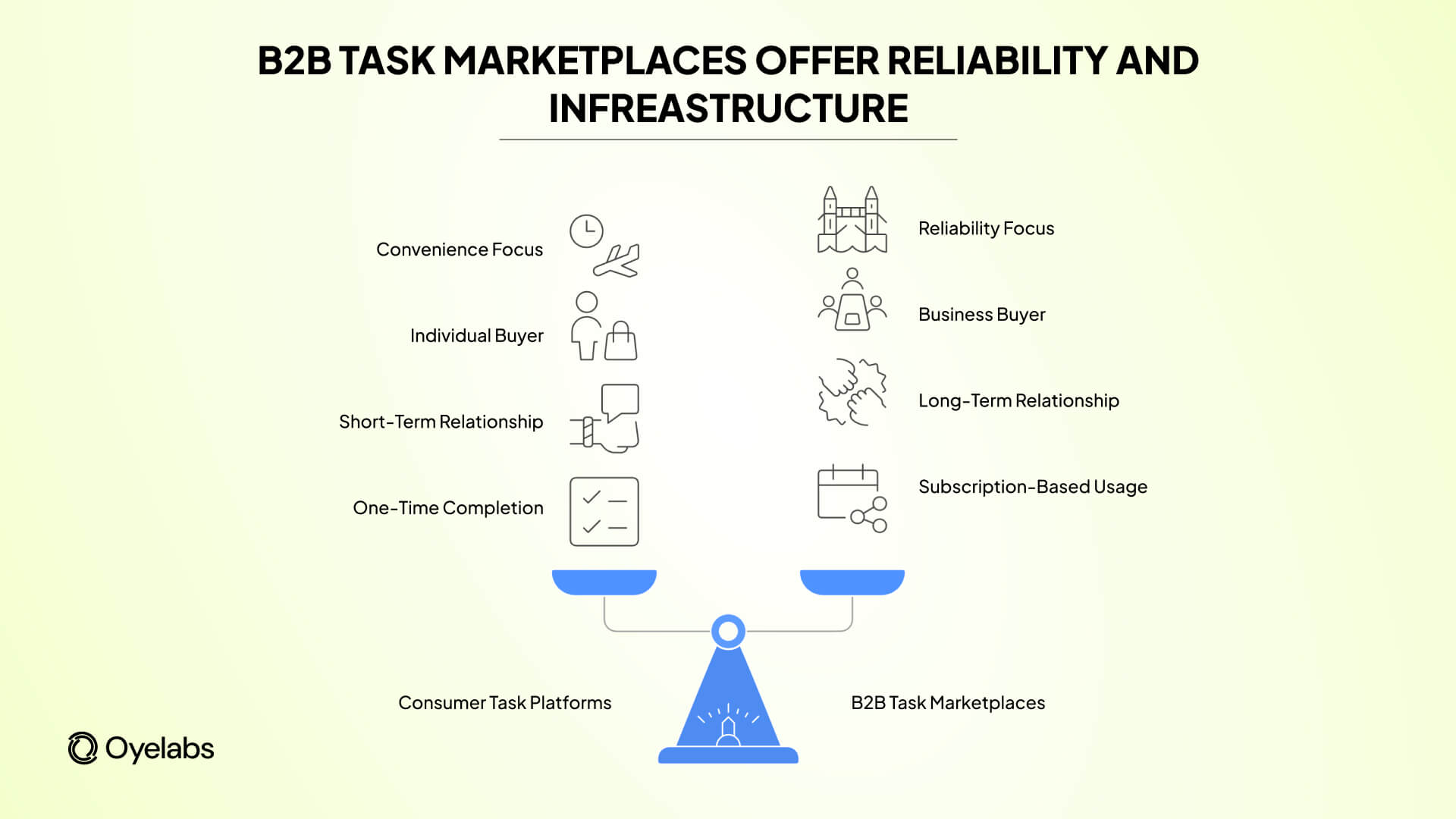
The Real Difference Between Consumer Task Marketplaces and B2B Platforms
Most founders are familiar with TaskRabbit as a consumer platform.
The underlying model – on-demand services, location-based matching, verified providers – is sound.
But when applied to B2B, the same logic becomes far more powerful.
Here’s why.
Consumer Task Platforms Optimize for Convenience
They focus on:
- Speed
- Price comparison
- One-time completion
The buyer is an individual. The risk tolerance is low, and the relationship is short.
B2B Task Marketplaces Optimize for Reliability
They focus on:
- Service continuity
- Accountability
- SLA adherence
- Commercial clarity
The buyer is a business.
The budget is allocated.
The relationship is ongoing.
This shift unlocks entirely different outcomes:
- Higher average order values
- Subscription or contract-based usage
- Platform stickiness that compounds over time
Most importantly, B2B marketplaces stop being “apps” and start becoming infrastructure.
Infrastructure platforms do not compete on novelty.
They win by being dependable.
That is why B2B TaskRabbit-style marketplaces remain underbuilt – and why the opportunity still exists for focused founders who understand their industry deeply.
If you’re curious about how worker classification impacts marketplace growth and compliance, read our deep dive on “Why TaskRabbit-Style Apps Are Adding W2 Tiers.”
The B2B Marketplace Stack (Simplified for Founders)
Most founders overestimate the complexity of building a B2B service marketplace – and underestimate where it actually fails.
You do not need a bloated product.
You need the right stack, working in harmony.
At a practical level, every successful B2B service marketplace rests on five layers.
- Demand layer: This defines who is buying, why they are buying, and how often. Strong platforms start narrow – one industry, one geography, one recurring use case.
- Supply layer: This is not “open sign-ups.” It is curated onboarding. Businesses want confidence that providers are capable, available, and accountable.
- Trust and governance: This includes verification, role-based access, service rules, cancellation logic, and clear accountability. In B2B, trust replaces marketing spend.
- Workflow orchestration: Requests, approvals, scheduling, updates, and completion must follow predictable flows. Businesses adopt platforms that fit into how they already operate.
- Commercial layer: Pricing, invoicing, commissions, subscriptions, or hybrid models must be transparent. Confusion here kills adoption faster than bad design.
When these layers are aligned, the platform scales naturally.
When one is missing, growth stalls – no matter how good the idea sounds.
Why CEOs and Founders Are Uniquely Positioned to Win Here
B2B service marketplaces are not won by first-time app builders.
They are won by operators.
If you are a CEO, founder, or entrepreneur with industry exposure, you already have three unfair advantages:
- You understand the real pain: You know where delays happen, where vendors fail, and where businesses lose time or money.
- You already speak the buyer’s language: You understand procurement logic, approvals, budgets, and expectations. This shows up in product decisions.
- You have access to supply: Most founders already know service providers – even if informally. Turning informal networks into structured platforms is the real unlock.
This is why early-stage startups often outperform large enterprises here.
Speed and focus beat scale in the early phases.
Monetization Models That Actually Work in B2B Service Marketplaces
B2B monetization is less experimental than consumer platforms – but only if it aligns with buyer behavior.
The strongest platforms usually adopt one of four models:
- Subscription access: Businesses pay a recurring fee to access vetted providers, workflows, and support. This works well for operational-heavy use cases.
- Transaction commission: The platform earns a percentage per completed job. This model scales naturally with usage and is easy to explain.
- Lead-based pricing: Businesses pay for qualified service requests rather than clicks or impressions. This aligns incentives cleanly.
- Hybrid models: Subscription for access plus commission on transactions. This is increasingly common in mature B2B marketplaces.
The winning factor is not creativity.
It is predictability.
Businesses prefer platforms where costs are easy to forecast and justify internally.
The Mistakes That Kill B2B Marketplaces Early
Most B2B service marketplaces don’t fail because the idea is bad.
They fail because founders overthink the wrong things.
Common early mistakes include:
- Building every feature before launch instead of validating demand
- Copying consumer UX patterns that don’t fit business workflows
- Allowing unvetted supply that erodes trust
- Delaying launch in search of perfection
In B2B, speed to first transaction matters more than polish.
Platforms improve through real usage – not internal assumptions.
A Founder Story: From Platform Launch to Market Credibility
One founder approached Oyelabs with a clear but focused goal: to launch a TaskRabbit-style B2B service marketplace in their niche without losing a year to development.
Instead of starting from scratch, the founder launched early with a working platform, onboarded real service providers, and focused on solving one operational problem well.
The impact went beyond transactions.
As businesses began using the platform, engagement increased, impressions grew organically, and the platform started being referenced as a category solution rather than “just another app.” The marketplace became a signal of credibility in the founder’s industry.
The product did not just enable services.
It elevated market positioning.
That is what happens when execution meets timing.
How to Launch a B2B Service Marketplace Without Burning 12 Months
Most early-stage founders don’t fail because the market rejects them. They fail because they run out of time, money, or momentum before learning anything meaningful. B2B service marketplaces are especially vulnerable to this mistake. The most common trap is treating the platform like a long-term software project instead of a go-to-market system.
Successful founders flip the order:
- Launch first
- Validate demand
- Refine workflows
- Then scale
In B2B, your first objective is not feature completeness.
It is real transactions between real businesses.
A focused launch – serving one industry, one service category, or one geography – creates clarity. It also gives you data that no amount of internal planning can replace.
Speed is not recklessness here.
It is a strategic advantage.
Why White-Label Plus Customization Is the Smart Founder Path
Custom development feels like control.
In reality, it often delays learning.
White-label platforms, when paired with the right level of customization, allow founders to:
- Enter the market quickly
- Avoid rebuilding solved problems (auth, payments, workflows)
- Focus resources on onboarding and demand acquisition
For B2B marketplaces, this approach is especially effective because:
- Core workflows are already standardized
- Differentiation comes from niche focus, not code novelty
- Early revenue matters more than architectural purity
Founders who win here do not outsource thinking – but they do buy speed.
They invest in customization only after the market confirms what actually matters.
Final Thoughts
B2B service marketplaces aren’t ignored because they lack potential. They’re ignored because they don’t shout. These platforms grow through solid operations, not virality; through retention, not hype; and they reward founders who understand how businesses actually work, not those chasing short-lived trends.
As procurement and service sourcing continue to digitize, B2B marketplaces will quietly become the default infrastructure. When that shift is complete, late entrants will find it difficult to stand out or compete on anything other than price.
Right now, the advantage still belongs to industry-focused founders, operators with real domain insight, and CEOs willing to launch before everything feels perfect.
If you’re looking to build something durable – something businesses rely on daily – B2B service marketplaces remain one of the most practical and defensible opportunities available today.
The market is forming. The rules are still flexible. The founders who move now won’t just participate – they’ll define the category.
FAQs
Q1: What is a B2B service marketplace?
A B2B service marketplace is a digital platform where businesses discover, hire, manage, and pay professional service providers.
It replaces fragmented vendor sourcing with structured workflows and trusted service delivery.
Q2: Why are B2B service marketplaces gaining momentum?
Businesses increasingly prefer online platforms for reliable, repeatable services that support daily operations.
This shift is driven by efficiency, accountability, and the need for scalable service procurement.
Q3: How do B2B marketplaces differ from consumer platforms?
B2B marketplaces are built around contracts, long-term relationships, and verified providers.
Consumer platforms focus more on one-time tasks, price comparison, and convenience.
Q4: What’s the biggest advantage for founders building B2B marketplaces?
B2B marketplaces benefit from predictable demand and recurring usage from business clients.
This results in higher lifetime value and more sustainable platform growth than B2C models.