
Why TaskRabbit-Style Apps Are Adding W2 Tiers
Why TaskRabbit-Style Apps Are Adding W2 Tiers
 Sachin Sharma
Last Updated on February 2, 2026
Key Takeaways
What You’ll Learn:
- TaskRabbit-style apps connect customers with local workers for short, on-demand services.
- Most platforms start with 1099 contractors to launch faster and reduce early costs.
- W2 tiers are added to improve reliability, quality, and operational control.
- Hybrid workforce models combine flexibility with predictable service delivery.
- Workforce design directly affects trust, growth, and platform valuation.
Stats That Matter:
- Over one-third of U.S. workers participate in gig or independent work.
- W2 short-term roles now outnumber 1099 contractor roles in paid gig jobs.
- Reliable service increases repeat usage and lifetime customer value.
- Enterprise clients prefer platforms with accountable, managed workforces.
- Hybrid marketplaces attract more stable, long-term revenue.
Real Insights:
- Service consistency matters more than worker flexibility at scale.
- Customers trust platforms that guarantee job completion.
- W2 workers reduce cancellations and service failures.
- Hybrid models protect brand reputation as platforms grow.
- Workforce strategy is a core product decision, not an HR detail.
Why TaskRabbit-Style Apps Are Adding W2 Tiers
A few years ago, building a TaskRabbit-style app felt simple: add freelancers, take a cut, scale fast. Done.
Today? That playbook is cracking.
Founders are running into real problems – missed jobs, uneven quality, angry customers, and regulators asking uncomfortable questions. The result is a quiet but strategic shift: TaskRabbit-style apps are adding W2 tiers.
This isn’t about copying big platforms. It’s about control, reliability, and long-term brand value. Modern on-demand marketplaces now blend 1099 contractors with W2 workers to balance flexibility with accountability, improve service-level consistency, and unlock enterprise demand.
If you’re a CEO or early-stage founder planning an on-demand service marketplace, understanding this shift early can save you years – and materially increase your platform’s valuation.
Why Are TaskRabbit-Style Apps Changing Their Workforce Models?
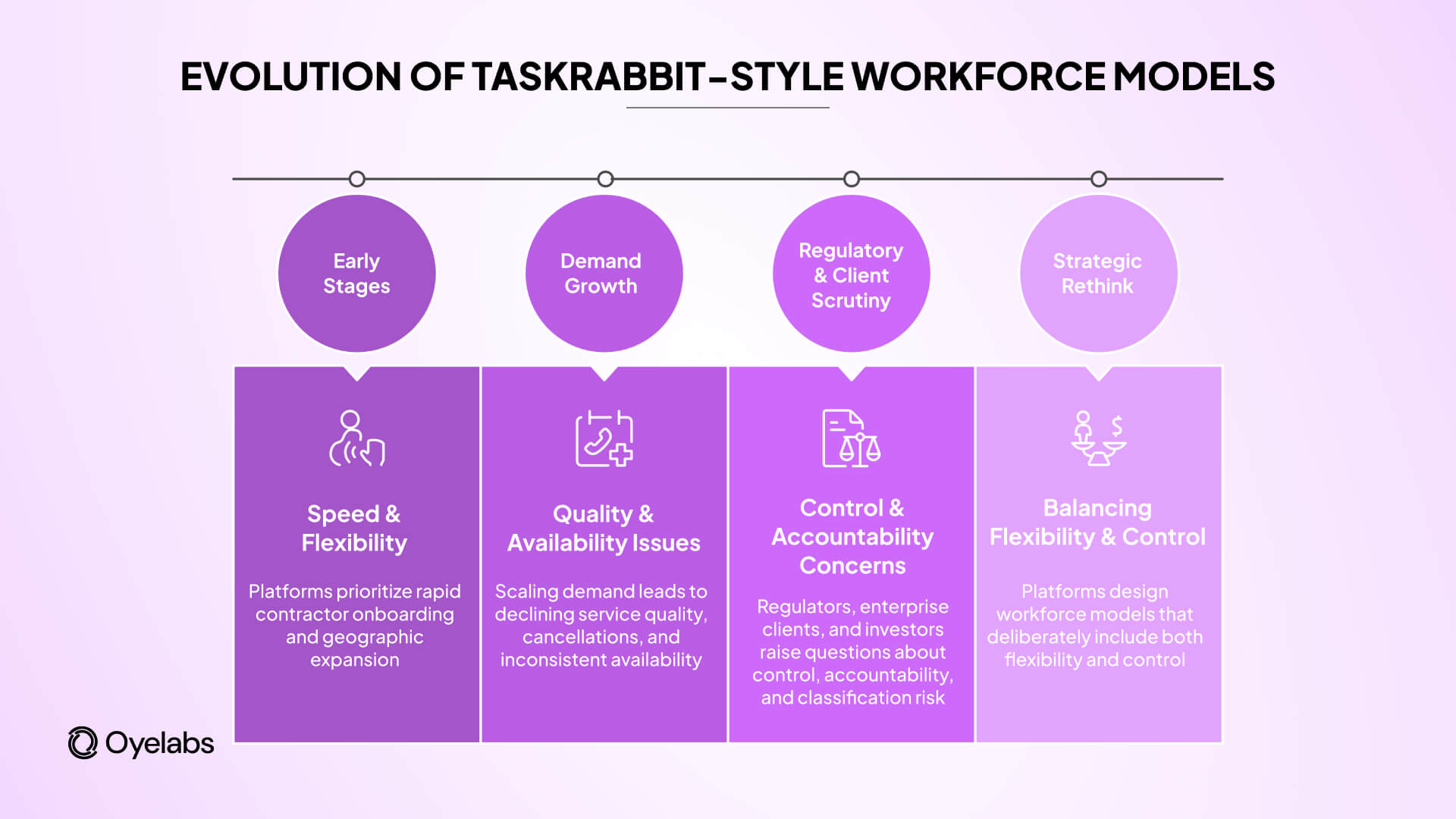
TaskRabbit-style marketplaces are not changing their workforce models because of trends or headlines. They are changing because the original operating model no longer supports predictable growth.
In the early stages, most platforms prioritized speed. Contractors could be onboarded quickly, costs stayed variable, and geographic expansion was easy. But once real demand arrived, cracks began to show. Founders started seeing patterns that technology alone could not fix.
Common triggers behind the shift include:
- Declining service quality as platforms scale
- High cancellation and no-show rates
- Inconsistent availability during peak demand
- Poor customer reviews tied to worker behavior, not product UX
- Limited ability to enforce service standards
At the same time, regulators, enterprise clients, and even investors began asking sharper questions around control, accountability, and classification risk.
The result is a strategic rethink. Leading platforms are no longer choosing between flexibility and control. They are designing workforce models that deliberately include both.
What Is a TaskRabbit-Style On-Demand Service Marketplace?
A TaskRabbit-style marketplace is a two-sided, location-based platform that connects customers with service providers for short-duration, task-based work. These tasks are typically fulfilled on-demand or within a defined time window.
According to Upwork’s Freelance Forward report, 38% of the American workforce – approximately 64 million professionals – engaged in freelance or gig work in 2025, underscoring the scale and relevance of on-demand platforms in today’s labor market.
From a technical and business perspective, these platforms rely on a few core building blocks:
- Real-time job posting and acceptance
- Location-based matching and availability logic
- Dynamic pricing or fixed-rate task models
- In-app communication and notifications
- Platform-mediated payments and reviews
What makes these marketplaces difficult is not the feature set. It is the human dependency.
Unlike ride-hailing or food delivery, many TaskRabbit-style services involve skill, trust, and in-home access. Customers do not just want speed. They want reliability, professionalism, and predictability.
As a result, the workforce is no longer a passive supply pool. It becomes a direct extension of the brand. This is where purely contractor-driven models start to struggle, especially as platforms move from MVP to multi-city operations.
Why Did Most TaskRabbit-Style Platforms Start With 1099 Contractors?
The 1099 contractor model dominated early on because it solved immediate startup problems. For founders launching a new marketplace, it offered the fastest path to market with the lowest upfront risk.
Key reasons platforms started with 1099 contractors include:
- No payroll or employment overhead
- Faster onboarding with minimal compliance friction
- Workers could set their own availability
- Easy market entry across cities or regions
- Costs scaled directly with demand
From a short-term perspective, this model works. It allows founders to validate demand, test pricing, and prove the marketplace concept without locking into fixed expenses.
However, what works at launch often breaks at scale.
As transaction volume grows, platforms begin exerting more influence over pricing, task acceptance, response times, and service standards. That operational control, while necessary for growth, starts to conflict with the assumptions of true contractor independence.
This tension is the foundation for why many TaskRabbit-style apps are now rethinking their workforce strategy – and why W2 tiers are entering the picture.
What Are the Limitations of a 1099-Only Marketplace Model?
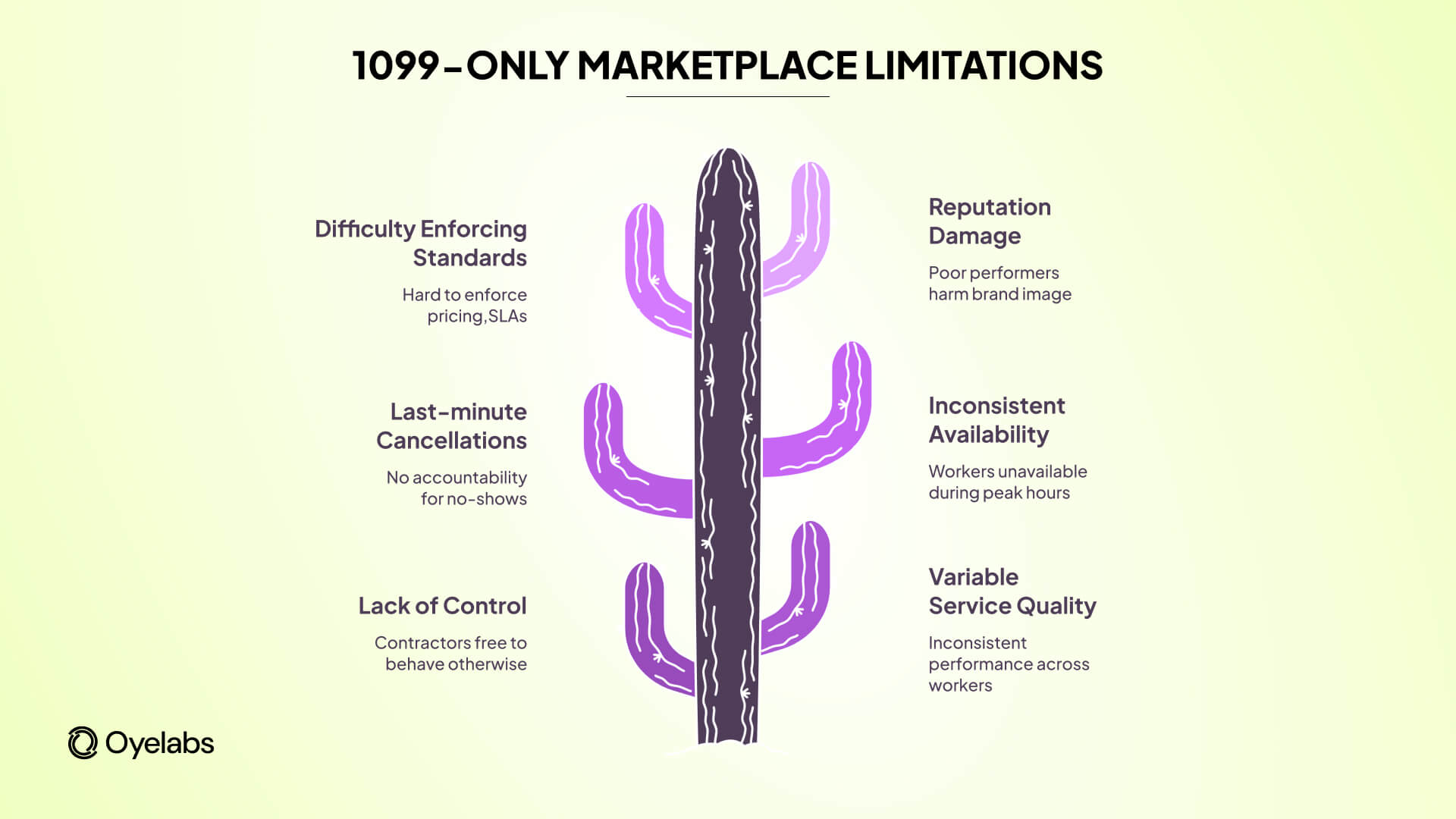
A 1099-only model looks efficient on paper, but at scale it introduces constraints that directly affect growth, brand perception, and unit economics.
The biggest limitation is lack of control. Platforms depend on workers to show up on time, follow service guidelines, and represent the brand well – yet contractors are legally free to behave otherwise. This gap becomes visible as volume increases.
Founders commonly encounter:
- High variability in service quality
- Last-minute cancellations with no accountability
- Inconsistent availability during peak hours
- Difficulty enforcing pricing, SLAs, or response times
- Reputation damage driven by a small percentage of poor performers
Customer complaints in these marketplaces rarely blame the worker alone. They blame the platform.
Over time, this leads to higher churn, rising support costs, and slower word-of-mouth growth. What began as a cost-saving choice turns into a growth bottleneck.
Why Are Independent Contractor Classifications Being Challenged?
Independent contractor classifications are being challenged because many marketplaces operate in ways that functionally resemble employment, even if the legal structure says otherwise.
The issue is not the label. It is behaviour.
When platforms influence how tasks are priced, how quickly workers must respond, which jobs they should accept, and how performance is evaluated, they are exercising operational control. That control creates risk – legal, financial, and reputational.
For founders, the takeaway is simple:
The more successful your platform becomes, the harder it is to maintain true contractor independence.
This pressure has forced many operators to rethink workforce design. Not to avoid compliance, but to align operations with reality. W2 tiers offer a cleaner structure for roles that require predictability, scheduling, and direct oversight.
Why Are TaskRabbit-Style Apps Adding W2 Tiers Now?
W2 tiers are not being added as replacements. They are being added as strategic layers.
Founders have realized that some jobs – and some customers – require guarantees that contractor-only models cannot reliably deliver. W2 workers allow platforms to design a controlled supply layer without dismantling the open marketplace.
The timing matters. Platforms are adding W2 tiers when:
- Demand becomes predictable in specific zones
- Repeat customers expect consistency
- Premium or enterprise clients enter the funnel
- Brand perception starts impacting conversion rates
Instead of asking, “Can contractors do this?”, platforms are asking, “Which part of our supply should we own?”
That shift marks the transition from marketplace startup to operating company.
How Does a W2 Workforce Improve Control and Service Quality?
A W2 workforce gives platforms structural tools they simply do not have with contractors.
With W2 workers, platforms can:
- Schedule shifts based on demand forecasting
- Guarantee coverage in high-volume zones
- Enforce service standards and training
- Reduce cancellations and response delays
- Align worker incentives with platform KPIs
This does not eliminate flexibility. It refines it.
Most successful platforms use W2 workers where reliability matters most – repeat jobs, time-sensitive tasks, or high-value customers – while keeping the contractor pool open for long-tail demand.
The result is a marketplace that feels more trustworthy to customers, more predictable to operators, and more defensible as a brand.
To understand how platforms like TaskRabbit monetize both contractors and W2 workers, explore how the TaskRabbit business and revenue model actually work.
How Do W2 Tiers Increase Customer Trust and Retention?
Customer trust in on-demand marketplaces is built on one simple expectation: the job gets done as promised. W2 tiers help platforms meet that expectation consistently.
When customers know a service provider is platform-backed, not just platform-listed, their perception changes. They expect accountability, professionalism, and follow-through. This directly affects conversion rates and repeat usage.
W2 tiers improve trust by enabling:
- Predictable arrival times and fewer cancellations
- Uniform service quality across locations
- Clear escalation paths when issues occur
- Better-trained workers who understand platform standards
Over time, this consistency compounds. Customers stop comparing your platform purely on price and start choosing it based on reliability. That shift is critical for retention, especially in categories where services are recurring rather than one-off.
Trust reduces friction. Reduced friction lowers churn. And lower churn improves lifetime value – one of the strongest signals of marketplace health.
Why Do Enterprise and B2B Clients Prefer W2-Backed Marketplaces?
Enterprise and B2B clients do not buy “flexibility.” They buy certainty.
Large organizations require service partners who can commit to service-level agreements, predictable availability, and compliance standards. A marketplace built entirely on independent contractors struggles to meet those expectations.
W2-backed tiers make enterprise adoption possible because they allow platforms to:
- Guarantee workforce availability
- Assign trained personnel to specific accounts
- Offer contractual SLAs
- Maintain compliance and insurance alignment
- Provide centralized reporting and accountability
This is why many TaskRabbit-style platforms plateau in consumer markets but unlock a second growth curve through B2B services once W2 layers are introduced.
For founders, enterprise demand is not just incremental revenue. It is more stable, higher-margin, and valuation-positive revenue.
What Is a Hybrid Marketplace Model (1099 + W2)?
A hybrid marketplace combines two workforce models under a single platform architecture.
- 1099 contractors serve open-market demand, long-tail jobs, and flexible availability needs
- W2 workers cover high-priority zones, premium customers, and time-sensitive services
The platform routes demand intelligently based on job type, urgency, customer tier, and location.
This structure allows founders to preserve the benefits of a marketplace – scale and flexibility – while adding operational reliability where it matters most. Importantly, it avoids the binary mistake of choosing one model too early.
Hybrid models are not about complexity for its own sake. They are about intentional workforce design aligned with real usage patterns.
Why Is the Hybrid 1099 + W2 Model Becoming the Industry Standard?
The hybrid model is becoming standard because it reflects how marketplaces actually operate at scale.
Pure contractor platforms struggle with control. Fully employed workforces struggle with flexibility and cost. Hybrid models solve both problems without overcorrecting.
From a business standpoint, hybrid marketplaces offer:
- Better risk management across workforce types
- Higher customer satisfaction in core service areas
- Stronger unit economics over time
- Greater appeal to investors and strategic partners
Most importantly, hybrid models allow founders to evolve without rebuilding their platform from scratch. Workforce strategy becomes a configurable layer, not a hard constraint.
This is why modern TaskRabbit-style apps are being designed with hybrid capability from day one – even if W2 tiers are activated later.
How Do W2 and 1099 Models Compare From a Business Perspective?
From a founder’s point of view, the W2 vs 1099 discussion is not ideological. It is operational and financial.
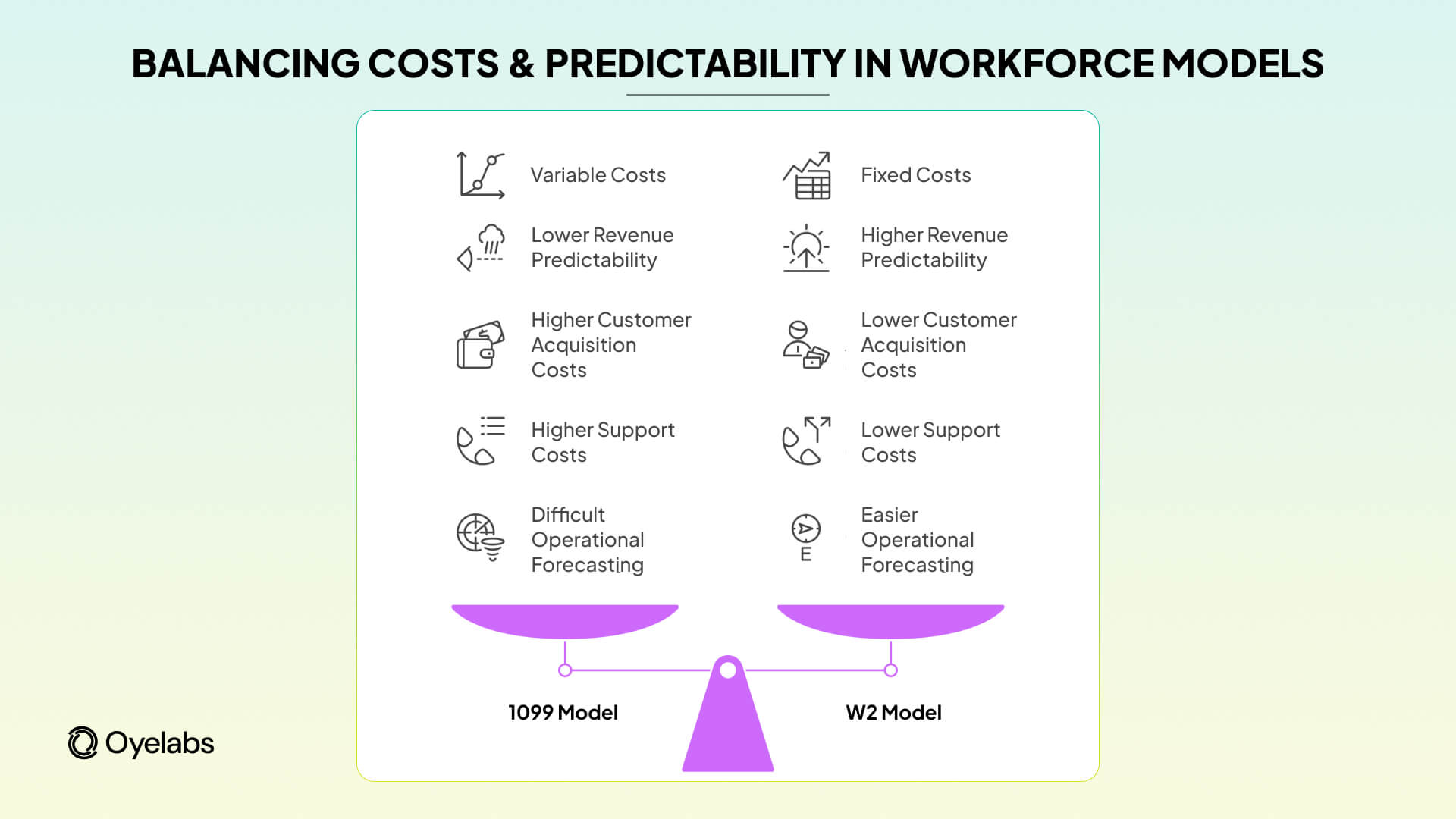
A 1099 model keeps costs variable and margins clean in the short term. A W2 model introduces fixed costs but delivers predictability. The real difference shows up once transaction volume increases.
At scale, founders typically notice:
- Revenue predictability improves with W2-backed fulfillment
- Customer acquisition costs stabilize due to better reviews and referrals
- Support costs decrease because service failures drop
- Operational forecasting becomes easier with scheduled labour
While W2 workers add payroll, taxes, and management overhead, they often reduce hidden costs tied to churn, refunds, and brand erosion. In many mature marketplaces, profitability improves not because labour is cheaper – but because execution is tighter.
When Should Founders Add a W2 Tier to Their Marketplace?
Timing matters more than intention.
Adding a W2 tier too early can strain cash flow. Adding it too late can lock in bad habits and damage brand trust. The right moment is usually driven by demand patterns, not company age.
Founders should consider adding a W2 tier when:
- Demand is recurring in specific locations or categories
- Customers expect guaranteed availability or fixed time slots
- Service quality issues are limiting growth
- High-value or business clients are entering the funnel
- Operational teams are already informally managing workers
At this stage, the platform is no longer just matching supply and demand. It is delivering outcomes. W2 tiers provide the structure needed to support that shift.
What Are the Risks of Adding W2 Workers Too Early or Too Late?
The risk is not adding W2 workers. The risk is adding them without clarity.
Too early, and founders face:
- Fixed costs without predictable demand
- Underutilized workforce
- Management overhead without leverage
Too late, and the damage is harder to reverse:
- Poor customer trust baked into brand perception
- Churn driven by service inconsistency
- Loss of enterprise opportunities
- Increased legal and compliance exposure
The most successful founders treat W2 tiers as phased infrastructure, not an all-or-nothing bet. They pilot in controlled zones, measure outcomes, and expand only where economics make sense.
What Mistakes Do Founders Make When Introducing W2 Workers?
The most common mistake is assuming W2 workers can be managed like contractors with payroll attached.
W2 tiers require operational redesign. Without it, complexity increases without benefit.
Frequent founder missteps include:
- Not redefining roles, expectations, and accountability
- Failing to implement scheduling and workforce planning
- Mixing contractor and employee logic in the same workflows
- Underestimating compliance and reporting needs
- Expecting technology alone to solve human management
W2 tiers work when they are treated as a core operating function, not a side experiment. Platforms that get this right see measurable improvements in quality, retention, and brand equity.
How Does Technology Need to Change When a Marketplace Adds W2 Workers?
Adding a W2 tier is not just a workforce decision. It is a platform architecture decision.
Most TaskRabbit-style apps are initially built for flexibility: open availability, self-selected jobs, and minimal scheduling logic. W2 workers introduce a different operating reality – one that requires structure.
At a minimum, platforms need to support:
- Shift-based scheduling instead of pure availability
- Zone and capacity planning tied to demand forecasts
- Role-based permissions for supervisors and managers
- Attendance, performance, and utilization tracking
- Payroll-ready reporting and compliance logs
Without these changes, founders end up managing W2 teams manually outside the system, which defeats the purpose and increases operational risk.
This is why many early platforms struggle to introduce W2 tiers later. The technology was never designed for it. Forward-looking founders now treat workforce flexibility as a configurable layer, not a hard-coded assumption.
How Did One Founder Build a Recognizable Brand Using a TaskRabbit-Style Platform?
One founder Oyelabs worked with launched a TaskRabbit-style service marketplace focused on local, high-frequency services. The platform initially ran on a 1099-only model to validate demand and pricing. As usage grew, they noticed repeat customers asking for guaranteed availability and more consistent service quality. With Oyelabs, the founder introduced a small W2 tier in high-demand zones while keeping the broader marketplace open. That shift reduced cancellations, improved reviews, and significantly increased repeat bookings. Over time, engagement and impressions rose, customer trust improved, and the platform transitioned from being seen as “another services app” to a recognizable local brand with stronger market value.
Why Do Most Founders Struggle to Build Hybrid Marketplaces From Scratch?
Hybrid marketplaces look simple conceptually, but they are difficult to execute without experience.
Founders building from scratch often underestimate:
- The complexity of managing two workforce types simultaneously
- The operational logic needed to route jobs correctly
- The compliance and reporting overhead of W2 layers
- The time required to redesign workflows mid-scale
As a result, many platforms either delay the hybrid transition or attempt it through workarounds. Both approaches slow growth and increase risk.
The challenge is not vision. It is execution. Hybrid marketplaces require battle-tested architecture that can evolve without breaking core operations.
What Features Should Founders Look for in a TaskRabbit-Style Platform?
Founders evaluating a TaskRabbit-style platform should look beyond surface-level features. The real differentiator is whether the system can evolve with the business, not just launch quickly.
At a minimum, the platform should support:
- A native 1099 contractor marketplace model
- The ability to introduce W2 workers without rebuilding core logic
- Zone-based job routing and workforce allocation
- Role-based permissions for operations and supervisors
- Configurable pricing, commissions, and service rules
- Clean reporting for performance, payouts, and compliance
Most early-stage platforms fail not because demand is missing, but because the technology locks founders into decisions made too early. Flexibility at the architecture level is what protects long-term growth.
Are W2 Tiers a Trend or a Long-Term Marketplace Strategy?
W2 tiers are not a temporary reaction to regulation or competition. They are a signal that on-demand marketplaces are maturing.
As platforms move from experimentation to scale, they must deliver outcomes, not just connections. That shift requires more control over service quality, availability, and accountability – especially in high-frequency or high-trust service categories.
The long-term winners in this space will not be purely open marketplaces or fully employed service companies. They will be platforms that intelligently combine both models based on demand, geography, and customer expectations.
In that sense, W2 tiers are not a departure from the marketplace model. They are its next evolution.
What Should Founders Do If They’re Planning a TaskRabbit-Style Marketplace?
Founders planning a TaskRabbit-style marketplace should make one decision early: build for today without limiting tomorrow.
That means launching lean, validating demand with a contractor-driven model, and designing the platform so W2 tiers can be introduced when the business is ready. The goal is not to predict the future perfectly, but to avoid structural decisions that block it.
This is where working with experienced marketplace builders matters. Teams like Oyelabs help founders launch faster while keeping workforce models, operations, and scalability in mind from day one – so growth adds leverage, not friction.
In today’s market, speed matters. But adaptability matters more. Founders who plan for both build platforms that last.
Conclusion
TaskRabbit-style marketplaces are growing up. What once worked for quick launches and early traction – pure 1099 contractor models – is no longer enough for platforms that want durability, trust, and scale. As customer expectations rise and service consistency becomes a competitive advantage, founders are being pushed to rethink how work actually gets delivered on their platforms.
W2 tiers are not about abandoning flexibility. They are about adding structure where it creates leverage. The most resilient on-demand marketplaces today are hybrid by design, combining open contractor networks with controlled workforce layers that protect brand value and unlock higher-quality demand.
For founders, the takeaway is clear: workforce strategy is no longer a legal footnote or an operations afterthought. It is a core product decision – one that directly shapes growth, retention, and long-term valuation.
FAQs
Q: Why are TaskRabbit-style apps adding W2 workers?
A: W2 workers give platforms better control, reliability, and service consistency at scale.
Q: Can a TaskRabbit-style app run only on 1099 contractors?
A: Yes, but quality issues and growth limits often appear as the platform scales.
Q: Is a hybrid 1099 and W2 model better for marketplaces?
A: Hybrid models balance flexibility with accountability and support long-term growth.
Q: Do W2 tiers increase marketplace valuation?
A: Yes, predictable service and enterprise readiness often improve investor confidence.