
How Airbnb’s In-App Only Policy is Creating a New Trend
How Airbnb’s In-App Only Policy is Creating a New Trend
 Anuraag Jain
Last Updated on February 23, 2026
Key Takeaways
What You’ll Learn:
- Airbnb’s In-App Only Policy keeps all bookings, payments, and communication inside its platform.
- Closed marketplace systems create opportunities for niche vacation rental apps.
- Hosts want lower commission fees and stronger control over their brand identity.
- Travelers prefer curated property options instead of overcrowded listing marketplaces.
- Founders can launch regional or vertical platforms instead of competing at a global scale.
- Mobile-first platform design is essential for modern travel startups.
- Strong marketplace trust systems increase repeat bookings and customer loyalty.
Stats That Matter:
- The global vacation rental market may exceed $113 billion by 2027.
- Travel and tourism generated $9.9 trillion globally in 2023.
- Online travel platforms typically charge 15% to 30% commission per booking.
- More than 60% of travel bookings happen on mobile devices.
- 65% of travelers prefer booking directly with accommodation providers when possible.
Real Insights:
- Lower commission structures attract more hosts to new platforms.
- Focused and niche platforms convert better than overcrowded marketplaces.
- Mobile apps improve booking completion rates and user retention.
- Trust features such as verification and secure payments increase guest confidence.
- Regional dominance is easier to achieve than global marketplace competition.
How Airbnb’s In-App Only Policy is Creating a New Trend
Nobody likes being locked inside an app. Especially not Gen Z travelers who grew up comparing, screenshotting, and booking in seconds. Yet that’s exactly what Airbnb’s In-App Only Policy is doing. Communication stays inside the platform. Booking stays inside the platform. Even hotel details are carefully controlled to prevent direct reservations.
From a marketplace architecture standpoint, this is smart. Airbnb protects its commission model, owns first-party data, and strengthens retention loops. But every closed ecosystem creates friction. And friction creates opportunity.
For founders looking to launch their vacation rental platform, this shift signals something bigger: a market ready for alternatives. Hosts want margin control. Hotels want brand visibility. Travelers want curated options.
When a dominant platform tightens control, space opens up. The question is simple – who will build in that space next?
What Is Airbnb’s In-App Only Policy – And Why It Matters
Airbnb’s In-App Only Policy refers to the company’s growing effort to keep every part of the travel journey inside its ecosystem. Communication between hosts and guests is restricted to in-app messaging. External links are filtered. Hotel contact information is often limited before booking. Payment processing must stay on the platform.
From a platform strategy perspective, this is deliberate. Airbnb protects:
- Its commission structure
- Its data ownership
- Its conversion funnel
- Its retention metrics
By controlling the full booking lifecycle – discovery, messaging, payment, reviews – Airbnb strengthens its network effects. The platform becomes the central authority.
For founders, this policy reveals something critical: when a marketplace centralizes control, it often reduces flexibility for suppliers and restricts relationship building. That tradeoff creates strategic openings for alternative models.
The Hidden Limitations of Airbnb’s In-App Only Policy
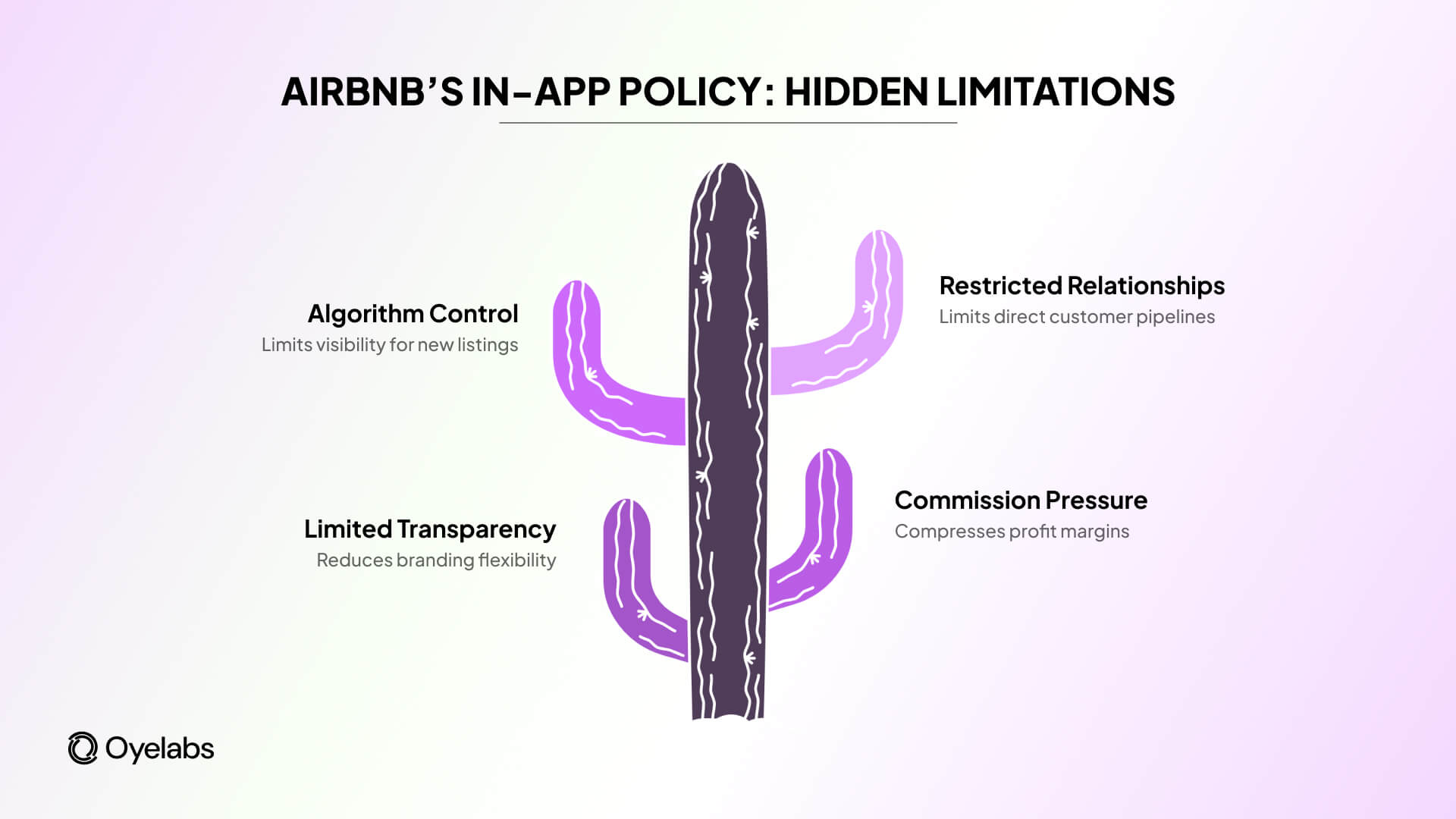
Airbnb’s model is optimized for scale. But scale introduces constraints. These constraints are not obvious to travelers. They are deeply felt by hosts, boutique hotels, and regional operators.
Limited Transparency for Hotels and Hosts
Many hotels prefer direct communication before confirming reservations. With the in-app restriction model, branding flexibility is reduced. Hotels cannot freely promote loyalty programs or encourage direct booking relationships.
For independent operators, this can weaken long-term brand equity.
Commission Pressure and Margin Compression
Airbnb’s service fees impact both guests and hosts. As competition increases and listing volume grows, smaller property owners often struggle to maintain profitability.
Founders entering this space can rethink monetization models, offering subscription-based access, lower commission tiers, or hybrid revenue structures.
Discovery Controlled by Algorithm
Airbnb’s search ranking system determines visibility. New listings compete against thousands of established properties. Smaller operators may struggle for placement.
A niche vacation rental platform can solve this by offering curated visibility rather than algorithm-driven saturation.
Restricted Direct Relationship Building
When communication stays locked inside the app, repeat booking relationships also remain platform-bound. Hosts cannot easily nurture direct customer pipelines.
For founders, this reveals a gap: platforms that enable loyalty building without sacrificing trust infrastructure.
Airbnb’s In-App Only Policy protects the platform. But it also limits autonomy.
How Airbnb’s In-App Only Policy Is Creating a New Trend
Closed ecosystems often trigger counter-movements. As Airbnb tightens control, a new trend is emerging: specialized, vertical vacation rental platforms.
This trend is not about replacing Airbnb globally. It is about serving specific audiences more effectively.
We are seeing growth in:
- Luxury-only rental platforms
- Digital nomad housing marketplaces
- Eco-focused accommodation apps
- Regional vacation rental networks
- Corporate short-stay platforms
The logic is simple. When a dominant marketplace becomes broad and restrictive, focused alternatives gain traction.
Airbnb’s In-App Only Policy is accelerating decentralization. It pushes hosts to explore options. It encourages entrepreneurs to build differentiated platforms. It validates the viability of marketplace infrastructure while exposing room for innovation.
Why This Is the Best Time to Launch an Airbnb Alternative
Timing matters in marketplace businesses. The current travel-tech environment offers three strategic advantages for founders.
- Hosts Want Better Economics: Many hosts seek higher margins and more flexible pricing. A new platform can differentiate by offering transparent fee structures and predictable costs.
- Travelers Want Curated Choice: Excess supply creates decision fatigue. Instead of thousands of listings, many travelers prefer trusted, filtered recommendations. A niche app improves conversion rates by narrowing focus.
- Hotels Want Brand Identity: Boutique hotels and independent properties want visibility beyond anonymous listing thumbnails. They want storytelling, brand presentation, and direct engagement.
- Technology Barriers Are Lower: Launching a vacation rental marketplace once required extensive custom development. Today, scalable architectures, secure payment integrations, and modular design frameworks reduce time-to-market significantly.
For founders, this combination of supplier dissatisfaction, consumer demand for curation, and accessible technology creates a rare window.
If you want a deeper breakdown of the structural decisions that built its dominance, explore our detailed guide on the List of Lessons from a Vacation Rental Platform like Airbnb, where we analyze what worked – and what founders should improve.
What Smart Founders Can Do Differently From Airbnb
Building an Airbnb-like app does not mean copying Airbnb. It means understanding where differentiation can create leverage.
Smart founders can:
- Introduce lower commission tiers or subscription pricing
- Allow enhanced property branding tools
- Provide loyalty integrations for repeat guests
- Focus on a single geographic region first
- Offer hybrid booking options (platform + membership models)
Airbnb’s strength is its scale. A startup’s strength is agility.
By designing a platform that prioritizes flexibility, transparency, and curated experience, founders can attract suppliers who feel constrained by larger ecosystems.
The objective is not volume. It is value concentration.
The Blueprint to Launch Your Own Vacation Rental App Like Airbnb
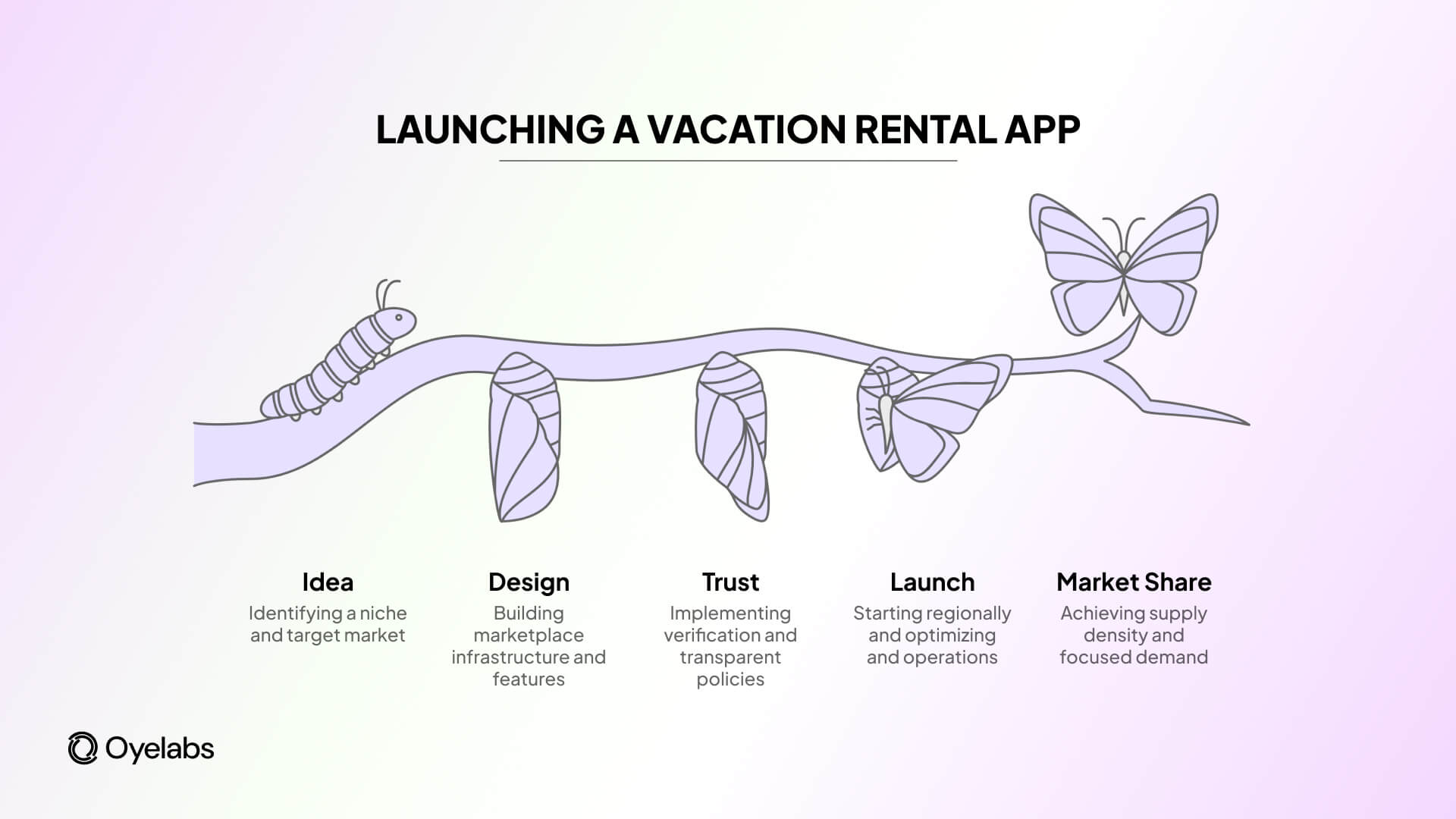
Execution determines whether the opportunity converts into market share. A structured approach reduces risk.
Step 1: Define a Clear Niche: Identify a target segment. Luxury retreats. Urban corporate housing. Faith-based tourism. Eco-resorts. Regional coastal stays. Specificity drives traction.
Step 2: Design Marketplace Infrastructure: A strong architecture includes:
- Host onboarding systems
- Secure payment gateway integration
- Escrow logic
- Ratings and review modules
- Admin control panel
- Mobile-first interface
Step 3: Build Trust Mechanisms: Trust is the currency of marketplace platforms. Verification systems, transparent pricing displays, cancellation policies, and dispute management protocols are essential.
Step 4: Launch Regionally, Then Expand: Start with one city or region. Achieve supply density. Optimize operations. Then scale gradually.
A vacation rental startup succeeds when supply quality meets focused demand. Technology supports this alignment. Strategy drives it.
How Oyelabs Helped a Founder Turn a Vacation Rental Idea Into a Recognized Brand
One founder approached Oyelabs with a vision: create a curated vacation rental platform focused on premium coastal destinations. Instead of competing broadly, the strategy centered on high-quality listings, consistent property standards, and streamlined in-app booking.
The platform architecture included integrated payments, host dashboards, guest verification, and performance analytics. Within months of launch, engagement rates increased significantly. App store impressions grew steadily due to focused positioning. Repeat bookings improved because the user experience was seamless and brand-forward.
By building a specialized vacation rental app instead of listing on a general marketplace, the founder established brand authority in their region.
The lesson is clear: controlled focus combined with scalable technology can elevate market perception quickly.
The Business Model Behind a Successful Airbnb-Like App
A sustainable vacation rental marketplace depends on clear revenue logic. Founders typically choose among the following structures:
| Model | Description | Strategic Advantage |
| Commission Per Booking | Percentage on each transaction | Scales with volume |
| Subscription for Hosts | Monthly access fee | Predictable revenue |
| Premium Placement | Paid listing visibility | High-margin upsell |
| Service Fees | Guest service charge | Revenue diversification |
| Experience Add-Ons | Tours, local services | Cross-sell opportunity |
The right model depends on the niche and supplier expectations. Flexibility often becomes a competitive advantage.
How Airbnb’s In-App Only Policy Will Shape the Next Five Years
The World Travel & Tourism Council reports that travel and tourism generated $9.9 trillion globally in 2025, reinforcing the scale of opportunity for digital booking platforms. The future of travel marketplaces will likely include:
- Increased vertical specialization
- Regional champions emerging
- Hybrid direct-booking communities
- Enhanced AI-driven personalization
- Stronger supplier autonomy demands
Airbnb’s In-App Only Policy signals that dominant platforms will continue consolidating control. That consolidation often stimulates entrepreneurial response.
The next generation of vacation rental platforms will not attempt global dominance immediately. They will win specific communities first.
For founders evaluating this space, the opportunity is not theoretical. It is structural. When market leaders tighten systems, innovation expands at the edges.
The edges are where startups thrive.
Why Partnering With the Right Tech Team Determines Marketplace Success
Building a vacation rental marketplace is not a simple website project. It is a multi-layered platform system. Founders often underestimate the architectural depth required to compete in this space.
A robust Airbnb-like app requires:
- Scalable backend infrastructure
- Secure payment gateway integrations
- Escrow and payout automation
- Host and guest verification layers
- Real-time availability synchronization
- Search and filter optimization
- Admin analytics dashboards
- Mobile responsiveness with low latency
Marketplace platforms also require role-based access controls, fraud prevention logic, cancellation workflows, and dispute resolution systems. These are not surface-level features. They are core stability mechanisms.
Founders frequently fail not because of lack of demand, but because of weak execution. Overbuilding wastes capital. Underbuilding limits growth.
The right technology partner understands marketplace economics, not just code. They build with scalability, compliance, and long-term maintenance in mind.
Speed matters. But sustainable architecture matters more.
Conclusion
Airbnb’s in-app-only policy reflects the natural evolution of a mature marketplace: tighter control, stronger data ownership, and protected revenue streams. But every strategic shift by a dominant player reshapes the competitive landscape. For founders, this moment is less about competing with Airbnb at scale and more about identifying where flexibility, transparency, and niche focus are underserved. Hosts want better margins. Hotels want brand visibility. Travelers want curated, trustworthy options. Technology is no longer the barrier it once was. What matters now is strategic positioning and disciplined execution.
The next successful vacation rental platform will be built by founders who recognize that when ecosystems close, new opportunities emerge – and who act decisively to capitalize on that space.
FAQs
What is Airbnb’s In-App Only Policy?
Airbnb’s In-App Only Policy requires communication, booking, and payment to remain inside its platform. Hosts and guests cannot freely exchange external contact details before booking. This protects Airbnb’s commission structure and data ownership but limits flexibility for hotels and independent property owners.
Why are hosts affected by Airbnb’s In-App Only Policy?
Hosts may experience reduced margin flexibility and limited direct relationship building. Commission fees and restricted branding tools can make it harder for boutique hotels and independent property owners to differentiate themselves or build long-term guest loyalty outside the Airbnb ecosystem.
Can founders build an alternative to Airbnb?
Yes. Founders can launch niche or regional vacation rental platforms. By offering lower commissions, stronger branding control, and curated property listings, startups can serve specific markets more effectively than large, broad-based platforms.
Is launching a vacation rental app expensive today?
Launching a vacation rental marketplace is more affordable than before due to modular platform development, secure payment integrations, and scalable backend architecture. Costs depend on features, geography, and business model, but technology barriers are significantly lower than a decade ago.