
Founder Mistakes That Kill Ride Marketplaces in Year One

Founder Mistakes That Kill Ride Marketplaces in Year One
 Anuraag Jain
Last Updated on February 23, 2026
Key Takeaways
What You’ll Learn:
- Ride marketplaces fail primarily due to liquidity gaps and weak unit economics.
- Driver retention directly impacts ride availability and platform stability.
- Expanding into multiple cities too early reduces density and increases cancellations.
- Strong trust and safety systems improve rider retention and repeat bookings.
- Niche positioning creates a competitive advantage over generic ride-hailing apps.
Stats That Matter:
- The ride-hailing market may exceed $300 billion by 2030.
- Nearly 90% of startups fail due to poor validation.
- Average ride commissions range between 20–30%.
- Customer acquisition costs increased over 60% recently.
- Network marketplaces require years to stabilize.
Real Insights:
- Liquidity determines survival in year one.
- Driver earnings transparency improves retention.
- Overbuilding delays market validation.
- Controlled city launches improve density.
- Strong operations sustain marketplace growth.
Founder Mistakes That Kill Ride Marketplaces in Year One
Building a ride marketplace looks easy on the outside. Download an app like Uber or InDriver, copy a few features, hire developers, launch ads – done, right? Not even close.
Most founders don’t lose because of bad code. They lose because of bad decisions in year one. Liquidity gaps. Broken unit economics. Poor driver acquisition. Weak KYC systems. High customer acquisition costs. These aren’t small issues. They’re silent killers.
The harsh truth? Two-sided marketplaces are structurally complex. You are balancing supply, demand, pricing logic, geo-density, and retention metrics at the same time. One misstep can collapse the entire flywheel.
This guide breaks down the real mistakes that kill ride marketplaces – and how smart founders avoid them.
Why 80% Fail Before They Scale
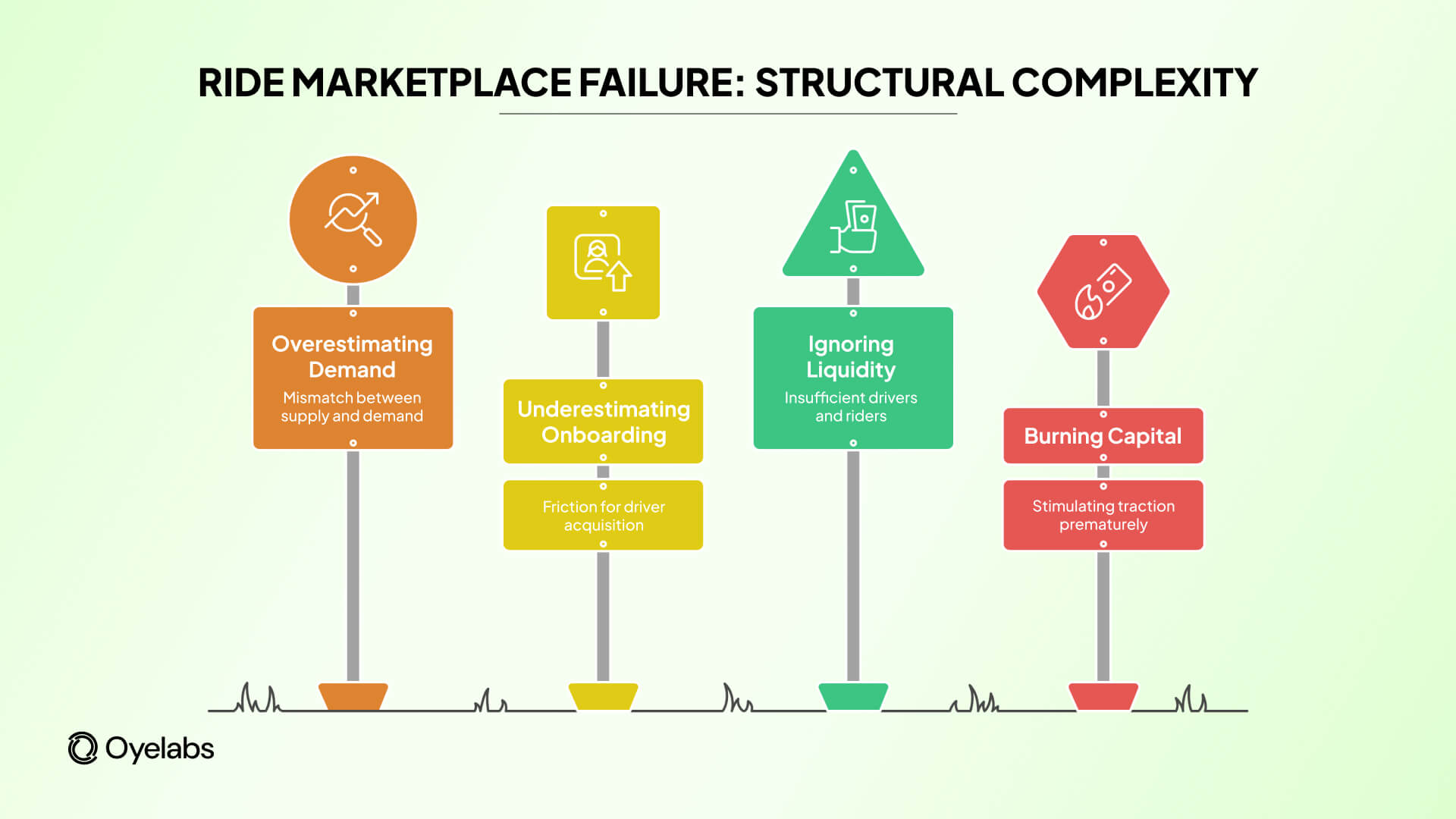
Most ride marketplace startups fail before they ever reach meaningful scale. Not because the idea was weak. Not because there was no demand. But the founder underestimated the structural complexity of running a two-sided marketplace.
A ride marketplace is not just an app. It is a live ecosystem. You are balancing rider acquisition, driver supply, real-time pricing logic, geographic density, trust systems, dispute resolution, and payment cycles – all at once.
In year one, small miscalculations compound quickly. A slight mismatch between supply and demand increases wait times. Increased wait times reduce rider retention. Reduced retention weakens driver earnings. Lower earnings push drivers off the platform. The entire flywheel slows down.
The most common early structural risks include:
- Overestimating initial demand
- Underestimating driver onboarding friction
- Ignoring liquidity thresholds
- Burning capital to “simulate” traction
Ride marketplaces are harder than SaaS startups because they require synchronized growth on both sides. You cannot grow riders without drivers. You cannot retain drivers without consistent ride volume. Founders who do not deeply understand this marketplace math often burn through their first year correcting preventable mistakes.
Building the App Before Validating Demand
One of the biggest ride marketplace startup mistakes is building before validating. Many founders assume that if Uber works globally, it will work in their city. That assumption is expensive.
Founders often spend six to nine months building a “perfect” ride-hailing app. They add advanced features, driver dashboards, loyalty systems, and multi-language support – before they have confirmed whether riders are willing to switch or drivers are willing to join.
This approach creates three problems:
- Long development cycles increase burn rate
- Market dynamics change while the product is still being built
- Founders launch without real demand signals
Smart founders do the opposite. They validate demand first. They study commuter behavior. They talk to fleet operators. They test driver incentives manually before scaling technology.
Instead of building complexity, they test:
- Is there frustration with current ride apps?
- Are drivers unhappy with commissions?
- Are riders price-sensitive?
- Is there an underserved niche segment?
Validation reduces risk. It shapes pricing strategy. It clarifies positioning. When founders skip this stage, year one becomes a reactive scramble rather than a structured growth phase.
Data from CB Insights shows that nearly 90% of startups fail, with a lack of market need ranking among the top reasons.
Ignoring the Supply Side (Drivers)
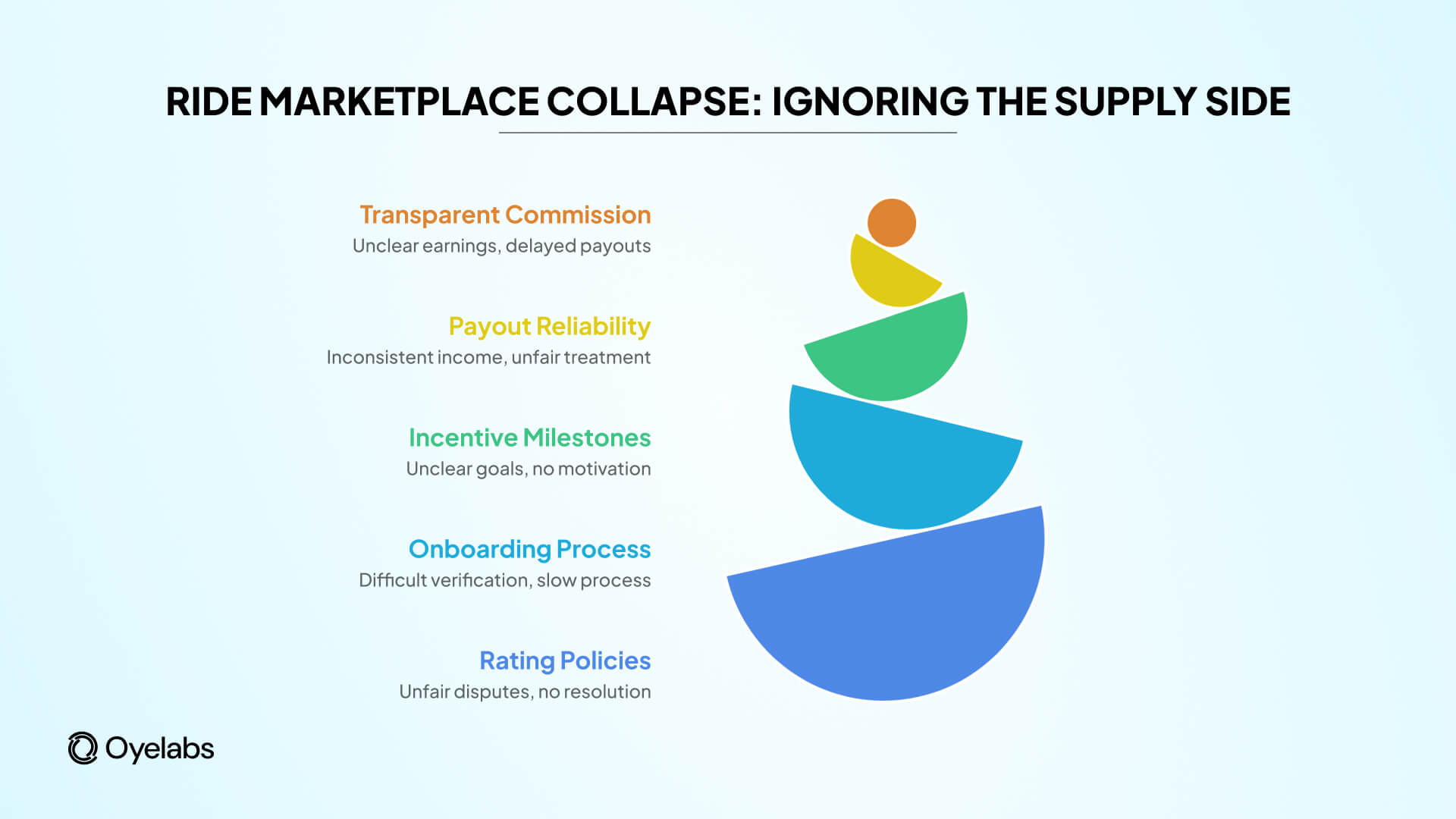
Many founders focus heavily on rider acquisition because demand feels visible. Downloads, impressions, app installs – these metrics look exciting. But in ride marketplaces, supply is the foundation.
If drivers are unhappy, inconsistent, or underpaid, the marketplace collapses quietly.
Driver economics matter more than app aesthetics. A polished interface will not compensate for unclear earnings or delayed payouts. Drivers evaluate platforms based on predictable income and operational fairness.
Critical supply-side factors founders often overlook:
- Transparent commission structure
- Weekly or daily payout reliability
- Clear incentive milestones
- Easy onboarding and document verification
- Fair rating and dispute policies
Ignoring supply creates liquidity gaps. Liquidity gaps increase rider frustration. Rider frustration lowers retention. The result is a downward spiral.
In the first year, your strongest growth lever is driver satisfaction. Retained drivers create consistent availability. Consistency builds rider trust. Trust builds repeat usage.
Ride marketplace founders who treat drivers as strategic partners – not just app users – dramatically increase their survival odds.
Weak Unit Economics
Another major reason why ride sharing startups fail is weak unit economics. Founders often subsidize rides aggressively to attract users. While discounts can accelerate adoption, unsustainable pricing destroys runway.
If your cost of acquiring a rider exceeds their lifetime value, scaling only increases losses. Many early-stage ride marketplaces confuse revenue growth with profitability signals.
Core economic indicators founders must monitor weekly:
- Customer acquisition cost (CAC)
- Average ride margin
- Driver commission payout ratio
- Retention rate by cohort
- Rider lifetime value (LTV)
Heavy discounting creates artificial traction. Once incentives disappear, riders churn. Drivers leave if earnings drop. The marketplace becomes dependent on external funding instead of operational sustainability.
Platforms like InDriver introduced negotiation-based pricing models to reduce subsidy pressure. By allowing drivers and riders to agree on pricing, they lowered burn rates while maintaining engagement.
Year one should focus on economic stability, not vanity growth metrics. Sustainable margins allow you to scale responsibly rather than constantly seeking emergency capital.
Expanding Too Fast
Rapid geographic expansion is one of the most damaging founder mistakes in ride marketplaces.
Many founders believe entering multiple cities signals strength. In reality, fragmented growth weakens density. Ride marketplaces depend on geographic concentration. Without high local activity, the experience deteriorates quickly.
Low-density markets lead to:
- Longer wait times
- Increased cancellations
- Lower driver utilization
- Reduced rider satisfaction
Instead of expanding horizontally, smart founders dominate vertically. They choose one city. They master neighborhood-level density. They optimize driver-to-rider ratios. Only after achieving stable liquidity do they replicate the model elsewhere.
Year one should prioritize market control over market coverage.
Scaling prematurely creates operational strain, inconsistent service quality, and marketing inefficiencies. Local dominance builds brand credibility and stronger network effects.
Poor Trust and Safety Planning
Trust is not a feature. It is the product.
Ride marketplaces operate in real-world environments where safety risks exist. Weak trust systems destroy credibility faster than pricing mistakes.
Founders who underinvest in verification systems, background checks, and dispute resolution often face early reputation damage.
Core trust components include:
- Driver KYC and identity verification
- Vehicle document validation
- Real-time GPS tracking
- Emergency contact protocols
- Transparent rating systems
- Fast customer support response
In year one, a single unresolved safety incident can permanently damage brand perception. Early-stage platforms must treat trust architecture as a core infrastructure layer, not a secondary upgrade.
Users adopt new ride platforms cautiously. Trust accelerates adoption. Weak safety systems slow growth dramatically.
Copying Uber Without a Unique Hook
Another reason why ride marketplace startups fail is lack of differentiation. Competing head-on with Uber on price alone is rarely sustainable.
Founders often replicate the same model without identifying a specific gap in the market. Without a unique value proposition, user acquisition becomes expensive and retention weak.
Successful niche ride marketplaces focus on specific segments:
- Women-only transportation services
- Rural mobility networks
- Corporate employee commute platforms
- Airport-only ride services
- Negotiation-based pricing systems
Differentiation reduces competition pressure. It clarifies marketing strategy. It strengthens brand identity.
In one case, Oyelabs supported a founder who adapted negotiation-style mobility logic into a language-learning community transport concept. By launching lean and focusing on engagement-driven interactions rather than feature overload, the platform increased session time, user impressions, and brand recognition within its target niche. The result was not just growth – it was category positioning.
Unique positioning transforms a ride marketplace from “another app” into a focused solution.
Overbuilding Instead of Launching Fast
Perfection is expensive in marketplaces.
Many founders spend excessive time customizing features before launch. They delay go-to-market timelines in pursuit of technical refinement. Meanwhile, competitors gain traction and market dynamics evolve.
Overbuilding creates three major risks:
- Increased burn rate
- Delayed user feedback
- Missed first-mover advantage
Speed to market matters more than feature depth in year one. Early traction generates real-world insights that no planning document can predict.
Founders should prioritize:
- Core booking functionality
- Stable payment systems
- Reliable driver onboarding
- Real-time tracking
Advanced features can be layered post-launch based on data.
Launching quickly allows founders to test pricing models, driver incentives, and demand elasticity in live conditions. Iteration based on real metrics is far more powerful than theoretical optimization.
Year one survival depends on disciplined execution, not feature abundance.
Not Understanding Liquidity
Liquidity is the invisible engine of every ride marketplace. Yet many founders do not fully understand it before launch.
Liquidity means balance. The right number of drivers are available when riders request trips. The right number of ride requests to keep drivers earning consistently. When this balance breaks, the user experience collapses.
Low liquidity creates long wait times. Long wait times increase cancellations. Cancellations reduce trust. Drivers lose motivation. Riders uninstall.
Liquidity depends on:
- Geographic density
- Peak-hour alignment
- Driver utilization rates
- Rider frequency patterns
Many founders assume that downloads equal traction. They celebrate install numbers while ignoring real-time availability ratios. But ride marketplaces operate on active engagement, not app presence.
To manage liquidity in year one, founders must track:
- Average pickup time
- Ride fulfillment rate
- Cancellation percentage
- Driver online hours vs active ride time
Winning a city requires micro-market dominance. High density in specific neighborhoods performs better than scattered coverage across a region. Liquidity is not about scale; it is about concentration.
Founders who prioritize liquidity from day one dramatically reduce early churn and stabilize marketplace behavior.
Underestimating Marketing Costs
Many early-stage ride marketplaces underestimate how expensive user acquisition can be. Paid advertising alone rarely builds sustainable growth.
Ride marketplaces compete against established brands with deep budgets. If founders rely only on digital ads, customer acquisition cost can quickly exceed ride margins.
The real challenge is not attracting downloads. It is driving repeat usage.
Common marketing missteps include:
- Overreliance on paid ads
- No referral incentives
- No driver-led promotion
- Ignoring offline partnerships
- Lack of localized campaigns
Smart growth strategies focus on structured expansion:
- Partnering with fleet operators
- Launching within universities or corporate parks
- Activating community ambassadors
- Offering referral bonuses tied to ride completion
Marketing for ride marketplaces must align with supply density. There is little value in driving rider traffic to areas with limited driver availability.
Year one marketing should focus on targeted activation, not broad awareness. Strong local engagement outperforms mass visibility campaigns.
No Operational Backbone
A ride marketplace is an operational business disguised as a technology product.
Founders who treat it purely as a software venture often struggle with day-to-day execution. Drivers need support. Riders need dispute resolution. Payment cycles require monitoring. Incentives must be recalibrated.
Without operational discipline, small issues compound.
Operational weaknesses often include:
- No structured driver support team
- Delayed issue resolution
- No real-time analytics dashboard
- Poor escalation systems
- Weak fraud detection
Operational readiness directly impacts retention. If drivers cannot resolve account issues quickly, they move to competing platforms. If riders face delayed refunds, they lose trust.
In year one, founders must establish clear operational protocols:
- Dedicated support channels
- Defined dispute timelines
- Weekly performance reviews
- Structured KPI tracking
Technology enables the platform. Operations sustain it.
Founders who invest early in operational clarity reduce volatility and increase long-term resilience.
Choosing the Wrong Tech Partner
The technology partner you choose can either accelerate growth or quietly stall it.
Many founders select low-cost development options without evaluating scalability. Some rely on freelance teams that lack marketplace expertise. Others purchase generic scripts that cannot handle real-world ride dynamics.
Common technology risks include:
- Poor backend scalability
- Limited customization capability
- No real-time analytics integration
- Weak payment gateway flexibility
- Lack of ongoing support
Ride marketplaces require:
- High concurrency handling
- Geo-location optimization
- Secure payment processing
- Driver-rider matching algorithms
- Dynamic pricing flexibility
Year one demands adaptability. If your tech infrastructure cannot evolve, strategic adjustments become expensive.
Founders should evaluate technology partners based on:
- Marketplace experience
- Deployment speed
- Scalability roadmap
- Customization flexibility
- Post-launch support
A scalable white-label system that allows rapid customization often provides a more efficient path to launch than building entirely from scratch.
How Smart Founders Avoid First-Year Failure
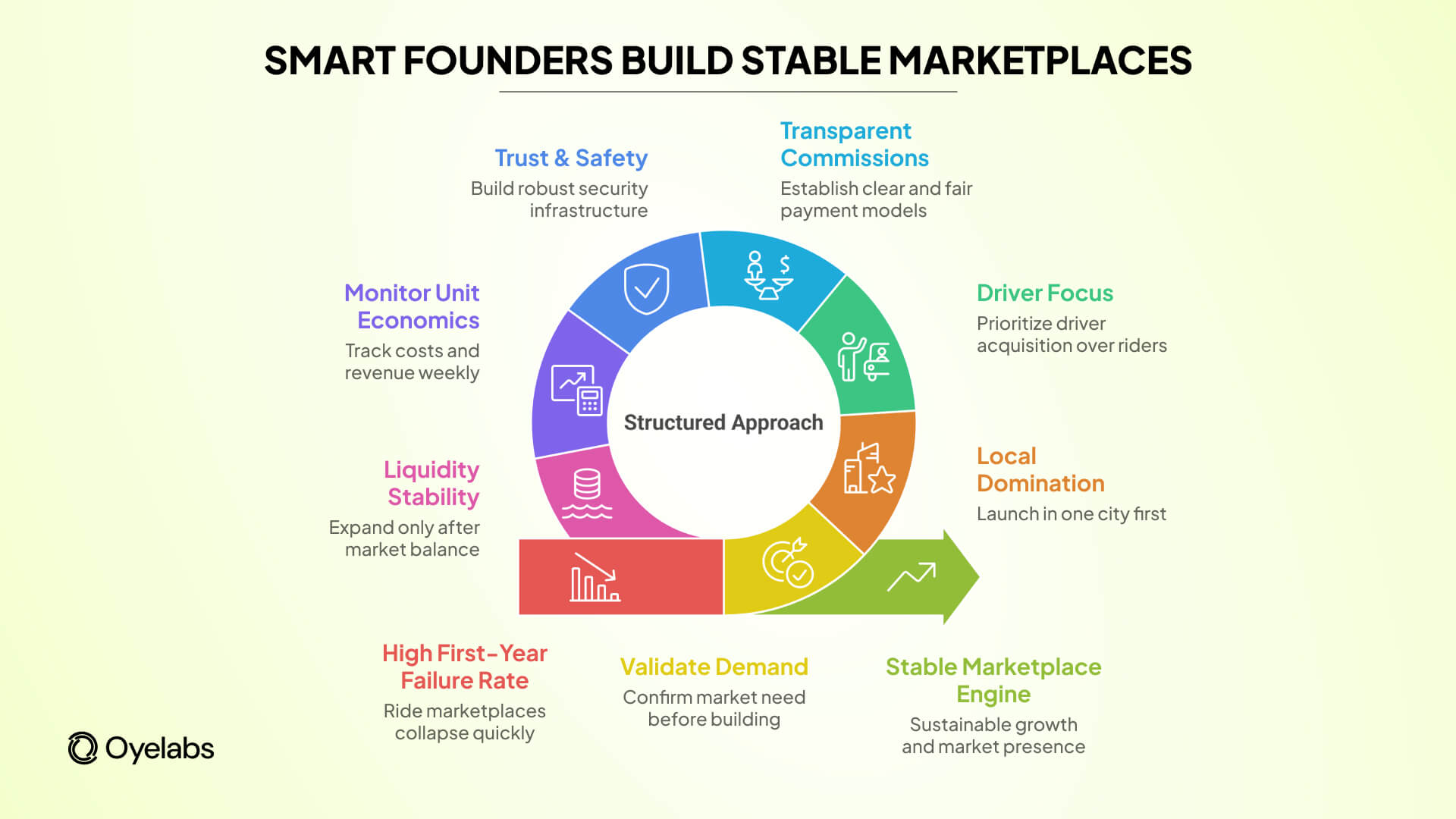
Avoiding failure is not about avoiding risk. It is about managing risk intelligently.
A structured approach can significantly increase survival probability:
- Validate demand before development.
- Launch in one city and dominate locally.
- Focus on driver acquisition before aggressive rider marketing.
- Establish transparent commission models.
- Build strong trust and safety infrastructure.
- Monitor unit economics weekly.
- Expand only after achieving liquidity stability.
- Launch fast and iterate using real data.
Year one is not about perfection. It is about building a stable marketplace engine.
Founders who treat their ride marketplace as a dynamic system – rather than just an app – outperform competitors who chase surface-level growth.
If you’re curious how negotiation-based pricing models like InDriver actually generate sustainable revenue, read our deep breakdown of the InDriver App Business Model.
How Oyelabs Helped One Founder Build a Super Successful Brand
Execution discipline makes the difference between noise and brand equity.
One founder approached Oyelabs with a mobility-based concept inspired by the InDriver negotiation model. However, instead of building a generic ride-hailing app, the goal was to integrate mobility logic into a language-learning ecosystem where users could connect through contextual interactions tied to location and transport behavior.
Instead of overbuilding, the launch focused on core functionality:
- Negotiation-style matching logic
- Controlled geographic rollout
- Simplified onboarding
- Clear value positioning
The strategy was not to compete broadly. It was to dominate a niche.
By launching lean and prioritizing engagement metrics over feature expansion, the platform increased session duration, repeat usage, and organic referrals within its target audience. Impressions grew steadily because the product experience felt differentiated, not copied.
The key takeaway was simple:
They avoided the founder mistakes that kill ride marketplaces in year one – no premature scaling, no uncontrolled subsidies, no feature overload.
Instead of chasing expansion, they built brand perception first.
And in marketplace businesses, brand trust compounds faster than paid growth.
Final Thoughts
Year one will define whether your ride marketplace becomes a scalable asset or an expensive lesson. Most founders fail not because the opportunity was weak, but because execution was rushed, economics were ignored, or expansion came too early. Ride marketplaces demand discipline. You must balance supply and demand, protect liquidity, monitor margins, and build trust from day one. Launch lean. Focus on one market. Strengthen driver relationships. Track real metrics, not vanity numbers. When the foundation is strong, scale becomes predictable. When it is weak, growth only accelerates losses.
If you are serious about launching a ride marketplace the right way, partner with a team that understands marketplace dynamics from day one. Talk to Oyelabs and build with strategy, not guesswork.
FAQs
Why do most ride marketplaces fail in year one?
Most fail due to poor liquidity, weak unit economics, and unbalanced supply-demand growth. Founders expand too fast without density. They overspend on marketing before stabilizing driver retention and ride margins.
What is the biggest mistake ride-hailing founders make?
The biggest mistake is building without validating real demand. Many founders invest heavily in technology before confirming driver willingness, rider demand, and sustainable pricing models.
How important is driver acquisition for ride marketplaces?
Driver acquisition is critical. Without consistent supply, wait times increase. Longer wait times reduce rider retention. Strong driver earnings and clear commission structures improve marketplace stability.
Can a new ride marketplace compete with Uber?
Yes, but only with niche positioning and controlled expansion. Competing directly on price rarely works. Success depends on differentiation, strong liquidity, and disciplined economics.