
Popular Business Models for a Handyman Booking App in 2026

Popular Business Models for a Handyman Booking App in 2026
 Anuraag Jain
Last Updated on May 25, 2026
Key Takeaways
- Commission-based handyman marketplace apps usually charge 15–25% per booking
- Managed service platforms often generate stronger repeat-booking behavior than aggregators
- Vendor retention matters more than rapid city expansion
- Hybrid monetization models are outperforming pure commission systems
- Most handyman clone platforms fail because of operational instability, not weak app design
Popular Business Models for a Handyman Booking App in 2026
The most successful handyman booking app businesses in 2026 are not winning because of features alone. They are winning because they solve operational problems like technician retention, booking reliability, payout consistency, and repeat customer behavior better than traditional marketplaces.
Most founders entering the home-services industry assume the challenge is primarily technical.
It usually is not.
The real difficulty begins after launch, when the platform starts handling real customer expectations, real technician behavior, and real operational pressure. Many platforms discover that scaling a handyman marketplace feels less like managing software and more like running a logistics network.
That shift changes everything – from monetization models to hiring structures, retention systems, customer support workflows, and even city expansion strategy.
The strongest platforms in 2026 are no longer simple service directories. They are operational ecosystems built around trust, fulfillment consistency, recurring maintenance demand, and workforce reliability.
Why Is the Handyman Booking App Industry Growing So Quickly?
The home-services industry has changed significantly over the last few years.
Consumers now expect the same convenience from home maintenance that they already receive from ride-hailing, grocery delivery, and food ordering apps. They want instant booking, verified professionals, live tracking, upfront pricing, and digital payments directly from mobile devices.
That behavioral shift is reshaping the industry rapidly.
The US handyman services market crossed approximately $365 billion in 2026, while field service management software continues growing at nearly 12.5% CAGR. Demand is increasing because urban consumers are outsourcing more daily maintenance work instead of handling it themselves.
Dual-income households are one of the biggest drivers behind this trend. Time has become more valuable than DIY savings for a large portion of consumers.
At the same time, trust in structured digital platforms is increasing because customers prefer transparent reviews, digital payment protection, and verified technicians over informal contractor discovery.
| Market Driver | Operational Impact |
| Smartphone-first consumers | Faster mobile booking adoption |
| Dual-income households | Higher outsourcing demand |
| Digital payment trust | More prepaid service transactions |
| Gig economy expansion | Larger technician supply pools |
One operational pattern repeatedly appears across marketplace deployments: customers rarely stay loyal because of app UI alone.
They stay because the platform consistently solves reliability problems.
That includes:
- technicians arriving on time
- transparent pricing
- fewer cancellations
- faster support resolution
- predictable service quality
This is why the strongest handyman marketplace businesses increasingly invest in dispatch systems, verification layers, escrow-backed payments, and recurring maintenance workflows instead of simply expanding vendor count aggressively.
What Business Model Generates the Highest Profitability?
One of the biggest misconceptions in the home-services industry is that high booking volume automatically creates a profitable business.
It does not.
Many marketplaces process thousands of transactions while still struggling financially because retention remains weak and customer acquisition costs continue rising.
The platforms generating the strongest long-term economics are usually hybrid systems combining:
- commissions
- recurring subscriptions
- vendor monetization
- maintenance memberships
- commercial service contracts
That diversification matters because dependency on one revenue stream creates instability once growth slows.
The four dominant handyman app business models each operate very differently.
| Business Model | Revenue Structure | Operational Complexity |
| Commission Marketplace | Percentage per booking | Medium |
| Managed Service Platform | Margin on services | High |
| Lead Generation Network | Pay-per-lead or subscriptions | Low |
| B2B SaaS Platform | Monthly recurring subscriptions | Medium |
A lead-generation platform simply sells customer inquiries to contractors without managing the actual service transaction.
A B2B SaaS handyman platform operates differently. Instead of acting as a marketplace, it provides operational software for handyman businesses, including scheduling systems, invoicing, dispatching, CRM workflows, workforce management, and reporting tools.
In actual deployments, the strongest operators rarely rely on one monetization layer alone.
What repeatedly works better is creating recurring revenue around customer behavior instead of depending entirely on transactional growth.
Maintenance plans are a strong example of this.
Platforms offering quarterly or annual maintenance subscriptions often generate significantly stronger retention because customers stop treating the service as a one-time transaction.
That changes customer lifetime value completely.
Why Are Commission-Based Handyman Marketplace Apps Still So Popular?
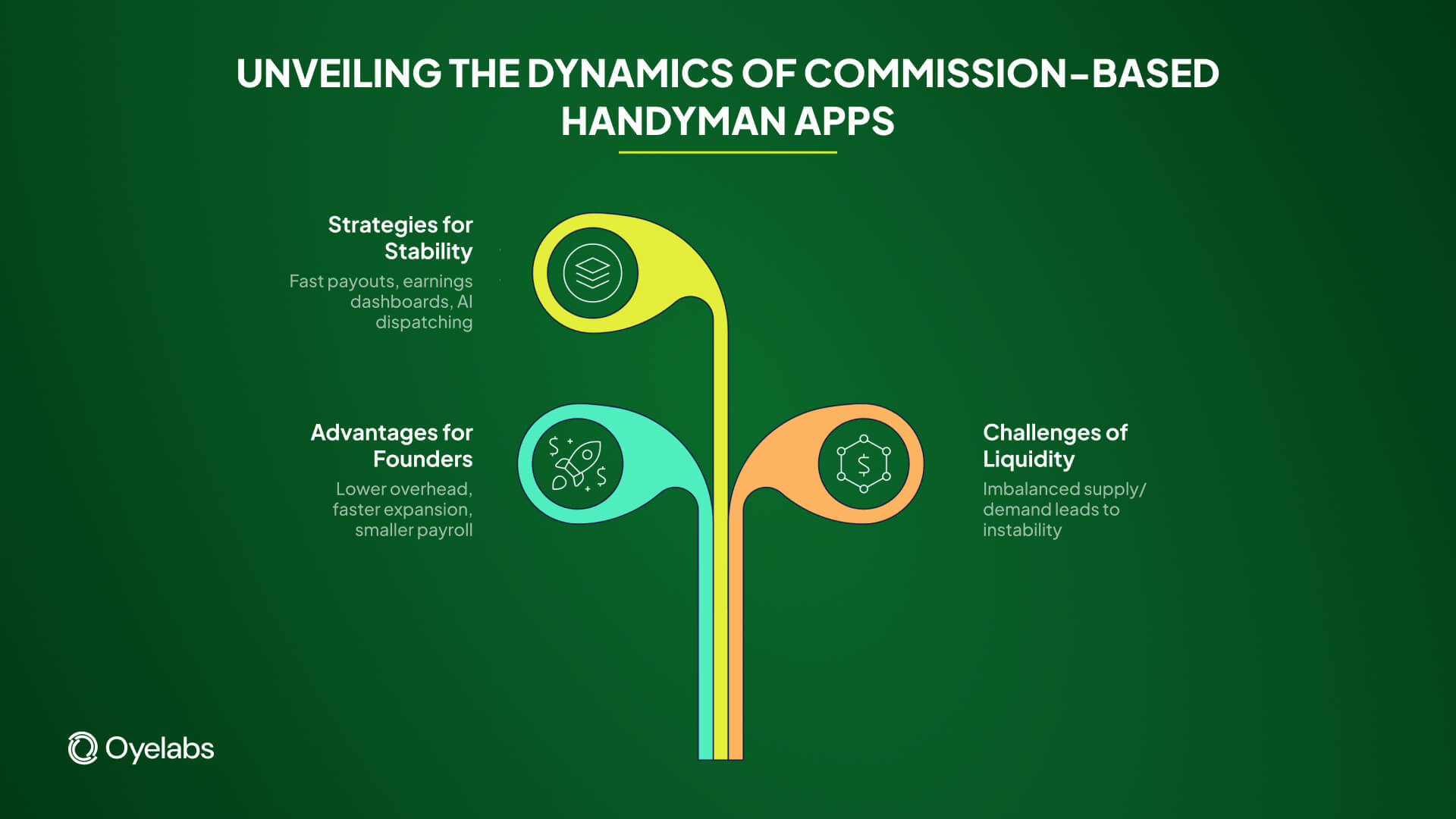
A commission-based handyman marketplace app remains the most common launch model because it is relatively asset-light.
The platform connects customers with independent professionals and deducts a percentage from each completed booking.
The basic workflow is straightforward:
- Customer requests a service
- Nearby professionals receive the request
- A technician accepts the booking
- The task gets completed
- The platform deducts commission before payout
Most marketplaces operate between 15–25% commission per transaction depending on category, geography, and booking frequency.
For early-stage founders, this model looks attractive because:
- operational overhead is lower
- expansion appears faster
- payroll obligations remain smaller
- onboarding technicians is easier
But this model becomes unstable very quickly when marketplace liquidity weakens.
A marketplace liquidity problem happens when technician supply and customer demand become imbalanced, causing poor response times and unreliable fulfillment.
This is where many handyman clone businesses begin collapsing operationally.
Technicians leave because earnings become inconsistent. Customers stop returning because cancellations increase. Refund requests rise. Support teams become overloaded.
In multiple marketplace evaluations, one operational truth became impossible to ignore: technicians stay where earnings remain predictable.
That is why stronger marketplaces invest heavily in:
- fast payout systems
- vendor earnings dashboards
- AI-driven dispatching
- review moderation systems
- repeat-booking incentives
- escrow-backed payments
Many founders underestimate how sensitive vendor retention becomes once booking density starts fluctuating.
The app itself is rarely the reason technicians leave.
Economics usually are.
Why Are Managed Handyman Platforms Scaling Faster Than Aggregators?
Managed handyman platforms are increasingly outperforming simple aggregators because they control service quality directly.
Instead of behaving like listing directories, these businesses operate more like structured service brands.
Customers generally trust managed systems more because pricing, technician standards, support workflows, and quality assurance remain standardized across the platform.
That consistency creates stronger repeat-booking behavior.
However, there is a hidden operational reality most founders underestimate.
Managed handyman businesses operate much closer to logistics companies than lightweight software marketplaces.
Once bookings scale, infrastructure requirements increase aggressively. Teams suddenly need technician training systems, escalation managers, workforce scheduling controls, insurance processes, and quality audit mechanisms simply to maintain consistency.
Urban Company itself reportedly invested heavily into internal training systems and partner standardization to stabilize fulfillment quality at scale.
This is one reason many aggregators struggle long term.
They scale customer acquisition faster than operational control.
That imbalance eventually damages trust.
One operational pattern repeatedly appears across home-service deployments: expanding into too many cities before technician density stabilizes locally usually creates declining fulfillment quality within months.
That is why many successful operators scale city-by-city instead of expanding nationally immediately.
The strongest platforms prioritize operational depth before geographic width.
Why Do Most Handyman Clone Platforms Fail After Launch?
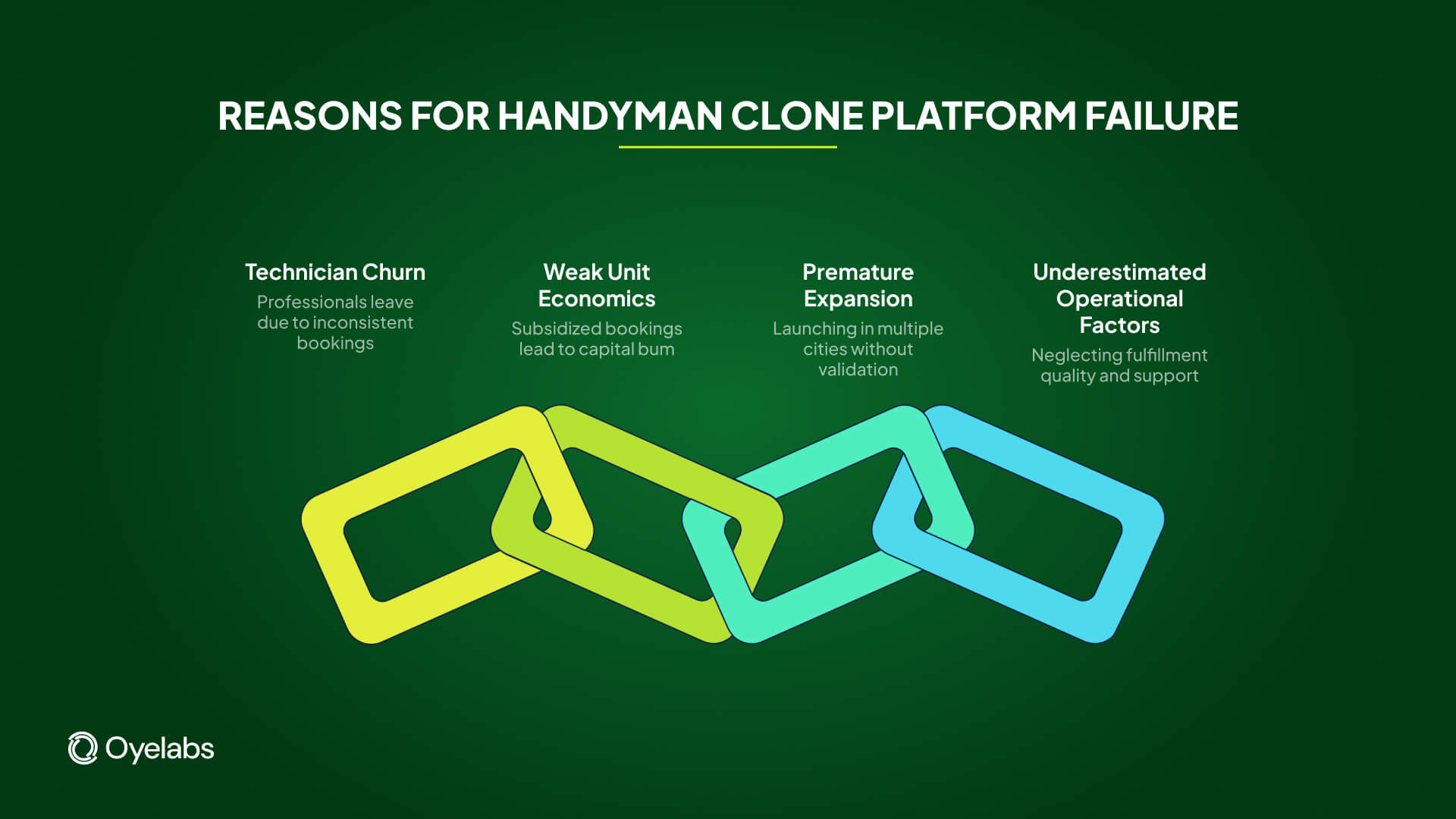
Most handyman clone businesses do not fail because they lack features.
They fail because the operational foundation weakens under real demand pressure.
Three recurring issues appear repeatedly across failed marketplace deployments.
The first is technician churn.
If professionals stop receiving consistent bookings, they leave quickly. Once supply weakens, cancellations rise and customer trust starts collapsing.
The second is weak unit economics.
Many founders heavily subsidize bookings during launch without fully understanding customer acquisition costs, refund exposure, or support overhead. Growth initially looks impressive, but the business burns capital aggressively underneath the surface.
The third issue is premature expansion.
Some platforms launch across multiple cities before validating:
- vendor density
- repeat-booking behavior
- support capacity
- response times
- operational workflows
That usually creates inconsistent fulfillment quality across markets.
One important lesson repeatedly appears across successful handyman marketplace launches: operational consistency scales better than aggressive expansion.
Founders often focus heavily on acquiring users while underestimating fulfillment quality, vendor economics, and customer support pressure.
Those factors eventually become more important than growth itself.
What Should Founders Validate Before Building an App Like Handyman Platforms?
Most founders think about development before operations.
The stronger approach is usually the opposite.
Before investing heavily into a handyman booking app, validate:
- technician availability
- booking frequency
- customer retention behavior
- cancellation patterns
- payout expectations
- support workload
- recurring demand potential
One overlooked reality in the home-services market is that support complexity increases faster than booking volume once scale begins.
Reschedules, refund requests, technician disputes, and quality complaints can quickly overwhelm small operational teams.
Several marketplace businesses underestimate these costs because they focus too heavily on launch speed and feature lists.
In practice, many operational expenses eventually become larger than initial development costs.
That changes how founders should think about scaling.
Also Read: How to Start a Handyman Platform with $5K Budget
A Faster Route to Launching a Handyman Marketplace
For many founders, rebuilding standard marketplace infrastructure from scratch creates unnecessary delays.
A more practical approach is validating the business model first and customizing infrastructure later.
Platforms like Oyelabs help businesses launch white-label handyman marketplace systems with:
- customer applications
- vendor panels
- admin dashboards
- booking systems
- payment integrations
- dispatch workflows
That allows founders to spend more time solving operational problems like:
- vendor acquisition
- repeat-booking systems
- technician retention
- local expansion strategy
- customer trust
In early-stage marketplaces, operational execution usually matters far more than custom engineering complexity.
What Will Separate Winning Handyman Platforms From Everyone Else?
The handyman booking app industry is becoming increasingly competitive, but not necessarily because of technology.
The real battle is operational.
The platforms surviving long term are the ones stabilizing:
- technician retention
- payout consistency
- repeat-booking behavior
- fulfillment reliability
- trust infrastructure
Commission marketplaces will continue dominating early-stage launches because they are faster and lighter operationally.
But long-term defensibility is increasingly shifting toward recurring revenue systems, maintenance subscriptions, workforce quality control, and operational automation.
One pattern continues appearing across successful marketplace businesses: customer acquisition creates visibility, but operational consistency creates survival.
That is where the real business eventually gets built.
Launch Your Handyman Marketplace With Operational Clarity
Skip months of rebuilding standard infrastructure and focus directly on vendor growth, retention systems, and marketplace execution.
✓ Multi-vendor booking workflows with scalable operational infrastructure
✓Customer, vendor, and admin applications ready for deployment
✓ Payment integrations with technician payout and commission management
✓ Faster market validation before investing heavily into custom development
Conclusion
The handyman booking app industry is no longer driven by features alone. In 2026, the platforms creating sustainable growth are the ones solving operational challenges better than competitors.
Commission marketplaces still offer the fastest route to launch, but long-term success increasingly depends on technician retention, repeat-booking behavior, payout reliability, and fulfillment consistency. That is why managed platforms and hybrid monetization models are outperforming simple aggregators over time.
One pattern repeatedly appears across successful marketplace businesses: rapid expansion without operational stability usually weakens customer trust quickly.
For founders planning to launch an app like handyman platforms, the strongest strategy is validating one market, one category, and one reliable operational workflow before scaling aggressively.
FAQs
What commission rate do handyman marketplace apps usually charge?
Most handyman marketplace apps charge between 15–25% per completed booking. Some platforms use variable commission structures based on technician performance, booking frequency, or service category.
What is the most profitable handyman app business model in 2026?
Hybrid models combining commissions, subscriptions, maintenance plans, and vendor monetization are currently generating the strongest long-term profitability.
How large is the handyman services market in 2026?
The US handyman services market crossed approximately $365 billion in 2026, while global demand for digital home-service platforms continues expanding rapidly.
Should founders build custom software immediately?
Usually not.
Most early-stage businesses benefit more from validating operational workflows first through white-label or semi-custom infrastructure before investing heavily into custom development.
What retention rate is considered strong for a handyman platform?
Top-performing handyman platforms often achieve 65–75% repeat-booking behavior, especially when recurring maintenance subscriptions are integrated into the business model.
How long does it take to launch a handyman booking app?
White-label handyman marketplace systems can often launch within 3–8 weeks, while fully custom platforms may require 6–18 months depending on complexity and operational requirements.