
Best Strategies for Launching a Taxi App in Europe in 2026

 Sachin Sharma
Last Updated on May 29, 2026
If you want to understand how to launch a taxi app in Europe, focus on operations before features. Start with one city, validate driver supply, understand local regulations, support GDPR compliance, and use reliable white-label taxi app infrastructure to reduce launch time from 12 months to as little as 30 to 60 days.
Launching a taxi app in Europe looks simple from the outside. Smartphone usage is high, digital payments are common, and ride-booking demand continues growing across major cities. But Europe is not one unified transportation market.
Every country, and often every city, follows different transportation rules, licensing structures, and driver expectations. What works in Warsaw may fail in Berlin or Paris. That is why successful startups treat mobility businesses as operational businesses first and technology businesses second.
Why Europe Still Has Room for New Taxi Apps
Europe remains one of the largest mobility markets for transportation startups.
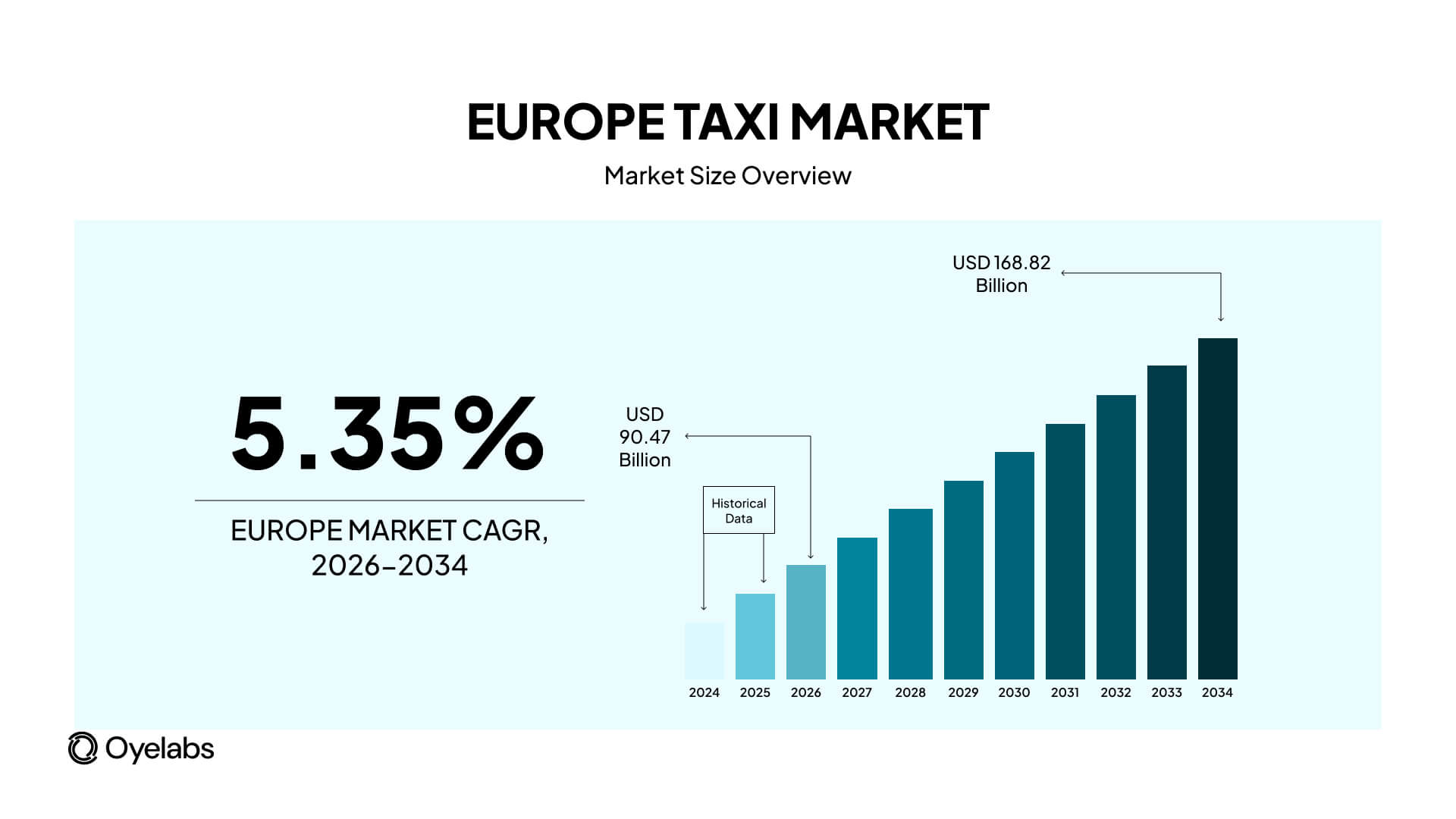
The European taxi market reached approximately USD 83.68 billion in 2025 and is projected to grow to nearly USD 168.8 billion by 2034, with an estimated CAGR of 8.11%. What makes the opportunity more interesting is that nearly 50% of taxi bookings still happen offline through phone calls, dispatch operators, hotels, and local taxi networks. That means many regional markets have not fully shifted to app-based booking yet.
In our experience working with ride-booking platform startups, founders often assume they are competing only with apps like Bolt or Uber. In reality, they are competing against traditional booking habits.
Many riders still:
- Call taxi operators directly
- Pay in cash
- Book rides through hotel desks
- Depend on local taxi networks
This creates opportunities for startups that make booking easier without forcing users to completely change behavior overnight.
Countries such as Poland, Romania, and the Czech Republic continue seeing strong digital transportation growth while remaining less saturated than major Western European markets.
Actionable next step: Research regional cities with growing smartphone adoption but limited ride-booking competition before selecting your first launch market.
Strategy #1: Understand Why Most Taxi App Startups Fail Early
Most failures happen long before the technology becomes the problem.
Many founders focus heavily on app features while underestimating:
- driver acquisition
- licensing delays
- local regulations
- support operations
- payment preferences
Some also expand too quickly.
Launching in multiple countries at once sounds ambitious, but Europe rarely rewards that approach early. Every additional market creates new operational complexity:
- different insurance rules
- different licensing structures
- different payment systems
- different labor expectations
The startups that usually survive start smaller than expected.
They launch in one city, stabilize operations, build driver supply, understand local rider behavior, and expand slowly from there.
Strategy #2: Choose the Right European Market First
The best launch market is not always the biggest city.
Large markets often come with:
- expensive user acquisition
- stronger competition
- stricter regulations
- higher operational costs
For many startups, regional cities offer a better starting point.
When evaluating a market, founders should focus on four things first:
| Factor | Why It Matters |
|---|---|
| Local regulations | Determines how difficult launch approval becomes |
| Driver availability | Supply decides marketplace reliability |
| Competition | Lower competition reduces marketing costs |
| Rider behavior | Some cities adopt digital booking faster than others |
Cities like Warsaw, Prague, and Bucharest are often discussed by mobility founders because they combine growing demand with relatively manageable competition.
One thing many founders underestimate is how important local relationships become in transportation businesses. In several European cities, taxi unions and local operators still influence how new ride-booking companies are perceived.
Technology alone does not solve that.
Strategy #3: Understand Regulations Before Scaling
Europe does not follow a single transportation framework.
Taxi and ride-booking regulations vary by:
- country
- region
- city
Some cities require:
- taxi permits
- commercial insurance
- licensed operators
- accessibility compliance
Others regulate:
- pricing structures
- worker classification
- vehicle standards
- surge pricing
This is where many startups lose time.
Founders often begin product development first and handle compliance later. But in transportation businesses, operational approval matters just as much as the app itself.
Before launch, startups should:
- review local licensing requirements
- understand worker classification laws
- confirm insurance obligations
- speak with transportation lawyers locally
Regulations also continue changing across Europe, especially around gig-economy employment structures.
Ignoring those realities early can slow expansion later, even if the app itself performs well.
Strategy #4: Build Around GDPR and User Trust
Taxi apps process sensitive user information constantly.
That includes:
- real-time location data
- trip history
- payment information
- driver records
- identity verification documents
Because of that, GDPR compliance becomes part of the product foundation, not just a legal checkbox.
Users increasingly care about:
- how their location is tracked
- how long data is stored
- who can access payment information
Simple operational decisions matter more than many founders realize.
For example:
- collecting unnecessary location data creates risk
- storing payment details internally increases liability
- weak driver verification damages trust quickly
Most successful apps reduce risk by integrating established payment providers such as Stripe, Adyen, or Braintree instead of building payment infrastructure themselves.
Strategy #5: Choose a Business Model That Fits the Market
Many founders assume commission-only models are the default because large ride-hailing companies use them.
But local transportation markets often work differently.
Several models are commonly used across Europe:
| Business Model | How It Works |
|---|---|
| Commission model | Platform takes percentage from rides |
| Subscription model | Drivers pay fixed weekly or monthly fees |
| Hybrid model | Combines subscriptions with smaller commissions |
| Fleet partnerships | Works with existing taxi operators |
| Corporate transport | Focuses on business transportation contracts |
Hybrid models have become increasingly popular because drivers often dislike high commission structures long term.
In some cities, partnering with existing taxi fleets also works better than building driver supply from zero. Local operators already understand regulations, licensing, and rider behavior.
That operational experience can matter more than rapid expansion.
Related Read: Understanding Uber Business Model
Strategy #6: Build Multiple Revenue Streams Early
Ride commissions are only one part of the business.
Many successful transportation apps generate revenue from:
- airport transfers
- corporate travel
- scheduled rides
- subscription plans
- cancellation fees
Airport transfers are particularly valuable because users often:
- book in advance
- spend more per ride
- repeat bookings regularly
Corporate transportation can also become stable recurring revenue because companies prefer centralized billing and reliable reporting.
One operational reality many founders discover later is that low-margin rides alone rarely create strong long-term economics. The stronger businesses usually combine multiple revenue streams early.
Strategy #7: Focus on Reliability Instead of Too Many Features
Founders often overbuild early versions of transportation apps.
In reality, users mostly care about reliability.
For riders, the core expectations are simple:
- accurate pickup timing
- fair pricing
- reliable drivers
- easy payments
- live ride tracking
For drivers, priorities are different:
- stable earnings
- clear trip information
- fast payouts
- easy navigation
- responsive support
The strongest early-stage apps usually focus on doing basic operations well rather than adding dozens of advanced features immediately.
At launch, most startups realistically need:
- GPS ride tracking
- driver onboarding
- payment integration
- trip management
- basic support tools
- ride scheduling
Advanced systems like dynamic pricing algorithms or loyalty programs can wait until operational stability improves.
Strategy #8: Prioritize Driver Supply Before Rider Growth
Many founders spend heavily on rider acquisition first. But transportation marketplaces usually succeed or fail based on driver supply.
If riders open the app and:
- cannot find drivers
- face long wait times
- experience repeated cancellations
they rarely return.
Drivers shape the marketplace experience long before brand recognition does.
Several operational decisions strongly affect driver retention:
- payout speed
- commission structure
- support quality
- trip consistency
- app reliability
One driver leaving the platform often affects multiple riders. Strong driver retention creates marketplace stability much faster than aggressive advertising campaigns.
This is one reason many successful taxi startups focus on driver onboarding before scaling rider marketing aggressively. Reliable supply creates better rider experiences naturally.
How Much Does It Cost to Launch a Taxi App in Europe?
Launching a taxi app in Europe typically costs between $5,000 and $100,000+ depending on the development approach, feature requirements, operational setup, and launch scale.
For most startups, using a white-label taxi app Europe solution is the fastest and most affordable option. A basic production-ready platform with rider apps, driver apps, admin panels, and payment integration can often launch within the $5,000 to $25,000 range.
Custom-built taxi platforms cost significantly more because they require dedicated engineering teams, longer development timelines, custom backend systems, and ongoing maintenance.
Estimated launch ranges typically look like this:
| Development Approach | Estimated Cost | Typical Timeline |
|---|---|---|
| White-Label Taxi App Europe Solution | $5,000 to $25,000+ | 2 to 8 weeks |
| MVP Transportation App | $15,000 to $50,000 | 2 to 4 months |
| Fully Custom App | $80,000 to $100,000+ | 6 to 12 months |
But software development is only part of the total investment.
Many founders underestimate operational expenses such as:
- Licensing approvals
- Commercial insurance
- Driver onboarding
- Customer support
- Local marketing
- Legal consultation
In transportation businesses, operational costs often become more expensive than app development over time.
Actionable next step: Start with an MVP or white-label ride-booking platform first, validate demand in one city, and scale features only after operations become stable.
How Long Does It Take to Launch a Taxi App in Europe?
A launch can happen relatively quickly if the operational groundwork is already prepared.
For startups using pre-built taxi app infrastructure, launches often happen within 30–60 days.
Fully custom systems usually take significantly longer because they require:
- backend development
- testing
- payment integration
- compliance adjustments
- operational setup
A realistic early launch timeline often looks like this:
| Stage | Typical Timeline |
|---|---|
| Market research | 1–2 weeks |
| Legal preparation | 2–6 weeks |
| App setup and customization | 2–8 weeks |
| Driver onboarding | 2–4 weeks |
| Testing | 1–3 weeks |
In practice, driver onboarding and compliance approval often take longer than the technology itself.
Launch Your Taxi App Faster with Oyelabs
Building a taxi app in Europe involves more than just creating a booking platform. Founders also need to think about driver onboarding, local regulations, payment systems, operational planning, and long-term market expansion. At Oyelabs, we work with startups looking to launch ride-booking businesses using customizable taxi app infrastructure designed for faster deployment and easier market adaptation.
Instead of spending months building core systems from scratch, businesses can focus on operations, driver growth, and customer acquisition earlier. Our white-label taxi app software supports real-time ride tracking, payment integration, driver management, and scalable deployment for different transportation models across regional and international markets.
Conclusion
Launching a taxi app in Europe is less about building the most advanced technology and more about understanding how local transportation markets actually operate.
The strongest startups usually:
- expand slowly
- focus heavily on driver reliability
- adapt to local regulations
- understand rider habits
- avoid overcomplicating operations early
Europe still offers significant opportunities for mobility startups, especially in regional and underserved markets where digital adoption continues growing.
At OyeLabs, we work with founders building transportation businesses using ready-to-launch taxi app infrastructure tailored for local markets and faster rollout timelines.