
How to Solve the Chicken-and-Egg Problem in Food Delivery

How to Solve the Chicken-and-Egg Problem in Food Delivery
 Sushmeet Setia
Last Updated on August 25, 2026
Key Takeaways
What You Will Learn
* Food delivery’s chicken-and-egg problem has three sides, not two: restaurants, drivers, and eaters.
* Subsidizing every side at once burns cash without building real liquidity.
* DoorDash beat better-funded rivals by picking suburbs, not by out-discounting them.
* Uber Eats solved its driver problem quickly by reusing its ride-hailing network.
* Zomato built restaurant trust years before it ever touched delivery.
* Uber Eats still lost in India by applying its global playbook without adapting enough to the local market.
* Single-player mode can give one side a reason to join before the other exists.
* Escape velocity is a specific, measurable moment, not a vague growth milestone.
Real Insights
* Drivers are usually the easiest side to seed; restaurants are usually the hardest.
* An existing asset, like a driver network, can solve one side of the problem almost instantly.
* A narrow launch city beats a wide, thin one every time.
* Restaurants can become your first demand channel if you let them.
* Off-platform leakage after launch quietly undoes the liquidity you built.
* A global playbook doesn’t automatically work in a local market.
How to Solve the Chicken-and-Egg Problem in Food Delivery
No restaurants means no hungry customers. No hungry customers means no restaurants want in. Welcome to one of the first structural problems that can kill a food delivery startup before the product has a real chance to scale.
If you’re building an app like Uber Eats, you’ll hit this wall in week one, not year one. From working with founders across product development, operations, and launch planning, I’ve seen that there is no clever growth hack that fills every side of a marketplace at the same time. Every platform that made it, DoorDash, Uber Eats, Zomato, solved this the unglamorous way, and each one solved it slightly differently.
This guide walks through exactly how, with real examples and practical lessons founders can actually use when planning their own launch.
Quick Answer
- Food delivery has a three-sided chicken-and-egg problem: restaurants, drivers, and eaters, not just two sides.
- Pick the hardest side and build it manually before automating anything.
- Launch narrow, in one dense area, instead of spreading thin across a whole city.
- Use single-player mode: give restaurants or drivers a reason to join before demand exists.
- Subsidize with a clear exit plan, or the growth disappears the moment incentives stop.
- An existing asset can solve one side instantly, the way Uber’s driver network did for Uber Eats.
- A global playbook still has to be adapted locally, or it can fail entirely, as Uber Eats did in India.
What Is This Problem, Exactly?
The chicken-and-egg problem is simple to state and brutal to live through: restaurants won’t join a delivery app with no customers, and customers won’t open an app with no restaurants on it.
Neither side has a reason to show up first. That’s not a marketing problem you can advertise your way out of. It’s structural, and in my experience, throwing more budget at it usually hides the problem rather than solving it.
Most articles on this topic borrow examples from Airbnb or Uber’s ride-hailing business, two-sided marketplaces with one supply side and one demand side. Food delivery isn’t that simple, and treating it like it is leads founders to under-plan the operational side of the business.
Why Food Delivery Is Harder Than a Normal Marketplace
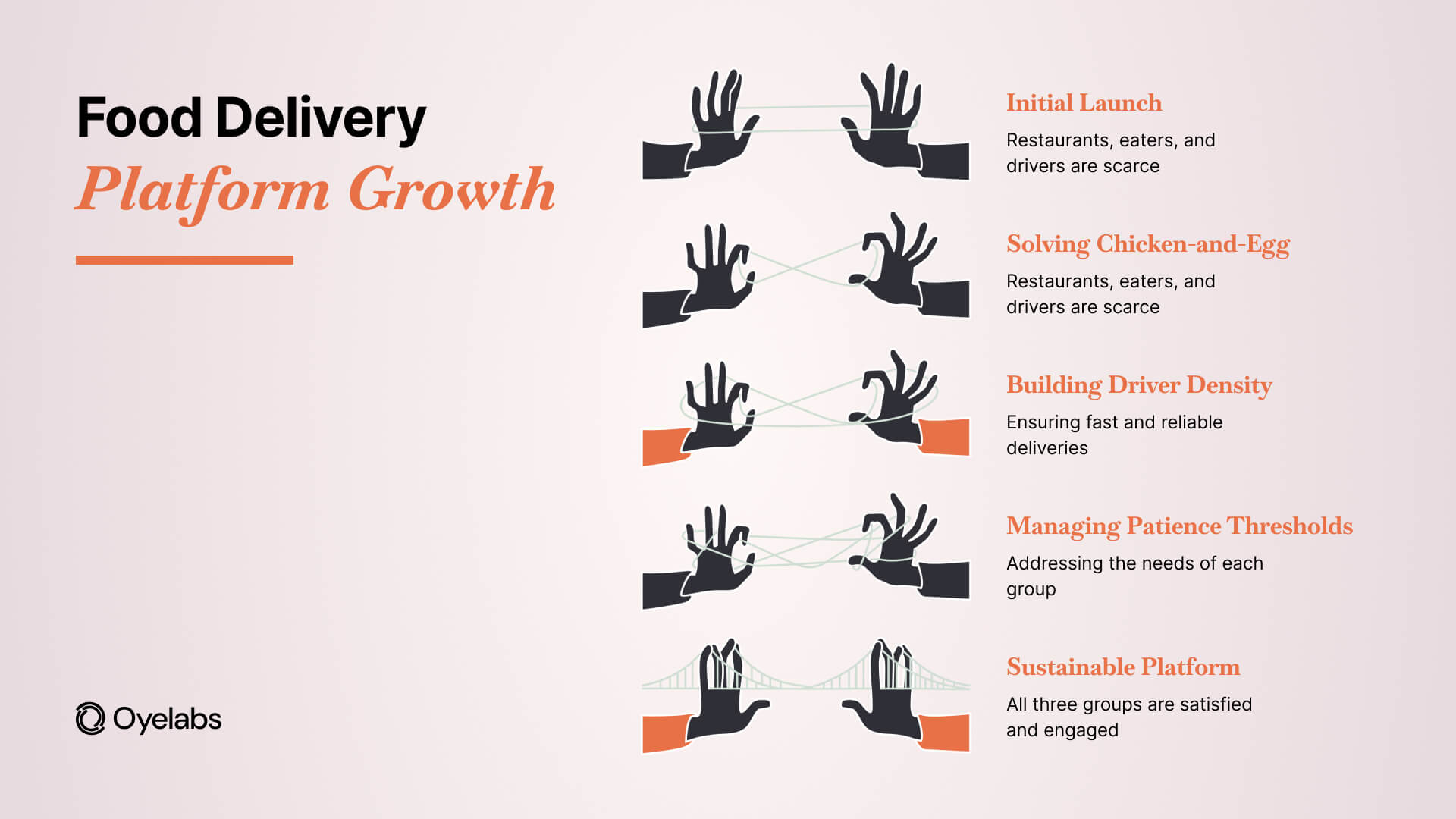
An app like Uber Eats has to solve the chicken-and-egg problem three times over, not once. Restaurants need eaters to justify joining. Eaters need restaurants worth ordering from. And both of them need drivers nearby, or none of it actually moves.
This is why food delivery platforms that copy a two-sided playbook often stall out. Solving restaurant supply doesn’t help if there’s no driver density to actually deliver the order fast enough to matter.
Each side also has a different patience threshold, which founders often underestimate. Drivers will try a new app for a single good shift and judge it by that one experience. Restaurants won’t risk their reputation on a platform that can’t reliably deliver their food hot, so their tolerance for operational failure is even lower.
Eaters sit somewhere in between. They’ll open a new app once out of curiosity, but a single bad experience, cold food, a canceled order, a long wait, and they’re unlikely to return. That means all three sides have to work reasonably well at the same time, in the same small area, before any one of them will stick around.
Founder Warning: Solving restaurant supply alone won’t work; without enough drivers nearby, restaurants will churn off your platform fast.
Pick Your Hardest Side First
Every successful marketplace picks one side to seed manually before worrying about the other. For food delivery, that’s usually restaurants.
Drivers are comparatively easier. Someone with a vehicle and available time can start delivering quickly, and many will try a new app just to see what it pays. Restaurants are a harder sell.
A restaurant owner is committing their brand, their food quality, and their kitchen’s capacity to a platform they’ve never used. That’s a bigger ask, which is exactly why it should come first.
This is one of those areas where I would not over-automate too early. Go door to door if you have to. Sign the first twenty restaurants by hand. Understand why they hesitate, what onboarding slows them down, and what operational support they actually need.
It doesn’t scale, and that’s fine, because it’s not supposed to yet. Scale comes after the loop actually works.
Or Skip the Hard Side Entirely
There’s a second option most chicken-and-egg advice skips: if you already have an asset that solves one side, use it instead of building from zero.
This is exactly what Uber did. Uber Eats launched in 2014 as UberFRESH by reusing Uber’s existing ride-hailing driver network, rather than recruiting delivery drivers from scratch. The driver side of the problem was already halfway solved before day one.
Not every founder has an existing driver network to borrow. But the underlying lesson applies more broadly: before building a side manually, check whether an adjacent business, partner, customer base, or existing operational asset could hand you a shortcut instead.
That is usually a smarter starting point than trying to build every side from scratch.
Go Narrow Before You Go Wide
This is the single biggest lesson from DoorDash’s early history. Instead of launching across a whole metro area, DoorDash started hyper-local in Palo Alto, then expanded suburb by suburb.
A wide, thin launch spreads your restaurants and drivers so far apart that neither side sees enough activity to matter. A narrow launch, one neighborhood, one dense zone, creates visible activity fast.
When I look at a launch plan, I would rather see one area with healthy order density than an entire city where the platform barely works anywhere.
Customers see restaurants near them are already on the app. Drivers see orders are actually coming in. Restaurants see transactions happening. That’s what starts the loop turning on its own.
Give One Side a Reason to Join Alone
This is called single-player mode, and it’s one of the most underused tactics in food delivery specifically. Give one side a tool that’s useful even with zero orders coming through your marketplace yet.
Zomato is the clearest example of this in food delivery. It launched years earlier as a restaurant discovery and menu platform, with no delivery function at all, before food delivery became a core part of the business.
By the time Zomato added delivery, it already had restaurant relationships and trust built up from the discovery product. The delivery marketplace didn’t have to start from zero on the restaurant side.
A simpler version of this works for a new platform too: offer restaurants a free digital menu page, order-tracking tool, basic customer management, or simple automation that saves them time before your delivery marketplace has real order volume.
This is where I see technology and AI becoming useful in the right way: not as a headline feature, but as a practical reason for one side to start using the platform early.
Builder Tip: A basic digital ordering or automation tool for restaurants can earn trust before your marketplace has any real order volume yet.
Subsidize With an Exit Plan
Free delivery, discounted commissions, sign-up bonuses for drivers: these all work, briefly. The mistake is treating subsidies as the strategy instead of the bridge.
Subsidizing both sides at once, with no plan to remove the subsidy, creates growth numbers that look real but collapse the moment the discounts stop. That’s not liquidity. That’s rented activity.
One thing I would always want defined before launching an incentive is the exit condition.
Something like: subsidies end in this zone once weekly order volume crosses a specific number, not once your funding runs low.
The difference matters because one is tied to marketplace performance. The other is tied to how long you can afford to keep paying for activity.
Let Restaurants Bring Their Own Demand
This is the part most competing content skips entirely, and it’s specific to food delivery. Restaurants already have customers walking in the door every day.
A restaurant that promotes your app to its existing regulars is bringing you warm demand, not cold traffic. That’s a demand channel a driver-only or eater-only marketplace simply doesn’t have.
Ask your first restaurant partners to put a QR code on the counter or a card in the takeout bag. They can share the ordering link through WhatsApp, email, or social media too.
It costs very little and works because the trust already exists between the restaurant and its customer. Instead of treating restaurants only as supply, treat them as distribution partners as well.
How to Actually Measure Liquidity
Founders often chase total sign-ups, restaurant count, and driver count without checking whether the marketplace is actually functioning locally. Sign-ups aren’t liquidity.
Track orders per driver per hour in your launch zone. If it’s too low, drivers will stop opening the app during your peak windows, and delivery times will slip.
Track restaurant repeat behavior: are the same restaurants staying active week over week, or quietly going dormant after the first order or two? Dormant restaurants are a warning sign that subsidy spend or vanity metrics can easily hide.
Track order acceptance rate on the driver side. A low acceptance rate usually means pay doesn’t match effort in that zone, which is an operational or pricing problem, not a marketing problem.
You can automate this reporting later through dashboards and AI-driven alerts, but first make sure you are measuring the right signals.
What DoorDash Actually Did
DoorDash launched in 2013 into a market that already had GrubHub, Seamless, and Postmates. It had no obvious right to win.
Instead of fighting incumbents in dense city centers, DoorDash targeted suburbs those competitors were ignoring. Restaurants there had little to no delivery option at all, so the value proposition was immediate and obvious.
By 2024, that suburb-first strategy had DoorDash operating in roughly 4,000 towns, compared to Uber Eats’ several hundred cities, and holding well over 60% of US market share.
The important lesson for founders is not simply “launch in suburbs.” It is to identify where your platform solves a stronger problem than the alternatives already in the market.
That gives your first users a reason to join beyond discounts.
What Zomato and Swiggy Did in India
India’s food delivery market shows a different version of the same lesson. Swiggy launched in 2014 with just six delivery executives and twenty restaurants, doing roughly 35 daily orders at the start.
That’s a genuinely tiny, manual launch, and it’s exactly why the example matters. Swiggy proved the loop could turn in one small area before trying to scale it.
Zomato took the single-player-mode route described earlier, building restaurant trust through discovery long before adding delivery.
Together, these two very different starting points built a duopoly that, years later, an outside competitor with far more global resources couldn’t crack.
There is no single marketplace launch formula. What matters is understanding which advantage you can build first and then designing the product and operations around it.
Where Uber Eats Got It Wrong
Uber Eats is a useful cautionary tale as much as a success story, and this is the part most articles on this topic leave out entirely.
Uber Eats launched in India in 2017, bringing the same global playbook, including access to its ride-hailing network, that had worked well in other markets. It never came close to challenging Zomato or Swiggy.
By January 2020, Uber sold its entire India food delivery business to Zomato in an all-stock deal, later disclosed at a fair value of $206 million, in exchange for a 9.99% stake in Zomato. Uber Eats had less than 5% market share in India at the time.
The lesson isn’t that Uber’s driver-network shortcut was a bad idea. It worked well elsewhere.
The lesson is that one operational advantage does not automatically solve the whole market. Zomato and Swiggy had already built restaurant relationships, customer habits, and local density that Uber could not overcome simply by applying a successful global model.
Common Mistakes Founders Make
- Launching city-wide on day one: Spreads restaurants and drivers too thin to create visible activity anywhere.
- Subsidizing without an exit condition: Creates growth that evaporates the moment incentives stop.
- Treating drivers and restaurants as equally hard to acquire: They aren’t; sequencing matters.
- Ignoring restaurants as a demand channel: Their existing customers are warm demand you’re not using.
- Copying a two-sided playbook exactly: Food delivery has three sides, and driver density is the piece two-sided thinking misses.
- Automating before the process works: AI and automation can accelerate operations, but they cannot fix a marketplace model that has not been validated.
- Assuming a global playbook travels untouched: Uber Eats’ India exit shows a strong global strategy can still lose to local relationships and local execution.
How You’ll Know It’s Working
Escape velocity is the specific moment organic growth exceeds the manual effort you’re putting in. Below it, every new restaurant and every new driver needs direct outreach from your team.
Above it, restaurants start hearing about you from other restaurants. Drivers start referring drivers. Customers begin reordering without needing constant discounts.
That’s the signal to expand to the next zone, not before.
Watch repeat order rate and driver retention in your first zone closely. If both are climbing without added incentive spend, the loop has actually started turning on its own.
From an execution perspective, that is the point where automation and scale become much more valuable because you are finally scaling a process that already works.
How Oyelabs Helped a Founder Launch in One City First
A founder came to OyeLabs wanting to launch an app like Uber Eats across an entire metro region on day one. The plan had no sequencing, just a long restaurant wish list and a marketing budget.
From a product and operations perspective, the problem was clear: building all the technology would not fix weak marketplace density.
Working from an Uber Eats clone script, the build was scoped instead around a single dense neighborhood launch, with restaurant onboarding done manually before any paid marketing began. Driver incentives were capped with a clear volume-based exit condition from the start.
Within the first launch zone, order density reached a level where restaurant referrals started arriving without outreach. Only then did the platform expand to a second zone, using the same playbook.
That is generally how I prefer to approach these launches: solve the operating model first, then use technology, automation, and additional development to scale what has already been proven.
Conclusion
The chicken-and-egg problem in food delivery isn’t solved by a clever trick or a bigger ad budget. It’s solved by sequencing: pick the hardest side, or shortcut it with an existing asset, go narrow, give one side a reason to join alone, and subsidize with an exit ramp already planned.
DoorDash didn’t beat better-funded competitors by spending more. Zomato didn’t beat a global giant by having more resources. Both understood their specific market’s version of this problem better than the competition, and Uber Eats’ India exit shows what happens when that understanding is missing.
From my perspective, this is also where founders need to separate technology from business execution. AI, automation, and a strong product can make a food delivery platform faster and more efficient, but they work best once the launch model itself is sound.
Build the loop first. Then automate and scale it.
Frequently Asked Questions
Which side should I acquire first in a food delivery app?
Restaurants, in most cases. Drivers are comparatively easier to bring on quickly, while restaurants require more trust and commitment before joining.
Is subsidizing both sides at once ever a good idea?
Rarely. It inflates growth numbers temporarily but collapses once the subsidy ends if neither side developed a real reason to stay.
How narrow should my first launch city or zone be?
Narrow enough that both restaurants and customers notice real activity quickly. A single dense neighborhood usually beats an entire city on day one.
What is single-player mode in a marketplace app?
Giving one side, usually the harder one, a standalone tool or benefit that’s useful before the other side even exists on the platform, the way Zomato used restaurant discovery before adding delivery.
Can an existing business shortcut the chicken-and-egg problem?
Yes, if it already has an asset relevant to one side. Uber Eats used its ride-hailing driver network this way, though the shortcut alone wasn’t enough to win in every market.
Why did Uber Eats fail in India despite succeeding elsewhere?
Local competitors Zomato and Swiggy had already solved restaurant trust and distribution years earlier, and Uber’s driver-network advantage wasn’t enough to overcome that local head start.
How do I know when I’ve solved the chicken-and-egg problem?
When growth on both sides starts coming from referrals and repeat use rather than direct outreach or incentive spend, you’ve reached escape velocity.
Sources and Editorial Notes
Sources
- McKinsey – Ordering In: The Rapid Evolution of Food Delivery
- NFX – 19 Tactics to Solve the Chicken-or-Egg Problem
- Dan Hockenmaier – Why Did DoorDash Win?
- TechCrunch – Uber Sold Its Food Delivery Business in India to Zomato for $206M
Editorial Notes
- Marketplace strategy tactics referenced in this article draw on NFX’s published research on network effects and two-sided marketplaces, a venture firm with direct investing history in this category.
- DoorDash’s suburb-first strategy and market share figures were cross-checked across multiple business press sources reporting the same underlying data.
- The Uber Eats India exit figure ($206 million fair value, 9.99% Zomato stake) is sourced directly from TechCrunch’s reporting on Uber’s own regulatory filing, the most authoritative confirmation available for this transaction.
- Swiggy and Zomato’s early growth figures were sourced from financial and business press coverage of their respective founding stories.
- The OyeLabs case study in this article is presented as an illustrative, anonymized scenario based on common founder engagements, not a named client account with independently verifiable figures.
Reviewed By: Sushmeet Setia
AI Solutions Architect, Oyelabs