
Top AI Automation Use Cases for Car Rental Apps

Top AI Automation Use Cases for Car Rental Apps
 Anuraag Jain
Last Updated on August 10, 2026
Key Takeaways
What You Will Learn
* AI automation in car rental apps now covers pricing, fraud checks, fleet moves, and vehicle access, not just support tickets.
* Contactless and keyless entry is becoming standard for car rental apps, not a premium add-on.
* Demand forecasting decides where a rental car should be positioned before it is ever booked.
* Fraud detection for car rental apps must cover onboarding and ongoing account monitoring, not just signup.
* Predictive maintenance cuts unplanned downtime by catching vehicle issues before they become breakdowns.
* Computer vision-based damage inspection reduces disputes between renters and car rental operators.
* US, UK, and UAE car rental markets need different AI automation priorities.
* A white label car rental app script should ship with AI foundations, not bolt them on later.
Real Insights
* Unconstrained dynamic pricing without floors or audit trails invites regulatory scrutiny, not just customer complaints.
* Account takeover after onboarding is a distinct fraud pattern most car rental apps fail to monitor.
* Pricing and fleet repositioning solve different problems and are often confused as one feature.
* AI customer support protects the least margin of any automation layer in a car rental app.
* Every AI feature in a car rental app needs ongoing retraining, not a one-time build.
* Sequencing AI automation by actual cost impact beats launching every feature at once.
Top AI Automation Use Cases for Car Rental Apps
Renting a car in 2026 is no longer a counter transaction. It is a data transaction that happens to end with a set of keys, or increasingly, no physical key at all. Every booking, price change, ID scan, vehicle unlock, and return inspection in a modern car rental app now runs through software that decides, in the background, whether the trip is profitable, whether the renter is who they claim to be, and whether the fleet is positioned where demand will actually show up.
That shift is why AI automation in car rental apps has moved from an innovation talking point to a baseline requirement. Car rental operators running static pricing sheets, counter-only pickup, and manual verification are competing against car rental apps that reprice inventory hourly, unlock a car through a phone, and onboard a verified renter in under a minute. The gap between the two shows up directly in utilization, fraud losses, and staffing cost.
For founders evaluating a white label car rental app script, the real question is not whether to add AI automation. It is which of the seven AI automation use cases below actually move revenue and risk for a car rental app in the US, UK, and UAE markets, and which ones are vendor marketing dressed up as strategy.
Quick Answer
The seven highest-impact AI automation use cases for car rental apps in 2026 are dynamic pricing, fraud and identity verification, predictive fleet maintenance, automated damage inspection, contactless and keyless vehicle access, AI-driven demand forecasting and fleet repositioning, and AI booking and support agents.
Together, these AI automation use cases address the car rental industry’s most expensive problems: idle inventory, stolen or fraudulently rented vehicles, unplanned repair costs, disputed damage claims, slow counter pickup, and misallocated fleet. A founder building a car rental app should sequence these use cases based on which cost is currently largest for their specific fleet model, not implement all seven at launch.
Why Car Rental Apps Need AI
The global car rental market was valued at roughly $150 billion in 2024, according to Grand View Research, with most analyst forecasts placing 2026 revenue between $170 billion and $225 billion depending on methodology. That range is worth noting on its own: market-size estimates vary this widely because analysts disagree on what counts as “car rental” versus adjacent peer-to-peer and subscription mobility. What every major report agrees on is direction. Online bookings already account for more than 71% of rental transactions in leading markets, and the car rental apps pulling ahead are the ones treating pricing, onboarding, and fleet allocation as continuously optimized systems rather than fixed processes reviewed once a quarter.
Deloitte’s 2026 Travel Industry Outlook found that generative AI use in travel shopping is rising sharply even as bookings and content remain imperfectly connected, and McKinsey’s travel research reported that AI-referred site visits already show a 45% lower bounce rate than other traffic sources. Car rental sits inside this broader shift, but a car rental app has a structural advantage over hotel or airline booking apps: every rental produces a physical asset with a location, a condition, and a return date, which makes AI automation in car rental apps one of the most measurable use cases for applied AI in travel.
How Does AI Dynamic Pricing Work?
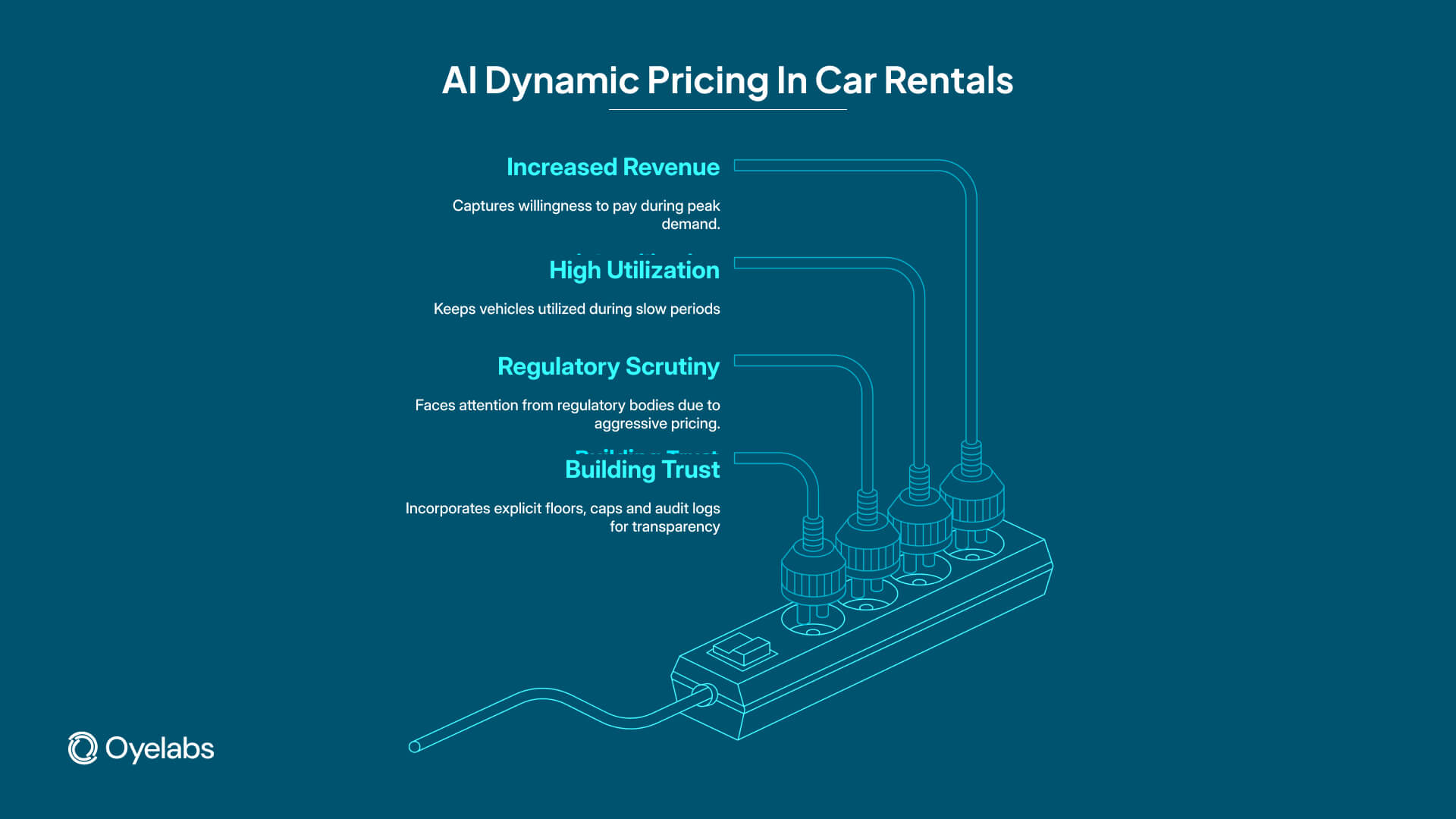
AI dynamic pricing continuously adjusts rental rates using live signals such as demand, competitor rates, local events, seasonality, and fleet utilization, rather than relying on a fixed rate card updated manually. In a car rental app, the system’s goal is to capture willingness to pay during peak demand while keeping utilization high during slow periods, instead of leaving a vehicle idle at a price nobody wants or under-pricing it during a surge.
Traditional rental pricing was built for monthly rate sheets and seasonal adjustments made by a revenue manager. That model breaks down the moment a competitor drops prices, a major event spikes local demand, or bad weather grounds flights and strands travelers who suddenly need a car. A rate sheet cannot react in real time. An AI pricing engine inside a car rental app can, by continuously reprocessing signals like local search volume, competitor rates, weather, and historical booking patterns for that specific location and vehicle class.
Pricing here is not simple prediction, it is constrained optimization against a finite, physical inventory, which is a distinction that matters for founders building a car rental app. A generic pricing algorithm built for digital goods with infinite supply will not translate cleanly to a fleet of 200 vehicles that cannot be duplicated on demand. The trade-off founders rarely hear about: aggressive dynamic pricing improves revenue per vehicle, but unconstrained algorithmic pricing has drawn direct regulatory attention.
The Federal Trade Commission’s own research into algorithmic and surveillance pricing documents growing scrutiny of automated, data-driven pricing across consumer industries, including travel and rental sectors. Build explicit floors, caps, and audit logs into a car rental app from day one rather than retrofitting them after a regulator or a customer complaint forces the issue.
[/vc_column_text][/vc_column][/vc_row]
Builder Tip: Start with price floors and ceilings before letting the model run freely, or margin protection becomes an afterthought.
How Does AI Fraud Detection Work?
AI fraud detection in car rental apps uses biometric verification, document authentication, and behavioral analysis to confirm a renter’s identity before handing over a vehicle, and to flag suspicious account activity afterward. This matters because identity fraud, including synthetic identities and account takeover, accounts for a large share of fraud losses across the mobility sector, and a stolen rental vehicle is a far more expensive loss for a car rental app than a chargeback.
Car rental apps face a fraud profile that looks different from e-commerce. Fraudsters do not just want to make a fraudulent purchase; they want physical control of a $25,000 to $60,000 asset, sometimes never returned. Common patterns include synthetic identities built from real and fake data combined, document forgery on driver’s licenses, and account takeover, where a fraudster gains control of an already-verified account to bypass onboarding checks entirely.
AI-based verification in a car rental app addresses this at two points:
- Onboarding verification: Real-time driver’s license and passport authentication using computer vision, cross-referenced against liveness detection to confirm the person booking matches the ID presented, not a photo of a photo.
- Continuous monitoring: Behavioral signals such as multiple rentals booked from a single device, unusual location patterns, or repeated failed payment attempts, which flag a verified account that may have been compromised after the fact.
Purpose-built verification models trained specifically on identity documents tend to outperform general-purpose AI models at catching tampered licenses, because they are trained to recognize specific forgery patterns like photo substitution rather than general image anomalies. A founder evaluating vendors for a car rental app should ask directly whether the verification model is purpose-built for identity documents or a repurposed general vision model.
Founder Warning: Skipping continuous monitoring after onboarding leaves verified accounts exposed to takeover, which is often the costlier fraud path.
How Does AI Predict Fleet Maintenance?
Predictive fleet maintenance uses telematics data and machine learning to forecast when a vehicle is likely to need service, allowing car rental operators to schedule maintenance before a breakdown rather than reacting after one. This reduces unplanned downtime, extends vehicle lifespan, and prevents a renter from breaking down mid-trip, which is both a safety issue and a guaranteed one-star review for the car rental app.
Every rental vehicle taken off the road for unplanned repair is lost revenue on an asset that is already depreciating whether it earns or not. Traditional maintenance scheduling relies on fixed mileage or time intervals, which either services a healthy vehicle too early or misses a developing issue too late. Predictive models trained on telematics data such as engine diagnostics, tire pressure, and battery health can flag a developing problem before it becomes a roadside failure.
Fleet Automation: Manual vs AI
| Fleet Function | Manual Process | AI-Automated Process |
|---|---|---|
| Maintenance scheduling | Fixed mileage or calendar interval | Predicted failure risk from telematics data |
| Vehicle allocation | Manual dispatch based on availability | Demand-forecast-driven repositioning |
| Damage assessment | In-person inspection at return | Computer vision comparison of check-in/check-out photos |
| Pricing updates | Weekly or monthly manual rate review | Continuous algorithmic repricing |
How Does AI Automate Damage Inspection?
AI-powered damage detection uses computer vision to compare photos or video taken at pickup and return, automatically flagging new scratches, dents, or interior damage without requiring a manual side-by-side inspection. This directly addresses one of the most common dispute points in car rental apps: disagreements over pre-existing versus new damage, which cost operators both money and customer trust.
Manual inspection is slow, inconsistent between staff members, and dependent on the inspector actually noticing small damage under variable lighting at a busy pickup counter. Computer vision models trained specifically on vehicle damage can detect and localize new damage from a short video walk-around, generating a timestamped, photo-backed record automatically attached to the booking inside the car rental app.
Growth Insight: Automated damage documentation reduces dispute cycles and gives support teams evidence instead of a he-said-she-said conversation.
How Does AI Enable Keyless Access?
Contactless and keyless access uses license-plate recognition, digital keys, and mobile-app-based unlock to let a renter locate, verify, and unlock their assigned vehicle without visiting a counter, replacing the traditional key handoff entirely. This has moved from a premium feature to a baseline expectation for car rental apps, particularly at airport locations where pickup speed drives customer satisfaction scores directly.
Major operators now guide renters through vehicle selection, lot location, and gate exit entirely through a mobile app, removing the counter step almost completely. Some large rental brands have also begun pairing this contactless infrastructure with connected and autonomous-vehicle partnerships, signaling that digital keys and lot automation are becoming part of the same operational stack rather than separate projects.
For a founder building a white label car rental app, this use case has two layers worth separating. License-plate recognition at gate exits and entries confirms the physical vehicle matches the booking record, which reduces theft and misdelivery. Digital keys, delivered through the renter’s own app, remove the physical key exchange step entirely, cutting average pickup time and reducing the staffing needed at high-traffic locations.
How Does AI Improve Fleet Forecasting?
AI-driven demand forecasting predicts where and when rental demand will spike or drop, using signals like flight schedules, local events, weather, and historical booking pace, so operators can reposition vehicles before demand materializes rather than reacting after a location runs out of inventory. This is a distinct capability from dynamic pricing inside a car rental app: pricing decides what to charge for the vehicles you have; repositioning decides where those vehicles should physically be.
Fleet underutilization is one of the most expensive, least visible problems in car rental. A vehicle sitting idle at the wrong location generates zero revenue while still depreciating and accruing insurance cost. Repositioning models built on real booking pace, rather than fixed historical averages, catch demand shifts, such as a sudden convention or a flight schedule change, that a manual fleet manager reviewing a weekly report would miss entirely. A car rental app that coordinates pricing, repositioning, and maintenance as one connected system consistently outperforms one that treats each as a separate tool.
Where Do AI Booking Agents Fit?
AI booking and support agents handle high-volume, repetitive rental queries, from checking availability and completing a reservation to modifying a booking or answering policy questions, so human staff can focus on disputes, damage claims, and escalations that actually require judgment. Deployed well inside a car rental app, this reduces first-response time and support headcount cost without degrading the experience for the queries that genuinely need a person.
The mistake founders make here is treating AI support as the flagship AI automation feature, when it is actually the lowest-leverage use case on this list in terms of revenue protection. A well-scoped AI agent should be trained specifically on rental policy, cancellation terms, and booking logic, with a clear, fast handoff to a human for anything involving damage disputes, accident reports, or payment disagreements. An AI agent that tries to resolve a damage dispute on its own will generate more complaints than it prevents.
Where the US, UK, and UAE Markets Differ for AI-Driven Car Rental Apps
Global demand for AI-automated car rental apps is real, but the priority order shifts by region.
In the United States, the market remains large and airport-transaction-heavy, with online booking already dominant. Regulatory attention is increasingly focused on algorithmic pricing transparency, as documented directly by the FTC’s surveillance pricing research, alongside emerging state-level peer-to-peer insurance rules. Founders targeting the US should prioritize pricing governance and compliant fraud verification in their car rental app over flashy conversational AI.
In the UK and Europe, cross-border rental under dense airport networks drives strong demand for fast, app-based pickup, making contactless access and automated identity verification particularly valuable for reducing counter friction at high-traffic airport locations.
In the UAE, self-drive tourism is growing quickly, and digital booking channels already account for the majority of car rental revenue in the market. For operators here, AI dynamic pricing tied to event calendars, and fast digital onboarding for international tourists with foreign documents, tend to deliver the fastest return on a car rental app.
The Infrastructure Cost Most Founders Underestimate
This is the part competitors covering “AI in car rental” rarely explain honestly: none of these seven AI automation use cases run for free once live inside a car rental app, and none of them are a one-time build.
Pricing and repositioning models need continuous retraining as market conditions shift, not a one-time deployment. Fraud detection models need ongoing tuning as fraud patterns evolve, or false-positive rates climb and legitimate renters get blocked. Damage-detection computer vision needs consistent lighting and camera angle standards to stay accurate. None of this shows up in a vendor’s feature list, and all of it shows up in a founder’s year-two operating budget for a car rental app.
A related trade-off worth stating plainly: tighter AI-driven identity verification improves fraud prevention but adds friction to onboarding. Every additional verification step is a small conversion cost at signup. The right balance depends on vehicle value and target market risk profile, not a universal setting copied from a competitor’s car rental app.
Why It Gets Missed: This infrastructure is almost never reflected in first-draft estimates. It rarely appears in wireframes, and many developers only discover the true scope once system architecture is drawn out.
Common Mistakes Founders Make When Adding AI to a Car Rental App
- Building AI support before pricing and fraud detection: A chatbot is visible and easy to demo, which is exactly why founders default to it first, even though it protects the least margin of any use case on this list.
- Letting pricing algorithms run without floors or audit trails: Unconstrained dynamic pricing invites regulatory scrutiny and customer backlash.
- Treating identity verification as a signup-only gate: Account takeover after onboarding is a distinct fraud pattern that a one-time check does nothing to prevent.
- Confusing pricing with repositioning: Charging the right price for a vehicle in the wrong location still leaves demand unmet elsewhere.
- Underbudgeting for retraining and monitoring: AI models degrade in accuracy as real-world patterns shift; a model deployed once and left alone becomes less reliable every quarter.
What Should Founders Build First?
Sequencing matters more than feature count. A founder launching on a white label car rental app script should prioritize based on which cost currently hurts the most: a fleet with high idle time benefits most from dynamic pricing and repositioning first; a platform seeing chargebacks or vehicle theft needs fraud and identity verification first; an airport-heavy operation needs contactless access first to cut pickup friction. Trying to launch all seven AI automation use cases simultaneously on a new car rental app usually means none of them gets tuned properly before launch.
If you’re evaluating how a car rental app’s technical architecture supports these AI automation layers at scale, our guide on white label car rental app development breaks down the underlying infrastructure decisions in more detail.
How OyeLabs Applied AI Automation
A US-based car rental startup approached OyeLabs after launching on a basic booking platform with no automation beyond a payment gateway. Fleet utilization was inconsistent across two cities, damage disputes were resolved manually through phone calls and photos texted between staff and renters, and every price change required a spreadsheet update pushed live once a week.
Working from a white label car rental app script, the team prioritized three automation layers in sequence rather than building everything at once: identity verification at onboarding to address a rise in fraudulent bookings, computer vision-based damage inspection to cut dispute resolution time, and a constrained dynamic pricing engine with explicit floors and caps to protect margin during rollout. Fraud and support-related manual work dropped noticeably within the first full quarter after launch, and damage disputes moved from multi-day phone resolution to same-day resolution backed by timestamped photo evidence.
The lesson mirrors the sequencing principle throughout this guide: the startup did not launch every AI automation use case at once. It identified which cost was hurting the business most, built that layer properly, and expanded from there.
Launch an AI-Ready Car Rental Platform Without Building From Scratch
Get a white label car rental app with dynamic pricing, fraud detection, and fleet automation built into the foundation.
✓ AI-powered dynamic pricing engine built in
✓ Real-time identity verification and fraud checks
✓ Renter, host, and admin apps included
✓ Faster launch for car rental startup founders
Conclusion
AI automation in car rental apps is not a single feature decision; it is a sequencing decision. Pricing and fraud detection protect margin and prevent asset loss, predictive maintenance and damage inspection protect vehicle uptime and reduce disputes, contactless access and demand forecasting cut friction and idle time, and AI support handles volume without replacing judgment on the cases that need it.
The car rental apps winning market share in the US, UK, and UAE through 2026 are not the ones with the most AI features listed on a landing page. They are the ones that built the automation layers that matched their actual cost structure, tuned them properly, and budgeted for the ongoing model maintenance that never makes it into the initial pitch deck.
A founder evaluating a white label car rental app script should ask each vendor one direct question: which of these seven AI automation use cases ships built-in, and which are bolted on later at extra cost. That answer says more about the platform’s real readiness than any feature list.
Frequently Asked Questions
What is the most important AI automation feature for a new car rental app?
There is no universal answer. Dynamic pricing and repositioning deliver the fastest revenue impact for fleets with high idle time, while fraud detection matters most for car rental apps in markets with high identity fraud exposure, such as peer-to-peer rental models.
Does AI dynamic pricing work for small rental fleets?
Yes, but the model needs enough historical booking data to learn demand patterns accurately. Very small fleets often start with rule-based pricing bands before moving to a full machine learning model as booking volume grows.
How does AI reduce fraud in peer-to-peer car rental apps?
AI verifies renter identity through document authentication and liveness detection at signup, then monitors account behavior continuously to catch account takeover, which onboarding checks alone cannot prevent.
Is contactless vehicle access secure enough to replace a counter check in a car rental app?
Yes, when paired with license-plate recognition and digital identity verification at the point of unlock. The risk is not the technology; it is skipping verification steps to make pickup feel faster.
Can AI fully replace human customer support in a car rental app?
No. AI agents handle high-volume, repetitive queries well, but damage disputes, accident reports, and payment disagreements still require human judgment and should route to a person quickly.
Sources and Editorial Notes
Sources
- Grand View Research – Car Rental Market Size, Share & Trends Report, 2025-2030
- Deloitte Insights – 2026 Travel Industry Outlook
- McKinsey – Travel Planning Gets an AI Upgrade
- Federal Trade Commission – Issue Spotlight: The Rise of Surveillance Pricing
Editorial Notes
- Sources are limited to four high-authority references: two global professional services firms (Deloitte, McKinsey), one established market research firm (Grand View Research), and one US federal agency publication (FTC.gov), in line with our editorial standard of prioritizing verified, high-authority sources over vendor or aggregator content.
- Global market-size figures come from Grand View Research; the wide variance across analyst firms in this space is disclosed rather than averaged into a single false-precision number.
- Travel-industry AI adoption claims were sourced from Deloitte and McKinsey’s 2026 published research.
- Algorithmic and surveillance pricing regulatory context was sourced directly from the FTC’s own published research, not from legal-commentary summaries of it.
- The OyeLabs case study in this article is presented as an illustrative, anonymized scenario based on common founder engagements, not a named client account with independently verifiable figures.
Reviewed By: Anuraag Jain
CEO, Oyelabs and AI Solutions Architect