
Why Live Trading Card Marketplaces are Attracting Investors

Why Live Trading Card Marketplaces are Attracting Investors
 Ayan Khan
Last Updated on August 18, 2026
Key Takeaways
What You Will Learn
* Whatnot’s valuation jumped from $11.5 billion to reported $20 billion talks in under a year.
* Live trading card marketplaces convert at rates far above standard e-commerce listings.
* Trading cards remain the largest and most liquid collectible category on live commerce platforms.
* Investors are backing the format, not just individual trading card marketplace apps.
* eBay Live and Fanatics Live show trading cards can pull major incumbents into live commerce.
* A live trading card marketplace succeeds on trust infrastructure, not just streaming technology.
* Grading, authentication, and payout speed decide whether collectors return to a platform.
* The US, UK, and Europe show different live commerce maturity and investor appetite.
Real Insights
* Investors are pricing live trading card marketplaces as commerce infrastructure, not entertainment apps.
* Community-driven bidding, not discounting, is what drives premium prices on these platforms.
* Card grading services are becoming as commercially important as the marketplace itself.
* Fee structure alone does not explain why sellers stay loyal to one platform.
* Regional live commerce maturity affects which investors move first, not just market size.
A live trading card marketplace looks, on the surface, like a hobby app. Someone opens a pack on camera, a bidding war breaks out in the chat, and a card sells for more than it would on a static listing page. What that surface hides is a business model investors have started pricing like commerce infrastructure, not entertainment. Whatnot, the platform most associated with this format, has gone from a $5 billion valuation in January 2025 to reportedly discussing a $20 billion round by mid-2026.
That is not hype pricing on a single app. It reflects a broader thesis: a live trading card marketplace combines two things investors have wanted separately for years, a high-conversion commerce format and a collectibles category with genuine scarcity and resale value, into one product. Understanding why investors are moving into this space now requires looking at what changed in the trading card market itself, not just the technology layer.
For founders evaluating an app like Whatnot, this guide breaks down the actual mechanics behind the investor interest, the trading card market fundamentals driving it, and where the US, UK, and European opportunity looks different.
Quick Answer
Investors are backing live trading card marketplaces because the format combines unusually high e-commerce conversion rates with a trading card market that already has scarcity, authentication infrastructure, and an active resale culture built in. Whatnot’s valuation moved from roughly $5 billion in January 2025 to $11.5 billion by October 2025, with reports of $20 billion talks by July 2026, while eBay and Fanatics have launched competing live formats specifically to defend their trading card market share. The opportunity is not the livestream technology itself; it is pairing that technology with a collectible category that already has proven demand and liquidity.
How Big Is the Trading Card Market?
The global trading card market is one of the more contested figures in collectibles research, with estimates ranging from roughly $15 billion to over $50 billion depending on whether a report includes sports cards, gaming cards, and adjacent collectibles as one category or separately. That range is worth stating plainly rather than picking whichever number sounds most impressive, because it tells founders something useful: this is a large, fragmented market without one dominant data standard, which is exactly the kind of market a well-run marketplace can consolidate.
What is not contested is direction. Sports cards represent close to half of global trading card activity, physical cards continue to outsell digital formats because collectors want authenticated, resalable products, and grading services have become central to how value is assessed and trusted. A live trading card marketplace sits directly on top of this existing infrastructure rather than trying to create a new collectible category from nothing, which is a meaningfully lower-risk bet for an investor than backing a platform built around a trend with no underlying asset value.
Why Investors Value Whatnot as Infrastructure
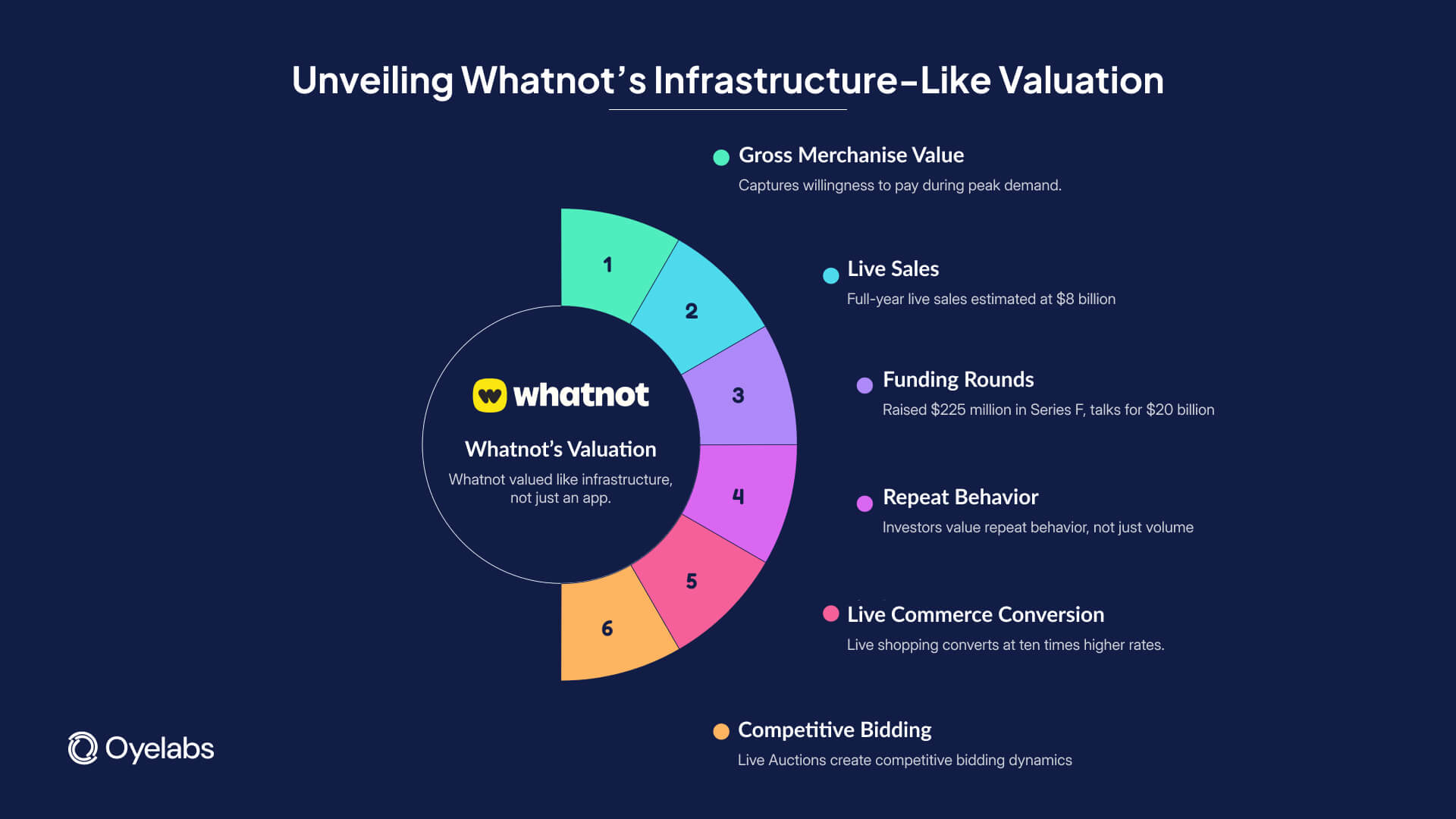
Whatnot’s own numbers explain the investor logic directly. The company’s gross merchandise value more than doubled from roughly $3 billion in 2024 to over $6 billion in the first ten months of 2025, and reporting places full-year live sales at approximately $8 billion. Funding has followed that growth closely: the company raised $225 million in an October 2025 Series F round at an $11.5 billion valuation, co-led by DST Global and CapitalG with participation from Andreessen Horowitz, Sequoia Capital, and Lightspeed Venture Partners, and by mid-2026 was reportedly in talks for a new round that would value the company near $20 billion.
Investors do not price a marketplace at that multiple based on transaction volume alone. What they are pricing is repeat behavior. According to McKinsey’s research on live commerce, live shopping formats convert at rates up to ten times higher than conventional e-commerce, driven by real-time interaction, host credibility, and social proof happening in the same moment as the purchase decision. For a live trading card marketplace, that mechanic compounds: a live auction format does not just sell a card, it creates competitive bidding dynamics that a fixed-price listing cannot replicate.
[/vc_column_text][/vc_column][/vc_row]
Growth Insight: Investors are pricing repeat purchase behavior and bidding dynamics, not the number of livestreams a platform can host.
Why Trading Cards Fit Live Commerce
Not every collectible category translates well to live selling, and trading cards translate unusually well. A live trading card marketplace works because the category already has three things most collectibles lack together: standardized grading, high per-item scarcity, and a buyer base that treats condition and authenticity as core to value rather than a footnote.
Card grading services already give buyers a shared language for quality before a stream even starts, which lowers the trust burden a live seller has to overcome in real time. Pack openings and case breaks, which are a distinct format from straightforward resale, let sellers turn a purchase decision into a shared moment of chance and excitement, which is a large part of why community-driven bidding tends to push prices well above what the same card would fetch on a static listing. Combined, these two properties turn a hobby transaction into genuine appointment viewing, and appointment viewing is what makes a live trading card marketplace defensible against a plain e-commerce competitor.
This is also why the category attracts serious collectors alongside casual buyers. High-grade vintage and modern chase cards continue to set record prices at auction, and that activity anchors credibility for the entire platform, not just the specific listing being sold.
How Established Players Are Responding
The clearest signal that investors are right about this category is who else has entered it. eBay, the largest single seller of trading cards on the secondary market by sales volume, launched eBay Live specifically to compete for the same collector base a live trading card marketplace serves, built directly into its existing app and backed by its existing buyer protection guarantee. Fanatics, which already controls major sports card licensing relationships, launched Fanatics Live with a more curated, brand-partnership-driven approach to live card breaks.
Neither of these moves happened because live commerce is trendy. They happened because trading cards specifically are valuable enough, and liquid enough, that incumbents with existing collector relationships were unwilling to cede the category to newer platforms. That competitive response is itself part of what investors are pricing: a market large enough to draw eBay and Fanatics into direct competition is a market with real, defensible commercial size, not a temporary format experiment.
The differences between platforms matter for a founder studying this space. Community-driven live auctions with broad seller variety tend to produce more price discovery and impulse-driven bidding. Curated, brand-partnership-led formats tend to produce more predictable pricing and stronger buyer trust on higher-value items. A new entrant does not need to copy either model exactly; it needs to decide which trade-off matches the collector base and geography it is targeting.
What Investors Look for in Marketplaces
Investors evaluating this category are not simply checking whether a platform can stream video and process a payment. They are underwriting three specific capabilities.
- Seller trust infrastructure: Ratings, verified seller history, and dispute resolution matter more in a live trading card marketplace than in standard e-commerce, because buyers are committing to a purchase in the moment, often without the ability to inspect the item closely first.
- Authentication and grading integration: Platforms that connect cleanly to established grading standards reduce fraud risk and give both sides of a transaction a shared reference point for value.
- Retention economics: A platform that can show buyers returning weekly, not just for a single high-profile break, demonstrates the habit-forming behavior that justifies a high revenue multiple.
A founder building toward investor interest in this category should treat these three capabilities as the actual product, not the livestreaming layer itself. The video technology is table stakes; the trust and retention systems built around it are what separate a durable live trading card marketplace from a short-lived streaming gimmick.
Founder Warning: Streaming technology alone will not attract investors; trust infrastructure and retention economics are what get underwritten.
Where Do the US, UK, and Europe Differ for a Live Trading Card Marketplace?
Investor appetite and collector behavior are not uniform across these three markets, and treating them as one opportunity is a common founder mistake.
In the United States, live commerce adoption is furthest along, and the trading card category specifically has the deepest existing culture, driven by decades of established sports card collecting alongside newer Pokémon and gaming card demand. This is also the most competitive market for a live trading card marketplace, given that Whatnot, eBay Live, and Fanatics Live are all already established here.
In the UK and Europe, live commerce adoption is earlier stage but growing quickly, and McKinsey’s live commerce research found meaningfully lower long-term usage in Europe compared to China, though first-time adoption has been accelerating. For a founder, this points toward a real opportunity gap: European collectors, particularly in gaming and anime-driven card categories, are underserved by platforms built primarily around the US sports card collector.
Across all three regions, the underlying investor logic stays the same: back the platform that pairs live commerce mechanics with a trading card market that already has scarcity, grading standards, and resale culture, rather than a platform trying to build collector demand from scratch.
Common Mistakes Founders Make Building a Live Trading Card Marketplace
- Treating livestreaming as the core product: The technology is now widely available; trust and retention systems are what actually differentiate a platform.
- Ignoring grading and authentication integration: A live trading card marketplace without a clear path to verified condition and authenticity struggles to earn buyer trust for higher-value cards.
- Copying a single competitor’s format exactly: Community-driven auctions and curated brand-partnership breaks serve different collector bases; picking blindly wastes early positioning.
- Underestimating seller economics: Sellers compare commission structures and payout speed closely; a platform that is slower or costlier to sell on will lose sellers to a competitor quickly.
- Assuming one region’s playbook works everywhere: US sports card culture does not map directly onto UK or European collector demand, which skews more toward gaming and anime card categories.
What to Prioritize Before Building
Sequencing matters here just as much as it does in any other marketplace build. A founder launching an app like Whatnot should prioritize seller onboarding and trust systems first, since a live trading card marketplace with no active sellers has nothing to stream. Buyer-side trust signals, ratings, verified history, and clear dispute handling, should follow immediately after, since live-format buying asks collectors to commit faster than a standard listing does.
If you’re evaluating the technical foundation this kind of platform needs, our guide on Whatnot clone app development breaks down the marketplace, live-streaming, and payment infrastructure decisions in more detail.
How OyeLabs Helped a Collectibles Startup Launch a Live Trading Card Marketplace
A UK-based collectibles reseller approached OyeLabs after outgrowing a static listings site, watching serious buyers migrate toward US-based live trading card marketplaces instead. Their core challenge was not demand, it was infrastructure: no live-streaming layer, no structured seller ratings, and no way to run auction-style bidding in real time.
Working from a Whatnot clone script, the build prioritized three things in order: a live auction and pack-break format built around card grading fields already familiar to serious collectors, a seller verification and rating system launched before public marketing began, and payout speed fast enough to compete with established platforms. Within the first few months post-launch, the platform saw meaningfully higher average order values on live auctions compared to its previous static listings, consistent with the conversion lift live commerce research generally reports.
The broader lesson holds for any founder studying this space: the streaming feature got collectors watching, but the trust and grading infrastructure is what got them buying and coming back.
Launch Your Own Live Trading Card Marketplace
Get a Whatnot clone app with live auctions, seller trust systems, and grading-ready listings built into the foundation.
✓ Live auction and pack-break streaming built in
✓ Seller ratings and buyer trust systems included
✓ Buyer, seller, and admin apps included
✓ Faster launch for collectibles startup founders
Conclusion
Investors are not backing live trading card marketplaces because livestreaming is a novel format. They are backing them because trading cards already had scarcity, grading standards, and an active resale culture, and live commerce mechanics turned that existing demand into materially higher conversion and engagement than static listings ever produced. Whatnot’s climb from a $5 billion to a reported $20 billion valuation in roughly eighteen months, and eBay and Fanatics both building competing live formats specifically to defend their trading card share, are the clearest evidence that this is a durable commercial category, not a passing trend.
For a founder building an app like Whatnot, the lesson is the same one that applies to every marketplace: the streaming layer gets attention, but seller trust, authentication, and retention economics are what get funded.
Frequently Asked Questions
Why is Whatnot valued so highly compared to other live shopping apps?
Whatnot’s valuation reflects both category scale in trading cards and collectibles, and demonstrated repeat purchase behavior, which investors weight more heavily than raw user counts alone.
Is the live trading card marketplace model only relevant to sports cards?
No. Pokémon and gaming cards represent a large and fast-growing share of activity on these platforms, alongside sports cards, and regional demand varies significantly by category.
Why are eBay and Fanatics launching their own live shopping formats?
Both companies have existing trading card market share to protect. Launching live formats keeps collectors inside their ecosystem rather than migrating to newer live-only platforms.
What makes a live trading card marketplace different from a normal e-commerce app?
The core difference is real-time bidding and host-driven trust, which research shows convert at meaningfully higher rates than static listings, combined with grading and authentication systems specific to collectibles.
Is the UK or European market a viable opportunity for a new live trading card marketplace?
Yes, particularly for gaming and anime-driven card categories that are underserved by platforms built primarily around the US sports card collector base.
Sources and Editorial Notes
Sources
- Crunchbase News – Whatnot Lands $225M Series F, Valuation Reaches $11.5B
- McKinsey – Ready for Prime Time? The State of Live Commerce
- The Business of Fashion – Whatnot Secures $11.5 Billion Valuation
Editorial Notes
- Whatnot funding, GMV, and valuation figures were cross-checked across Crunchbase News and The Business of Fashion; the reported $20 billion valuation talks figure is disclosed as reported and unconfirmed by Whatnot at time of writing, not treated as a closed round.
- Live commerce conversion rate and regional adoption claims were sourced directly from McKinsey’s published live commerce research rather than secondary summaries of it.
- Trading card market-size figures vary widely by research firm depending on category scope; this article discloses that range rather than presenting a single figure as precise.
- The OyeLabs case study in this article is presented as an illustrative, anonymized scenario based on common founder engagements, not a named client account with independently verifiable figures.
- Per our sourcing standard, external links are capped at high-authority references; company-reported funding data (Crunchbase, Business of Fashion) was used here in place of a .gov source because no government dataset tracks private marketplace valuations.