
Freelance Marketplace Trends Investors Are Watching Now (2026)

Freelance Marketplace Trends Investors Are Watching Now (2026)
 Anuraag Jain
Last Updated on January 21, 2026
Key Takeaways
What You’ll Learn
- Freelance marketplaces are infrastructure, not side-income platforms.
- Investors prefer focused platforms over generic marketplaces.
- AI supports matching and trust, not the replacement of humans.
- Repeat hiring matters more than signups.
- Platform ownership creates long-term enterprise value.
Stats That Matter
- 38% of the U.S. workforce freelances today.
- 65% of companies plan increased freelance hiring.
- Digital platforms may impact 540M workers globally.
- AI matching reduces hiring time by 40%.
- Sustainable commissions range between 10–25%.
Real Insights
- Focused marketplaces outperform general platforms.
- Trust increases repeat hiring.
- AI reduces friction, not responsibility.
- Subscriptions stabilize revenue.
- Early clarity beats feature overload.
Freelance Marketplace Trends Investors Are Watching Now (2026)
“Freelancing” doesn’t mean what it used to.
In 2026, it’s no longer about side hustles, profile bidding, or racing to the lowest price. It’s about infrastructure. And investors know it.
Capital is quietly shifting toward freelance marketplaces that behave like businesses, not bulletin boards. Platforms with clear supply logic, controlled quality, repeat hiring, and defensible network effects. The kind that scales revenue without scaling headcount.
For founders and CEOs, this creates a real opportunity. Not to compete with Fiverr or Upwork head-on, but to build focused, high-trust freelance platforms with smarter matching, embedded payments, and data-driven operations.
This article breaks down the freelance marketplace trends investors are watching in 2026 – and what it actually takes to launch one that survives scrutiny, earns trust, and compounds value.
Why Freelance Marketplaces Are Still Attracting Serious Capital in 2026
Despite economic cycles and shifting startup narratives, freelance marketplaces continue to draw investor interest in 2026 for one simple reason: they sit at the intersection of labor, technology, and recurring demand.
Modern businesses no longer view freelancers as temporary help. They see them as flexible extensions of their workforce. This structural change has created a steady, repeat-driven demand that platforms can monetize efficiently. Unlike traditional SaaS, marketplaces don’t rely solely on feature adoption. They benefit from transaction flow, network density, and behavioral lock-in.
From an investor’s lens, freelance marketplaces offer:
- Asset-light scalability with global reach
- Multiple monetization levers (commissions, subscriptions, value-added services)
- High margin potential once liquidity is achieved
- Long-term defensibility when trust and data compound
What matters most in 2026 is not raw user growth, but how predictably the platform converts activity into revenue. Investors are backing marketplaces that behave like infrastructure, not experiments.
The Shift Investors Care About: From General Marketplaces to Focused Platforms
One of the clearest freelance marketplace trends investors are watching in 2026 is the move away from broad, horizontal platforms toward focused, purpose-built marketplaces.
General marketplaces solved discovery. They did not solve quality, trust, or outcomes at scale. As a result, many suffered from oversupply, price erosion, and declining engagement on both sides of the market.
Focused platforms are winning because they reduce complexity.
Instead of serving “everyone who freelances,” they serve:
- A defined role (e.g., DevOps engineers, legal researchers, AI prompt specialists)
- A specific industry (healthcare, fintech, Web3, real estate)
- A clear buyer persona with repeat needs
This focus allows platforms to enforce standards, guide pricing, and improve match quality. For investors, this translates into higher retention, stronger unit economics, and clearer positioning.
General vs Focused Freelance Marketplaces (Investor View)
| Aspect | General Marketplaces | Focused Marketplaces |
| Supply Quality | Inconsistent | Curated |
| Pricing Control | Weak | Structured |
| Retention | Low to Medium | High |
| Brand Trust | Platform-level only | Category-level |
| Defensibility | Low | Strong |
In 2026, focus is not a limitation. It is a moat.
Freelance Marketplace Trends 2026: What the Data Is Actually Showing
When investors analyze freelance marketplace opportunities today, they care less about surface-level growth and more about behavioral signals inside the platform.
Across the ecosystem, several patterns are becoming hard to ignore.
Enterprise and SME Hiring Is Driving Volume
Freelancers are no longer hired only by individuals or startups. Enterprise adoption is accelerating, with 65% of companies planning to increase freelance hiring.
Mid-sized companies and enterprise teams now rely on freelance talent for ongoing delivery. This has increased:
- Contract sizes
- Project duration
- Platform lifetime value per client
Repeat Hiring Matters More Than New Signups
Investors track how often clients return to hire again. A platform with modest traffic but strong repeat usage is more valuable than one with high acquisition and low retention.
Key metrics investors watch:
- Re-hire rate per client
- Time-to-second-project
- Freelancer utilization rate
Freelancers Are Choosing Platforms Strategically
Top freelancers are no longer chasing exposure. They are choosing platforms that offer:
- Payment reliability
- Clear scope definition
- Fair dispute resolution
- Long-term client relationships
Platforms that fail to protect freelancer economics see silent churn. In 2026, freelancer retention is as critical as client acquisition.
How AI Is Reshaping Freelance Marketplaces (Without the Hype)

AI is part of nearly every freelance marketplace pitch today, but investors are quick to separate real utility from surface-level claims.
The most successful platforms are not using AI to replace humans. They are using it to reduce friction, improve decision-making, and enforce consistency.
Practical AI use cases that investors value include:
- Intelligent talent matching based on skill depth and past outcomes
- Scope clarification tools that reduce misalignment before contracts start
- Quality scoring systems using delivery history and client feedback
- Fraud detection and anomaly monitoring in payments and profiles
What investors actively avoid are platforms that position AI as the product without having the data volume or workflow maturity to support it.
In 2026, AI is expected. Discipline is what differentiates platforms.
New Business Models Emerging in Freelance Marketplaces (2026)
Another major freelance marketplace trend investors are watching is how platforms make money beyond simple commissions.
Transaction-only models struggle when price competition intensifies. Modern platforms diversify revenue while improving user outcomes.
The strongest models emerging include:
Subscription-Driven Access
Freelancers pay for visibility, tools, or access to premium projects. Clients subscribe for faster hiring, vetted talent, or dedicated support.
Managed Marketplaces
Platforms take partial responsibility for delivery by:
- Vetting freelancers
- Defining pricing bands
- Standardizing workflows
This increases trust and allows higher margins.
Marketplace + SaaS Hybrids
Platforms embed tools such as:
- Project tracking
- Compliance documentation
- Payout automation
- Performance analytics
These tools create switching costs and predictable revenue, which investors value highly.
In 2026, the most investable freelance marketplaces are not just places to hire talent. They are operating systems for flexible work.
Why Investors Are Betting on Founders Who Own the Platform – Not Just Profiles
One of the most important mindset shifts investors expect founders to make in 2026 is this: owning a platform is fundamentally different from participating in one.
A freelancer profile on Fiverr or Upwork is an income stream. A freelance marketplace is an asset.
Profiles don’t compound. Platforms do.
When founders build their own freelance marketplace, they control:
- Pricing logic
- Data ownership
- Quality enforcement
- Payment flows
- User relationships
This control allows platforms to evolve based on real usage rather than external policy changes. Investors understand that long-term value is created when the founder owns the rules of engagement, not when they rent visibility inside someone else’s ecosystem.
In 2026, capital is flowing toward founders who think like platform operators, not marketplace users.
What It Really Takes to Build a Fiverr-Like Platform in 2026
Building a Fiverr-like platform today is less about copying features and more about designing a clear operating model.
Most failed freelance marketplaces didn’t fail because of technology. They failed because the platform logic was unclear.
Successful platforms start by answering three questions with precision:
- Who is the buyer, and why do they return?
- Who is the freelancer, and how do they succeed?
- How does the platform reduce friction for both?
In 2026, investors expect founders to avoid common mistakes such as:
- Launching too many categories at once
- Allowing uncontrolled bidding that erodes value
- Over-customizing before demand is validated
A focused MVP with strong workflows beats a complex system with no traction. Speed to clarity matters more than feature depth at launch.
How Founders Are Launching Faster Using Proven Marketplace Frameworks
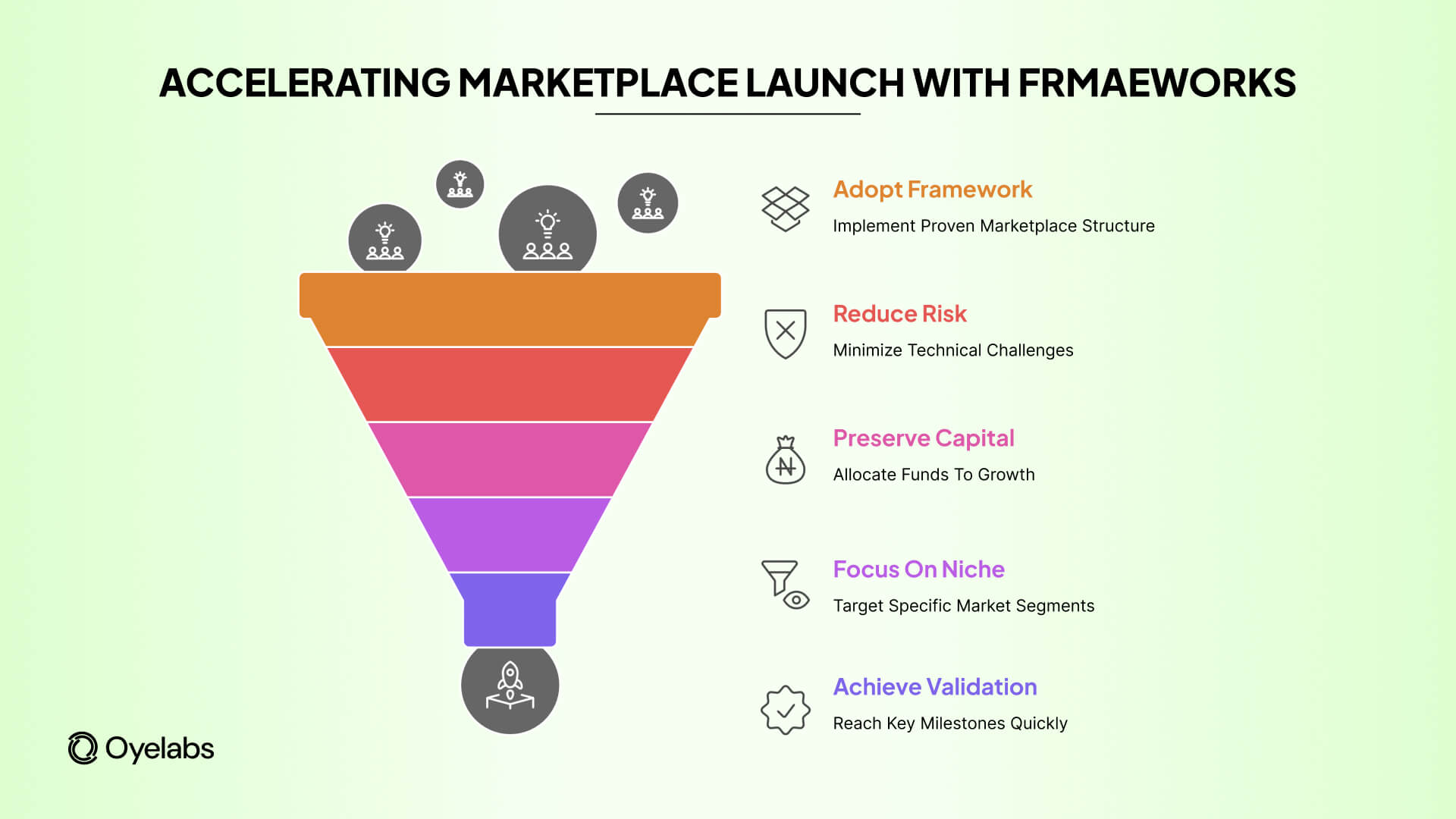
Time-to-market has become a strategic advantage.
Investors increasingly favor founders who launch early, test assumptions fast, and iterate based on real behavior. This has led to a growing preference for proven marketplace frameworks instead of ground-up custom builds.
Using established foundations allows founders to:
- Reduce technical risk
- Preserve capital for growth and marketing
- Focus on niche positioning and onboarding quality
- Reach validation milestones faster
Rather than spending months solving solved problems, founders can concentrate on demand creation, trust-building, and retention. In competitive fundraising environments, this execution speed often separates funded startups from stalled ones.
A Founder Story: From Idea to Recognized Freelance Marketplace Brand
One founder approached Oyelabs with a clear vision: launch a focused freelance marketplace inspired by Fiverr, but tailored to a specific service niche underserved by large platforms. Instead of overbuilding, the platform launched quickly with a clean user flow, structured pricing, and curated freelancer onboarding. Within months, engagement metrics improved, repeat hiring increased, and the platform began attracting organic attention from both freelancers and clients. More importantly, the founder transitioned from pitching an idea to operating a visible brand with real market presence, significantly improving perceived valuation and investor confidence.
What Investors Look for Before Backing a Freelance Marketplace Startup
By 2026, investors have become far more selective about freelance marketplace opportunities. Revenue alone is not enough. What they want is evidence of a working system.
Key signals investors evaluate include:
- Clear ICP definition: Investors want to see that the platform knows exactly who it serves and why those users stay.
- Behavioral traction: Metrics such as repeat hiring, freelancer success rates, and time-to-fill matter more than signups.
- Operational control: Platforms that manage quality, pricing boundaries, and disputes signal maturity.
- Path to defensibility: Niche focus, data leverage, and workflow depth create long-term protection against competitors.
A freelance marketplace that demonstrates disciplined execution and clarity of purpose stands out quickly in investor discussions.
Freelance Marketplace Trends 2026: Mistakes Investors Are Actively Avoiding
As capital becomes more selective, investors in 2026 are not just looking for promising freelance marketplace ideas. They are actively filtering out patterns that have failed repeatedly over the past decade.
One of the biggest red flags is the generic Fiverr clone with no defensible angle. Platforms that replicate surface-level features without rethinking structure, incentives, or positioning are seen as high-risk from day one. Investors recognize that traffic alone does not create value when differentiation is weak.
Other common mistakes investors avoid include:
- Launching with too many categories, leading to diluted liquidity
- Allowing unrestricted price competition that damages freelancers’ economics
- Building feature-heavy platforms without validating demand
- Relying solely on paid acquisition without organic retention signals
In 2026, investors are not impressed by how much a platform can do. They are impressed by how well it does a small number of things repeatedly and predictably.
Is 2026 the Right Time to Launch a Freelance Marketplace?
For founders asking this question, the answer depends less on timing and more on approach.
The freelance economy itself is no longer emerging. It is established. What is still emerging is how work is organized, governed, and delivered through platforms. This creates room for new marketplaces that are more structured, more focused, and more aligned with how businesses actually hire today.
Several conditions make 2026 a favorable moment:
- Enterprises are comfortable outsourcing core work
- Freelancers expect professional-grade platforms, not job boards
- Technology barriers to launch are lower than ever
- Investors favor capital-efficient, revenue-driven models
Founders who wait for a “perfect” moment often miss the advantage of early learning. In contrast, those who launch with clarity and iterate quickly gain insight that no market report can replace.
What a Strong Go-to-Market Strategy Looks Like for Freelance Platforms
Investors pay close attention to how a freelance marketplace plans to reach its first meaningful users. A weak go-to-market strategy signals execution risk, regardless of how strong the idea appears.
Effective platforms in 2026 tend to:
- Start with one buyer persona and one primary use case
- Onboard supply manually to ensure quality and early success
- Use early wins as proof points rather than chasing scale
- Build trust before optimizing growth
A focused launch strategy reduces burn, sharpens positioning, and creates narratives investors can believe in. Growth is expected, but controlled growth is respected.
Final Thoughts
The most important takeaway from the freelance marketplace trends investors are watching in 2026 is this: volume is no longer the goal. Durability is.
Successful platforms are designed to compound value over time. They improve with usage, reward quality, and create predictable outcomes for both freelancers and clients. These are the characteristics that attract serious capital and long-term partners.
For founders and CEOs, the opportunity is clear. The next generation of freelance success stories will not come from competing on size alone. They will come from platforms that are intentional, focused, and operationally sound.
In 2026, the winners won’t be the loudest marketplaces.
They will be the ones who quietly become indispensable.
FAQs
What makes freelance marketplaces attractive to investors in 2026?
Investors are drawn to freelance marketplaces because they scale without inventory, generate repeat transactions, offer multiple monetization models, and benefit from network effects that strengthen platform defensibility over time.
Are niche freelance marketplaces better than general platforms?
Yes. Niche freelance marketplaces outperform general platforms by delivering better talent quality, higher trust, stronger retention, and clearer value propositions, resulting in healthier unit economics and predictable growth.
How does AI improve freelance marketplaces today?
AI improves freelance marketplaces by enabling smarter talent matching, reducing scope misunderstandings, detecting fraud, supporting pricing decisions, and increasing operational efficiency without replacing human judgment.
Can startups realistically launch a Fiverr-like platform now?
Yes. Startups can launch Fiverr-like platforms using proven frameworks that reduce development risk, shorten time-to-market, preserve capital, and allow founders to validate demand before scaling operations.