
How I Help Non-Technical Founders Launch On-Demand Startups
How I Help Non-Technical Founders Launch On-Demand Startups
 Anuraag Jain
Last Updated on April 6, 2026
Key Takeaways
What You’ll Learn:
- On-demand apps connect users and providers through real-time service platforms
- MVP helps test ideas before investing in full development
- White-label solutions reduce cost and speed up launch
- Custom development is needed only after product validation
- Market demand is more important than app features
Stats That Matter:
- The on-demand economy may reach $335 billion by 2027
- The food delivery market may exceed $1.4 trillion globally
- 36% workforce participates in gig economy platforms
- 42% startups fail due to no market demand
- The ride-hailing market may reach $248 billion by 2030
Real Insights:
- Launch fast to validate demand early
- Focus on the supply and demand balance first
- Avoid overbuilding before real users join
- Simple systems perform better in the early stages
- Revenue starts from transactions, not features
How I Help Non-Technical Founders Launch On-Demand Startups
Most non-technical founders assume their biggest limitation is not knowing how to code. After working with over 300 founders across markets like the US, UK, and the Middle East, a different pattern becomes clear. The real challenge is not technology – it is clarity, speed, and execution.
Too many founders spend months trying to understand how products are built, instead of focusing on why they should exist in the first place. On-demand startups, in particular, reward those who move early, validate quickly, and adapt based on real users. Building technology is no longer the bottleneck. Making the right decisions at the right time is.
This is the approach consistently used to help non-technical founders move from idea to a functioning, revenue-ready platform
Most Non-Technical Founders Don’t Fail Because of Tech – They Misunderstand On-Demand Businesses
The assumption that technology is the primary barrier to launching an on-demand startup is one of the most common misconceptions among first-time founders. The real challenge lies in understanding how an on-demand business actually operates.
The on-demand economy is projected to reach over $335 billion, highlighting massive growth potential.
On-demand platforms are not simply mobile applications. They are structured marketplaces that rely on the balance between two critical sides: demand (customers) and supply (service providers, drivers, or vendors). Without this balance, even the most well-built application fails to deliver value.
Many founders approach the problem from a product perspective, focusing on features, interface, and functionality. However, successful platforms prioritize operational logic – how services are requested, fulfilled, and monetized.
This distinction is important. A technically perfect application without a functioning marketplace remains unused. On the other hand, a simple system with strong demand and reliable supply can generate consistent transactions and scale over time.
Why On-Demand Startups (Uber Eats, TaskRabbit, InDriver Models) Attract Non-Technical Founders
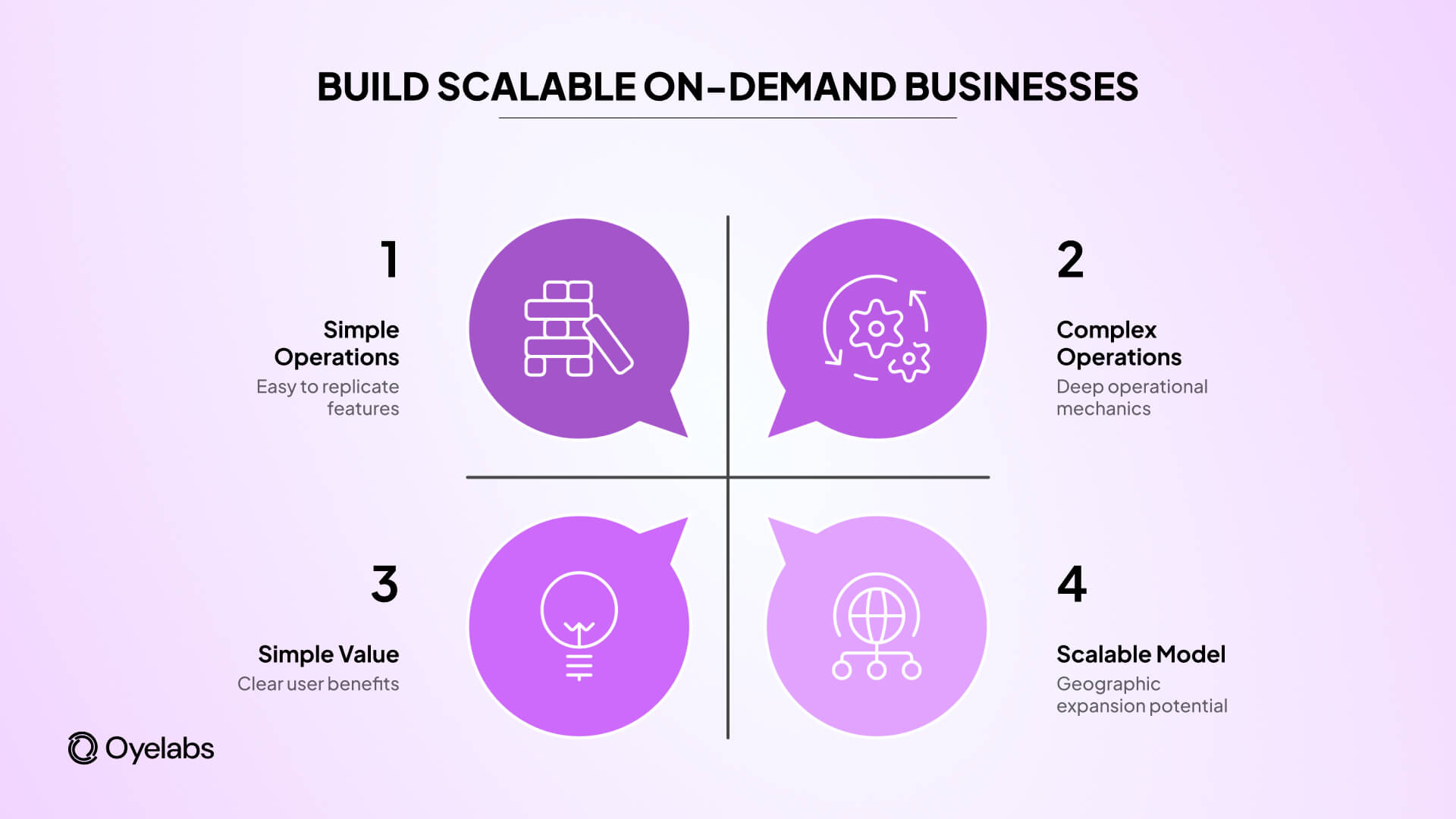
On-demand startups continue to attract non-technical founders because the underlying business models are easy to understand at a surface level. Platforms like Uber Eats, TaskRabbit, and InDriver have demonstrated that connecting users with service providers through a digital interface can create scalable businesses.
These models share a few defining characteristics:
- Clear value proposition for both users and providers
- Repeat usage driven by everyday needs
- Transaction-based revenue models
- Geographic scalability
For founders, this creates a perception that similar platforms can be replicated across industries. As a result, ideas such as “Uber Eats” or “TaskRabbit for home services” are common starting points.
However, replication at the feature level does not translate into business success. The strength of these platforms lies in how they manage operations – driver availability, service fulfillment, pricing logic, and user experience.
Understanding these underlying mechanics is far more important than replicating the interface.
Growth Reality: Marketplace success depends more on operations than technology.
The Pattern Seen Across 300+ Founders Building On-Demand Apps
Across multiple founder journeys, a consistent pattern emerges when non-technical entrepreneurs attempt to build on-demand startups.
The process typically begins with a strong idea but quickly shifts toward unnecessary complexity. Founders often move directly into development without validating whether the problem exists at scale.
Common patterns include:
- Defining the idea as “Uber Eats” without understanding the marketplace dynamics
- Prioritizing feature lists instead of business fundamentals
- Delaying launch due to continuous product revisions
- Ignoring the supply side of the marketplace
This approach creates friction early in the journey. Instead of entering the market and learning from real users, founders spend months refining a product that has not yet been tested.
The result is predictable – delayed launch, increased costs, and uncertainty about whether the platform will generate demand.
The Framework Used to Help Non-Technical Founders Launch On-Demand Startups
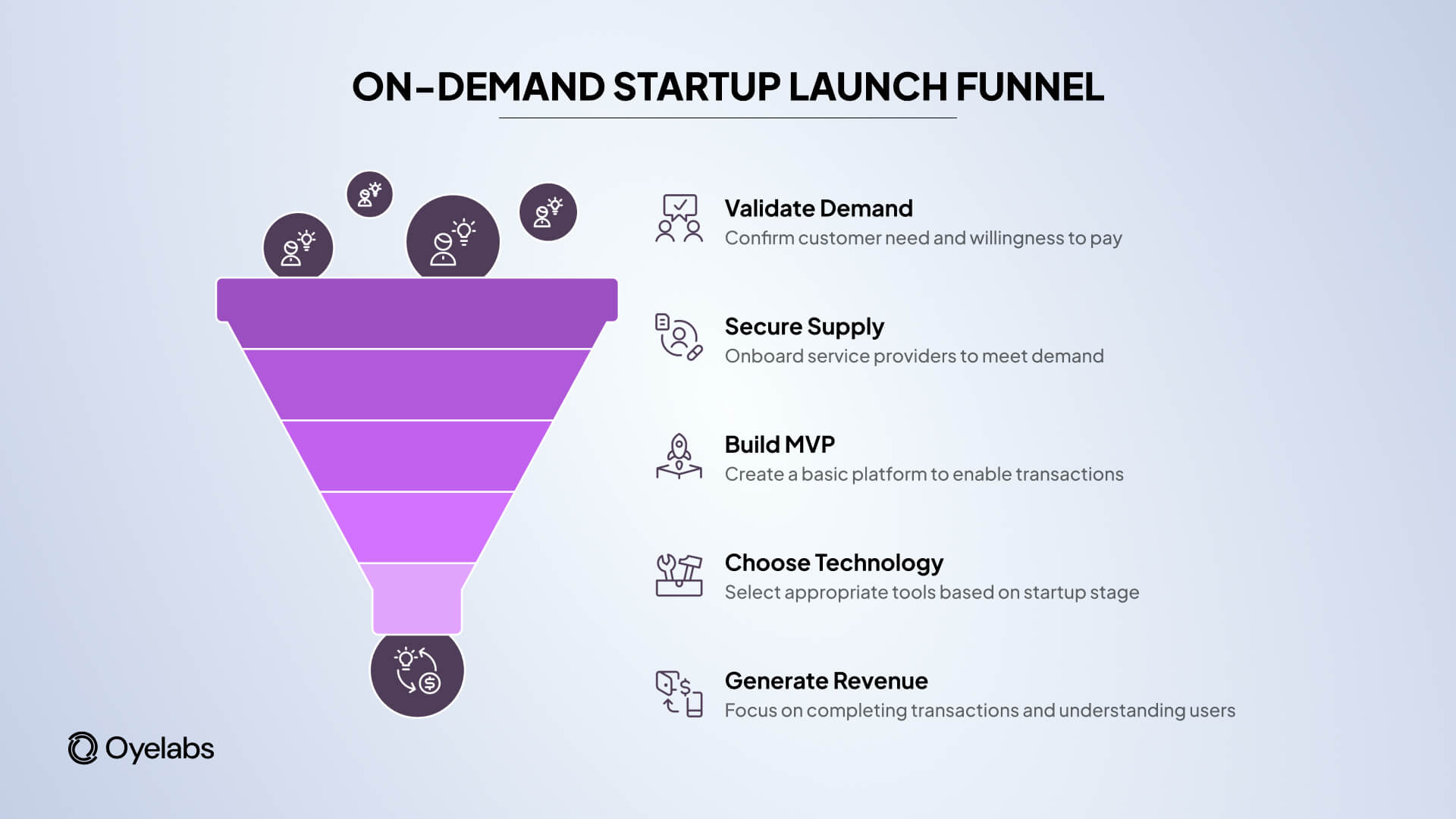
Launching an on-demand startup without a technical background requires a structured approach. The focus shifts from building technology to building a functioning marketplace.
The framework below reflects a practical method that reduces risk and accelerates execution.
1. Validate Before Building the On-Demand Startup
Validation is the foundation of every successful marketplace.
Before investing in development, founders should confirm:
- whether customers actively face the problem
- whether they are willing to pay for a solution
- how existing alternatives are performing
Validation methods include:
- direct customer conversations
- analyzing local service demand
- testing interest through simple landing pages
If demand is weak at this stage, building an application will not solve the problem.
2. Start With Supply (Drivers, Vendors, Service Providers)
On-demand platforms depend heavily on supply availability.
Without service providers, the platform cannot fulfill customer requests. This leads to poor user experience and low retention.
Founders should prioritize:
- onboarding initial providers manually
- ensuring availability during launch
- understanding provider expectations
A marketplace becomes viable only when both sides are active.
3. Build a Minimum Viable On-Demand Platform
The goal of an MVP is not to launch a complete product. It is to enable transactions.
A functional MVP typically includes:
- user registration
- service listing
- booking workflow
- provider acceptance
- payment processing
This structure allows the platform to operate in a real-world environment while keeping development time minimal.
4. Choose the Right Technology Approach Based on Stage
Technology decisions should align with the stage of the startup.
| Stage | Recommended Approach | Purpose |
| Idea Validation | No-Code Tools | Test demand quickly |
| Early Launch | White-Label Platforms | Enable faster go-to-market |
| Growth Stage | Custom Development | Scale and optimize |
Selecting the wrong approach often leads to delays and unnecessary expenses.
5. Focus on First Revenue, Not Perfect Product
Revenue provides the strongest validation for an on-demand startup.
Instead of focusing on feature expansion, founders should aim to:
- complete initial transactions
- understand user behavior
- refine pricing and service flow
Early revenue signals that the marketplace is functioning.
6. Bring Technical Talent Only After Validation
Hiring technical resources too early can increase costs without improving outcomes.
Once the business model is validated and demand is established, founders can:
- hire developers
- onboard a technical co-founder
- invest in custom development
This approach helps retain equity and ensures that technical investment aligns with real business needs.
Wondering what it actually costs to build an Uber Eats-like app in 2026? Read Here.
On-Demand Startups Begin With Marketplaces, Not Mobile Apps
A common mistake among non-technical founders is equating an on-demand startup with a mobile application.
In reality, the application is only a delivery interface. The core business is the marketplace.
An on-demand marketplace consists of:
- customers requesting services
- providers fulfilling those services
- a platform coordinating interactions
The strength of the platform depends on how efficiently these elements interact.
For example:
- Uber Eats ensures driver availability before scaling demand
- TaskRabbit focuses on reliable task completion
- InDriver allows flexible pricing between users and providers
These platforms succeed because they manage marketplace dynamics effectively.
What an MVP for an On-Demand Startup Actually Looks Like
Understanding what to include – and what to exclude – in an MVP is critical for early-stage founders.
A well-defined MVP focuses on enabling core transactions without unnecessary complexity.
Core MVP Components
- User onboarding and profile creation
- Service selection and listing
- Booking and scheduling system
- Provider acceptance mechanism
- Payment integration
These components create a complete transaction cycle from request to fulfillment.
What an MVP Does Not Include
Many founders attempt to include advanced features prematurely. This slows down development and delays launch.
Features that are typically not required at the MVP stage include:
- advanced analytics dashboards
- AI-based recommendations
- complex automation systems
- multi-region scaling features
These can be introduced later, once the platform has validated demand and usage patterns.
Choosing the Right Way to Build Your On-Demand Startup
One of the most critical decisions for a non-technical founder is how the product will be built. Not from a technical lens, but from a strategic one.
Different on-demand businesses – whether it’s ride-hailing, home services, or delivery – operate on similar marketplace principles but require different levels of complexity at different stages.
The mistake most founders make is choosing a development approach based on ambition instead of stage.
No-Code Tools for Early Validation
No-code platforms are useful when the goal is to test assumptions quickly.
They allow founders to validate:
- whether users actually want the service
- how bookings might flow
- whether providers are willing to participate
For example, a founder exploring a TaskRabbit-like app can test demand locally without committing to full-scale development.
However, these tools are not designed to handle real marketplace scale, especially when coordination between multiple users becomes critical.
White-Label Platforms for Fast Launch
Once demand starts becoming visible, the next challenge is execution.
This is where structured platforms become valuable. Instead of building the entire system from scratch, founders can launch with the core marketplace already in place – booking logic, provider flows, and payment systems.
For most non-technical founders, this is the stage where ideas begin to resemble real platforms – whether similar to a service marketplace or a delivery system.
At this stage, the goal is not innovation. The goal is reliability.
Custom Development for Scale
Custom development has its place – but not at the beginning.
It becomes relevant when:
- the business model is validated
- users are actively transacting
- specific features are required for differentiation
For example, platforms that evolve toward models like an InDriver clone may eventually require flexible pricing logic or deeper operational control.
Until then, building custom systems often slows down progress without adding real value.
Why Speed to Market Matters in On-Demand Businesses
On-demand businesses behave differently from traditional products. They rely on real-world interactions that cannot be simulated in isolation.
Pricing, availability, and user behavior – none of these become clear until the system is live.
This is true whether someone is building a TaskRabbit-like app for services or exploring delivery workflows similar to an Uber Eats-like app.
Launching early allows founders to:
- see how users actually behave
- identify gaps in service delivery
- adjust the model based on real usage
Delaying launch in pursuit of a “complete product” often leads to untested assumptions.
What Every Non-Technical Founder Needs to Understand Before Starting
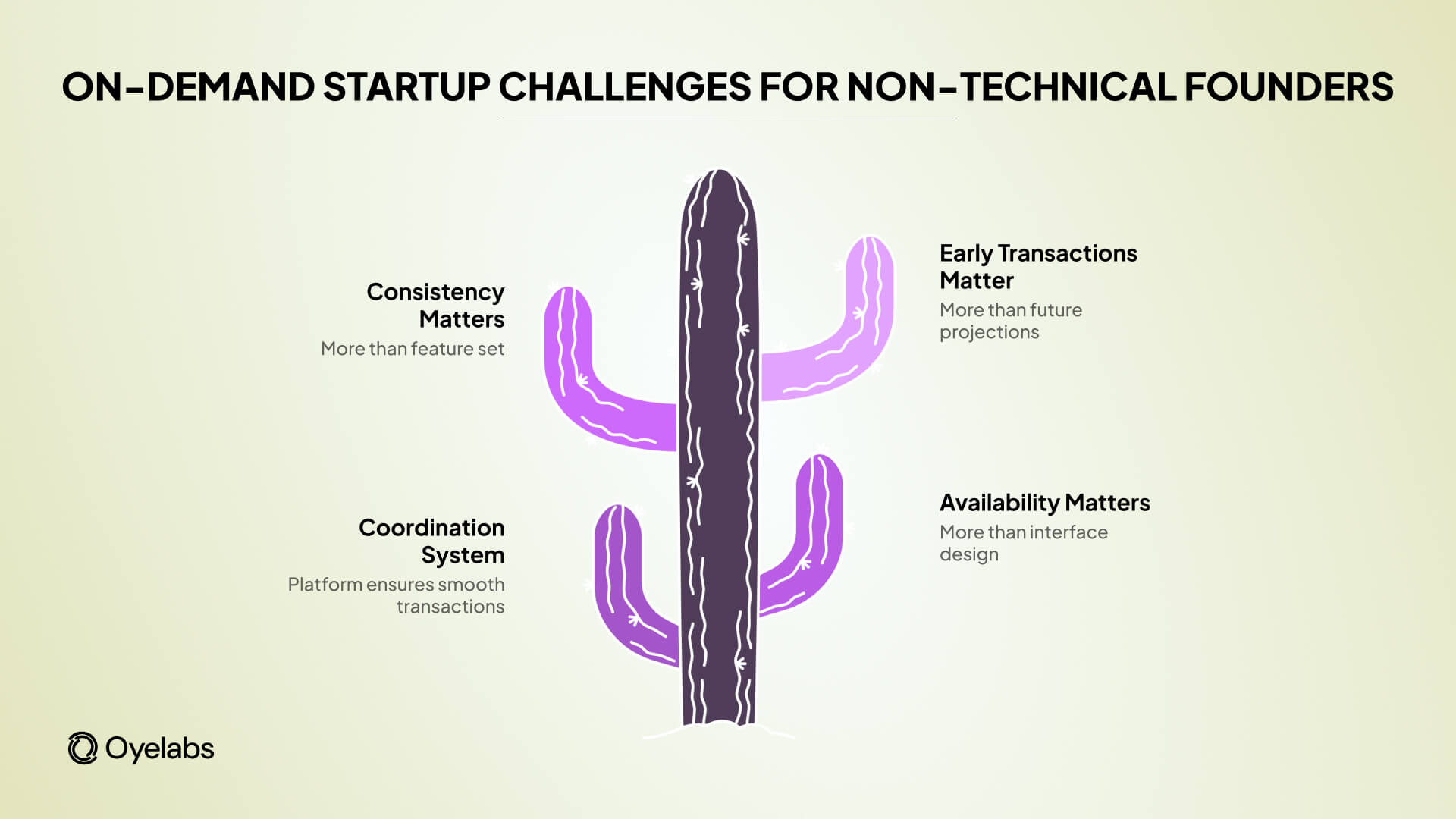
The role of a founder in an on-demand startup is not to understand how to build software. It is to understand how the business functions.
At its core, an on-demand platform is a coordination system:
- someone requests a service
- someone fulfills it
- the platform ensures the transaction happens smoothly
This remains consistent across models – from service marketplaces to delivery systems and ride-based platforms.
A few principles consistently hold true:
- availability matters more than interface
- consistency matters more than features
- early transactions matter more than projections
Strategic Insight: Marketplace success depends more on operations than technology.
Where Oyelabs Supports Non-Technical Founders
Most non-technical founders do not struggle because of lack of ideas. They struggle because translating an idea into a working system requires structure.
This is where the right execution partner, Oyelabs, becomes valuable.
Instead of approaching development as a blank canvas, a structured approach focuses on enabling real transactions – whether building a service marketplace, a delivery platform, or even a ride-based system similar to an InDriver clone.
The focus remains on:
- reducing unnecessary build time
- aligning with marketplace logic
- enabling faster go-to-market
Over time, founders who launch with structure tend to learn faster and scale more effectively.
A Founder Journey: From Idea to On-Demand Platform
A typical journey often begins with a simple thought – connecting people who need a service with those who can provide it.
This idea may resemble a TaskRabbit-like app for local services or evolve into something closer to an Uber Eats-like app for delivery.
Initially, the focus is on the product. Over time, it shifts toward execution.
Real progress begins when:
- providers are onboarded
- transactions are enabled
- users start interacting with the system
The first few bookings reveal more than months of planning.
The One Insight Most Founders Realize Too Late About On-Demand Startups
There is a point in every founder’s journey where a shift in understanding happens.
The realization is simple:
The product is not the business.
This becomes especially clear in marketplace-driven systems, including ride-hailing models or service platforms similar to a TaskRabbit-like app.
What determines success is:
- how reliably services are delivered
- how consistently users return
- how effectively supply and demand are balanced
Without these, even a well-built platform struggles to sustain itself.
Launch Your On-Demand Platform Without Wasting Time
Start faster with a proven system designed for real marketplace execution.
✓ Pre-built marketplace system ready for immediate business launch
✓ Scalable architecture supports delivery, services, and ride models
✓ Faster go-to-market without heavy custom development investment
✓ Built to handle real users, transactions, and growth
Final Thought
Non-technical founders do not need to become developers to build successful on-demand startups. What matters is understanding how to structure a system where demand and supply interact consistently.
Whether the goal is to launch a TaskRabbit-like app, an Uber Eats-like app, or an InDriver clone, the fundamentals remain unchanged. A marketplace only works when transactions happen reliably and users find value in returning. Technology enables this system, but it does not define it. The real advantage comes from clarity, speed, and execution.
Founders who validate early, launch with focus, and learn from real usage build stronger businesses than those who wait for perfection. In the end, success in on-demand startups is not built in code – it is built in the market.
FAQs
What is the average cost to build an on-demand delivery app in 2026?
With Oyelabs, the cost of building an on-demand delivery app in 2026 typically ranges between $999 to $2599, depending on features, scalability, and development approach. White-label solutions reduce costs significantly, while custom-built platforms require higher investment due to backend architecture, integrations, and long-term scalability planning.
How can non-technical founders reduce delivery app development costs effectively?
Non-technical founders can reduce costs by starting with validated ideas, using white-label solutions, and avoiding unnecessary custom development early on. Launching a Minimum Viable Product helps minimize investment while enabling real market testing, ensuring that funds are spent only on features that contribute to growth and revenue.
Is building a custom delivery app better than using a ready-made solution?
Custom development is better suited for scaling businesses with proven demand. For early-stage founders, ready-made solutions offer faster launch, lower cost, and reduced risk. Starting with a structured platform allows founders to test the market before committing to expensive custom features and infrastructure.
What features impact the cost of an on-demand delivery app the most?
Key cost drivers include real-time tracking, payment integration, multi-vendor management, admin dashboards, and scalability features. Advanced functionalities like route optimization, AI recommendations, and dynamic pricing increase development complexity, making custom solutions significantly more expensive compared to standard marketplace platforms.