
What Is TikTok Go? TikTok’s New Move Into Travel Marketplaces
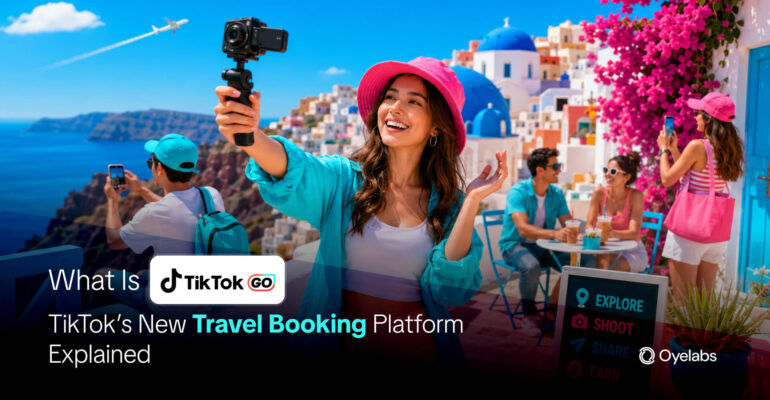
What Is TikTok Go? TikTok’s New Move Into Travel Marketplaces
 Sachin Sharma
Last Updated on May 22, 2026
Key Takeaways –
What You’ll Learn:
- TikTok Go combines travel discovery and booking inside one app.
- Users can book hotels and experiences directly from creator videos.
- TikTok Go reduces booking steps and improves conversion rates.
- Travel marketplaces now focus more on experiences than hotel-only bookings.
- Mobile-first booking platforms attract younger travelers more effectively.
- Shorter booking journeys increase completed reservations and platform revenue.
Stats That Matter:
- TikTok Shop crossed $33 billion global GMV by 2024.
- TikTok Go officially launched in the United States in 2026.
- TikTok Go currently partners with six major travel platforms.
- TikTok creators need 1,000 followers to join TikTok Go monetization.
- GetYourGuide supports over 200,000 experiences across 12,000 destinations globally.
- Goldman Sachs estimates creator economy growth may reach $480 billion by 2027.
- Nearly 40% of younger users prefer TikTok for discovery searches.
When TikTok launched TikTok Shop in 2023, many people dismissed it as another experimental commerce feature. A lot changed after that.
By 2024, TikTok Shop reportedly crossed $33 billion in global GMV, proving that users were willing to buy directly inside a short-form video platform. Now TikTok is applying the same strategy to travel.
In May 2026, TikTok officially launched TikTok Go in the United States. The feature allows users to discover and book hotels, tours, attractions, and local experiences without leaving the app.
TikTok Go is an in-app travel booking platform that turns travel discovery videos into direct booking opportunities. Users can watch creator content, tap listings, check availability, and reserve experiences inside TikTok without switching apps. The model combines creator commerce, affiliate marketing, and local experiences booking platform functionality into one seamless flow.
What Exactly Is TikTok Go?
TikTok Go is an in-app travel booking platform integrated directly into TikTok’s discovery ecosystem. It is not a separate app. Users encounter bookable listings while browsing videos, search results, and destination pages. For example, someone watching a creator review a boutique hotel in Nashville can instantly:
- Tap the hotel listing
- View pricing and availability
- Complete a booking inside TikTok
The platform currently works with six major travel partners.
| Partner | Category |
|---|---|
| Booking.com | Hotels and accommodations |
| Expedia | Hotels and travel packages |
| Viator | Tours and experiences |
| GetYourGuide | Activities and attractions |
| Tiqets | Museum tickets and attractions |
| Trip.com | Hotels, flights, and packages |
TikTok Go is currently available to US users aged 18 and older. It also has a creator-side program: travel content creators with at least 1,000 followers can earn commissions when their videos lead to bookings through the platform.
How Does TikTok Go’s In-App Travel Booking Platform Actually Work?
The biggest insight behind TikTok Go is simple: it removes friction. TikTok did not invent travel discovery. Users were already discovering destinations through creator videos. The platform shortened the booking path.
Before TikTok Go
See hotel in video → Screenshot → Search on Google → Open Booking.com → Search again → Book
After TikTok Go
See hotel in video → Tap → Book
That reduction from six steps to two matters. In our experience working on marketplace products, every additional click in a booking flow can lower conversion rates significantly. Reducing even one unnecessary redirect can improve completion rates within weeks of launch. TikTok Go distributes booking inventory across multiple touchpoints.
| Touchpoint | What Happens |
|---|---|
| Video content | Bookable listings appear as tappable tags within travel videos |
| Search results | When users search for a destination or activity, bookable listings appear inline |
| Location pages | Users browsing a city or neighborhood see nearby experiences to book |
| Creator content | Tagged locations include booking links tied to the creator’s affiliate account |
This structure effectively turns TikTok into a travel + local business affiliate/booking platform inside TikTok rather than just a discovery app.
Why Does TikTok Go Matter Beyond Travel?
Most headlines frame TikTok Go as a travel product. That misses the bigger story. TikTok is gradually transforming its social media platform into a transaction layer.
It started with eCommerce through TikTok Shop. Now it is moving into travel and local experiences. The pattern is strategic. TikTok identifies high-intent discovery behavior and inserts booking functionality directly into the user journey. That creates three major industry shifts.
Is TikTok Competing With Google Search?
Yes, especially for younger audiences. Google executives previously acknowledged that nearly 40% of younger users increasingly used TikTok and Instagram instead of traditional search for discovery-related queries.
Travel discovery fits naturally into that behavior. Instead of searching “best cafés in Tokyo” on Google, users now watch creator recommendations directly inside TikTok. The booking layer simply monetizes that attention.
Why Is Content-Led Commerce Growing So Quickly?
A few years ago, purchasing products from a creator video felt experimental. Now it feels normal.
TikTok Shop proved users are comfortable buying directly inside a short-form video platform. TikTok Go extends the same behavior into travel bookings.
The business logic is straightforward:
- Discovery happens through content
- Trust comes from creators
- Conversion happens instantly inside the app
That compression dramatically reduces user drop-off.
Why Is the Local Experiences Booking Platform Market Expanding?
Experiences are becoming the main reason people travel. Companies like GetYourGuide already operate across 12,000 destinations with more than 200,000 experiences globally.
TikTok Go is built around this shift. Instead of focusing only on flights and hotels, the platform prioritizes activities, tours, attractions, and local experiences. That aligns directly with how Gen Z and Millennials plan trips today.
The Creator Economy Angle
For founders, the creator monetization side of TikTok Go is just as interesting as the booking mechanics.
TikTok Go includes a built-in affiliate program for travel creators. Here is how the eligibility and workflow breaks down:
| Requirement | Detail |
|---|---|
| Minimum followers | 1,000 |
| Minimum age | 18 years |
| Account standing | Must be in good standing |
| Access point | Monetization section of TikTok Creator Center |
| Workflow | Browse partner catalog, select a business, post content with location and partner tags pre-attached |
| Earnings | Commission-based, triggered when content drives a confirmed booking |
Travel creator Amanda Dishman from Salty Vagabonds noted that TikTok Go reduced the complexity traditionally associated with travel affiliate monetization.
That matters because creators do not need separate blogs, affiliate dashboards, or external booking redirects anymore.
Everything happens inside TikTok.
What we learned from launching creator-driven marketplace systems is that creators promote products far more aggressively when commissions are visible, automated, and instantly trackable inside the app.
What Can Founders Learn From TikTok Go’s Business Model?
TikTok Go offers a clear framework for anyone building an in-app travel booking platform or a local experiences booking platform.
How Can You Reduce Booking Friction in Your Marketplace?
TikTok Go focused on reducing steps instead of adding more features. That decision matters. Many marketplaces spend months building advanced filters, loyalty systems, and recommendation engines while ignoring conversion friction. If users must:
- Switch apps
- Re-enter search terms
- Create multiple accounts
- Reload checkout pages
…conversion rates drop quickly.
Audit your booking flow carefully. If your checkout process takes more than 60–90 seconds on mobile, users will abandon it.
Why Should Booking Inventory Appear Where Users Already Spend Time?
TikTok Go embeds inventory directly into content feeds. Users do not need to leave the discovery environment. That principle applies to almost every marketplace category today.
If you are building a travel marketplace or local services platform, ask:
- Can users book directly from video content?
- Can listings appear inside search results?
- Can creators tag businesses natively?
The less context switching users experience, the higher your conversion potential becomes.
Why Are Creator Affiliate Systems Becoming Essential?
TikTok Go turned creators into growth partners from day one. That lowers customer acquisition costs. Traditional travel platforms often spend heavily on paid advertising. TikTok Go instead uses creators with built-in trust and audience relationships.
For startups, this model is extremely important. A creator-driven affiliate system can help generate scalable distribution without depending entirely on performance ads.
Why Did TikTok Choose API Partnerships Instead of Building Inventory?
TikTok did not build its own hotel supply network. It partnered with established platforms like Booking.com and Expedia.
That accelerated launch speed dramatically. In our experience deploying marketplace platforms, API partnerships can reduce launch timelines from 12–18 months to as little as 3–5 months depending on integration complexity. For early-stage startups, speed matters more than ownership.
Related Read: The TikTok Business Model
TikTok Go vs. Traditional Travel Marketplaces
To make this concrete, here is how TikTok Go compares to what founders typically think of when they imagine building a travel marketplace:
| Feature | TikTok Go | Traditional Travel Marketplace |
|---|---|---|
| Discovery mechanism | Algorithmic video feed | Search-driven |
| Booking flow | In-app, a few taps | Multi-step, often redirected |
| Creator monetization | Built-in affiliate program | Usually external |
| Inventory source | API partnerships | Direct listings or aggregation |
| User intent signal | Content engagement | Keyword search |
| Competition for attention | Other videos in the feed | Other search results |
| Primary user age group | 18–35 (Gen Z and Millennials) | Broader, skews older |
The key difference is where the user’s intent originates. In traditional travel marketplaces, the user arrives with a plan. In TikTok Go, the plan is created by the content. That is a fundamentally different funnel, and it is one that founders building new platforms should think carefully about replicating in some form.
What Should Startups Build After Watching TikTok Go?
TikTok Go proves that the future of travel commerce is:
- Creator-driven
- Mobile-native
- Content-first
- Booking-focused
If you want to build a modern local experiences booking platform, you should prioritize:
- In-app checkout systems
- Affiliate monetization
- Creator tagging features
- API-based inventory integrations
- Location-aware recommendations
At Oyelabs, we have seen growing demand for marketplace platforms that combine discovery feeds with transaction systems. Founders are no longer asking only for booking engines.
They want ecosystems where discovery, engagement, and conversion happen inside the same product experience. The next step is clear: validate your niche, secure inventory partnerships, and reduce the booking journey to as few taps as possible.
Conclusion: Is TikTok Go the Future of Travel Commerce?
TikTok Go is more than a travel feature. It is a blueprint for how digital commerce is evolving.
Discovery now happens inside content feeds. Booking happens instantly inside the same app. Creators influence purchasing decisions while earning affiliate revenue from completed transactions. TikTok quietly tested travel bookings in 2025 before scaling the product into a full US launch in 2026.
The rollout looks intentional, data-driven, and aligned with changing user behavior. For founders, the opportunity is obvious.
If you are building an in-app travel booking platform or a local experiences booking platform, focus on reducing friction, integrating creator-driven discovery, and embedding transactions directly into the user experience. The platforms that shorten the distance between inspiration and booking will likely dominate the next phase of digital commerce.