
What is DeepSeek And Why It’s Becoming a Hot Topic in 2026

What is DeepSeek And Why It’s Becoming a Hot Topic in 2026
 Anuraag Jain
Last Updated on January 8, 2026
AI innovation is moving fast, and one name that keeps coming up in 2025 is DeepSeek. This Chinese AI startup has taken the industry by storm with its latest model, DeepSeek R1, which rivals OpenAI’s ChatGPT while being significantly cheaper to develop. Its rapid success has catapulted DeepSeek to the top of app download charts, drawing global attention and sparking conversations about the future of AI competition.
The impact has been so profound that even Nvidia’s stock dropped 17%, wiping out $589 billion in market value, as investors reacted to the growing challenge from China’s AI sector.
Many believed that U.S. tech giants like OpenAI and Google would always lead the industry, but DeepSeek’s rise is changing that perception. With its cost-efficient and innovative AI solutions, it is quickly becoming one of the most talked-about players in the field. But what exactly is DeepSeek, and why is it gaining so much traction? Let’s dive in.
What is DeepSeek?
DeepSeek is an AI research and development company focused on creating cost-efficient, high-performing language models. Unlike many Western AI firms that rely on large-scale supervised training, DeepSeek utilizes reinforcement learning, optimizing efficiency while maintaining competitive performance. With an open-source approach, DeepSeek aims to democratize AI, allowing developers to access, modify, and implement its models without significant financial investment.

Its flagship models include DeepSeek-R1, known for its reasoning capabilities, and DeepSeek-V3, which leverages multi-head latent attention for enhanced data processing. These innovations have positioned DeepSeek as a strong alternative to industry leaders like OpenAI and Google. With over 10 million downloads, DeepSeek’s AI solutions are rapidly gaining traction, making advanced AI more accessible and driving increased competition and innovation across the AI ecosystem.
Also Read: What is Artificial General Intelligence
OpenAI vs. DeepSeek
The emergence of DeepSeek has led to growing comparisons between its models and those developed by OpenAI, one of the most dominant AI companies globally. While OpenAI has long been at the forefront of artificial intelligence with models like GPT-4 and GPT-5, DeepSeek is rapidly gaining attention for its alternative approach.
Key Differences
| Feature | OpenAI | DeepSeek |
| Training Method | Primarily supervised learning with reinforcement learning used in some cases | Primarily reinforcement learning-based training |
| Model Pricing | High API pricing; GPT-4 Turbo costs $15 per million input tokens | Affordable API pricing; DeepSeek-R1 costs $0.55 per million input tokens |
| Architecture | Large monolithic models | Mixture-of-Experts (MoE) architecture |
| Open-Source | Closed-source, proprietary models | Open-source AI models available to the public |
| Computational Cost | Expensive training requiring vast computational resources | Cost-efficient training through MoE and reinforcement learning |
| Market Focus | Dominantly U.S.-based, serving enterprises and developers worldwide | China-based, focusing on global open-source collaboration |
DeepSeek’s ability to provide high-quality AI solutions at a fraction of OpenAI’s cost has made it particularly attractive to smaller enterprises, startups, and independent researchers who may not have the budget for expensive proprietary AI models.
Also Read: AI Agents vs Agentic AI
DeepSeek’s Innovative Techniques
DeepSeek’s rapid ascent can be attributed to its groundbreaking technological advancements. Unlike traditional AI models that rely heavily on supervised learning, DeepSeek employs a combination of novel methodologies that enhance efficiency and adaptability. These innovations allow DeepSeek to develop high-performing AI models while minimizing resource consumption, making it a serious competitor in the AI industry.
Reinforcement Learning
DeepSeek sets itself apart by utilizing reinforcement learning instead of supervised fine-tuning. This method allows AI models to learn through trial and error, receiving algorithmic rewards for successful reasoning and decision-making. Studies show that reinforcement learning can improve AI decision-making efficiency by up to 40% compared to supervised training methods. This approach is particularly effective in enhancing DeepSeek-R1’s reasoning capabilities, allowing the model to continuously refine its responses based on real-time feedback. Similar to how humans improve through experience, DeepSeek’s models autonomously enhance their performance over time, making them more adaptable to complex tasks.
Mixture-of-Experts (MoE) Architecture
DeepSeek leverages a Mixture-of-Experts (MoE) architecture, a technique that enables selective activation of model parameters for specific tasks. Rather than utilizing the entire model for every operation, only 10%–20% of the parameters are activated per task, significantly reducing computational costs while improving efficiency. This selective engagement functions like a team of specialists—each AI “expert” handles tasks in its domain, optimizing resource allocation and boosting performance. Research from Google DeepMind indicates that MoE architectures can reduce computational expenses by up to 50% while maintaining high accuracy, reinforcing DeepSeek’s position as an efficiency-driven AI provider.
Multi-Head Latent Attention
DeepSeek-V3 introduces multi-head latent attention, an advanced mechanism that allows the model to process multiple aspects of input data simultaneously. This enables nuanced understanding and improved accuracy in complex reasoning tasks. Transformer-based models, like DeepSeek-V3, show a 35% increase in data processing efficiency when using multi-head attention mechanisms compared to traditional single-head models. Similar to how human cognition can focus on multiple details at once, this technique enhances DeepSeek’s ability to analyze large datasets with higher precision and speed.
Distillation
To ensure accessibility, DeepSeek employs knowledge distillation, a process that transfers knowledge from larger, more complex models into smaller, optimized versions. This allows DeepSeek’s models to maintain high performance while requiring less computational power for deployment. Studies indicate that distilled models can retain up to 90% of the original model’s accuracy while reducing size and cost by over 60%. By making advanced AI more compact and efficient, DeepSeek broadens its usability across industries, from startups to enterprise-level AI applications.
DeepSeek’s Cost-Efficient Approach
One of DeepSeek’s strongest selling points is its commitment to affordability without sacrificing performance. By reducing training costs, offering lower API pricing, and embracing an open-source model, DeepSeek ensures that AI development is within reach for a wider audience.
Reduced Training Costs
DeepSeek’s models require significantly less financial investment for training compared to competitors. For instance, DeepSeek-V3 was trained at a fraction of the estimated $100 million cost required to train Meta’s Llama 2 model, showcasing the company’s ability to maximize efficiency without compromising output quality. Efficient training techniques, such as MoE and reinforcement learning, allow DeepSeek to scale its models without incurring the massive costs faced by traditional AI providers.
Affordable API Pricing
DeepSeek has positioned itself as a cost-effective alternative to dominant AI providers by offering significantly lower API pricing. For comparison, OpenAI’s GPT-4 Turbo API costs approximately $0.01 per 1,000 tokens for input and $0.03 per 1,000 tokens for output, which can become costly at scale. DeepSeek’s pricing strategy ensures that smaller businesses and independent developers can leverage AI capabilities without incurring excessive costs, making it a more accessible choice for startups and research institutions.
Open-Source Model
Unlike proprietary AI solutions, DeepSeek embraces an open-source approach, eliminating licensing fees and fostering community-driven innovation. Open-source AI models encourage collaboration, allowing developers to customize and improve upon existing frameworks. Hugging Face, an open-source AI hub, has seen over 1 million AI models shared and downloaded globally, proving that open-access AI significantly accelerates research and development. By promoting transparency and adaptability, DeepSeek ensures that AI advancements remain widely available rather than confined to a handful of tech giants.
Also Read: AI Development Costs Explained
The Impact of DeepSeek on the AI Industry

Lowering the Cost of AI Adoption
DeepSeek is making AI more accessible by significantly lowering costs, a major barrier for startups, small businesses, and researchers. Traditional AI models, such as those from OpenAI and Google, often require expensive API access or proprietary licensing, making them unaffordable for many organizations. DeepSeek’s open-source approach allows companies to deploy AI without paying exorbitant fees, reducing financial constraints. By offering affordable API pricing and open-source AI models, DeepSeek is democratizing AI adoption, fostering innovation, and enabling more businesses to integrate AI into their operations without breaking the bank. Notably, DeepSeek-V2 was made available at an unprecedentedly low cost of only 1 yuan ($0.14) per 1 million tokens processed by the AI mo
Strengthening the Open-Source AI Movement
Unlike proprietary AI providers that keep their models closed, DeepSeek supports the open-source AI movement by providing unrestricted access to its models. This encourages collaborative research and development, allowing AI engineers, startups, and enterprises to customize and enhance AI tools based on their needs. By reducing reliance on closed AI ecosystems from OpenAI and Google, DeepSeek promotes transparency and fosters innovation.
The open-source model also accelerates AI advancements, as developers worldwide can contribute improvements, identify vulnerabilities, and optimize DeepSeek’s AI solutions without being restricted by licensing agreements. DeepSeek has partnered with Hugging Face, a leading AI repository, to distribute its models, making them easily accessible to the global developer community. Within days of its release, DeepSeek’s model became one of the most downloaded open-source AI frameworks, reinforcing its position as a major player in the AI landscape.
Competitive Pressure on AI Giants
DeepSeek’s rise has introduced a new wave of competition, challenging established AI leaders like OpenAI, Google, and Meta. With its lower pricing, efficiency-driven architecture, and open-source availability, DeepSeek forces these companies to reconsider their pricing structures and service offerings. OpenAI, for instance, has faced criticism for its high costs, pushing developers toward alternatives like DeepSeek.
The increasing competition compels AI giants to either lower costs, enhance model efficiency, or introduce new innovations to retain market dominance, ultimately benefiting businesses and consumers by providing better AI tools at reduced costs. DeepSeek-R1 operates at roughly 5% of the cost compared to traditional models, as it only needs to process 37 billion parameters per calculation instead of all 671 billion. This significant cost reduction makes it an economically attractive option for large-scale AI deployments.
Expanding AI Adoption in Emerging Markets
AI adoption in emerging markets has been limited due to the high costs and computational requirements of advanced AI models. DeepSeek’s cost-efficient and optimized AI solutions provide businesses in Asia, Africa, and Latin America with affordable tools to integrate AI into industries such as healthcare, finance, agriculture, and education. For instance, AI-powered chatbots, medical diagnosis models, and financial fraud detection tools are becoming more accessible to developing economies.
By making AI affordable and adaptable, DeepSeek is bridging the global digital divide, empowering businesses in underserved regions to leverage AI-driven solutions. DeepSeek’s emergence highlights a growing industry-wide shift away from brute-force scaling toward intelligent optimization, making AI more accessible globally.
Encouraging Sustainable AI Development
DeepSeek is leading a shift in AI development by proving that high-performing AI models don’t require excessive computational resources. Traditional AI providers like OpenAI rely on large-scale model training, which demands massive energy consumption and high-end GPUs. DeepSeek, on the other hand, focuses on efficiency-driven AI, using techniques like Mixture-of-Experts (MoE) and reinforcement learning to achieve similar results with lower resource usage.
This not only reduces costs but also minimizes environmental impact, making AI development more sustainable. DeepSeek’s efficiency-driven approach is setting a new industry standard for AI performance and resource optimization. DeepSeek-V2, for example, achieves significantly stronger performance while saving 42.5% of training costs and reducing the Key-Value cache by 93.3%.
Positioning China in the AI Race
DeepSeek is emerging as a key player in China’s AI strategy, directly competing with U.S.-based AI giants. While OpenAI and Google have led AI research and development, China has been investing heavily in homegrown AI solutions. DeepSeek’s rapid rise demonstrates China’s ability to develop competitive AI models, challenging Western dominance in AI innovation. Given rising geopolitical tensions, China is also striving for AI self-sufficiency, reducing reliance on U.S. technology. DeepSeek’s success strengthens China’s AI capabilities, positioning it as a global AI powerhouse and signaling a shift in the international AI landscape. DeepSeek’s latest launch has shaken up the global AI market, surpassing ChatGPT to become the top-rated free app on the US Apple App Store.
Also Read: The Impact of AI in Manufacturing Industry
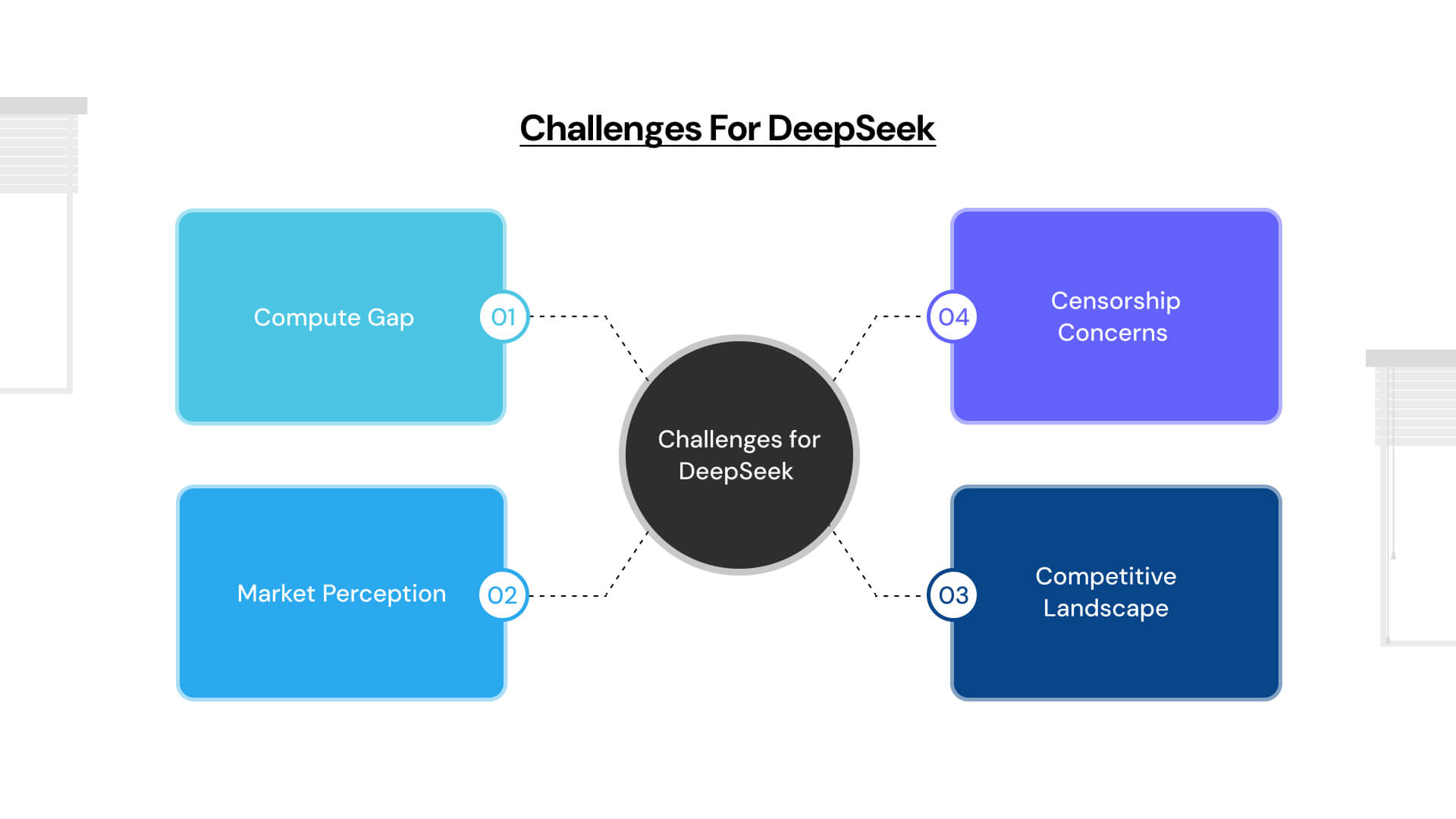
Challenges for DeepSeek
Compute Gap
One of DeepSeek’s biggest challenges is its limited access to advanced computing hardware, particularly due to U.S. export restrictions on AI chips. AI models require powerful GPUs, such as NVIDIA’s A100 and H100 chips, which dominate over 90% of the AI chip market, for efficient training and inference. However, U.S. sanctions prevent China from acquiring these high-performance processors, forcing DeepSeek to rely on domestic alternatives like Huawei’s Ascend AI chips or optimizing models to run on older hardware.
While China’s semiconductor industry is making progress, local chips still lag behind NVIDIA’s cutting-edge technology, potentially slowing DeepSeek’s model improvements. Without access to the latest AI chips, DeepSeek faces significant scalability challenges, which could impact its ability to compete with U.S. AI leaders who benefit from unrestricted access to top-tier hardware.
Market Perception
Competing with well-established brands like OpenAI, Google, and Meta is a major challenge for DeepSeek. While DeepSeek offers cost-effective and open-source AI solutions, it lacks the same level of global brand recognition and trust. OpenAI’s ChatGPT reached 100 million users in just two months, setting an industry benchmark for AI adoption, while DeepSeek is still in the early stages of building a user base. Many enterprises and developers hesitate to switch from proven AI providers to newer alternatives. To establish credibility, DeepSeek must demonstrate long-term reliability, security, and continuous innovation.
Additionally, collaborations with leading research institutions, AI communities, and global tech firms—similar to OpenAI’s partnership with Microsoft—will be crucial in gaining industry trust. Establishing strong case studies, enterprise success stories, and independent audits of its AI models can further boost DeepSeek’s credibility in a highly competitive AI landscape.
Competitive Landscape
The AI industry is evolving at an unprecedented pace, with new breakthroughs emerging regularly. DeepSeek must constantly innovate to stay ahead of competitors and maintain its relevance. Google has invested over $100 billion in AI research and development, while OpenAI recently secured a $10 billion investment from Microsoft, underscoring the intense competition. These companies continue to refine their AI models with state-of-the-art architectures, real-world reinforcement learning, and multimodal AI capabilities, pushing the boundaries of what AI can achieve. If DeepSeek fails to continuously improve its models, enhance performance, or address emerging AI trends like AI agents, real-time multimodal processing, and more efficient model training techniques, it risks losing momentum. To stay competitive, DeepSeek must invest in breakthrough research, optimize model efficiency, and differentiate itself with features that established players have yet to implement.
Censorship Concerns
DeepSeek faces potential restrictions on content moderation and censorship, particularly due to its ties to China. AI models are often subject to government regulations, and China has strict guidelines on data privacy, content generation, and information dissemination. China’s Cyberspace Administration has implemented stringent AI regulations, requiring AI companies to prevent the generation of politically sensitive or misleading content. These regulations could impact DeepSeek’s global adoption, as international users may be concerned about government influence over AI-generated content.
In contrast, OpenAI and Meta have faced their own controversies regarding AI bias and misinformation, but they operate in markets with fewer government-imposed AI restrictions. To expand internationally, DeepSeek must address these concerns by demonstrating transparency, ensuring data protection, and providing customizable content moderation options for global users. Successfully navigating regulatory challenges while maintaining open accessibility will be crucial in securing a strong international presence.
Also Read: Challenges in AI Agent Development
Oyelabs for AI Development
At Oyelabs, we specialize in cutting-edge AI solutions tailored to businesses of all sizes. Whether you’re looking to integrate AI-driven automation, enhance customer experiences, or develop a custom AI-powered platform, our expertise ensures a seamless and efficient process. Our team is skilled in implementing state-of-the-art models like DeepSeek, optimizing their performance for various applications.
We focus on creating scalable, high-performance AI solutions that align with your business goals, ensuring long-term success. With AI playing a crucial role in modern industries, partnering with Oyelabs gives you a competitive edge. We help you harness the power of AI with innovative, cost-effective solutions that drive growth and efficiency in an increasingly digital world.
Conclusion
DeepSeek’s rise highlights the growing demand for affordable and efficient AI solutions. With its open-source approach and cost-effective models, it challenges the traditional AI landscape dominated by companies like OpenAI and Google. As AI adoption accelerates, DeepSeek’s impact on pricing, accessibility, and ethical AI development will be closely watched. However, challenges such as limited access to high-performance chips, regulatory scrutiny, and the need for continuous innovation remain critical factors in its journey. Whether DeepSeek cements itself as a dominant force or remains a disruptive challenger will depend on its ability to sustain momentum and address the evolving demands of the global AI ecosystem.
Also Read: What is AI TRiSM & Why It’s Important?