
How IKEA’s Collaboration Helped TaskRabbit – An Analysis
How IKEA’s Collaboration Helped TaskRabbit – An Analysis
 Sachin Sharma
Last Updated on September 24, 2025
Key Takeaways
What You’ll Learn:
- IKEA and TaskRabbit teamed up to solve the “furniture assembly” pain for customers.
- TaskRabbit got more bookings, and IKEA increased average order value and reduced product returns.
- Service marketplaces grow faster when integrated directly into the buying process.
- Building a TaskRabbit-style app doesn’t require starting from scratch – OyeLabs has a ready-made solution.
- Founders can scale faster by focusing on regional needs, not copying global apps blindly.
Stats That Matter:
- TaskRabbit bookings doubled after IKEA integration; furniture assembly rose from 2% to nearly 10%.
- Gig work made up 13% of U.S. income in 2024; 4% used task apps. (Federal Reserve)
- Nonemployer (gig-style) businesses earned $152.6B in 2023. (U.S. Census Bureau)
- Assembly upsells increased IKEA basket sizes nearly 5× and reduced returns by 40%.
Real Insights:
- Embedding services in checkout makes more users try them – no extra clicks needed.
- Bigger brands help smaller platforms build trust instantly.
- Marketplace apps must solve local problems, not just replicate U.S. models.
- Modular tech saves time, cost, and helps founders launch in weeks – not months.
How IKEA’s Collaboration Helped TaskRabbit – An Analysis
Do You Know what happens when a legacy furniture giant teams up with a gig economy disruptor?
You get a masterclass in strategic collaboration – and the IKEA x TaskRabbit partnership is exactly that.
Assembling flat-pack furniture isn’t on anyone’s vision board. IKEA knew it. TaskRabbit solved it. But this wasn’t just about Allen keys and side tables. It was a calculated move to optimize CX (customer experience), reduce product returns, and increase basket conversion rates-all while strengthening IKEA’s omnichannel strategy.
For early-stage founders and marketplace CEOs eyeing the next service-based unicorn, this case study is more than just corporate gossip. It’s a blueprint for platform-led growth, integrating third-party services directly into product flows.
And yes – OyeLabs has done this before. We’ve helped founders build TaskRabbit-style platforms that didn’t just go live-they got traction, built communities, and closed funding rounds.
Read on to unpack how IKEA and TaskRabbit cracked it-and how you can, too.
What Can Founders Learn from the IKEA × TaskRabbit Collaboration?
In a rapidly shifting digital economy, few partnerships demonstrate business model innovation as clearly as IKEA’s collaboration with TaskRabbit. For startup founders and CEOs exploring the service marketplace space, this case study presents a rare opportunity to learn from a real-world execution that blends technology, logistics, and customer experience (CX) into one scalable ecosystem.
Unlike typical tech acquisitions where brand identity often overshadows the acquired platform, IKEA retained TaskRabbit’s autonomy while integrating it deep within its core value chain-resulting in a rare win-win. This wasn’t just a corporate experiment-it was a calculated response to growing consumer demand for convenience and value-added services.
Key Takeaways for Founders:
- Marketplace integrations can create incremental revenue without owning the entire supply chain.
- Strategic partnerships can accelerate trust-building with users.
- A well-structured platform can embed into traditional retail models, not just coexist with them.
How Did TaskRabbit Start and What Problem Was It Solving?
Founded in 2008, TaskRabbit began as a peer-to-peer platform enabling users to outsource everyday chores-moving, assembling furniture, handyman work, and more. It capitalized on the growing gig economy, offering a flexible supply of “Taskers” who could fulfill hyperlocal jobs on demand.
Challenges in the Early Stage:
| Category | Challenge |
| Supply Side | Inconsistent availability, lack of vetting, regional gaps |
| Demand Side | Trust deficit, pricing inconsistencies, unclear quality standards |
| Platform | Fragmented UX, high friction in task discovery and completion |
Despite these hurdles, TaskRabbit maintained a user base due to its time-saving value proposition. However, scalability was stunted by two key issues:
- Lack of embedded use cases (i.e., it wasn’t integrated into retail ecosystems).
- Over-reliance on customer self-discovery, meaning growth was mostly reactive.
The IKEA acquisition would later resolve both problems.
Why Did IKEA Acquire TaskRabbit?

In 2017, IKEA acquired TaskRabbit to close a crucial service gap in its omnichannel offering. While the brand excelled at product accessibility and pricing, post-purchase fulfillment, particularly furniture assembly, remained a friction point. Consumers loved the affordability of IKEA but dreaded the DIY process.
By bringing TaskRabbit into the equation, IKEA added a value-added layer to its customer journey:
IKEA’s Strategic Goals Behind the Acquisition:
- Enhance CX: Eliminate a pain point without changing core product design.
- Reduce Returns: Improper assembly often led to product dissatisfaction.
- Drive Basket Conversion: Adding a service layer increased the likelihood of completing a purchase.
- Futureproof the Brand: Prepare for a digitally integrated, service-focused retail environment.
The acquisition wasn’t just about convenience-it was about controlling the post-sale experience. It shifted IKEA from a transactional retailer to a solution provider, aligning with modern consumer expectations.
How Has the IKEA – TaskRabbit Partnership Evolved Over Time?
When IKEA first acquired TaskRabbit in 2017, it was seen as a bold move-a traditional retailer aligning with a digital-first service platform. But rather than treating TaskRabbit as a standalone brand, IKEA gradually brought it closer to the core shopping journey.
In the early days, TaskRabbit operated as an optional add-on, manually booked after checkout. But by 2020, IKEA integrated TaskRabbit into its online store, allowing customers to book assembly services directly at the point of purchase. This reduced decision fatigue and increased service attachment rates.
Since then, the partnership has scaled across hundreds of IKEA stores in the U.S., U.K., Canada, France, Germany, and beyond. With every rollout, the integration became deeper, with more predictive scheduling, dynamic pricing, better mobile UX, and tighter inventory coordination.
Today, the partnership doesn’t feel like an add-on. It feels like a built-in service layer. That’s the evolution: from adjacent tool to essential utility. For founders, this underscores the importance of building platforms that can adapt to deeper integration over time, not just operate in isolation.
What Made This Collaboration So Successful?
Many corporate–startup partnerships fail not because of a bad idea, but due to poor execution. IKEA and TaskRabbit, however, succeeded because they aligned on the customer’s pain point and worked backward from the solution.
Following the checkout integration with TaskRabbit, roughly 50 % more customers added assembly; for those orders, average order value climbed about 4.7 times, and returns on complex items dropped nearly 40 %.
Here’s what made it work:
Seamless Checkout Integration
Rather than redirecting customers to a third-party service, IKEA embedded TaskRabbit into its checkout flow. A customer buying a bookshelf could see a “Need help assembling?” option, complete with pricing and scheduling, before placing the order. This reduced decision fatigue and encouraged more users to try the service.
Mutual Value Delivery
IKEA saw fewer returns due to proper assembly. TaskRabbit got consistent demand without spending on user acquisition. Both companies increased customer satisfaction, and that improved retention.
Brand Trust
TaskRabbit, previously known in niche markets, gained massive credibility through IKEA. The partnership instantly removed skepticism about hiring strangers for home services. For founders building similar platforms, partnering with a trusted name can unlock user trust at scale.
Operational Compatibility
TaskRabbit didn’t require IKEA to change its logistics. It complemented it. The ease of this backend coordination, availability, technician tracking, and follow-up mechanisms made scaling easier. Founders should keep this in mind while designing their platform architecture.
Ultimately, the partnership succeeded because it solved a real user pain, in real time, with minimal friction. That’s what made it stick.
Discover the latest TaskRabbit features that founders should adopt to improve bookings, task management, and user retention in their own platforms.
How Can You Apply These Lessons to Your Own Service Marketplace?
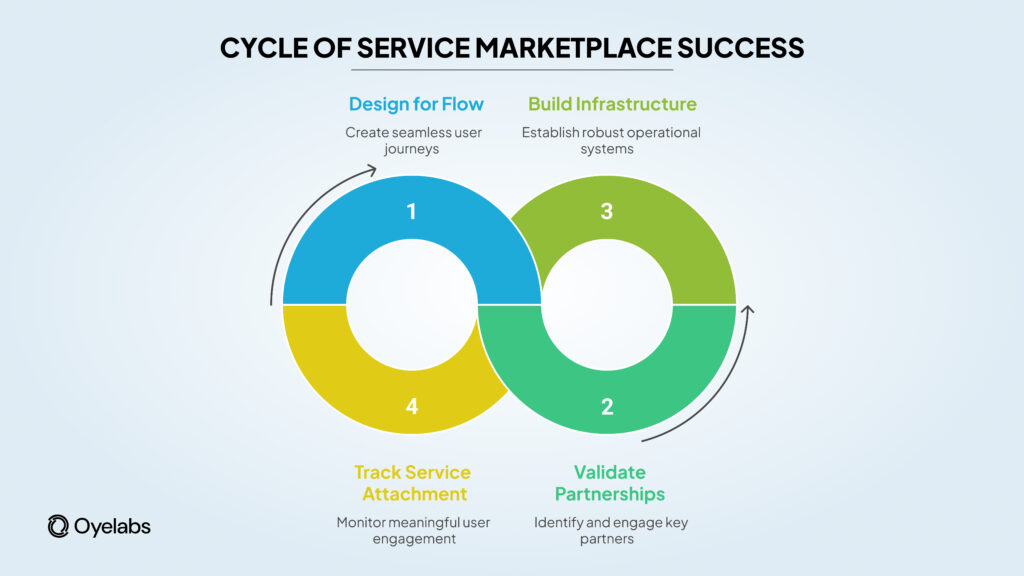
As a founder, it’s tempting to focus solely on your product. But TaskRabbit’s journey with IKEA shows how your product fits into someone else’s ecosystem can matter just as much as how it works on its own.
Here’s how you can translate their model into your own startup strategy:
- Design for flow, not just features: Your platform should fit into natural user journeys, with partners, retail flows, or embedded experiences.
- Validate the right partnerships early: TaskRabbit became scalable because IKEA already had the demand. When launching your marketplace, identify who already has your audience’s attention-and design for them.
- Build operational infrastructure from Day 1: You don’t need all the features upfront, but flows like scheduling, service tracking, and messaging should be smooth from the beginning. Poor backend coordination breaks user trust faster than anything else.
- Track service attachment, not just signups: Vanity metrics won’t help. Just like IKEA watched how many users actually booked assembly, your focus should be on completed tasks, repeat bookings, and conversion rates.
In short, think beyond the app. Build a service platform that fits into people’s lives-and possibly, other businesses’ operations too.
How Did OyeLabs Help a Founder Launch a TaskRabbit-Style Platform?
A founder needed to launch a home services marketplace fast – without hiring a full dev team or spending months in build cycles. With MoonService, Oyelabs’ white-label TaskRabbit-style solution, they got a production-ready platform with booking, scheduling, provider onboarding, and payment features pre-built. We customized it for their region and deployed it in under four weeks.
The founder saved over 6 months of development time, avoided $50K+ in build costs, and went live with a scalable, investor-ready product. Within 90 days, they saw 30% user growth and 4× task completions – enough to validate the model and begin expansion.
What Are Common Mistakes When Launching a Service Marketplace?
Success stories are useful, but knowing what to avoid is just as critical, especially in the early stages. We’ve seen founders burn time, capital, and opportunity on avoidable missteps.
Here are the most common mistakes we’ve observed when launching platforms like TaskRabbit:
1. Building Too Much, Too Early
Founders often overinvest in features before validating the basics, like whether customers are willing to pay or whether supply can be reliably onboarded.
2. Ignoring the Supply Side
Without skilled service providers, your platform can’t deliver. Failing to onboard, vet, and retain service partners early on leads to inconsistent quality and user drop-off.
3. Friction-Filled User Experience
Clunky onboarding, poor search logic, or confusing booking flows can kill engagement, no matter how strong your idea is.
4. Absence of Trust Indicators
No reviews, unclear pricing, or inconsistent task quality can break trust. A gig platform thrives on reputation. Make that a core feature.
5. Scaling Without Process
Even if demand spikes, your operations need to hold. Without clear SOPs for service tracking, payments, and customer support, growth becomes chaos.
Being aware of these traps is the first step. Avoiding them takes focus, planning, and the right team behind your execution.
How Do You Launch a Scalable Marketplace with OyeLabs?
Launching a service marketplace is not about coding an app-it’s about designing an ecosystem that connects supply and demand reliably, profitably, and with trust.
Here’s the approach we follow at OyeLabs to bring your platform from idea to execution:
Step 1: Discovery & Validation
We begin by understanding your market, user personas, competition, and value gaps. This defines your MVP roadmap.
Step 2: UI/UX Design & User Journey Mapping
We craft flows that reduce decision friction from signup to service completion. Clean, intuitive, and optimized for conversion.
Step 3: Development on a Modular Architecture
We use our white-label platform as a base, with customization for your unique needs. This speeds up delivery and reduces technical debt.
Step 4: Launch with Operational Readiness
We don’t just deploy the product-we ensure your backend (support, SLA tracking, payment reconciliation) is ready to go live.
Step 5: Post-Launch Iteration
Through analytics, feedback, and user behavior tracking, we help you iterate intelligently, prioritizing the features that move your metrics.
With OyeLabs, you’re not just hiring a development team. You’re partnering with a service marketplace specialist-someone who understands both product and performance.
Learn the essential technology stack behind platforms like TaskRabbit – built for real-time tasks, provider matching, payments, and scalable architecture.
Why Now Is the Best Time to Build a Service Marketplace App?
The service economy has shifted. What used to be dominated by agencies or word-of-mouth is now led by digital-first platforms. Consumers no longer want to find services-they expect services to find them, book fast, and deliver reliably. In 2024, 13 % of U.S. adults engaged in short‑term task work, while 4 % used platform apps, underscoring steady adoption of gig‑based services.
Why timing matters now:
- Post-COVID behavior is permanent: People now prefer trusted, app-based interactions for in-home services.
- Hyperlocal is growing: Consumers are searching for nearby solutions, often on mobile. This creates opportunities for region-specific marketplaces.
- Technology is more accessible: Founders today don’t need to build from scratch. Modular platforms, plug-and-play APIs, and proven architecture can get you to market in weeks, not months.
- Brands are looking for partnerships: Just like IKEA tapped TaskRabbit, many retailers, D2C brands, and even property managers are open to embedding service marketplaces into their offerings.
Most importantly, there’s still whitespace. While major players like Thumbtack or Urban Company exist, they don’t dominate every niche or geography. If you bring strong execution to a focused market, your odds of traction are higher now than they were five years ago.
What Should You Do Next as a Founder?
If this breakdown of IKEA and TaskRabbit’s partnership shows you anything, it’s that execution beats ideas. The opportunity to build a service marketplace still exists-but only for those who launch with purpose, clarity, and the right infrastructure.
Here’s what to consider before your next move:
- What real-world problem does your marketplace solve?
- Can you offer a better experience, convenience, or trust than existing options?
- Do you have a reliable development partner who understands this model end-to-end?
At OyeLabs, we’ve helped founders across the U.S., Europe, Africa, and Asia bring service marketplaces to life on time, on budget, and with the flexibility to evolve post-launch.
Whether you’re looking to disrupt home services, skilled gigs, B2B logistics, or anything in between, we can help design, develop, and deploy your platform, built for real-world use, not just demo screens.
Conclusion
The IKEA -TaskRabbit partnership is more than a business case-it’s a blueprint for modern service marketplaces. It proves that with the right integration, trust model, and user experience, a service platform can create exponential value. For founders and CEOs, the opportunity is real-and the window is open.
At OyeLabs, we specialize in building scalable, white-label service marketplace platforms tailored to your vision. Whether you’re launching locally or planning to scale globally, we’ll help you build it right from day one.
Ready to launch your own TaskRabbit-style platform?
Contact us to get a free demo today.
FAQs –
Q1: Why did IKEA collaborate with TaskRabbit instead of building its own service platform?
A1: IKEA leveraged TaskRabbit’s existing infrastructure to scale faster and reduce development and operational risks.
Q2: How did TaskRabbit benefit from partnering with a global brand like IKEA?
A2: TaskRabbit gained credibility, consistent task volume, and international reach through IKEA’s trusted customer base.
Q3: What measurable impact did this collaboration have on IKEA’s customer experience?
A3: Task integration increased conversions, reduced returns, and improved satisfaction across multiple IKEA markets.