
Is Ride Bargain Still the Future of the Ride-Hailing Industry?

Is Ride Bargain Still the Future of the Ride-Hailing Industry?
 Anuraag Jain
Last Updated on December 6, 2025
Key Takeaways
What You’ll Learn
- Ride Bargain apps work by letting riders set a price and drivers respond instantly.
- Negotiation-based ride-hailing reduces surge pricing issues by giving users full control over fares.
- Drivers earn more on bargaining platforms because they choose which fares to accept.
- Founders can launch a complete Indriver-style ride-hailing app for only 950 USD through Oyelabs.
- Transparent pricing models help new ride-hailing apps grow faster in local and price-sensitive markets.
Stats That Matter
- Ride-hailing may reach 430B USD globally by 2030.
- Over 100 million people use ride-hailing apps monthly worldwide.
- 57% of riders switch apps because of surge pricing.
- 45% of drivers are unhappy with current app earnings.
- Emerging markets prefer negotiation for over 60% of rides.
Real Insights
- Transparent pricing increases rider trust and daily app usage.
- Drivers stay longer when they choose their income per ride.
- Simple interfaces convert better in low-internet regions.
- Hybrid models mix fixed pricing and bargaining for smoother operations.
- Digital wallets and multiple payment options boost ride completion rates.
Is Ride Bargain Still the Future of the Ride-Hailing Industry?
The ride-hailing world isn’t the same place it was when Uber and Lyft felt unstoppable. Riders today scroll, compare, negotiate, and expect more control than ever. And that shift has opened the door for one model everyone’s talking about again: Ride Bargain, the Indriver-style “offer-your-price” approach that flipped traditional pricing on its head.
Global mobility reports from FMI and PS Market Research show that the ride-hailing industry is still accelerating toward a multi-billion-dollar market. But the real story isn’t just scale – it’s where the next opportunity lies for founders. Surge-free pricing, transparent fare discovery, and peer-to-peer negotiation are shaping what modern riders trust.
For CEOs and early-stage entrepreneurs exploring this space, the question is real: Is Ride Bargain still the future, or is the industry moving on.
This guide breaks it down with simplicity, clarity, and insights backed by market data.
What Is Ride Bargain and Why Does It Matter in Today’s Ride-Hailing Market?
Ride Bargain refers to a rider-driven pricing model where users propose a fare and drivers respond with counter-offers. Unlike traditional algorithmic pricing, this negotiation flow brings transparency, control, and fairness to both sides.
Its relevance today comes from three major shifts in rider behavior. First, price sensitivity has increased across global markets due to rising inflation and higher daily commuting costs. Second, consumers are losing trust in opaque dynamic-pricing systems. Third, the new generation of ride-hailing users prefers platforms that feel participatory, not prescriptive.
For founders, Ride Bargain represents a clear opportunity to differentiate in markets saturated with uniform Uber-like apps. Instead of competing on marketing budgets or discounts, startups can compete on the experience itself – an experience where riders and drivers feel in control.
A bargaining model is not just a feature; it is a positioning strategy for modern mobility platforms looking to build trust, retention, and local market loyalty.
How Big Is the Ride-Hailing Industry in 2025–2026?
The global ride-hailing market continues to expand at a strong pace, with research from Future Market Insights and PS Market Research indicating significant growth through 2030. The industry is moving from traditional models to hybrid and flexible mobility ecosystems shaped by shared rides, micro-mobility, subscription fleets, and regional operators.
Below is a concise comparison summarizing key industry metrics from leading research sources:
| Metric | 2025–2026 Estimates | Source |
| Global Market Size | USD 170B–200B+ | FMI, PS Market Research |
| Expected CAGR | 10%–15% | FMI |
| Daily Active Riders Worldwide | 100M+ | Industry Aggregates |
| Share of Alternative Models (P2P, Bargain, Micro-Mobility) | 25%–35% and rising | DriveMond Analysis |
| Emerging Market Contribution | 45%+ of total growth | PS Market Research |
Key Takeaways:
- Demand is shifting from metropolitan dominance to suburban and semi-urban expansion.
- Alternative pricing models (Ride Bargain, Subscription Rides, Fleet-as-a-Service) are capturing meaningful share.
- Early-stage founders have more room to enter because riders no longer assume Uber or Lyft is the only option.
This growth, paired with consumer fatigue toward algorithmic pricing, has made rider-driven models a practical and profitable entry point.
What Factors Are Driving Global Demand for Ride-Hailing Services?
Multiple industry forces continue to push the ride-hailing sector forward. These drivers matter for founders because they indicate where user expectations are heading and what product decisions will win markets.
As reported by AAA, the average annual cost of owning a new car now exceeds USD 12,000, making ride-hailing a more economical option for millions of commuters.
Primary Growth Drivers
- Urbanization and Congestion: Cities are becoming more crowded, increasing reliance on flexible mobility over car ownership.
- Smartphone Penetration: Affordable devices and broader internet reach enable quick adoption, especially in emerging markets.
- Cost of Vehicle Ownership: Rising fuel prices, maintenance, and insurance costs make ride-hailing a financially efficient alternative.
- Shift Toward On-Demand Convenience: Consumers expect instant access – transportation included.
- Regulatory Acceptance: Many governments are now formalizing mobility guidelines, opening up space for local operators.
- Rise of Alternative Pricing Models: User demand for transparent and negotiable fares is pushing Ride Bargain platforms into mainstream relevance.
Together, these factors create favorable conditions for founders entering the market. A model that prioritizes transparency, rider choice, and driver empowerment aligns directly with current market expectations.
What Do Passengers Expect From Modern Ride-Hailing Apps Today?
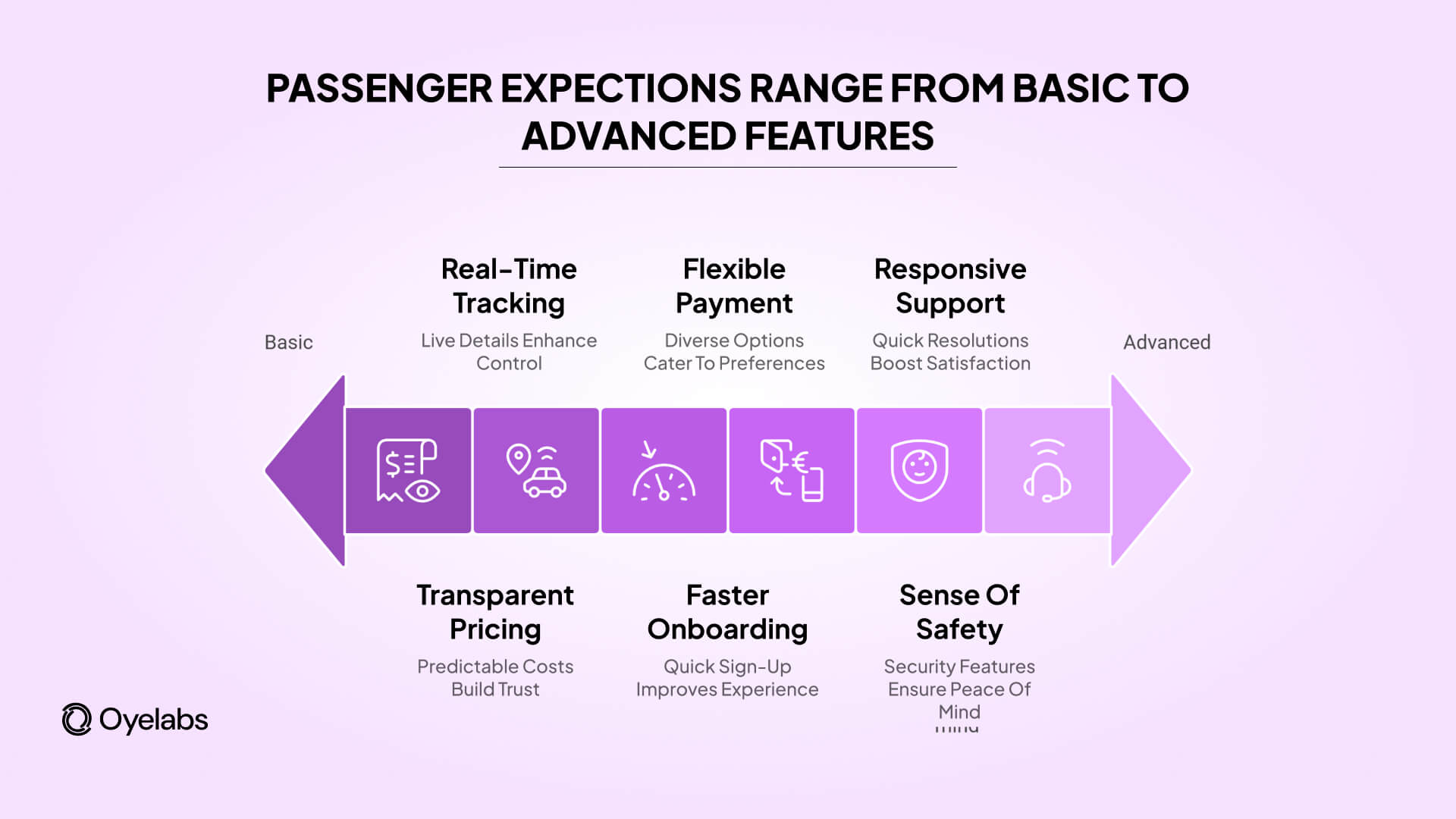
Passenger expectations have evolved far beyond simple A-to-B transport. Users now evaluate ride-hailing platforms by how much control, clarity, and security they offer. This shift is well-documented across recent analyses from FMI, DriveMond, and Appicial.
The modern rider expects:
- Transparent and predictable pricing: Riders want clarity before confirming a trip. Unexpected surges erode trust.
- Real-time visibility: Live tracking, driver details, and ETA accuracy are now baseline expectations.
- Faster onboarding: Users expect sign-up and verification to take minutes, not hours.
- Flexible payment options: Cards, wallets, local gateways, cash-on-completion – varies by region but the expectation stays constant.
- A sense of safety: ID verification, trip-sharing, and SOS layers are no longer considered premium features.
- Responsive customer support: Users want issues resolved quickly, preferably through in-app flows.
Ride Bargain apps, by their nature, address the central expectation – transparent pricing – and give riders an active role in the booking process, making them feel more valued and engaged.
Is Ride Bargain Still a Strong Business Model for Ride-Hailing Startups?
Yes, Ride Bargain remains a strong and relevant model, particularly for founders targeting markets underserved by traditional ride-hailing structures. Its continued success stems from addressing real economic and behavioral gaps that algorithm-driven pricing cannot solve.
Several factors support its viability:
- High trust through open negotiation: Riders appreciate choosing the price they are comfortable with.
- Better driver economics: Drivers can decline low offers and negotiate fair earnings.
- Lower market-entry barriers for new startups: Competing on experience – not discounts – reduces cash burn.
- Viral and community-driven adoption: Negotiation-based booking often leads to stronger word-of-mouth because the experience feels human and local.
- Sustainable in inflation-driven economies: Users readjust their spending daily; bargaining aligns with flexible affordability.
The model is especially potent in regions where algorithmic pricing is viewed as unpredictable or unfair. While not perfect for every geography, Ride Bargain continues to outperform in community-centric markets where trust is a deciding factor.
Why Are Pricing Transparency and Control So Critical for Riders Now?
Pricing transparency has become one of the primary decision-making factors for passengers. The rise in public frustration toward surge pricing, hidden fees, and inconsistent fare calculations has pushed riders toward platforms that reveal costs upfront.
The importance of transparency is rooted in three shifts:
- Economic pressure: With living costs rising globally, predictable transportation expenses matter more than ever.
- Loss of faith in algorithmic pricing: Riders increasingly believe traditional apps inflate fares during peak hours or in specific areas.
- Perception of fairness: When riders set the price – or negotiate it – they feel the service respects their budget.
Control ties directly into user satisfaction. Platforms that allow riders to adjust offers or choose from multiple driver responses create a sense of agency. This emotional impact leads to better retention, stronger daily usage, and more brand loyalty – crucial for early-stage operators entering competitive regions.
How Does the Ride Bargain Model Benefit Drivers Compared to Traditional Apps?
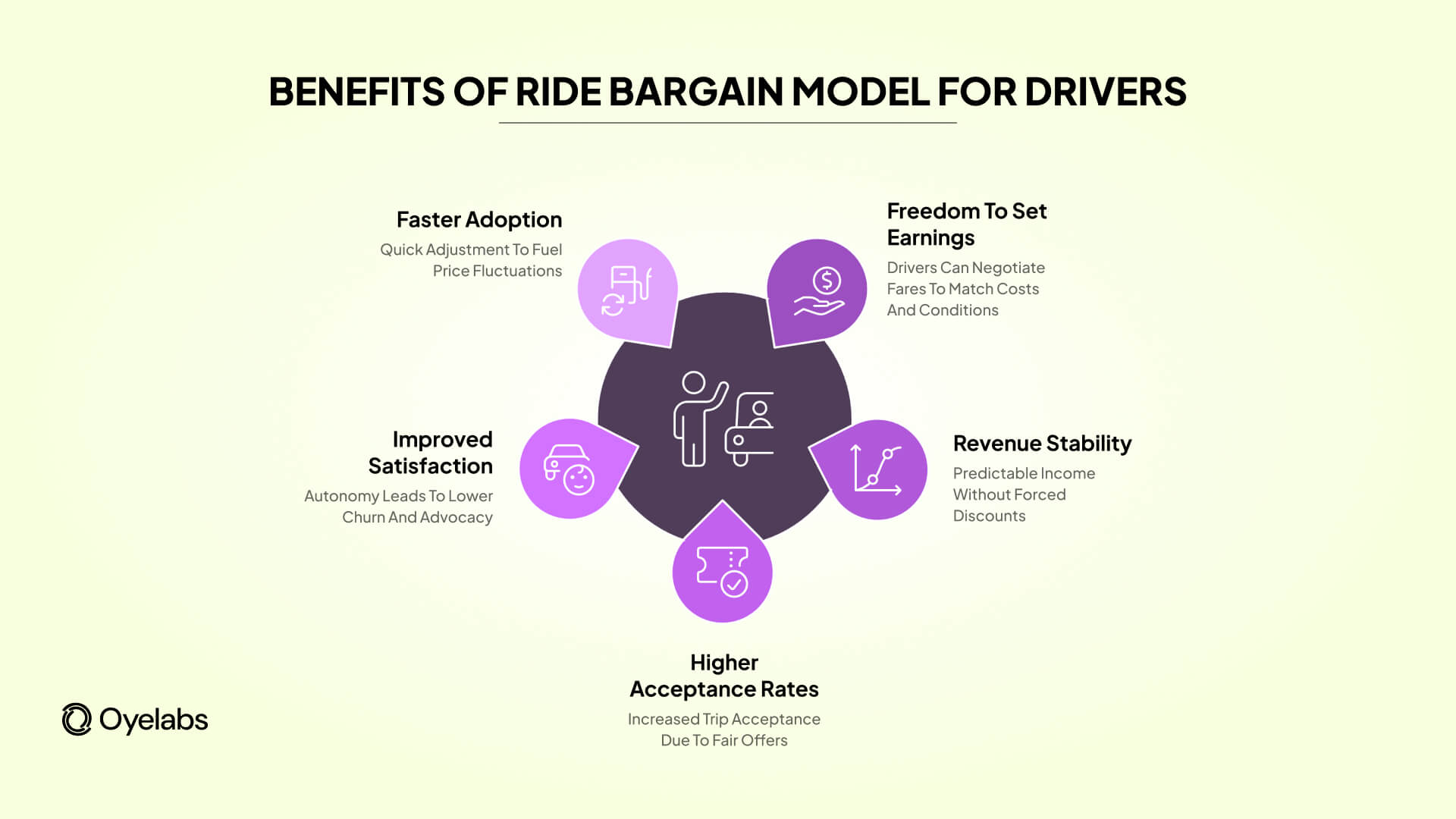
Drivers are at the center of every successful ride-hailing platform. If they feel underpaid or restricted, the entire ecosystem weakens. This is where the Ride Bargain model provides a structural advantage over traditional pricing formats.
Key benefits include:
- Freedom to set fair earnings: Drivers can negotiate instead of accepting automated fares that may not match fuel costs or local conditions.
- Better revenue stability: Without forced discounts or algorithmic deductions, their income becomes more predictable.
- Higher acceptance rates: When drivers see offers aligned with their expectations, trip acceptance increases organically.
- Improved driver satisfaction: The sense of autonomy leads to lower churn and better platform advocacy.
- Faster adoption in markets with rising fuel prices: Negotiation-based pricing allows drivers to adjust instantly to daily cost fluctuations.
Ride Bargain platforms build trust by allowing drivers to participate directly in pricing decisions – an advantage traditional models often fail to provide.
What Are the Major Challenges of Launching a Ride Bargain Platform?
While the Ride Bargain model has clear strengths, founders should understand the operational and structural challenges involved. Awareness of these factors helps startups plan better and avoid unnecessary complexities during scaling.
Common challenges include:
- Slower early traction in premium urban markets: Users accustomed to instant booking may take time to adopt negotiation-based flows.
- Regulatory compliance: Some regions require predefined pricing bands or government-approved fare limits.
- Balancing rider and driver expectations: Successful platforms need a mechanism to prevent lowballing and exploitative pricing.
- Supply-demand management: Negotiation systems rely heavily on active user participation; inactive drivers or riders can slow the flow.
- Operational safeguards: ride dispute handling, safety protocols, and fraud prevention require robust backend systems.
- Interface complexity: Overly complicated negotiation screens can reduce conversion rates if not thoughtfully designed.
These challenges are solvable with the right product strategy, strong onboarding design, and a clear understanding of regional behavior. Most successful Ride Bargain apps address these issues early in their architecture and UI design.
Is a Hybrid Ride Bargain Model the Future of Ride-Hailing?
A growing number of mobility analysts suggest that the future is not purely bargaining or purely algorithmic – it’s a hybrid of both. This evolution aligns with shifting consumer expectations, regulatory environments, and platform scalability needs.
A hybrid Ride Bargain model typically includes:
- Suggested fares based on distance and traffic, allowing riders to negotiate but still see reference benchmarks.
- Time-based controls, where negotiation is open during non-peak hours and fixed pricing applies during high-demand periods.
- AI-driven price recommendations, guiding riders to reasonable offers while preventing lowballing.
- Driver earning calculators help drivers evaluate whether a proposed fare matches their income goals.
- Flexible booking modes, allowing riders to switch between instant booking and bargain negotiation.
This hybrid approach resolves key limitations while preserving the transparency and fairness the bargaining model is known for. It gives founders the best of both worlds – a scalable system with a user-centric experience that still feels local, flexible, and fair.
Which Markets Are Best Suited for Ride Bargain Platforms?
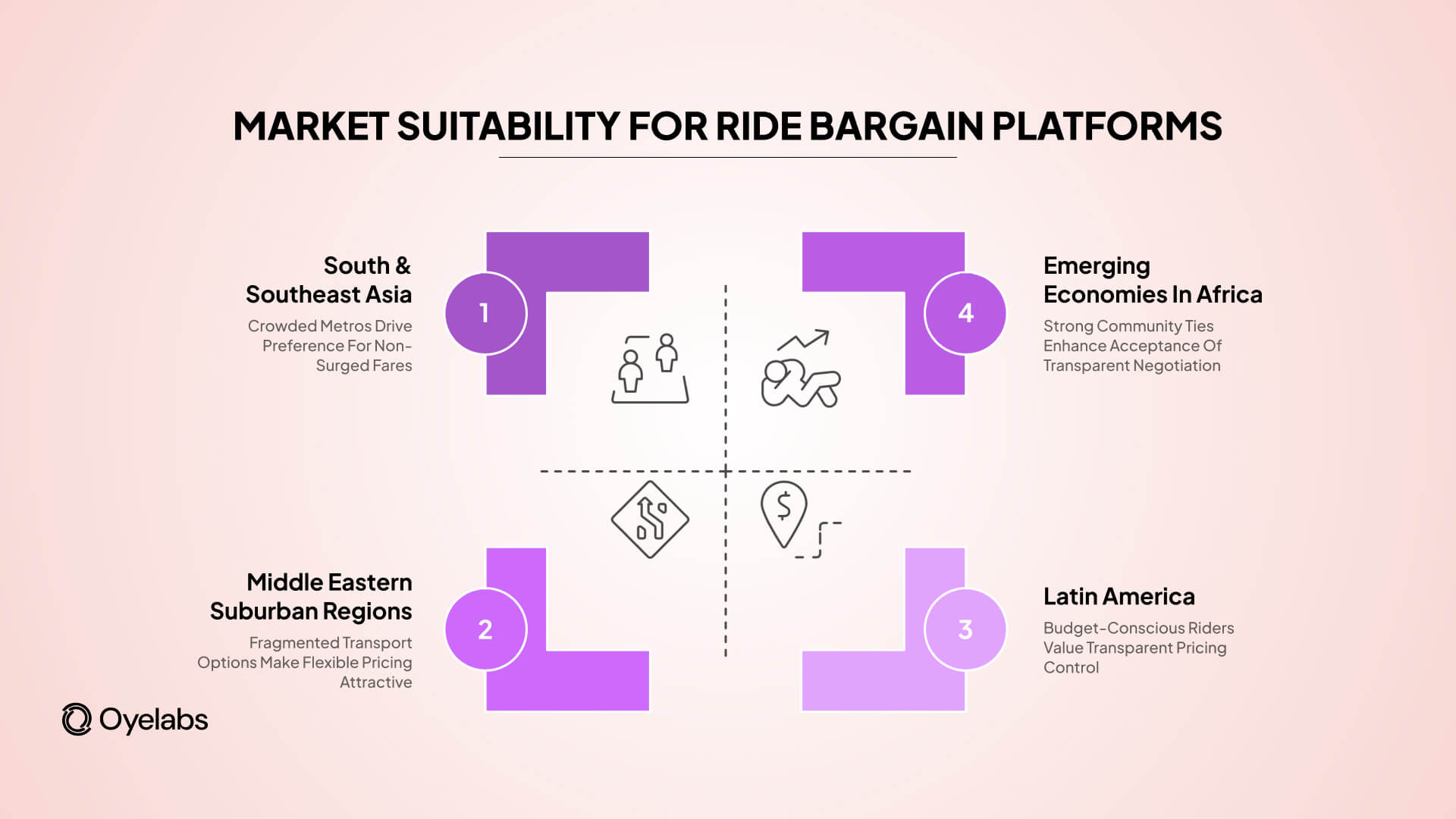
Ride Bargain platforms thrive in markets where riders and drivers value transparency, control, and flexibility more than algorithmic convenience. These characteristics are most common in regions with developing infrastructure, volatile fuel pricing, and strong community-driven commerce behaviors.
Markets where the model performs exceptionally well:
- Emerging economies in Africa: High price sensitivity and strong acceptance of negotiation-based transactions.
- South and Southeast Asia: Large commuter populations, crowded metros, and preference for non-surged fares.
- Latin America: Local mobility ecosystems shaped around budget-conscious riders and micro-entrepreneurs.
- Eastern Europe and CIS countries: Familiarity with bargaining and dissatisfaction with traditional surge algorithms.
- Middle Eastern suburban regions: Fragmented transport options make flexible pricing attractive.
These markets share a common theme: consumers appreciate choice. They respond strongly to platforms that allow them to decide what they pay rather than relying solely on algorithmic calculations. Founders entering such regions often find faster adoption, better retention, and higher organic growth.
What Should Founders Know Before Building a Ride Bargain–Style App?
Before entering the market, founders must understand that Ride Bargain apps succeed only when operational planning and feature architecture align with regional behavior. This model requires more than a booking interface – it demands thoughtful system design.
Critical considerations include:
- Validating rider and driver willingness to negotiate: Not all markets adopt bargaining behavior equally.
- Building a reliable driver supply from day one: Negotiation flows fail without active supply participation.
- Understanding local regulatory requirements: Some regions demand fare ceilings, safety integrations, or licensing frameworks.
- Implementing clear user guidelines: Platforms should guide riders on reasonable offers to avoid low-quality interactions.
- Mapping payment flow complexity: Local gateways, cash trips, and wallets play a major role in adoption.
- Designing safety-first architecture: ID verification, real-time monitoring, and trip reporting must be integrated from the start.
Founders who approach the model with structured planning often gain a strategic advantage, especially in competitive or highly fragmented markets.
What Core Features Does a Successful Ride Bargain App Require?
A high-performing Ride Bargain platform balances flexibility with reliability. While negotiation is the defining feature, the surrounding system must deliver stability, safety, and seamless execution.
Essential features include:
- Offer-and-counter-offer negotiation system: Allows riders to propose fares and drivers to respond instantly.
- Driver verification and document management: Ensures platform safety and regulatory compliance.
- Real-time location tracking: Accurate pickup, route navigation, and ETA calculations.
- In-app communication: Chat or call options to clarify pickup details or pricing.
- Multiple payment modes: Wallets, cards, cash, and region-specific gateway integrations.
- Ratings and review system: Encourages accountability on both sides.
- Admin control center: For monitoring disputes, managing fares, handling fraud, and reviewing trip history.
- Trip safety protocols: SOS features, ride-sharing, and in-app reporting.
A Ride Bargain app succeeds not because of negotiation alone, but because the surrounding features create a structured, dependable experience. Founders who balance flexibility with operational discipline tend to scale faster and retain users more effectively.
Want a full breakdown of how negotiation apps make money? Read our InDriver business model blog.
How Did Oyelabs Help a Founder Launch a Successful Indriver-Style Platform?
One of the most compelling demonstrations of the Ride Bargain model’s potential came from a founder who partnered with Oyelabs to build an Indriver-style negotiation platform. The founder operated in a price-sensitive region where riders felt disconnected from the high, algorithm-driven fares offered by major competitors. Using Oyelabs’ white-label ride-hailing system as the foundation, the platform was launched in a matter of weeks – not months.
The results were noticeable almost immediately. Riders engaged actively with the bargain feature, drivers appreciated the ability to negotiate earnings, and the brand built credibility quickly through transparent pricing. Within the first quarter, the startup saw a rise in rider retention, a stronger presence in local search trends, and higher engagement on social channels. By giving riders and drivers a sense of control, the platform evolved from a new entrant into a recognized local brand. This transformation showed how strategic execution and the right technology partner can accelerate market positioning.
Why Do Ride-Hailing Startups Choose Oyelabs as Their Technology Partner?
Founders often choose Oyelabs because the company offers both technical capability and market understanding. Ride-hailing platforms are operationally complex, requiring real-time data management, geo-services, identity verification, multi-gateway payments, and driver-rider matching – all of which Oyelabs has already engineered within its white-label framework.
Key reasons startups trust Oyelabs include:
- Faster deployment timelines, often as quick as seven days for base solution rollouts.
- Scalable system architecture capable of supporting thousands of concurrent trips.
- Customizations aligned with regional regulations, safety standards, and market expectations.
- End-to-end delivery, including rider app, driver app, admin dashboard, dispatch system, and optional fleet management modules.
- Experience across global markets, giving founders the confidence to operate in diverse environments.
- Post-launch support and enhancements, allowing startups to grow sustainably.
For founders aiming to capture market gaps or build a local challenger to major incumbents, Oyelabs provides a balanced combination of speed, reliability, and strategic product depth.
What Revenue Models Work Best for Ride Bargain–Based Startups?
Successful Ride Bargain platforms typically rely on diversified income streams rather than a single revenue line. This allows founders to maintain competitive fares while still generating predictable revenue at scale.
Effective monetization strategies include:
- Commission per trip: A standard practice where a portion of each completed ride is retained by the platform.
- Driver subscription plans: Drivers pay weekly or monthly fees to access unlimited ride requests – common in high-volume markets.
- Service fee on negotiated fares: A small processing fee that remains surge-free yet profitable at high transaction volume.
- Wallet recharge fees: Especially effective when platforms introduce digital wallet ecosystems.
- Corporate ride partnerships: Provide predictable revenue and steady trip volume.
- Driver promotion packages: Paid boosts to appear higher in rider search results.
- In-app advertising: Works well once user engagement reaches critical mass.
The best-performing platforms typically combine two to three models, depending on market maturity and rider expectations. Diversifying early helps founders reduce dependency on a single revenue stream and strengthen long-term financial stability.
What Does the Future of the Ride-Hailing Industry Look Like by 2030?
The ride-hailing industry is moving toward a more adaptive, transparent, and tech-driven ecosystem. Multiple forecasts indicate a shift from purely algorithmic models to systems that blend AI-assisted pricing, negotiation layers, and multi-modal mobility in a single platform.
Key trends shaping the future:
- AI-driven trip matching and smart fare suggestions: Platforms will use contextual data – traffic, driver availability, neighborhood demand – to recommend fair bargain ranges.
- Growth of autonomous and semi-autonomous fleets: Human-driven rides will coexist with automated vehicles in select cities.
- Surge-free and transparent pricing is becoming standard: Riders will gravitate toward services that guarantee predictable fares.
- Expansion of local ride-hailing ecosystems: Small and mid-size operators will continue to emerge, giving riders more alternatives.
- Rise of first-mile/last-mile mobility: Micro-mobility integrations – e-bikes, shared scooters, mini EVs – will expand platform utility.
By 2030, platforms that give users more control over pricing, safety, and personalization will outperform those that rely solely on fixed algorithmic fares.
Should Founders Still Invest in Bargain Ride-Hailing Platforms in 2026?
Yes – if executed correctly, the growth potential remains strong. The Ride Bargain model continues to outperform in regions where transparency and affordability influence booking decisions. For founders entering developing markets or suburban regions underserved by global apps, it provides a powerful differentiator.
What makes the opportunity even more accessible is the reduced cost of launching such platforms today. Oyelabs has packaged its proven Indriver-style solution – complete with rider app, driver app, admin panel, and bargaining modules – into an affordable launch-ready inDriver clone product priced at 950 USD. This allows startups to test markets quickly, iterate faster, and scale with far lower upfront investment compared to building from scratch.
Given rising demand for alternative pricing models and the availability of cost-efficient technology, 2026 remains a strong entry point for founders aiming to build regional ride-hailing brands.
Conclusion
Ride Bargain is not fading; it is evolving. The model remains highly relevant for markets that prioritize transparency, affordability, and fairness – values increasingly demanded by riders and drivers worldwide. While algorithmic pricing will always have a place in dense metropolitan regions, negotiation-based or hybrid pricing models continue to earn trust in emerging and suburban markets.
For founders, the opportunity lies in positioning: entering with a flexible model, understanding local pain points, and using technology that supports scalable, transparent operations. With solutions like Oyelabs’ $950 USD Indriver-style platform, the barrier to entry has never been lower, making it possible to launch quickly, validate demand, and build a sustainable mobility brand.
FAQs
Q: Is the Ride Bargain model still profitable for ride-hailing startups today?
A: Yes, it remains profitable in price-sensitive markets demanding transparent and negotiable fares.
Q: How does Ride Bargain differ from traditional surge-based ride-hailing apps?
A: Riders propose prices, drivers counter, ensuring transparent, surge-free and mutually agreed fares.
Q: Is it expensive to launch an Indriver-style Ride Bargain app?
A: No, Oyelabs offers a complete Indriver-style solution starting at only 950 USD.
Q: Which regions adopt Ride Bargain apps fastest in 2026?
A: Africa, Latin America, South Asia, and Tier-2 markets with strong price sensitivity.