
Why Your Live Commerce App Will Cost 70% More Than Estimated

 Sachin Sharma
Last Updated on February 26, 2026
Key Takeaways: What You’ll Learn: Live commerce apps cost more than early estimates suggest. Live streaming requires complex real-time infrastructure. Video overlays and product sync need custom development. Marketplace payments are harder than normal eCommerce payments. Seller payouts require split payment architecture. Trust and safety must be built before launch. Infrastructure costs continue after launch every month. Stats That Matter: Whatnot surpassed $6B in GMV in 2025. Video infrastructure can cost $3,000–$15,000 monthly. Viewer concurrency above 10,000 increases infrastructure costs sharply.
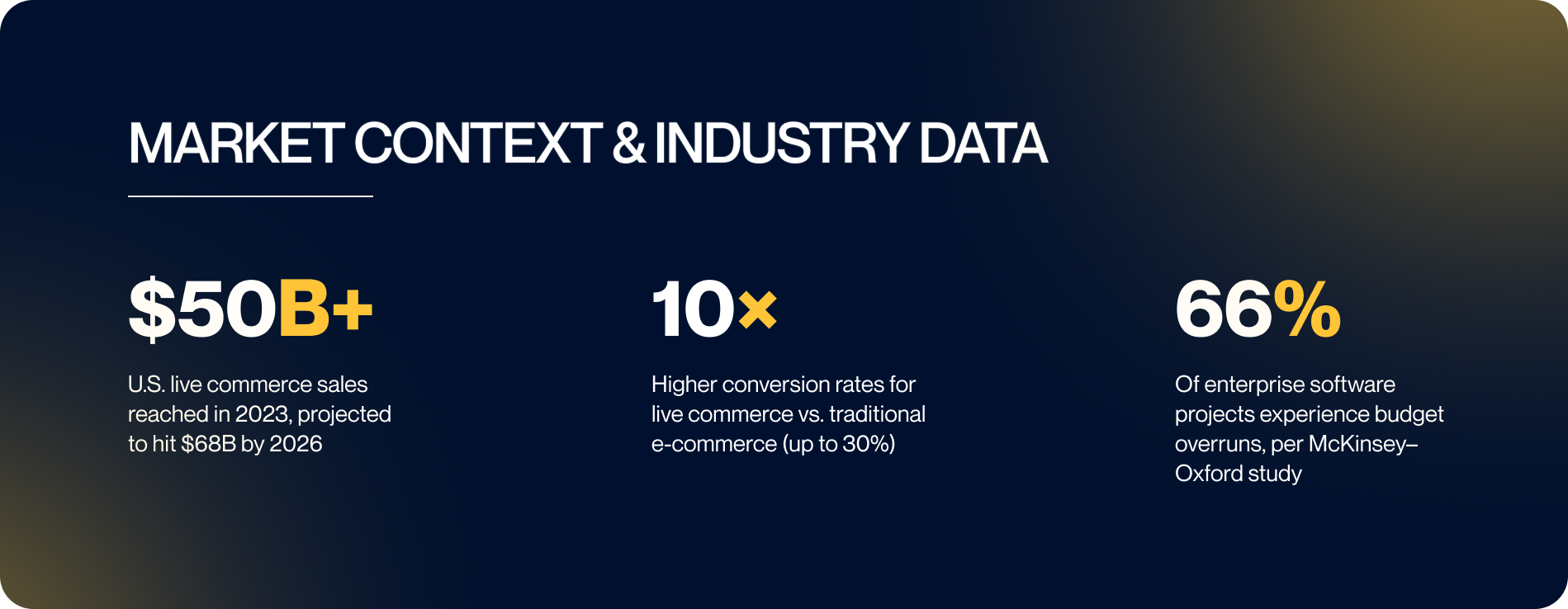
It’s basically live video with a buy button. That is how most founders describe their MVP. It is also the framing that produces wildly underestimated development costs. If you have received a development quote for a live commerce platform, think Whatnot, Popshoplive, or TalkShop Live, there is a strong chance that number will balloon significantly before you go live. Not because developers are dishonest. But because live commerce applications are architecturally complex, and most initial estimates are built on optimistic assumptions about scope. At Oyelabs, we have helped founders build live streaming platforms and marketplace across industries. This article breaks down exactly where the hidden costs accumulate, so you can plan for them before they become a crisis. Each feature that sounds trivial on a product brief contains layers of technical complexity that most initial estimates gloss over entirely. When you stack these, you’re not building one app. You’re building four tightly integrated systems that must work simultaneously, in real time, under concurrent load. Live commerce is not a standard request-response application. Every product view, bid, chat message, and inventory update must propagate to thousands of concurrent users in under one second. Standard web architectures are not designed for this. This layer requires WebSocket servers maintaining persistent connections, message brokers (Redis Pub/Sub or Kafka) to fan out events at scale, and conflict resolution logic for simultaneous actions, such as two users clicking “Buy” on the last unit at the same moment. Why It Gets Missed: This infrastructure is almost never reflected in first-draft estimates. It rarely appears in wireframes, and many developers only discover the true scope once system architecture is drawn out. Per the McKinsey-Oxford study on 5,400+ IT projects, large software projects run an average of 45% over budget, and live commerce apps sit at the more complex end of that distribution. Most estimates treat streaming as a third-party drop-in: “We’ll plug in Agora or Mux.” But live commerce video is an interactive broadcast experience, not just a stream. It demands: Third-party SDKs handle the transport layer. Everything surrounding the video, overlays, interactive elements, and product data synchronized to specific stream moments, requires fully custom engineering. Video infrastructure alone, CDN fees, SDK licensing, and custom work around the stream, typically costs $15,000–$60,000 to build and $3,000–$15,000 per month to operate at modest scale.
Builder Tip: Ask your development partner to provide separate line items for video infrastructure build costs versus ongoing operational costs. These are frequently combined into a single upfront figure, which obscures your true monthly overhead once you launch.. A standard e-commerce payment integration typically takes one to two weeks. A live commerce marketplace payment system can take two to four months to build correctly. You are not simply accepting payments. You are running a marketplace where: Whatnot allocated significant resources to trust and safety early in its development, not as a formality, but because without it the platform would have collapsed under fraud, fake listings, and bad actors within weeks of launch. Whatnot now operates at an $11.5B valuation and continues to expand its trust and safety team with each funding round. Your MVP requires at minimum: AI-assisted chat moderation for hate speech and spam, seller verification workflows, dispute resolution tied to order history, bid rate limiting to prevent bot activity, and fraud detection hooks connected to payment processing. A live commerce event is a flash-load scenario. Your platform may have 50 concurrent users at 11:58 AM and 8,000 users at 12:01 PM when a product drop goes live. Standard QA processes do not test this traffic profile. Proper load testing and infrastructure hardening for burst-load scenarios requires dedicated performance engineering cycles, auto-scaling configuration across the full stack, database connection pooling tuned for concurrent traffic, and end-to-end stress testing of real-time event propagation. Also Read: Whatnot Business Model The total overrun in this example reaches 97%, with the initial projected budget increasing from $98,000 to $193,000. Live commerce platforms, because of their real-time infrastructure, marketplace payments, streaming complexity, and scalability requirements, often experience significant cost expansion once full technical scope is properly defined. Grade 1 MVP $80K – $130K Market-Ready $150K – $250K Funded Launch $280K – $500K+ 1. Require a Technical Architecture Review Before Receiving an Estimate A feature-list estimate is not a scoped estimate. Require your development partner to produce a system design document before quoting. Any developer who cannot explain how real-time state will be managed across concurrent users is not yet ready to price the project. 2. Separate Infrastructure Costs from Development Costs Ongoing fees for video, payment processing, push notification services, and CDN belong in your financial model as recurring line items, not buried inside a one-time development figure. Conflating the two creates false confidence in your burn rate. 3. Phase Your Build Around Revenue Events, Not Feature Completeness You do not need VOD replay, simultaneous multi-seller streams, or a referral engine before your first 10 shows. Build what generates revenue. Layer in complexity as the business earns the capital to fund it. 4. Pressure-Test the Estimate with “What Happens When” Questions What happens when two users bid simultaneously on the last item? What happens when 5,000 users join a stream in the first 30 seconds? If your developer cannot answer these questions with specifics, the estimate does not account for solving them. 5. Insist That Trust and Safety Appears as a Named Line Item If moderation, seller verification, and dispute resolution are not visible in your development estimate, they are not included. Ask for them explicitly. A platform without these is not ready for public users, regardless of how polished the product screens look. The question is not “How much will this cost?” The more useful question is: “How much will it cost to build something that does not fail when it matters most?” Live commerce platforms are stress-tested at peak moments, a product drop, a high-profile seller, a viral moment. Whatnot’s GMV surpassed $6 billion in 2025, growing over 2x year-on-year. That kind of platform performance is built on infrastructure decisions made early, decisions that most initial estimates never price correctly. The live commerce market in the U.S. is projected to reach $393 billion by 2033 at a 41% CAGR, according to Grand View Research. The opportunity is real. So is the technical complexity required to capture it. Founders who go into a build with a realistic understanding of costs do not spend less, they spend more wisely. They phase correctly, scope accurately, and do not rebuild the same system twice because the first version could not handle the load. Check Out: What to Look for in a Good Whatnot Like App Script At Oyelabs, we scope live commerce platforms with full transparency, infrastructure, trust and safety, load testing, and payment architecture included from day one. ✓ Marketplace payment and seller payout system ✓ Moderation and trust frameworks built for growth ✓ Scalable bidding and checkout infrastructure ✓ Load-tested infrastructure designed for peak traffic Live commerce is far more than live video with a checkout button. It combines real-time infrastructure, interactive streaming, marketplace payments, and trust systems that must perform flawlessly under peak traffic. Most cost overruns happen not because of poor development, but because early estimates fail to account for this technical depth. If streaming latency, concurrent bidding, payouts, moderation, and load testing are not clearly scoped, your budget is incomplete. Founders who succeed are not those who spend the least, but those who plan realistically, phase strategically, and build systems that hold under pressure. In live commerce, clarity at the start protects capital at launch.
The “Simple” Feature That Isn’t
Budget Killers Nobody Puts in the Initial Estimate
1. Real-Time Infrastructure: The Hidden Foundation
2. Video Streaming: A Product, Not a Feature
Video Cost Breakdown
3. Payments and Payouts: A Multi-Month Engineering Sprint
4. Moderation and Trust Infrastructure: Invisible Until Launch
5. Scalability and Load Testing: Non-Negotiable Line Items
The Before-and-After: Where Estimates Break Down
Realistic Budget Ranges by Launch Stage
Single seller streams, basic cart features, iOS or Andriod.
Multi-seller, bidding, dashboards, iOS and Android.
Full feature parity, moderation tools, analytics, web and mobile scale.How to Protect Your Budget Without Cutting Corners
The Right Question to Ask Before You Build
Build It Right the First Time
Conclusion