
Features to Convert Free Users to Paid in an EdTech Platform
Features to Convert Free Users to Paid in an EdTech Platform
 Anuraag Jain
Last Updated on March 8, 2026
Key Takeaways
What You’ll Learn:
- Which product features drive the highest free-to-paid conversion rates in EdTech platforms
- How gamification, AI personalization, and social accountability function as conversion engines
- What the correct free tier architecture looks like – how much to give away and where to stop
- How to tier your subscription model to maximize revenue across different user segments
- The platform maturity stages and what investment each stage requires
Stats That Matter:
- Duolingo generated $748 million in revenue in 2024, with subscriptions accounting for 83% of total revenue, driven by a freemium model converting roughly 8% of monthly active users (Source: Pestel-Analysis / Duolingo public data)
- Over 90% of users drop free online courses before completion – motivation, not content, is the primary dropout driver (Source: Blue Ocean Strategy)
- The global EdTech market is projected to reach $1.65 trillion by 2030, with freemium-to-enterprise conversion funnels dominating new startup strategies (Source: Statista)
Real Insights:
- Gamification converts users by making free-tier friction feel solvable with a subscription
- Platforms converting above 4% engineer upgrade moments around existing user habits
Features to Convert Free Users to Paid in an EdTech Platform
Most EdTech platforms do not fail because they lack content. They fail because they cannot convert the users they already have. The freemium model is the dominant acquisition strategy in EdTech – but acquisition and conversion are two entirely different disciplines. A platform with one million free users and a 1% conversion rate generates 10,000 paying customers. The same platform with a 4% conversion rate generates 40,000. The product and its feature decisions are what determine which one you are.
Duolingo converted just 3% of its free user base – and generated over $300 million in subscription revenue in 2025. That outcome was not an accident. It was the result of deliberate product engineering: specific features designed to build habit, create friction at the right moment, and make the paid tier feel like the logical next step rather than an upsell.
This guide maps those features. It is written for founders allocating real capital toward building a competitive EdTech platform – not for product managers running A/B tests on button colors.
Why Most EdTech Platforms Get the Free-to-Paid Conversion Wrong
The most common mistake founders make is treating the paid tier as a content wall. They build a library, put 30% of it behind a paywall, and wait for upgrades. Users leave instead.
Free-to-paid conversion in EdTech is not a pricing problem. It is a behavioral design problem. The user who upgrades does not do so because they hit a paywall – they do so because the platform has already made itself indispensable. The upgrade feels like a natural extension of an existing habit, not the beginning of a financial commitment.
Platforms that convert well engineer the free experience to create momentum and then design a paid tier that protects and accelerates it. The features that drive this outcome are specific, measurable, and buildable. Understanding which ones to prioritize at each stage of platform maturity is the decision this article is designed to help you make.
Gamification as a Conversion Engine – What Duolingo Actually Built
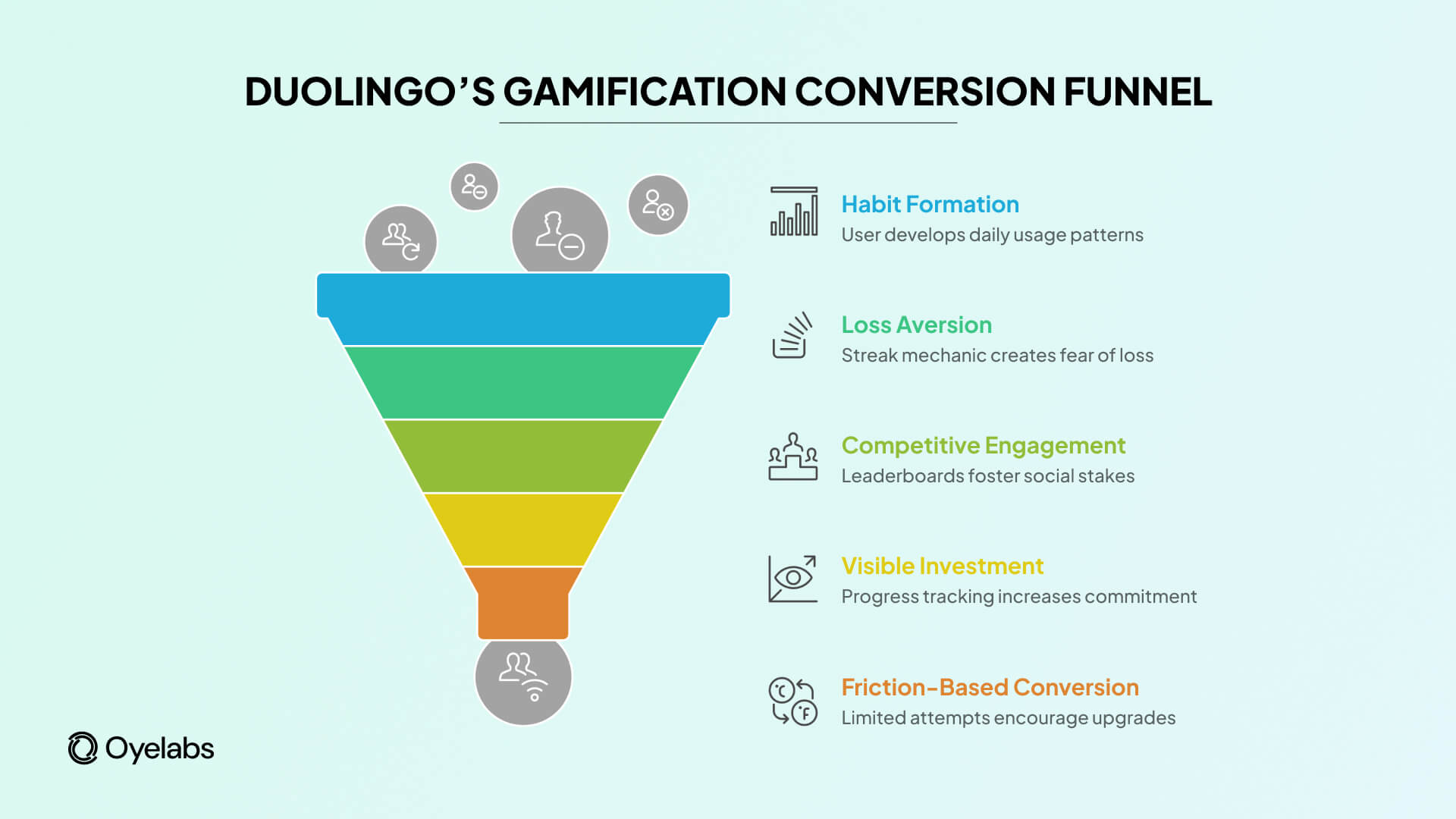
Gamification is not streaks and badges. That is the surface layer. The conversion engine underneath it is habit formation – turning an inconsistent user into a daily active user whose usage pattern is now emotionally and behaviorally tied to the platform.
Duolingo’s streak mechanic is the most studied example. A streak creates a loss aversion dynamic: the longer a user maintains it, the more painful breaking it becomes. This is not engagement for its own sake. It is a mechanism that converts a low-commitment free user into a high-frequency user – and high-frequency users convert to paid at dramatically higher rates than occasional users.
The specific gamification features that drive free-to-paid conversion in EdTech platforms include:
- Daily streaks with recovery mechanics: Users who miss a day face the loss of a streak. Offering a paid “streak freeze” or “streak repair” feature converts habit-motivated users directly. This is a single-feature conversion trigger that Duolingo executes with high precision.
- XP and leaderboard systems: Competitive ranking among peers creates social stakes. Users who care about their position in a leaderboard are demonstrating engagement depth that correlates strongly with paid conversion.
- Progress visualization: Explicit tracking of skills mastered, lessons completed, and proficiency improvements makes the learning investment visible. Visible investment increases the psychological cost of abandoning the platform – which keeps users in the funnel.
- Limited “hearts” or attempt mechanics: Restricting the number of mistakes a free user can make per session before requiring a cooldown or reset is a friction-based conversion trigger. Users who want to maintain flow without interruption upgrade to remove the constraint.
The key principle: gamification drives conversion not by rewarding users for paying, but by making the free experience slightly uncomfortable in ways that a small monthly fee can resolve.
Builder Tip: Do not build gamification features as cosmetic additions. Each mechanic should serve a specific behavioral objective – daily return, session depth, or upgrade trigger. Map every feature to a conversion moment before you build it. Decorative engagement features do not convert users. Behavioral ones do.
AI Personalization – The Feature That Justifies the Premium Price
Personalization is the clearest functional differentiator between free and paid tiers in modern EdTech. It is also the feature category that users are most willing to pay for – because they experience the value directly and immediately.
A free tier delivers content. A paid tier delivers a learning experience that adapts to the individual user’s pace, knowledge gaps, learning style, and availability. These are not the same product.
The AI personalization features that drive the highest paid conversion rates:
- Adaptive learning paths: The platform adjusts lesson difficulty, content sequencing, and topic prioritization based on user performance data. A user who consistently struggles with a specific concept receives additional practice in that area before advancing. A user who demonstrates mastery moves faster. This creates a personalized experience that a static course library cannot replicate.
- Spaced repetition systems (SRS): SRS schedules content review at scientifically optimal intervals to maximize long-term retention. For skill-based learning – languages, coding, mathematics – spaced repetition is one of the highest-impact learning mechanisms available. Offering it exclusively in the paid tier creates a genuine functional gap between free and paid that users can feel.
- AI-powered feedback on open-form responses: Written summaries, code submissions, short-form answers, and spoken pronunciation all benefit from AI evaluation. Free tiers typically offer multiple-choice and automated scoring. Paid tiers with AI feedback loops deliver a qualitatively different learning experience.
- Personalized study plans: Users who receive a structured plan built around their stated goal and timeline experience higher completion rates. Offering plan generation as a paid feature delivers immediate, tangible value at the point of upgrade.
The business case for AI personalization in the paid tier is straightforward: it delivers measurable learning outcomes that the free tier cannot, which creates a rational justification for the subscription price.
Social and Community Features That Convert Free Users to Paid
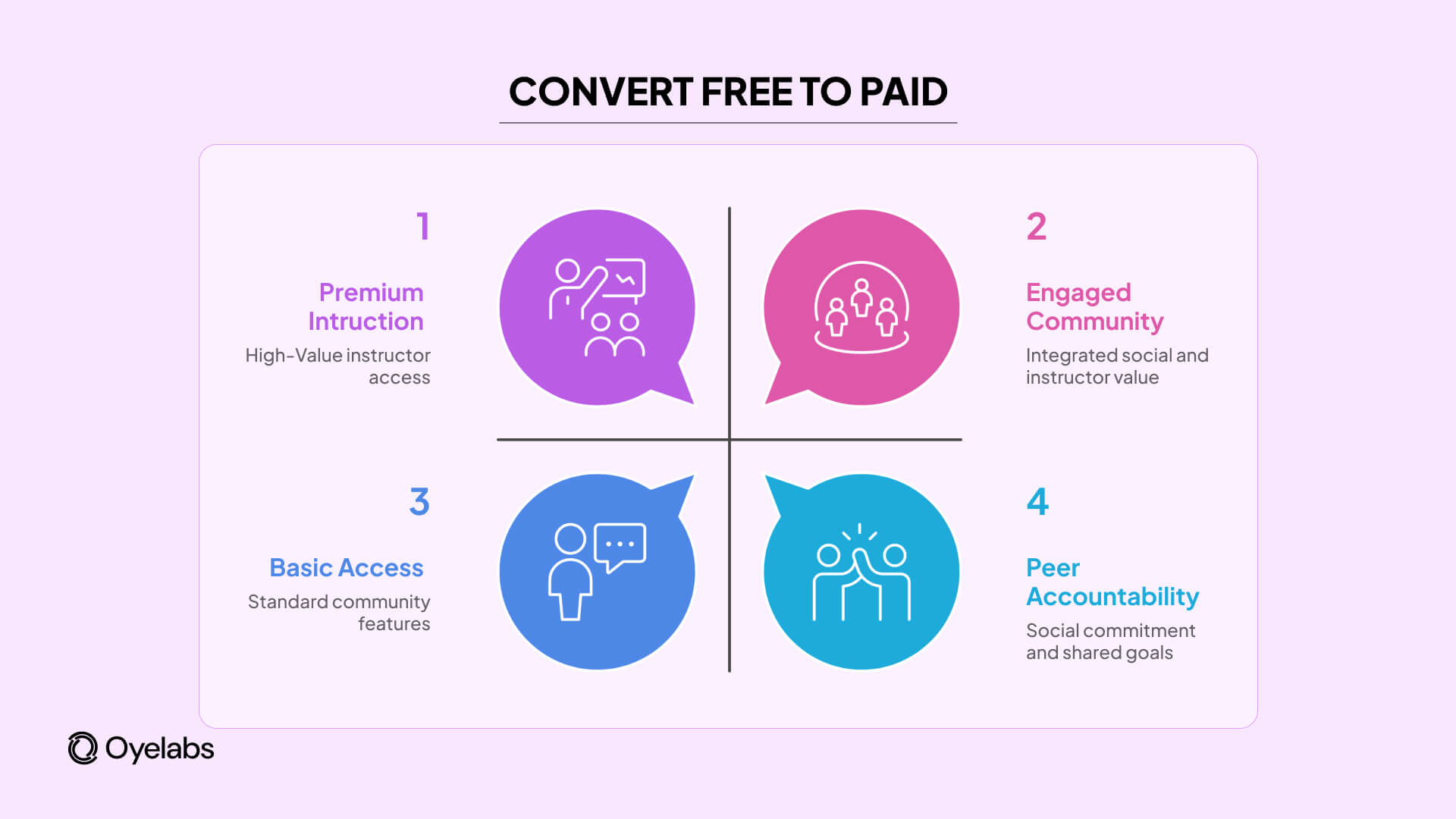
Learning is not inherently social, but accountability is. Platforms that build social accountability mechanisms into their paid tiers convert at higher rates and retain paying users longer, because the social layer creates switching costs that content libraries do not.
The most effective social and community features for driving free-to-paid conversion:
- Study groups and cohorts: Users assigned to a cohort of learners at similar levels, working toward similar goals, experience social accountability that significantly increases session frequency and course completion. Cohort-based learning consistently outperforms self-paced learning on both completion and satisfaction metrics.
- Live sessions with instructors or tutors: Access to scheduled live instruction or one-on-one tutoring sessions is a high-value premium feature. It is also one of the clearest functional differentiators a paid tier can offer. Udemy’s paid live Q&A sessions and Coursera’s tutor access features demonstrate sustained willingness to pay for this format.
- Peer accountability partnerships: Matching users with an accountability partner – someone to check in with, share progress, and set shared goals with – creates a social commitment device. Users with accountability partners cancel subscriptions at significantly lower rates.
- Community forums with instructor participation: Free-tier users typically get access to community discussion. Paid-tier users get prioritized or direct instructor responses. This is a low-cost, high-perceived-value feature that reinforces the paid tier’s premium positioning.
Founder Mistake: Founders frequently build community features as afterthoughts – added late in development, under-resourced, and rarely moderated. A low-quality community feature is worse than none at all. Users who experience an inactive or unhelpful community associate that failure with the product’s overall quality. If you build social features, resource them adequately from launch.
Certification and Credential Features That Drive Paid Conversion
For professional learners – which represents the largest and highest-value segment in EdTech – certification is often the primary reason they are on the platform. This is the segment most likely to convert, and most likely to renew.
Certificates and credentials drive conversion for a specific reason: they have external value. A learner who completes a free course gains knowledge. A learner who completes a paid course and receives a verifiable certificate gains a credential they can put on a LinkedIn profile, a resume, or a portfolio. The conversion decision is not emotional – it is rational and career-motivated.
The certification features that most reliably convert free users to paid:
- Verified certificates of completion: Third-party verified certificates, ideally with institutional or employer recognition, create genuine career value. Coursera’s certificates – accepted by companies including Google, IBM, and Unilever – demonstrate how credential quality directly drives subscription volume. Coursera Plus grew to 15 million learners in 2024 in large part because its certification held career weight.
- Skill assessments and proficiency badges: Assessments that produce a public, shareable proficiency score give users a tangible deliverable from the paid learning experience. These function as both a conversion trigger and a renewal incentive.
- Course completion certificates with graded assignments: Access to graded assignments, which produce a verifiable completion certificate, is a standard paid-tier feature that platforms like Coursera have used effectively. Free users can audit the course content. Only paid users receive grades, feedback, and certification.
- Professional certificates tied to employer partnerships: Where possible, building employer recognition for platform certifications creates a direct conversion argument that transcends product features. If your platform’s certificate is recognized by employers in a specific vertical, users in that vertical have a concrete financial incentive to pay.
Also Read: Key Gamification Features for Language Learning Platforms
The Free Tier Architecture – How Much to Give Away and Where to Stop
The free tier is not charity. It is your top-of-funnel acquisition asset. Its job is to demonstrate enough value to create genuine habit, and create enough visible limitation to make the upgrade compelling.
Getting this balance wrong is expensive in both directions. Give away too much, and users have no incentive to pay. Give away too little, and users leave before they are invested enough to care.
The principles that govern effective free tier architecture in EdTech:
The free tier should deliver real, tangible learning outcomes. A user who cannot actually learn on the free tier has no reason to trust that the paid tier delivers either. Duolingo’s free tier teaches full language courses – the limitation is on the experience, not the education. Ads, interruptions, and feature constraints exist, but learning progresses. This builds genuine product credibility.
The paid tier should protect the habit the free tier created. The most effective conversion triggers are features that preserve or accelerate a behavior the user has already established. Streak freezes protect an existing streak. Unlimited hearts protect an existing session flow. These features have high conversion rates because the user already has something to lose.
Soft gates outperform hard walls. A hard paywall stops users and forces a binary decision. A soft gate – a feature limitation that creates friction but does not fully block progress – keeps users in the experience while making the case for upgrade through repeated, low-friction exposure.
| Feature Type | Free Tier | Paid Tier |
| Core course content | Full access | Full access |
| Ads and interruptions | Present | Removed |
| Offline access | Not available | Available |
| Practice attempt limits | Restricted (hearts/lives) | Unlimited |
| AI personalization | Basic | Full adaptive system |
| Certificates | Not available | Verified, shareable |
| Live sessions / tutoring | Not available | Available |
| Streak repair / freeze | Not available | Available |
Notification and Retention Engineering as a Conversion Prerequisite
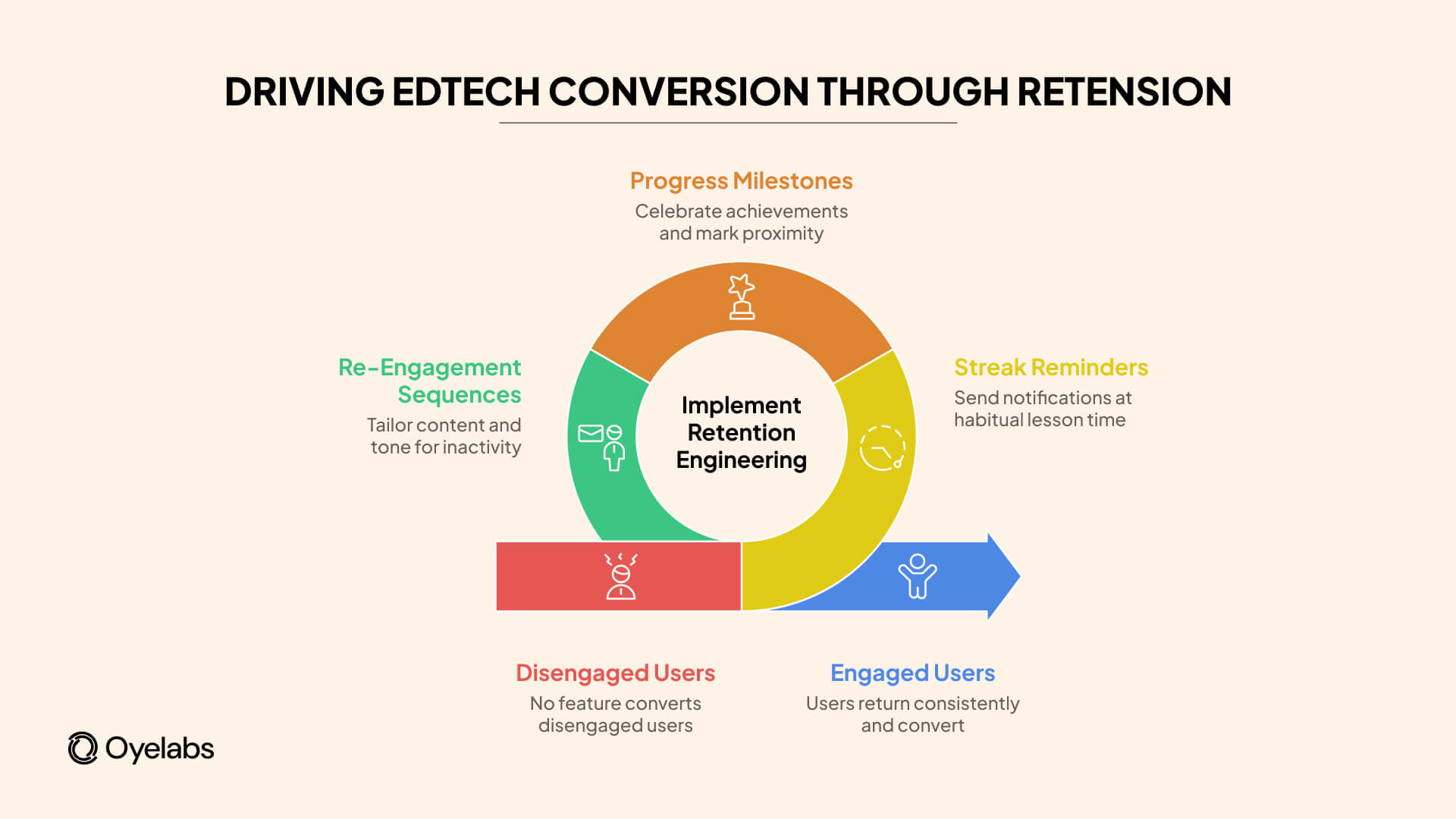
No feature converts a disengaged user. Before any conversion feature can work, the platform must keep users coming back. Retention engineering is not a growth team responsibility – it is a product responsibility.
Push notifications, when used correctly, are the highest-ROI retention tool available to mobile EdTech platforms. Duolingo’s notification strategy is famously studied. The Duo owl reminder – an escalating series of messages that shifts from encouragement to mild guilt as absence extends – drives daily return rates that are measurable and consistent.
Effective notification strategy for EdTech conversion:
- Streak reminder notifications sent at the user’s habitual lesson time, using behavioral data to determine the most effective send window, produce consistently higher open rates than time-based blasts. The timing specificity signals to the user that the platform knows their behavior – which is itself a signal of personalization quality.
- Progress milestone notifications that celebrate achievements and mark proximity to the next level or certificate completion create positive momentum. Users who receive milestone notifications at critical progression points convert at higher rates than users who do not, because the notification surfaces a goal the user already holds.
- Re-engagement sequences for users who have been inactive for 3, 7, and 14 days should differ in content and tone. The 3-day sequence focuses on resumption. The 7-day sequence introduces a concrete incentive – a limited-time trial of a premium feature. The 14-day sequence is a last-activation attempt with a clear value proposition.
Build Your EdTech Platform Without Guesswork
At Oyelabs, we scope EdTech platforms with full transparency, infrastructure, trust and safety, load testing, and payment architecture included from day one.
✓ Freemium feature architecture designed to create habit and trigger upgrade decisions – not just to limit access
✓ AI personalization, spaced repetition, and certification systems built for real learning outcomes at the correct investment tier for your stage
✓ Production-ready EdTech platform in 60 days or less, structured to scale from MVP to enterprise without a full rebuild
✓ Load-tested infrastructure designed for peak traffic
What OyeLabs Built for an EdTech Founder – and What Changed
One of OyeLabs’ clients came to the table with a well-defined concept: a skill-based learning platform targeting working professionals in a high-demand vertical, competing with established marketplace platforms on course quality and personalization. The challenge was not content. They had strong subject matter expertise and a clear curriculum. The challenge was building a platform whose product features could convert free registrations into paying subscribers at a rate that made the business viable.
OyeLabs scoped the build around the specific conversion mechanics the target audience would respond to: verified certification tied to employer-recognizable credentials, an adaptive learning path built on spaced repetition, and a streak-based engagement system with a paid freeze feature as the primary upgrade trigger. The platform launched on a structured monolithic foundation with a clean paid-tier feature architecture. Within the first operating quarter, brand impressions grew through organic sharing of certificates on LinkedIn, session engagement metrics exceeded benchmarks, and the founder moved from a launch-stage operator to a recognized platform in their niche. The architecture decision and the feature prioritization decision were made together – and the outcome reflected both.
Conclusion
Free-to-paid conversion in EdTech is not solved by a paywall. It is solved by product decisions made across every layer of the platform – the engagement mechanics that keep users returning, the personalization features that make the experience feel indispensable, the certification infrastructure that makes the investment professionally rational, and the free tier architecture that creates momentum before asking for a commitment.
Duolingo converts 8% of its monthly active users to paid subscriptions because it engineered the conditions that make conversion the natural outcome of continued engagement.
Building those conditions requires prioritizing the right features at the right platform maturity stage. Start with the mechanics your target user will feel immediately. Layer certification and social accountability as the platform grows. The path from free users to a viable subscription business runs through deliberate product engineering – not through pricing strategy alone.
FAQs
Q: What features most effectively convert free EdTech users to paid subscribers?
Streak mechanics with paid recovery options, AI-powered adaptive learning paths, verified certificates, and access to live instruction are the highest-converting features. The most effective triggers protect habits users have already formed rather than offering entirely new benefits.
Q: What is the average free-to-paid conversion rate for EdTech platforms?
Successful EdTech platforms with mature freemium models convert between 2% and 8% of free users to paid. Duolingo operates at approximately 8%. Most early-stage platforms target 2–4% as a viable benchmark at launch.
Q: Should an EdTech MVP launch with a free tier or a paid-only model?
A free tier is the recommended starting point for most EdTech founders. It reduces acquisition friction, builds platform credibility, and creates the behavioral data needed to understand which features drive conversion. Paid-only models require established brand trust that most new platforms have not yet built.
Q: How much does it cost to build an EdTech platform with freemium conversion features?
A production-ready EdTech MVP with core freemium conversion mechanics – gamification, push notifications, basic adaptive content, and payment integration – typically starts at $30,000 to $70,000. Full conversion feature suites, including AI personalization and enterprise certification, range from $70,000 to $160,000+.