
Monolithic vs Microservice: Best Choice for Your Food Delivery App

Monolithic vs Microservice: Best Choice for Your Food Delivery App
 Anuraag Jain
Last Updated on March 11, 2026
Key Takeaways
What You’ll Learn:
- How monolithic architecture and microservice architecture differ in practice, not just in theory
- Which architecture is the right starting point for a food delivery app at the MVP stage
- How to plan an architectural transition before you actually need it
- What the real infrastructure cost difference looks like across platform maturity stages
- When the complexity of microservices is justified by business scale – and when it is not
Stats That Matter:
- The global food delivery market is projected to reach $1.65 trillion by 2030 (Source: Statista)
- 86% of software development teams report that architectural decisions made at the MVP stage caused significant rework costs within 18 months of launch (Source: McKinsey Digital)
- Companies that migrate from monolith to microservices report an average 60–70% improvement in deployment frequency after successful transition (Source: DORA / Google Cloud)
Monolithic vs Microservice: Best Choice for Food Delivery App
Every founder building a food delivery app eventually faces the same decision: how to architect the platform before the first line of code is written. The wrong choice at this stage does not just slow development – it compounds. It inflates infrastructure costs, restricts team velocity, and forces expensive rewrites precisely when the business starts gaining traction.
This is not a theoretical debate. Architectural decisions made at the MVP stage directly shape how fast you can scale, how much downtime your users experience, and how much your engineering costs grow as order volume increases.
Founders who understand the monolithic vs microservice trade-off for food delivery apps walk into their technical conversations with clarity and control. Those who do not often discover the problem only after they have already paid for it.
Why Architecture Is a Business Decision, Not Just a Technical One
Most founders delegate architecture to their engineering team. That is a mistake.
The choice between monolithic and microservice architecture for a food delivery app determines your time to market, your infrastructure spend, your team’s ability to move fast, and your capacity to scale when demand spikes. These are capital decisions.
A monolith is cheaper to build and faster to launch. A microservice architecture is more expensive upfront but designed to handle scale without systemic risk. Neither choice is inherently superior – the right answer depends entirely on where your business is today and where it needs to be in 24 months.
Founders who understand this framing ask better questions. They do not ask “which is better?” They ask “which fits my stage, my team, and my runway?”
What Monolithic Architecture Actually Means for a Food Delivery App
A monolithic application runs as a single, unified codebase. The user interface, backend logic, database interactions, order management, driver tracking, and payment processing all exist within one deployable unit.
When a customer places an order, one system handles everything – login validation, menu retrieval, order routing, driver assignment, payment charge, and push notification. That tightly coupled design is its core strength at early stages. It is also the source of its limitations at scale.
For a food delivery startup, a well-structured monolith means a faster MVP, simpler debugging, lower infrastructure overhead, and a smaller team requirement. These are not trivial advantages when you are operating with seed capital and a six-month runway.
The liability surfaces when volume grows. Scaling a monolith means scaling the entire application – even the parts that do not need it. One poorly written database query during a Friday night dinner rush can slow the entire platform. One bad code push can take down every feature simultaneously.
Builder Tip: Build your monolith with clean internal module boundaries from day one. Separate your order logic, user logic, and payment logic into distinct internal packages – even if they share one database. This is the difference between a monolith that can evolve and one that requires a complete rewrite at Series A.
What Microservice Architecture Means for a Food Delivery App
A microservice architecture decomposes your platform into independent services, each responsible for a specific function. Order management, driver tracking, restaurant onboarding, payment processing, and notifications all run as separate applications. They communicate via APIs.
In practice, this means each service can be built, deployed, updated, and scaled without touching the others. If your GPS tracking service experiences a spike in load on a Saturday night, you scale that service alone. Your menu management service and your payment processor remain unaffected.
This architecture is how DoorDash, Uber Eats, and Zomato operate at scale. It enables independent engineering teams, faster deployment cycles, and fault isolation. If the promotions service fails, customers can still order food – they simply will not see a discount banner.
The cost of this flexibility is real. You are not managing one application. You are managing twelve to twenty. Each requires its own deployment pipeline, monitoring configuration, and failure handling. Without experienced DevOps support, this overhead collapses quickly into chaos.
| Factor | Monolithic Architecture | Microservice Architecture |
| Time to MVP | Fast – weeks | Slower – months |
| Infrastructure Cost (Early Stage) | Low | High |
| Scalability | Limited to vertical scaling | Independent horizontal scaling |
| Fault Isolation | One failure risks full downtime | Failures stay contained per service |
| Team Size Required | Small team viable | Requires specialized, larger team |
| Long-Term Maintenance | Harder as codebase grows | Easier per isolated service |
The Stage-by-Stage Decision Framework
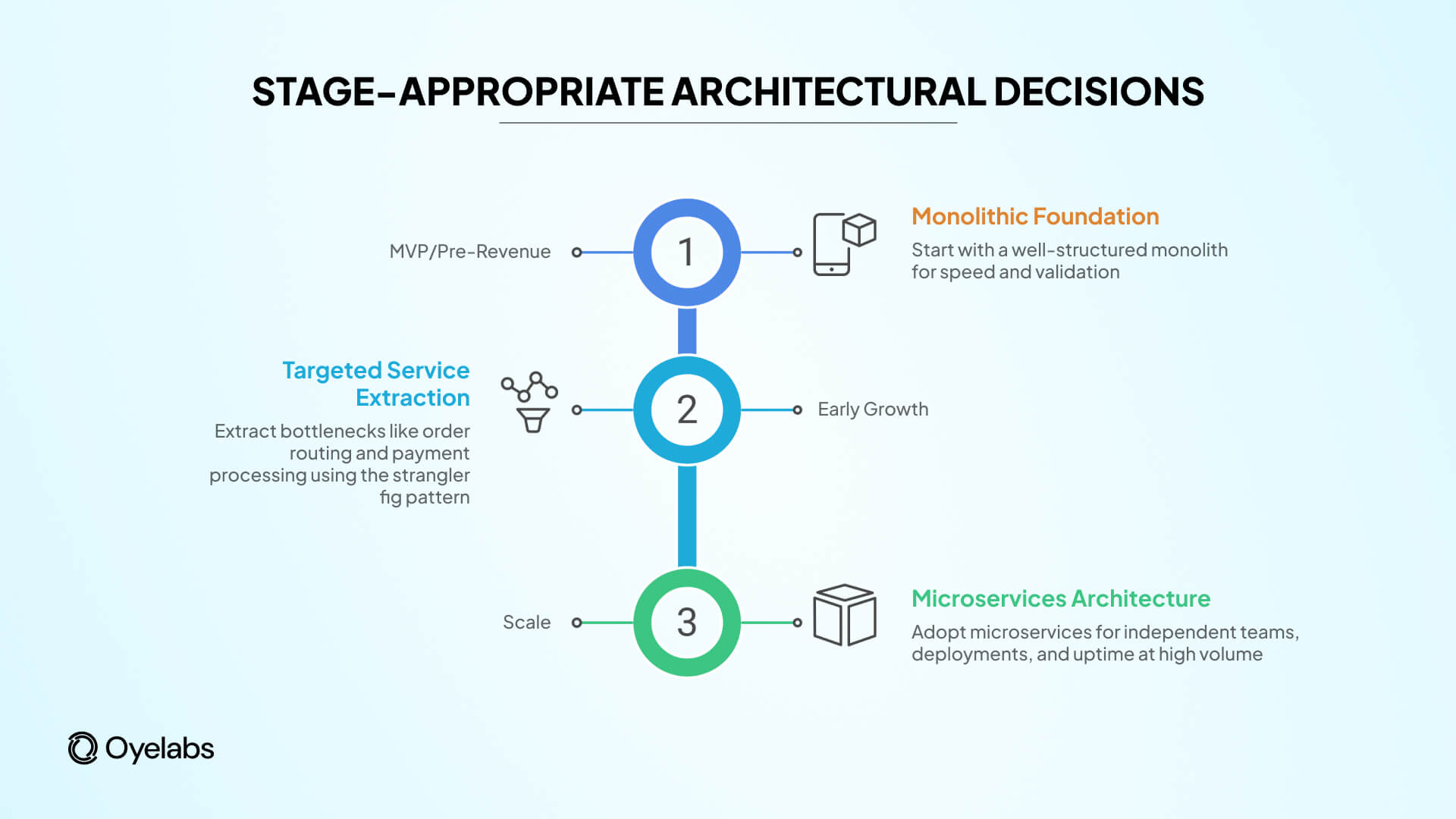
The monolithic vs microservice question is not permanent. It is a stage-appropriate decision that should be revisited as the business matures.
Stage 1 – MVP / Pre-Revenue
Start with a well-structured monolith. Your priority is speed of learning, not architectural perfection. Get the app in front of real users, validate demand, and identify which features actually matter. Building twenty microservices before your first customer places an order is how founders burn $200,000 and six months on infrastructure their business does not yet need.
Stage 2 – Early Growth (10,000 to 100,000 monthly orders)
At this stage, specific bottlenecks emerge. Order routing under peak load. Real-time driver tracking creates database strain. Payment processing requires compliance isolation. This is when targeted service extraction makes sense. You do not rebuild the entire platform – you extract the services causing measurable friction and let the rest of the monolith continue operating. This is known as the strangler fig pattern, and it is how every major food delivery platform managed the transition.
Stage 3 – Scale (100,000+ monthly orders, multi-city, enterprise partners)
At true scale, microservices are no longer optional – they are the only architecture that supports the business. Independent engineering teams, independent deployment cycles, and service-level uptime guarantees all require the separation that microservices provide. The overhead complexity is now proportional to the complexity of the business itself.
Founder Mistake: Founders often treat an architectural migration as a future problem. It is not. If you plan to migrate from monolith to microservices later, you must design with clean internal boundaries from day one. The cost of retrofitting a poorly structured monolith often exceeds the cost of building microservices from scratch.
The Core Features of a Food Delivery App and Their Architectural Demands
Not every feature creates the same architectural pressure. Understanding which components require the most scale helps founders make smarter decisions about where to invest engineering complexity early.
- User Authentication and Profiles: Low traffic, infrequent changes. A monolith handles this easily at every stage. Authentication is rarely a bottleneck for food delivery platforms.
- Order Management: This is the highest-stakes component in the entire platform. It handles real-time state changes, driver assignment, customer notifications, and payment triggers simultaneously. At scale, this becomes the first and most critical candidate for microservice extraction.
- Real-Time Driver Tracking: GPS pings every few seconds per active driver generate a significant database load. In a monolith, this competes directly with order processing queries. As an independent microservice, it can use a purpose-built in-memory store – Redis or a time-series database – optimized specifically for high-frequency location data.
- Payment Processing: PCI-DSS compliance requirements, integration with multiple payment gateways, and the high cost of errors all make payment processing an early microservice candidate. Many startups offload this entirely to Stripe or Braintree and treat it as a managed third-party service.
- Restaurant and Menu Management: Works well in a monolith at an early stage. At scale, separating this service allows restaurant partners to update menus, hours, and availability without creating any risk to the live order pipeline.
- Notifications: Push, SMS, and email notifications function adequately inside a monolith. At scale, moving notifications to an asynchronous microservice ensures a notification failure cannot block or delay an active order.
If you’re also exploring how to structure the core order flow and driver assignment logic in your delivery platform, see: How to Build a Food Delivery App: Features, Architecture, and Cost Breakdown.
How OyeLabs Helped a Founder Build a Market-Ready Food Delivery Platform
Most development firms will tell you what architecture to build. Very few will tell you which architecture fits your business stage – and then execute against that recommendation with the discipline to match.
One of OyeLabs’ clients arrived at exactly the right inflection point: a founder with a clear vision for a hyperlocal food delivery platform targeting an underserved metropolitan market. No technical co-founder. No existing engineering team. A defined timeline and a concrete budget. OyeLabs assessed the business stage, the growth roadmap, and the team’s operational capacity – and recommended a clean, modular monolithic foundation designed for fast launch and structured for future decomposition.
The platform launched in under 60 days. Within months of going live, consistent platform performance, a polished user experience, and fast delivery reliability drove measurable growth in brand engagement, impressions, and organic user acquisition. The founder had entered the market as an operator. They left that initial phase as a recognizable brand in their city. The architecture decision, made correctly at the right stage, was the structural reason that growth was possible without a premature rewrite.
Reality Check: The most expensive architectural decision is not choosing microservices too early or monolith too late. It is building a monolith with no internal structure – no module separation, no domain boundaries, no API layer – and then trying to extract services from it at the growth stage. That process takes longer and costs more than starting over.
What DoorDash, Uber Eats, and Zomato Actually Chose – And When
The pattern across every major food delivery platform is consistent and instructive.
DoorDash launched as a simple web application with a monolithic backend. The founding team was focused on one market, one city, one use case. As the platform expanded to new geographies and enterprise restaurant partners, they systematically migrated high-traffic services to microservices – starting with the components under the most load and carrying the most risk.
Uber Eats inherited Uber’s existing microservice infrastructure. This provided immediate scalability but also imposed substantial upfront complexity. That model works when the infrastructure already exists. For a startup building from zero, replicating Uber’s architecture before validating the business is not a strategy – it is speculation.
Zomato operated core functions on a monolith through early growth before decomposing services as order volume and team size made the transition operationally necessary.
None of them went from concept to full microservice architecture on day one. The consistent pattern is: launch with a structured monolith, extract services as scale demands, and plan the transition before it becomes urgent.
Also Read: How DoorDash Works: Business & Revenue Model
Common Architectural Mistakes Founders Make When Building Food Delivery Apps
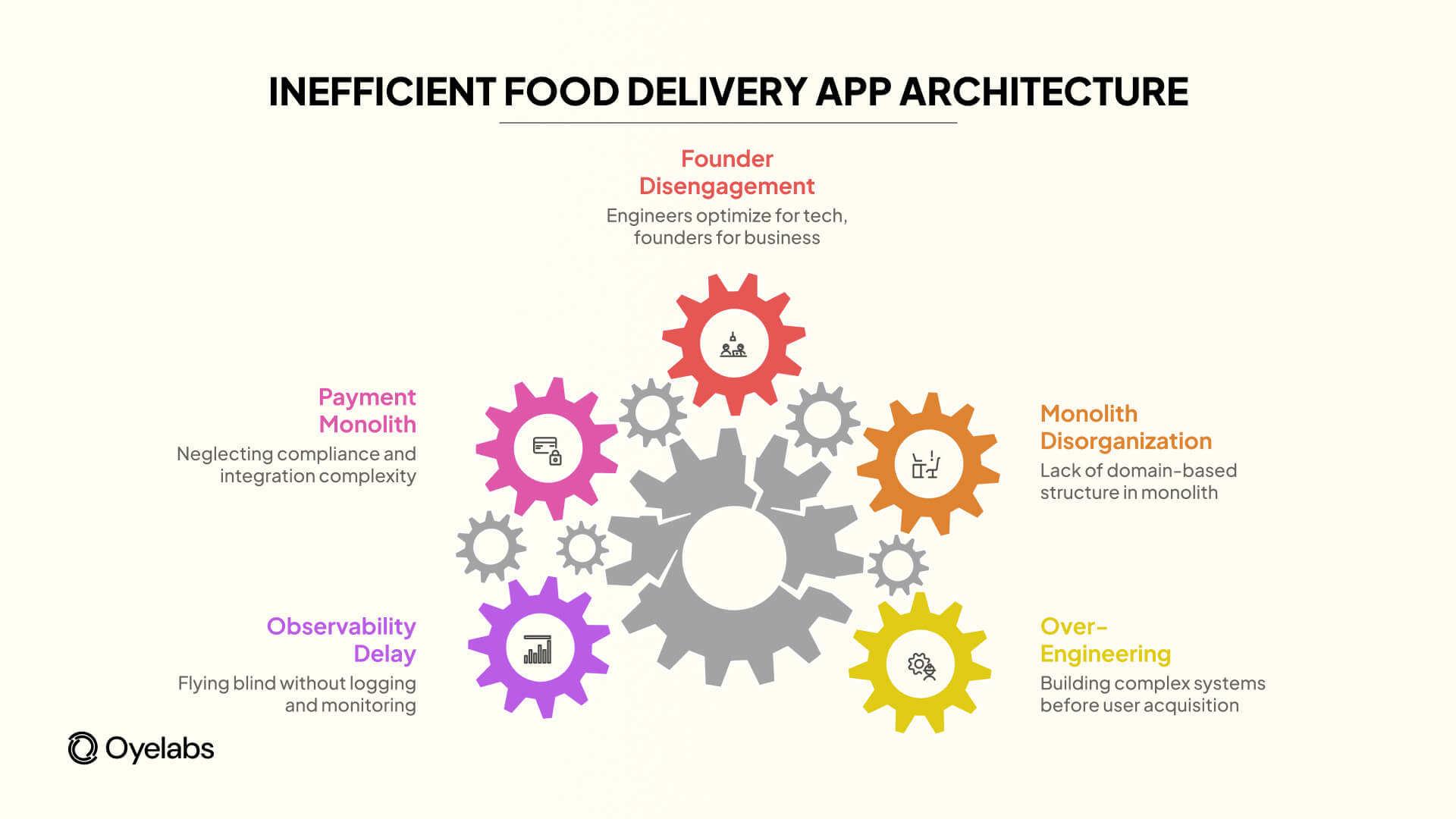
- Over-engineering before revenue: Building microservices for a platform with zero users is how founders confuse technical sophistication with business progress. Ship a working product first. The architecture can evolve.
- Ignoring internal structure in a monolith: A monolith is not an excuse for disorganized code. Every function, module, and database query should be organized by domain from day one. This is the foundation of every successful architectural migration.
- Delegating the architecture decision entirely to engineers: Engineers optimize for technical elegance. Founders need to optimize for business outcomes. These are often the same – but not always. Founders who stay engaged in the architectural conversation make better resource allocation decisions.
- Treating payment processing as a monolith component without compliance review: Payment processing inside a monolith is not inherently wrong. But the compliance overhead of PCI-DSS and the integration complexity of multiple payment gateways often make early extraction to a managed service the more practical decision, regardless of stage.
- Delaying observability investment: Logging, monitoring, and alerting are not optional upgrades. A monolith without observability is flying blind. A microservice architecture without observability is flying blind with twenty planes.
Platform Investment Tiers: Monolithic vs Microservice for Food Delivery Apps
Tier 1 – MVP Launch Stage
Investment Range: $25,000 – $60,000
Tier 2 – Market-Ready Growth Stage
Investment Range: $60,000 – $150,000
Tier 3 – Scale Stage
Investment Range: $150,000+
Tier 1 – MVP Launch Stage Investment Range: $25,000 – $60,000 Scope: Monolithic architecture. Core order flow, restaurant listings, payment integration, driver assignment, push notifications. Single-market deployment. Production-ready but structured for future decomposition.
Tier 2 – Market-Ready Growth Stage Investment Range: $60,000 – $150,000 Scope: Modular monolith with initial service extraction. Order management and driver tracking are separated as independent services. Multi-city support. Admin dashboard. Analytics pipeline. Staged deployment infrastructure.
Tier 3 – Scale Stage Investment Range: $150,000+ Scope: Full microservice architecture. Independent services for all high-load components. Multi-region deployment. Load balancing, auto-scaling, and high-availability infrastructure. Dedicated DevOps pipeline. Enterprise restaurant partner integrations.
Each tier represents a stage-appropriate investment, not a permanent constraint. The right starting point is the tier that matches your current order volume, team size, and growth timeline – not the tier that sounds most impressive.
Build Your Food Delivery Platform Without Guesswork
At Oyelabs, we scope live commerce platforms with full transparency, infrastructure, trust and safety, load testing, and payment architecture included from day one.
✓ Architecture recommendation matched to your current business stage and team capacity
✓ Production-ready MVP in 60 days or less, structured for future decomposition
✓ End-to-end development including order management, driver tracking, payment processing, and real-time GPS
✓ Load-tested infrastructure designed for peak traffic
Conclusion
The monolithic vs microservice decision for a food delivery app is not a technical debate – it is a capital allocation decision. Build the wrong architecture for your stage and you pay twice: once to build it wrong and again to fix it. The right answer for most founders is a structured monolith at launch, with a deliberate transition plan built into the architecture from day one. This approach delivers speed to market without sacrificing future scalability. As your platform grows, extract the services under the most strain first – order management, driver tracking, and payments. The platforms that scale successfully are not the ones that chose microservices earliest. They are the ones who chose the right architecture at the right time and planned the transition before it became urgent. Start with clarity on your stage, build with structure, and scale with intention.
FAQs
Q: What is the main difference between monolithic and microservice architecture for food delivery apps?
A monolithic architecture runs all features in one codebase. A microservice architecture splits each function – orders, payments, tracking – into independent services. Monoliths are faster to build early. Microservices scale better under high load.
Q: Should a food delivery startup begin with monolithic or microservice architecture?
Most startups should begin with a structured monolith. It launches faster, costs less, and allows early learning. Microservices become appropriate when specific components require independent scaling – typically after reaching 10,000 or more monthly orders.
Q: How much does it cost to build a food delivery app using microservice architecture?
A microservice-based food delivery platform typically starts at $150,000 and scales upward depending on service count, team size, and infrastructure requirements. A monolithic MVP can launch for $25,000 to $60,000.
Q: When should a food delivery startup migrate from monolith to microservices?
Migration makes sense when specific bottlenecks appear at scale – typically order routing, real-time tracking, or payment processing under peak load. Plan the migration before it becomes urgent. Extract the highest-strain services first.