
DoorDash Enters AI Social Discovery With New Zesty App
DoorDash Enters AI Social Discovery With New Zesty App
 Anuraag Jain
Last Updated on December 26, 2025
Key Takeaways
What You’ll Learn:
- DoorDash launched Zesty to solve food choice confusion, not delivery speed.
- AI discovery helps users decide faster and feel confident about restaurant choices.
- Discovery-first apps increase engagement more than discounts or faster delivery.
- Startups can compete by focusing on local tastes, not national scale.
- AI in food apps works best when built gradually using real user behavior.
Stats That Matter:
- Over 70% of consumers expect personalized experiences from digital platforms.
- Personalization leaders generate up to 40% more revenue than competitors.
- Improving retention by 5% can increase profits by up to 95%.
- Recommendation systems drive over one-third of user engagement.
- Local relevance doubles user engagement compared to generic platforms.
Real Insights:
- Users stay loyal to apps that help them choose confidently.
- Discovery builds stronger brands than delivery speed alone.
- Simple AI recommendations outperform complex systems without real data.
- Local food apps can beat global platforms through relevance.
Founders win by owning decisions, not just transactions.
DoorDash Enters AI Social Discovery With New Zesty App
Opening a food delivery app today feels like scrolling Netflix at 11 p.m. Too many choices, zero clarity. You’re hungry, not in the mood to “research.” That exact moment of frustration is where the next wave of food-tech is being built.
In December 2025, DoorDash changed the game by launching Zesty, an AI-powered social discovery app designed to help users decide where to eat before they ever place an order. This wasn’t a feature update. It was a strategic shift. DoorDash is no longer competing only on delivery speed or logistics optimization – it’s moving upstream into AI-driven taste profiling, behavioral intelligence, and social food discovery.
For founders, CEOs, and early-stage startups, this move sends a clear signal: the real moat in food delivery is no longer delivery itself – it’s personalized decision-making at scale.
And here’s the opportunity most people are missing.
What Is Zesty? DoorDash’s New AI Social Discovery App Explained
Zesty is DoorDash’s answer to a growing problem in food delivery: people don’t struggle to order food – they struggle to choose it.
Unlike the core DoorDash app, Zesty is designed as a standalone AI social discovery app. Its primary job is not checkout or logistics. Its job is to help users discover restaurants they are likely to enjoy before they ever think about placing an order.
At its core, Zesty focuses on:
- Learning individual taste preferences over time
- Recommending restaurants based on similarity, not popularity
- Reducing decision fatigue caused by endless lists and filters
Instead of showing “top-rated near you,” Zesty answers a more personal question:
“What would someone like me enjoy right now?”
This separation is intentional. DoorDash is decoupling discovery from transaction, treating restaurant choice as its own high-value product experience.
Why DoorDash Built Zesty: The Business Problem It Solves
Food delivery platforms have quietly hit a ceiling. Speed, coverage, and pricing are no longer meaningful differentiators at scale. Most leading platforms already deliver fast enough. The real friction lives earlier in the journey.
This problem is not anecdotal. Research published by Harvard Business Review shows that when users are presented with too many choices, decision quality and satisfaction drop sharply – a pattern that directly applies to modern food delivery platforms.
DoorDash built Zesty to solve three business-critical problems:
- Choice overload: Users are overwhelmed by thousands of listings, similar menus, and generic star ratings. More options have reduced confidence, not improved it.
- Weak personalization: Traditional filters (price, distance, cuisine) don’t reflect how people actually choose food. Taste is emotional and contextual, not transactional.
- Lost engagement upstream: When users leave to browse social media, Google Maps, or food blogs for inspiration, platforms lose control of the demand funnel.
By owning discovery, DoorDash protects:
- Session time
- User intent
- Brand recall
- Long-term retention
Zesty is not about adding features. It is about owning the moment of decision.
How Zesty Uses AI for Social Restaurant Discovery
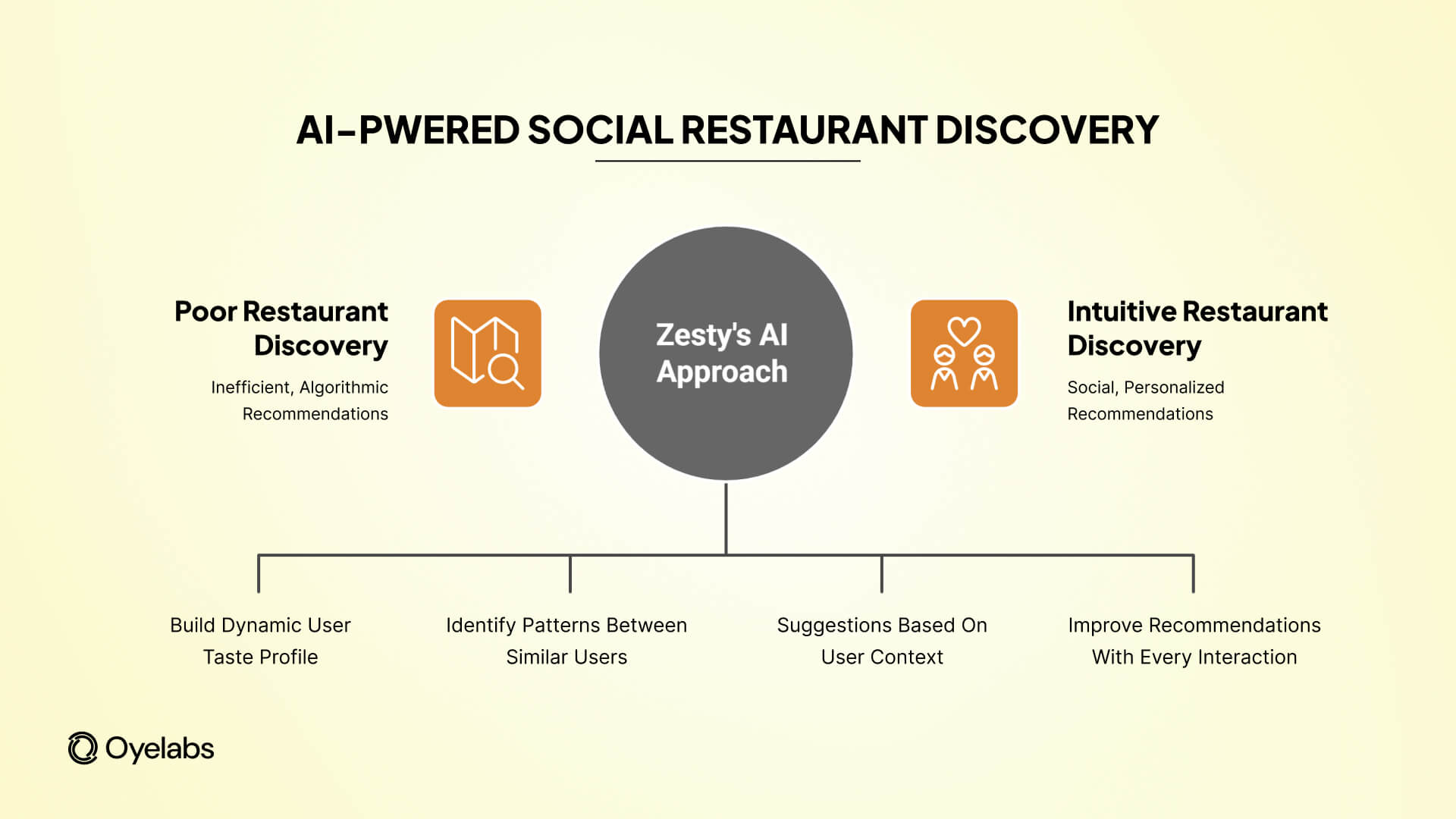
Zesty’s AI approach is practical, not experimental. It applies machine learning where it directly improves user experience, without overengineering.
Here’s how the system works at a high level:
- Taste modeling: The app builds a dynamic taste profile based on user behavior, preferences, and feedback.
- Pattern recognition: Instead of ranking restaurants by popularity, Zesty identifies patterns between users with similar tastes.
- Context-aware recommendations: Suggestions change based on time, usage history, and interaction signals.
- Continuous learning: Every interaction improves future recommendations, creating a feedback loop.
Importantly, Zesty treats discovery as a social signal problem, not a search problem. It blends behavioral data with social similarity, allowing recommendations to feel intuitive rather than algorithmic.
For founders, this matters because it shows a clear shift:
AI in food tech is no longer about optimization behind the scenes – it is becoming the product itself.
Why AI Social Discovery Is the Future of Food Delivery Apps
Food delivery has matured. Logistics, routing, driver supply, and payment flows are largely solved problems. What remains unsolved – and increasingly valuable – is how users decide.
AI social discovery shifts food delivery from a utility to an experience.
Instead of asking users to search, filter, and compare, platforms like Zesty predict intent. They move from reactive interfaces to proactive recommendations. This change drives measurable business outcomes:
- Higher session duration because users explore instead of scrolling
- Better conversion rates because recommendations feel relevant
- Stronger retention as the app “understands” the user over time
- Reduced churn caused by choice fatigue
This mirrors what happened in media and commerce. Spotify did not win because it had more songs. Netflix did not win because it had more titles. They won because discovery felt effortless.
Food delivery is now entering the same phase.
What Zesty Signals to Founders and Early-Stage Startups
The launch of Zesty is not a warning shot to startups. It is validation.
DoorDash is proving that discovery is where long-term value lives, and that insight applies just as strongly to smaller, focused platforms.
For founders, the signal is clear:
- You do not need national scale to build discovery-first experiences
- Niche markets benefit more from personalization than mass platforms
- Regional taste patterns are easier to model than global ones
- Social context matters more in local food decisions
A startup focused on a single city, cuisine, lifestyle segment, or dietary preference can often deliver better discovery than a global platform trying to serve everyone.
This is where startups win – not by copying DoorDash feature-for-feature, but by outperforming it in relevance.
Can Startups Build an App Like DoorDash + Zesty? A Realistic View
The common assumption is that platforms like Zesty require massive datasets, advanced research teams, and years of iteration. That assumption is outdated.
A modern startup can launch a DoorDash-style platform with AI-driven discovery by taking a phased approach:
- Start with core delivery and ordering workflows
- Add preference-based onboarding to collect intent early
- Introduce simple recommendation logic before advanced AI
- Improve personalization incrementally using real usage data
AI does not need to be perfect on day one. In fact, early-stage platforms benefit from lean intelligence, where models evolve alongside real user behavior.
The key is architecture. Platforms built with modular systems can add discovery layers without rebuilding from scratch.
The Smart Way to Launch a Food Delivery App Like DoorDash Today
Founders who succeed in food tech today do one thing differently: they sequence correctly.
Instead of launching everything at once, they focus on:
- A clear target market and use case
- Fast MVP deployment to validate demand
- Discovery features that reduce user friction
- Data-driven iteration before expansion
A simplified comparison makes this clear:
| Traditional Approach | Discovery-First Approach |
| Feature-heavy launch | MVP with focused experience |
| Generic search & filters | Preference-based discovery |
| Compete on price & speed | Compete on relevance |
| High upfront cost | Controlled, phased investment |
This approach lowers risk, speeds up time-to-market, and creates room to differentiate before scaling.
From Platform Launch to Brand Recognition: A Founder’s Outcome
One founder Oyelabs worked with approached the market with a clear goal: build a DoorDash-style platform tailored to a specific regional audience, rather than competing nationally from day one. The focus was on fast launch, strong discovery flows, and a clean user experience that reflected local food culture.
By going live quickly and iterating based on real usage, the platform saw steady growth in engagement, repeat usage, and organic visibility. Over time, it stopped being perceived as “another delivery app” and started to function as a recognizable local food-tech brand. That shift – from utility to brand – is what ultimately increased its market value and positioned it for long-term growth.
The lesson is simple: when discovery, experience, and execution align, scale becomes a consequence – not a prerequisite.
Why Discovery-First Platforms Create Stronger Brands
Most food delivery apps are remembered for convenience. Very few are remembered for taste, identity, or trust. That difference comes down to discovery.
When a platform consistently helps users find food they enjoy, it stops being a utility and starts becoming a habitual brand. Discovery-first platforms build brand strength in subtle but powerful ways:
- Users associate the app with good decisions, not just fast delivery
- Recommendations feel personal, increasing emotional loyalty
- Repeated positive experiences reduce price sensitivity
- Word-of-mouth grows naturally because discovery feels share-worthy
Delivery speed can be matched. Discounts can be copied. But taste confidence is difficult to replicate. Platforms that own discovery own the relationship, not just the transaction.
This is why DoorDash’s move with Zesty matters. It signals a long-term shift from competing on operations to competing on experience and intelligence.
Key Features Founders Should Prioritize (Inspired by Zesty)
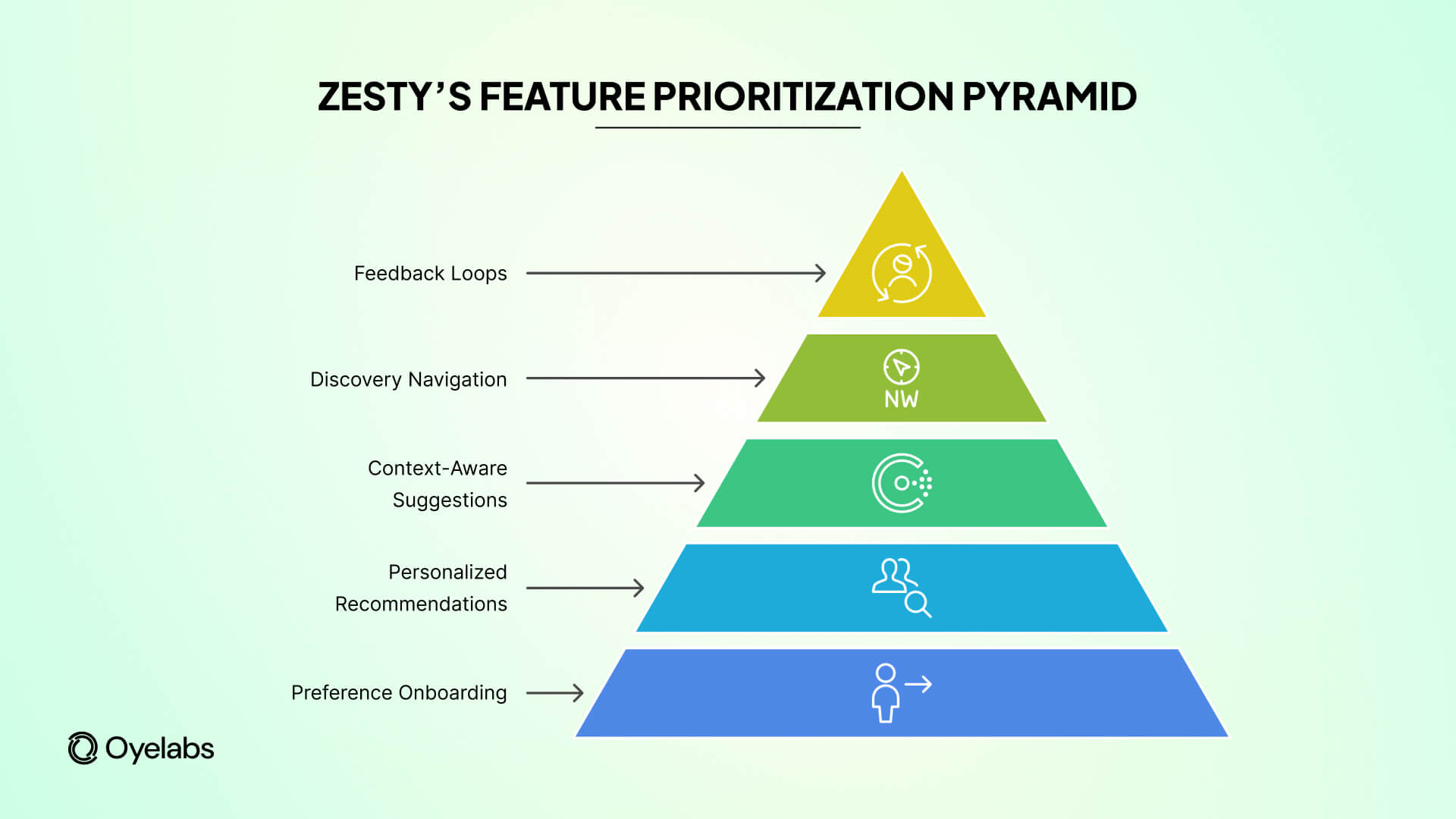
Founders often ask which features truly matter when building a food delivery or discovery platform. The answer is not “more features,” but better sequencing.
Based on Zesty’s direction, the following capabilities deliver the highest impact early:
- Preference-based onboarding: Simple questions about taste, cuisine, and habits create immediate personalization.
- Personalized recommendations: Even basic logic that matches users with similar profiles can outperform generic rankings.
- Context-aware suggestions: Recommendations that adapt to time of day, frequency, or past behavior feel more relevant.
- Discovery-led navigation: Reducing reliance on search bars and filters improves engagement.
- Feedback loops: Lightweight signals such as likes, saves, or skips help models improve without friction.
These features do not require enterprise-scale AI on day one. They require clarity on what decision the user is trying to make and removing unnecessary steps from that decision.
Common Mistakes Founders Make When Trying to Copy DoorDash
The biggest risk founders face is not competition from DoorDash – it is copying DoorDash incorrectly.
The most common mistakes include:
- Trying to build everything at once: Overloading the MVP delays launch and increases burn without validating demand.
- Ignoring discovery experience: Focusing only on delivery mechanics creates a functional app, not a differentiated one.
- Overengineering AI too early: Complex models without real usage data often add cost without adding value.
- Competing too broadly: National ambitions before local dominance dilute focus and resources.
- Measuring the wrong metrics: Tracking orders without tracking engagement, discovery success, or repeat behavior hides real problems.
Successful platforms reverse this logic. They start narrow, learn fast, and let discovery guide expansion.
How Oyelabs Helps Founders Launch Discovery-First Food Delivery Platforms
Building a food delivery platform today is not about recreating DoorDash’s scale. It is about recreating clarity for users – and doing it faster, smarter, and with controlled risk.
This is where Oyelabs typically supports founders.
Instead of starting from a blank slate, founders use a proven delivery and ordering foundation, then layer discovery, personalization, and AI-driven logic in phases. This approach allows teams to launch early, observe real user behavior, and invest only where data justifies it.
In practical terms, this means:
- Faster time-to-market with an MVP that actually ships
- Modular architecture that supports discovery features without rework
- Controlled budgets through phased development
- Flexibility to evolve from basic recommendations to AI-driven discovery
The goal is not to overpromise intelligence on day one. The goal is to build a platform that learns with its users, just as Zesty is designed to do.
What the Zesty Launch Reveals About the Next Five Years of Food Tech
Zesty is less about a new app and more about a directional shift.
Over the next five years, food delivery platforms will increasingly compete on:
- How well they understand individual taste
- How confidently they reduce decision friction
- How naturally they integrate social and behavioral signals
- How early they influence user intent
Search-heavy interfaces will feel outdated. Discovery-led experiences will become expected. Platforms that fail to adapt will still deliver food – but they will lose relevance, engagement, and brand power.
For founders, this creates a rare window. The market is no longer just about logistics dominance. It is about experience intelligence, and that is a space where focused startups can move faster than incumbents.
Final Takeaway
When large platforms invest heavily in new product categories, they do not eliminate opportunity. They confirm it.
DoorDash’s move into AI-powered social discovery with Zesty makes one thing clear: the future of food delivery is not just faster delivery, but better decisions. And better decisions are built through personalization, context, and trust.
For CEOs, entrepreneurs, and early-stage startups, the takeaway is simple. You do not need to outspend DoorDash. You need to out-focus it. By starting with discovery, launching lean, and evolving intelligently, founders can build food delivery platforms that feel less like utilities and more like brands.
The next generation of food-tech winners will not be defined by how quickly they deliver meals – but by how confidently they help people choose them.
FAQs
What is DoorDash Zesty and why is it important for food delivery platforms?
Zesty is DoorDash’s AI discovery app that helps users choose restaurants before ordering food.
Can startups build a food delivery app like DoorDash with AI discovery features?
Yes, startups can launch discovery-first food delivery apps using phased development and modern AI tools.
Why is AI-powered restaurant discovery more valuable than faster food delivery?
AI discovery improves decisions, engagement, retention, and brand loyalty beyond simple delivery speed.
How does AI social discovery help food delivery apps grow revenue?
Personalized recommendations increase repeat orders, session time, and user trust, driving sustainable revenue growth.