
RETS vs RESO Web API for Real Estate Platforms in 2026
RETS vs RESO Web API for Real Estate Platforms in 2026
 Anuraag Jain
Last Updated on March 9, 2026
Key Takeaways
What You’ll Learn
- RETS was the older MLS data exchange system used by early real estate platforms.
- RESO Web API is the modern standard for accessing property listings from MLS systems.
- Real estate platforms today rely on real-time APIs instead of large data downloads.
- Standardized property data helps platforms expand across multiple MLS markets faster.
- Startups can build Zillow-like platforms using modern API integrations and scalable infrastructure.
Stats That Matter
- 97% of homebuyers search for homes online during their buying journey.
- The U.S. housing market value exceeds $47 trillion.
- Zillow platforms attract more than 227 million monthly users.
- The United States operates over 580 MLS systems.
- Over 75% of MLS providers are adopting the RESO Web API.
Real Insights
- Real-time MLS data improves property search speed and user engagement.
- Standardized APIs reduce development complexity for real estate platforms.
- Mobile-first property apps increase property discovery and buyer engagement.
- MLS integrations are essential for building scalable property marketplaces.
- Modern APIs enable AI tools like property recommendations and price predictions.
RETS vs RESO Web API for Real Estate Platforms in 2026
Imagine opening a real estate app and seeing homes appear instantly as you refine your search. That seamless experience depends on how property data moves behind the scenes. For years, platforms relied on RETS (Real Estate Transaction Standard) to pull listings from MLS systems.
But in 2026, the industry has largely moved to the RESO Web API, a modern REST-based framework designed for faster, more secure data exchange. Supported by the Real Estate Standards Organization (RESO) and widely adopted across MLS networks, this API enables real-time property queries using JSON and standardized data models. According to the National Association of REALTORS®, 97% of homebuyers now begin their property search online, highlighting the importance of scalable digital real estate platforms.
For founders and startups building a Zillow-like real estate platform, understanding RETS vs RESO Web API is not just technical trivia. It directly impacts performance, scalability, security, and the ability to launch a modern property marketplace that users trust and investors respect.
What is RETS? Understanding the Legacy MLS Data Standard
Before the rise of modern APIs, the real estate industry relied on a protocol called RETS (Real Estate Transaction Standard) to exchange listing data between Multiple Listing Services (MLS) and property platforms.
RETS was introduced to solve a serious problem: every MLS stored property data differently. This made it difficult for brokers, agents, and technology platforms to access consistent information across markets.
The RETS protocol created a standardized way to transfer property data. It allowed applications to connect to MLS databases and download listing information using HTTP requests.
Most real estate platforms built before 2018 relied heavily on RETS MLS integration.
However, the way RETS worked reflects the technology limitations of its time.
How RETS Delivered Property Data
In a typical RETS integration:
- The platform connects to an MLS server.
- The system downloads large datasets of property listings.
- The platform stores this data in a local database.
- Periodic synchronization updates the listings.
This approach required heavy infrastructure and careful maintenance.
Developers had to manage data replication, handle synchronization errors, and maintain servers capable of storing large volumes of listing data.
Key Characteristics of RETS
RETS integrations typically involved:
- XML-based data responses
- HTTP communication protocols
- Bulk downloads of MLS listings
- Local database replication
- Scheduled updates instead of real-time access
While this system helped standardize MLS data exchange for many years, the modern web ecosystem evolved faster than RETS could adapt.
As a result, the industry began searching for a more flexible and scalable solution.
Why RETS Is Being Phased Out in 2026
The real estate technology ecosystem has changed dramatically in the past decade. Platforms now demand real-time data access, mobile-first performance, and seamless integrations with analytics tools, AI systems, and cloud infrastructure.
RETS was not designed for this environment.
For that reason, the Real Estate Standards Organization (RESO) officially deprecated RETS and encouraged MLS providers to transition toward the RESO Web API.
Today, most MLS systems are actively moving away from RETS.
Major Limitations of RETS
Several structural limitations led to the retirement of RETS.
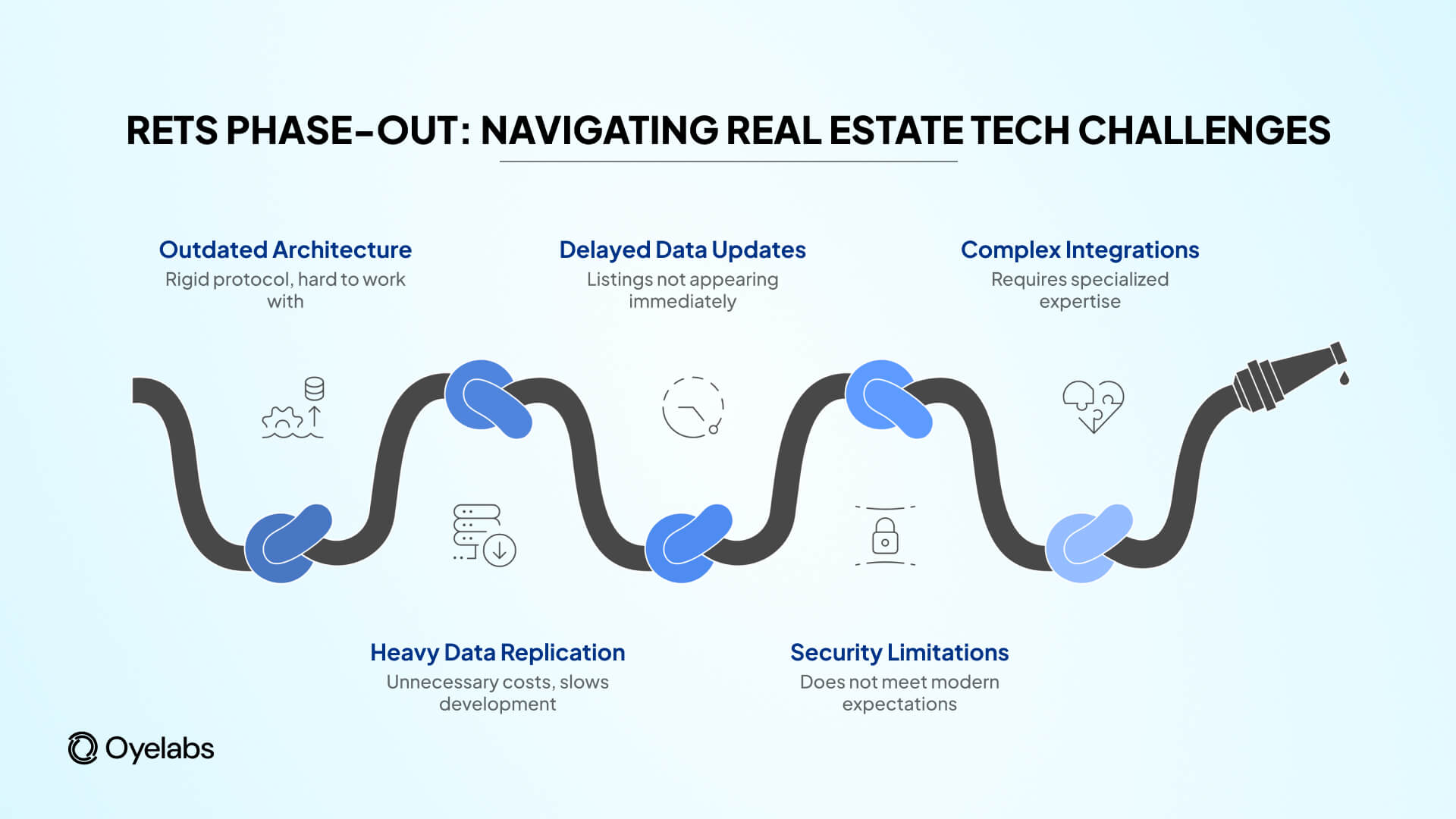
- Outdated architecture: RETS was built before REST APIs became the standard for internet services. Its protocol structure is rigid and harder for modern developers to work with.
- Heavy data replication: Most RETS integrations require downloading large datasets and storing them locally. This creates unnecessary infrastructure costs and slows down development.
- Delayed data updates: Because data synchronization happens periodically, listings may not appear immediately when they are added or updated in the MLS.
- Security limitations: Modern platforms rely on OAuth authentication and stronger encryption models. RETS security mechanisms do not meet the expectations of modern enterprise systems.
- Complex integrations: Building RETS integrations requires specialized expertise, and connecting them to modern tools often involves additional layers of custom engineering.
For founders building new real estate platforms today, RETS is no longer a practical option. The industry has moved forward.
What is the RESO Web API? The Modern Standard for Real Estate Platforms
The RESO Web API is the modern framework used to access MLS property data in today’s real estate technology ecosystem.
Developed by the Real Estate Standards Organization, this API provides a standardized method for retrieving property listings using modern web technologies.
Unlike RETS, the RESO Web API follows a RESTful architecture, which is the same approach used by companies such as Google, Amazon, and Stripe.
Instead of downloading large datasets, platforms can request specific information from the MLS in real time.
Core Technologies Behind the RESO Web API
The RESO Web API is built on widely adopted internet standards.
Key components include:
- RESTful API architecture
- JSON-formatted data responses
- OData query language for filtering data
- OAuth authentication for secure access
- Standardized property fields through the RESO Data Dictionary
These technologies make the system easier for developers to integrate and scale.
Real-Time Property Data Access
One of the most important improvements introduced by the RESO Web API is real-time data retrieval.
A real estate platform can query the MLS with very specific parameters.
For example:
- Homes under $600,000 in Dallas
- Properties with 3 bedrooms and a garage
- Listings added in the past 24 hours
Instead of storing massive databases, the platform receives the requested data instantly through the API.
This dramatically improves both development speed and user experience.
RETS vs RESO Web API: Key Differences in 2026
The shift from RETS to RESO Web API is not simply a technical upgrade. It represents a fundamental improvement in how real estate data moves across platforms.
Below is a simplified comparison of the two systems.
| Feature | RETS | RESO Web API |
| Industry Status | Deprecated | Current industry standard |
| Data Format | XML | JSON |
| Architecture | Proprietary protocol | RESTful API |
| Data Access | Bulk downloads | Real-time queries |
| Security | Basic authentication | OAuth authentication |
| Integration | Complex development | Developer-friendly |
| Performance | Slower updates | Faster data retrieval |
| Mobile Compatibility | Limited | Optimized for modern apps |
The takeaway is simple.
RETS was designed for a different era of internet infrastructure. The RESO Web API is designed for modern platforms that rely on speed, flexibility, and cloud architecture.
For startups and founders building new property marketplaces, adopting the RESO Web API is now considered best practice.
If you’re evaluating platform options, our detailed guide explains how startups build Zillow-style real estate apps without coding from scratch.
Why RESO Web API Is Critical for Zillow-Like Platforms
Modern real estate platforms are far more advanced than simple property listing websites.
Users expect fast search results, interactive maps, personalized recommendations, and real-time notifications.
These experiences require instant access to property data.
This is where the RESO Web API becomes essential.
Real-Time Property Search
Platforms like Zillow allow users to refine searches continuously.
As filters change, results update instantly.
This experience depends on real-time data queries that the RESO Web API supports.
Faster User Experience
Instead of waiting for periodic database updates, platforms receive fresh listing information directly from MLS systems.
This ensures users see the latest properties available.
Easier Multi-Market Expansion
Startups often begin in one city but expand into additional markets over time.
The RESO Web API standardizes property data fields across MLS systems, making expansion easier.
Lower Infrastructure Costs
Since data is retrieved dynamically, platforms do not need to maintain large replicated databases.
This reduces hosting and maintenance costs significantly.
AI and Analytics Readiness
Modern real estate platforms increasingly use artificial intelligence for:
- price prediction
- investment analysis
- property recommendations
Structured data delivered through the RESO Web API makes these capabilities possible.
For founders planning to build a Zillow-like platform, choosing the right data infrastructure determines how quickly the product can evolve.
Growth Insight: Successful property marketplaces are not just listing websites. Their competitive advantage comes from how quickly they process, search, and personalize property data. Fast APIs and clean data architecture directly influence user engagement and platform growth.
How MLS Integration Works When Building a Real Estate Platform
Many founders understand the concept of a property marketplace but are less familiar with the technical architecture behind it.
At the center of every modern real estate platform is the MLS integration layer.
MLS systems store the property listing data submitted by real estate agents and brokers. To display this data in an application, the platform must connect to the MLS through an approved API.
Typical Architecture of a Zillow-Like Platform
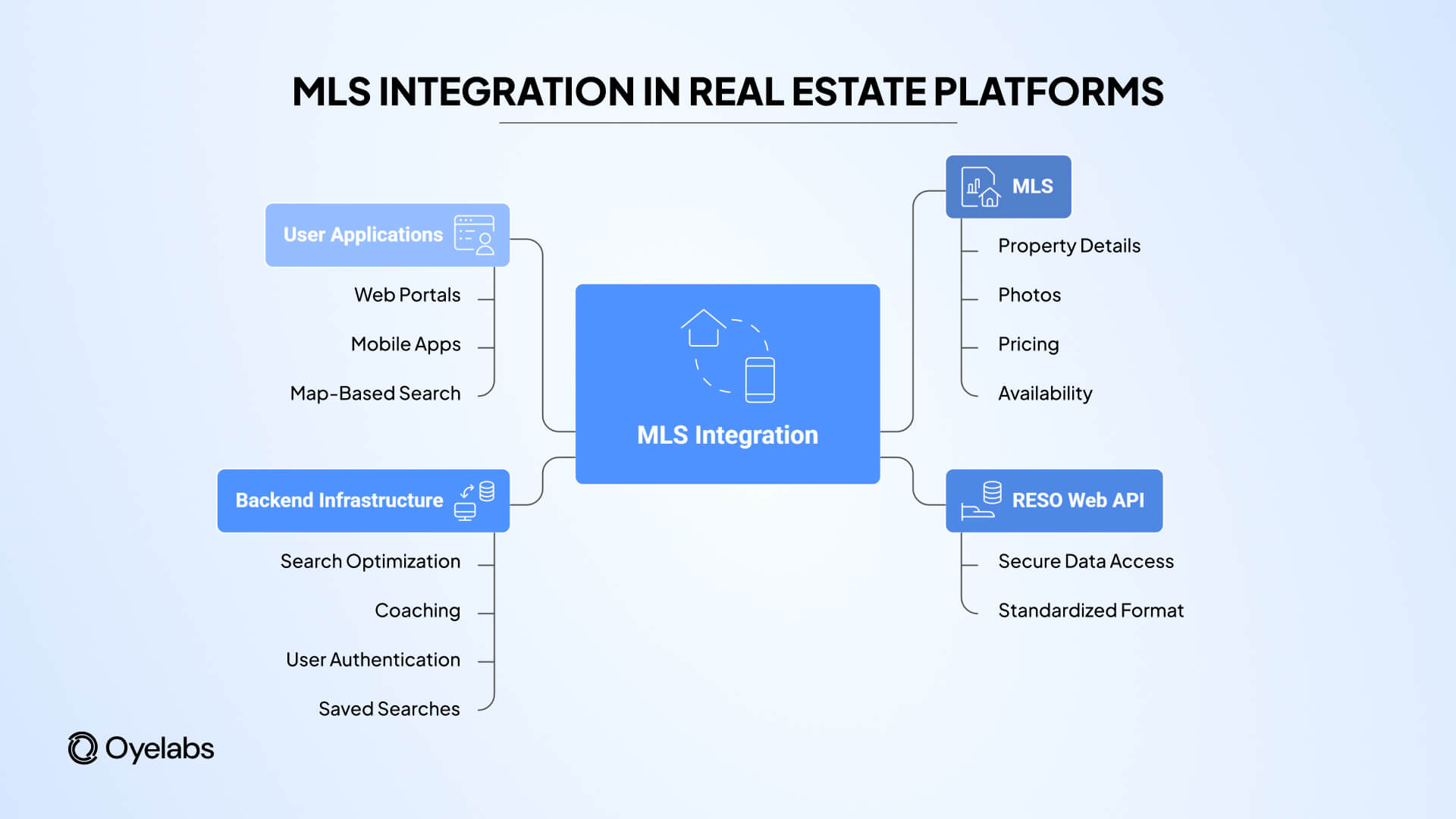
A simplified architecture looks like this:
MLS Systems
to
RESO Web API
to
Application Backend
to
Web and Mobile Applications
to
Users Searching Properties
Role of Each Component
MLS
The MLS acts as the source of truth for property listings. Agents submit property details, photos, pricing, and availability through the MLS.
RESO Web API
This API allows external applications to retrieve standardized listing data securely.
Backend Infrastructure
The backend handles:
- search optimization
- caching frequently accessed listings
- user authentication
- saved searches and alerts
User Applications
The frontend includes:
- web portals
- mobile apps
- map-based search interfaces
When these components work together, users can search and discover properties seamlessly.
Builder Tip: Most successful real estate platforms begin in one city but expand to multiple markets. Structuring your platform architecture around standardized APIs like RESO makes it easier to connect with additional MLS systems without rebuilding your backend.
Real Challenges Startups Face With MLS Integrations
While the concept of MLS integration appears straightforward, the reality is more complex. Many startups underestimate the technical and regulatory requirements involved.
MLS Approval and Data Licensing
Most MLS providers require platforms to apply for access before retrieving listing data.
The approval process often includes:
- application reviews
- data licensing agreements
- compliance checks
This process can take several weeks or months.
Data Standardization Across MLS Systems
Even with RESO standards, MLS systems may structure certain fields differently.
Platforms must normalize these variations to ensure property listings appear consistent.
Infrastructure and Performance
Large metropolitan MLS databases may contain hundreds of thousands of listings.
Handling this scale requires optimized search infrastructure and caching strategies.
Compliance Requirements
MLS providers often enforce rules regarding:
- display of listing data
- attribution to listing agents
- data refresh intervals
Failure to comply with these rules can lead to suspension of API access.
For founders building real estate platforms, these technical and compliance layers make experienced development guidance extremely valuable.
Founder Mistake to Avoid: Many founders assume MLS integrations are simple API connections. In reality, they involve licensing agreements, compliance requirements, and data normalization across multiple MLS systems. Planning these integrations early prevents costly development delays.
How Real Estate Startups Can Launch a Zillow-Like Platform Faster
Launching a real estate marketplace used to require years of development and heavy investment. Today, modern APIs and modular platform architecture make it possible for startups to build property platforms much faster.
However, speed should not come at the cost of scalability. The most successful founders focus on building a solid technical foundation from the beginning.
Step 1: Choose the Right Data Infrastructure
The first decision is the most important one.
Real estate platforms must rely on modern data exchange standards such as the RESO Web API rather than legacy protocols. This ensures long-term compatibility with MLS providers and allows the platform to scale across multiple markets.
Step 2: Build a Mobile-First Property Search Experience
Most property searches now begin on mobile devices. A Zillow-like platform should provide a seamless mobile experience with features such as:
- location-based search
- map-based property discovery
- saved searches and alerts
- quick property filters
Mobile usability significantly improves engagement and session duration.
Step 3: Design Advanced Property Filtering
Property buyers rarely browse randomly. They search with clear criteria such as:
- budget
- number of bedrooms
- property type
- location preferences
Advanced filtering helps users discover relevant properties quickly and reduces friction in the search process.
Step 4: Implement Monetization Features Early
A real estate marketplace should generate revenue from multiple channels.
Common monetization models include:
- agent subscription plans
- promoted property listings
- advertising placements
- referral commissions for services such as mortgages or inspections
By planning monetization from the beginning, founders create a sustainable business model.
Step 5: Focus on Market Differentiation
While Zillow dominates the U.S. market, regional platforms continue to grow successfully by focusing on niche markets.
Examples include:
- local property markets
- rental-focused platforms
- luxury property discovery
- investment property marketplaces
The key is offering a user experience that solves specific problems for buyers and agents in a given market.
How a Founder Built a Real Estate Brand With a Custom Platform
One founder approached Oyelabs with the goal of launching a regional real estate marketplace focused on improving property discovery in a highly competitive local market. The platform was developed with modern MLS integrations and a mobile-first user experience that allowed buyers to explore listings through map-based search and advanced filters. Within months of launch, the platform began attracting local agents who wanted more visibility for their listings. As user engagement increased, the founder noticed a significant rise in impressions and property inquiries. The consistent user activity helped position the platform as a recognizable brand in its region, demonstrating how a well-built real estate application can quickly create market presence and strengthen a founder’s credibility in the property ecosystem.
Future of Real Estate APIs: What Founders Should Expect Beyond 2026
Real estate technology continues to evolve rapidly. The shift to the RESO Web API is only the beginning of a broader transformation in how property data is used.
In the coming years, real estate platforms will increasingly rely on intelligent data systems to enhance the property search experience.
AI-Powered Property Discovery
Artificial intelligence will help platforms recommend properties based on user behavior. Instead of browsing manually, users will receive personalized listings based on search history, saved preferences, and browsing patterns.
Predictive Property Pricing
Machine learning models are being used to estimate property values using historical listing data, neighborhood insights, and market trends.
These tools help buyers and investors evaluate properties more accurately.
Integrated Real Estate Services
Future platforms will combine multiple services within a single ecosystem.
These may include:
- mortgage approvals
- property valuation tools
- legal documentation services
- moving and relocation services
By integrating these services, platforms create a complete digital real estate journey.
Real-Time Market Analytics
Real estate investors increasingly rely on data dashboards that track price trends, rental yields, and neighborhood demand.
Structured property data delivered through APIs enables these analytics capabilities.
As these innovations mature, the platforms built on modern API architecture will have a clear advantage.
When Should You Migrate From RETS to RESO Web API?
Many existing real estate platforms still rely on RETS integrations. While these systems may continue functioning for now, migration to the RESO Web API should be considered a strategic priority.
The industry is moving rapidly toward modern standards.
Signs That Migration Is Necessary
A platform should consider migrating when:
- MLS providers begin discontinuing RETS access
- Development teams struggle to maintain legacy integrations
- Performance issues appear due to outdated data synchronization
- The platform plans to expand into additional markets
Transitioning to the RESO Web API provides long-term stability and improves the platform’s technical foundation.
Key Benefits of Migrating
Migrating from RETS to RESO Web API can deliver measurable improvements.
These include:
- faster listing updates
- improved data consistency
- stronger security standards
- easier integration with mobile and analytics systems
Most importantly, migration ensures compatibility with the evolving MLS ecosystem.
Build Your Zillow-Like Real Estate Platform Without Guesswork
Launch a scalable property marketplace with modern MLS integrations, faster development timelines, and a platform designed for growth.
✓ MLS integrations built on modern RESO Web API standards
✓ Mobile-first property search with advanced filtering capabilities
✓ Scalable architecture designed for multi-market MLS expansion
✓ Monetization tools for agents, listings, and marketplace revenue
Final Thoughts
The shift from RETS to the RESO Web API marks a major evolution in real estate technology. While RETS helped standardize MLS data exchange in earlier digital platforms, modern marketplaces demand faster systems, stronger security, and flexible integrations. The RESO Web API delivers real-time property data, standardized fields, and secure authentication, making it the foundation for scalable real estate platforms.
For founders planning to build Zillow-like applications, adopting RESO ensures smoother expansion across markets, better analytics capabilities, and faster property search experiences for users. The technology choices made during the early stages of development often define how far a platform can grow.
If you’re planning to build your own real estate marketplace, explore how Oyelabs can help you launch a scalable Zillow-like platform with modern MLS integrations.
FAQs
What is the difference between RETS and RESO Web API in real estate platforms today?
RETS is a legacy protocol used by MLS systems to exchange property listing data. The RESO Web API is the modern standard using REST architecture and JSON data. It enables faster queries, real-time updates, stronger security, and easier integrations for modern real estate platforms and Zillow-like marketplaces.
Why are MLS systems moving from RETS to RESO Web API for property data access?
MLS organizations are adopting RESO Web API because it provides faster data retrieval, stronger security standards, and easier integration with modern applications. RETS requires bulk downloads and complex maintenance, while RESO allows real-time data queries that support scalable real estate platforms and mobile applications.
Can startups build Zillow-like platforms using RESO Web API and MLS integrations today?
Yes. Startups can build Zillow-style platforms by integrating MLS property data through the RESO Web API. This approach enables real-time property listings, advanced search filters, and scalable infrastructure. With the right development partner, founders can launch property marketplaces and expand across multiple MLS markets efficiently.
Is RETS still used by MLS providers in 2026 or fully replaced by RESO APIs?
Most MLS providers are transitioning away from RETS and adopting the RESO Web API as the industry standard. While some legacy systems may still support RETS temporarily, the real estate industry is rapidly moving toward RESO-based integrations to support modern applications, real-time data access, and improved security.