15 Popular Software as a Service Examples | SaaS Platforms

15 Popular Software as a Service Examples | SaaS Platforms
 Anuraag Jain
Last Updated on November 26, 2026
Key Takeaways
What You’ll Learn
-
SaaS platforms let users access software online through browsers or mobile apps.
-
Most SaaS providers charge monthly or yearly subscription fees.
-
Salesforce and HubSpot help businesses manage customers, sales, and marketing.
-
Microsoft 365, Google Workspace, Slack, and Notion support workplace productivity.
-
Canva and Figma provide online tools for graphic and interface design.
-
Dropbox and Box help users store, share, and manage files.
-
Buffer, Lumen5, Squibler, and Sitechecker support social media, video, writing, and SEO.
Stats That Matter
-
Salesforce reported $11.3 billion in Q2 FY2027 revenue.
-
Dropbox had 18.2 million paying users in Q3 2026.
-
Canva reported 260 million monthly users in 2025.
Running a business today often means relying on different software tools to get work done. Companies use platforms to manage sales, communicate with employees, run marketing campaigns, create designs, and store files. Many of these tools are delivered through a model called Software as a Service (SaaS).
SaaS allows users to access software over the internet without purchasing, installing, or maintaining the application themselves. Instead, they typically pay a monthly or annual subscription to use the service.
From customer relationship management and workplace collaboration to graphic design and SEO, SaaS platforms serve a wide range of business and personal needs. Their cloud-based delivery makes it easier for users to access software, work with teams, and manage everyday tasks.
In this blog, we’ll explore 15 popular SaaS examples, explain what each platform offers, highlight some of its key features, and look at notable updates from the companies behind them.
What Is SaaS?
Software as a Service (SaaS) is a cloud computing model in which a provider hosts software applications and makes them available to users over the internet. Users can access these applications through a web browser or mobile app, usually by paying a recurring subscription fee.
Unlike traditional software that often requires local installation and manual updates, SaaS providers manage hosting, maintenance, software updates, and the underlying infrastructure.
SaaS is one of the three main cloud computing service models, alongside Infrastructure as a Service (IaaS) and Platform as a Service (PaaS).
SaaS applications serve both businesses and individual users. Examples include Salesforce for customer management, Microsoft 365 for productivity, Canva for graphic design, and Dropbox for cloud storage. Their widespread use is also reflected in Eurostat’s 2025 data, which shows that 96.44% of EU enterprises using paid cloud computing services purchased at least one SaaS application.
15 Popular SaaS Examples
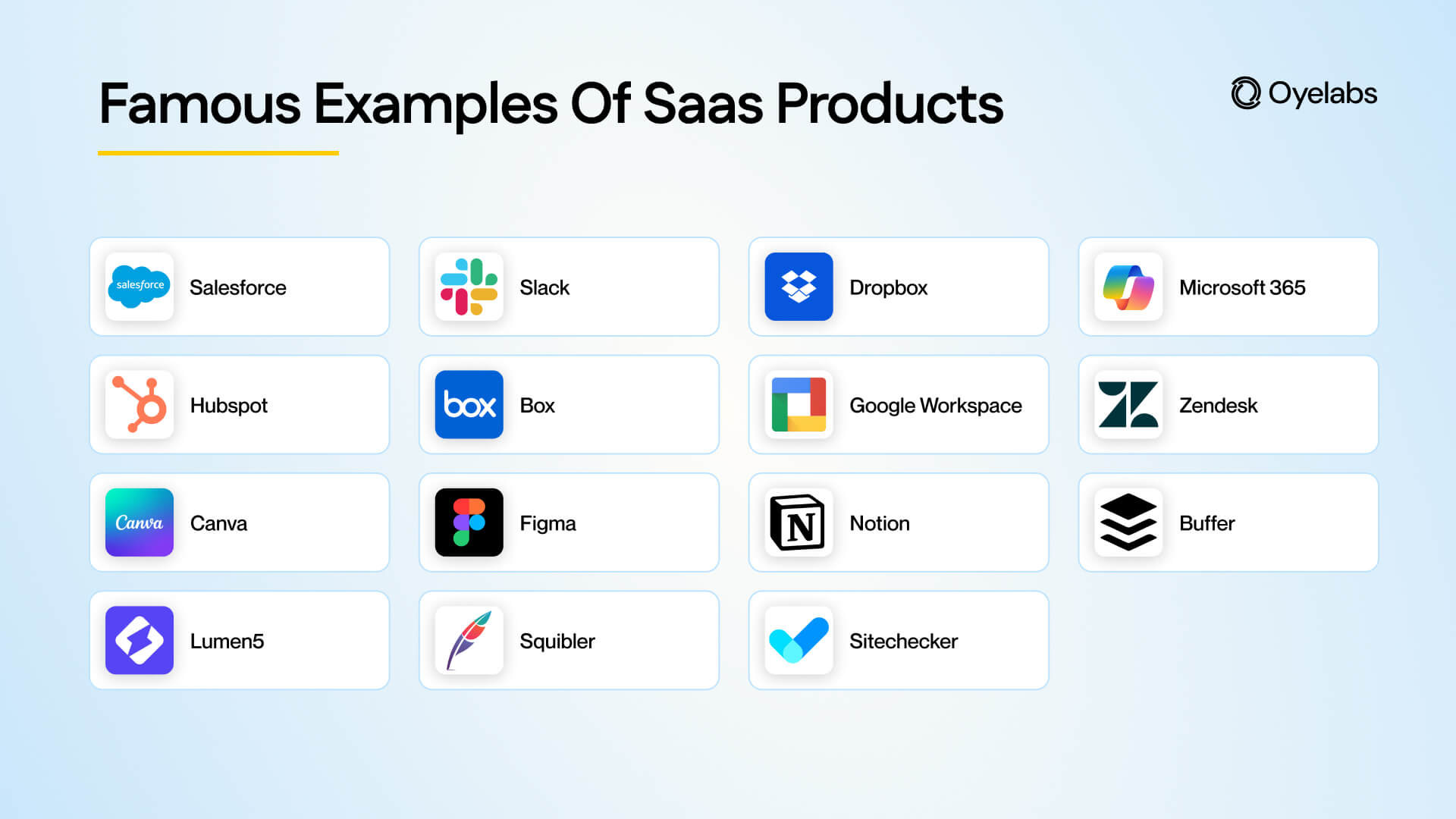
15 SaaS Examples at a Glance
|
SaaS Example |
Purpose |
Key Fact |
|---|---|---|
|
Salesforce |
CRM |
$11.3B Q2 FY2027 revenue |
|
Microsoft 365 |
Productivity |
5% seat growth |
|
Google Workspace |
Collaboration |
Gemini AI integration |
|
Slack |
Communication |
1M Slackbot monthly users |
|
HubSpot |
Marketing and CRM |
311,704 customers |
|
Zendesk |
Customer support |
Acquired Forethought in 2026 |
|
Dropbox |
Cloud storage |
18.2M paying users |
|
Box |
Content management |
106% net revenue retention |
|
Canva |
Graphic design |
260M monthly users |
|
Figma |
UI/UX design |
$391.4M Q3 2026 revenue |
|
Notion |
Project management |
AI agent adoption |
|
Buffer |
Social media management |
$22.46M 2025 revenue |
|
Lumen5 |
Video creation |
AI video tools |
|
Squibler |
Writing |
AI writing tools |
|
Sitechecker |
SEO |
AI visibility tracking |
1. Salesforce
Salesforce is a cloud-based CRM platform that helps businesses manage customer relationships, sales, marketing, and customer service. It also offers AI tools through Agentforce to automate business workflows.
Key points (Q2 FY2027)
-
Revenue reached $11.3 billion, up 11% year over year.
-
Subscription and support revenue reached $10.8 billion.
-
Informatica contributed $456 million in revenue.
Also Read: Steps to Building a SaaS Application in 2026
2. Microsoft 365
Microsoft 365 is a subscription-based productivity suite that includes Word, Excel, PowerPoint, Outlook, and Teams. It helps individuals and businesses create documents, manage emails, collaborate, and store files online.
Key points (Q1 FY2027)
-
Microsoft 365 commercial cloud revenue grew 17%.
-
Commercial seats increased by 5%.
-
Copilot adds AI assistance to supported applications and plans.
3. Google Workspace
Google Workspace combines Gmail, Drive, Docs, Sheets, Meet, and Calendar in one cloud-based platform. Businesses use it to manage communication, create documents, store files, and collaborate in real time.
Key points
-
Gemini AI capabilities are included in eligible Workspace plans.
-
Google introduced an AI Expanded Access add-on in March 2026 for higher usage limits on selected AI features.
-
The platform supports team collaboration through shared documents and cloud storage.
4. Slack
Slack is a workplace communication platform that helps teams organize conversations through channels, direct messages, and integrations with other business applications. Its AI assistant, Slackbot, can help users find information and summarize workplace conversations.
Key points
-
Salesforce acquired Slack in 2021.
-
Slackbot crossed 1 million monthly active users.
-
Slack supports integrations with tools such as Google Drive and Salesforce.
5. HubSpot
HubSpot provides CRM, marketing, sales, and customer service software through one connected platform. Businesses use its tools to manage leads, automate campaigns, track sales, and handle customer relationships.
Key points (Q3 2026)
-
Revenue reached $947.6 million, up 17% year over year.
-
Customer count reached 311,704, up 12%.
-
Subscription revenue was $930.2 million.
6. Zendesk
Zendesk is a customer service platform that helps businesses manage support tickets, emails, messaging, and customer inquiries from one workspace. It also offers AI-powered tools to automate routine support tasks.
Key points
-
Zendesk became privately held in 2022.
-
It completed its acquisition of AI customer service company Forethought in March 2026.
-
Its tools support ticket management, workflow automation, and customer service reporting.
7. Dropbox
Dropbox is a cloud storage and file-sharing service that lets users save, access, and synchronize files across devices. It also provides shared folders and collaboration features for businesses and individuals.
Key points (Q3 2026)
-
Reported 18.20 million paying users.
-
Annual recurring revenue reached $2.555 billion.
-
Quarterly revenue was $637.3 million.
8. Box
Box is a cloud-based content management platform that helps businesses securely store, share, and manage documents. It also provides workflow automation, electronic signatures, and AI-powered tools for working with business content.
Key points (Q2 FY2027)
-
Revenue reached $321.1 million, up 9%.
-
Net revenue retention was 106%.
-
Remaining performance obligations reached $1.7 billion.
9. Canva
Canva is an online design platform that allows users to create social media posts, presentations, videos, posters, and marketing materials using ready-made templates. Its AI-powered Magic Studio tools also help users generate and edit visual content.
Key points
-
Canva reported 260 million monthly users in 2025.
-
It offers design tools for individuals, businesses, and educational institutions.
-
Users can choose from free and paid subscription plans.
10. Figma
Figma is a cloud-based design and collaboration platform used to create website interfaces, mobile app designs, and interactive prototypes. Its real-time editing features allow designers and developers to work together in one workspace.
Key points (Q3 2026)
-
Revenue reached $391.4 million, up 43%.
-
Net dollar retention was 131%.
-
It reported 16,566 paying customers with more than $10,000 in annual recurring revenue.
11. Notion
Notion is an all-in-one workspace for notes, documents, project management, and team knowledge. Its AI features help users summarize information, generate content, and automate tasks.
Key points
-
Notion’s CEO reported in November 2026 that AI agents created roughly half of the platform’s pages.
-
The platform supports shared workspaces, databases, and project tracking.
-
Its AI tools can assist with writing and information management.
12. Buffer
Buffer is a social media management platform that helps businesses and creators schedule posts, manage social accounts, and track content performance. It also offers analytics and AI-assisted content creation tools.
Key points (2025)
-
Annual revenue reached $22.462 million.
-
Buffer reported 69,760 customers.
-
Revenue grew 31% year over year.
13. Lumen5
Lumen5 is an AI-assisted video creation platform that helps businesses turn blog posts, scripts, and other written content into videos. Users can customize scenes, add images, include music, and create branded videos for marketing and social media.
Key points
-
Converts written content into video formats.
-
Offers AI-assisted video creation and animated explainers.
-
Designed for users without advanced video editing skills.
14. Squibler
Squibler is an online writing platform designed for authors, novelists, and screenwriters. It provides tools for organizing writing projects, developing outlines, drafting chapters, and creating long-form content.
Key points
-
Includes an AI Smart Writer for writing assistance.
-
Supports book, novel, and screenplay projects.
-
Offers free and paid plans with different usage limits.
15. Sitechecker
Sitechecker is an SEO platform that helps website owners monitor website health, track keyword rankings, and identify technical issues. It has also expanded its reporting tools to cover traffic and visibility from AI platforms.
Key points
-
AI Traffic reports visits referred by AI chat platforms.
-
AI Chat Visibility tracks brand mentions and citations in AI-generated answers.
-
Also offers website audits and SEO monitoring tools.
Benefits of SaaS Platforms
The 15 SaaS examples discussed above show how businesses and individuals use cloud-based software for tasks such as communication, design, customer management, and file storage. Beyond these different applications, SaaS platforms offer several benefits that make software easier to access and manage.
-
Access from anywhere: Users can access software through a web browser or mobile app without being tied to one device or location.
-
Lower upfront costs: Subscription plans eliminate the need for expensive software licenses or in-house infrastructure.
-
Automatic updates: SaaS providers handle software updates, security patches, and new feature releases.
-
Scalability: Businesses can add users, upgrade plans, or access additional features as their requirements change.
-
Easier collaboration: Teams can share files, communicate, and work on projects through a shared platform.
-
Reduced maintenance: Providers manage hosting and infrastructure, allowing businesses to focus on their daily operations.
Planning to Build a SaaS Platform?
Launching a SaaS platform requires the right combination of features, technology, and business planning. Whether you want to create a CRM, project management tool, marketing platform, or another cloud-based application, choosing the right development approach is important.
Oyelabs helps businesses turn software ideas into functional digital products. Our team provides SaaS application development services to build customized platforms based on your business requirements. From planning the core features to developing a scalable application, we help bring your software idea to life.
Looking to launch your own SaaS product? Contact Oyelabs to discuss your project and development requirements.
Conclusion
SaaS platforms have become an important part of how businesses and individuals use software. From Salesforce and HubSpot for customer management to Canva for design and Dropbox for cloud storage, these examples show how SaaS products address different needs through internet-based applications.
As more businesses look for accessible and scalable software solutions, SaaS continues to offer opportunities for companies planning to launch their own platforms.
FAQs
1. What are the most popular SaaS platforms?
Popular SaaS platforms include Salesforce, Microsoft 365, Google Workspace, Slack, HubSpot, Canva, Dropbox, and Figma.
2. What is the difference between SaaS and traditional software?
SaaS runs online through cloud-based services, while traditional software usually requires local installation, manual updates, and device-based maintenance.
3. Can individuals use SaaS applications?
Yes, individuals use SaaS applications for personal tasks such as writing, graphic design, file storage, communication, and productivity.
4. How do SaaS companies make money?
SaaS companies generate revenue through monthly or annual subscriptions, usage-based pricing, premium features, and customized business plans.
5. What should businesses consider when choosing a SaaS platform?
Businesses should compare pricing, essential features, data security, integrations, ease of use, customer support, and future scalability before choosing.
Senior Digital Transformation Consultant at Oyelabs