
The Business Model Behind Micro-Entertainment Apps

 Akshata Kapileshwari
Last Updated on June 29, 2026
Key Takeaways
What You’ll Learn
- What micro-entertainment apps are
- How the business model of TikTok works
- How ReelShort makes money
- Why short-form video platforms scale quickly
- How TikTok clones generate revenue
- How ReelShort clones monetize premium content
- Which revenue model works best for different app types
- What features a profitable app like TikTok needs
Stats That Matter
- TikTok had around 1.6 billion users in 2025, showing the global scale of short-video entertainment.
- DataReportal reported that TikTok’s Android users spent almost 35 hours per month on the app in November 2024.
- Goldman Sachs estimated that the creator economy could reach $480 billion by 2027.
- Sensor Tower reported that ReelShort generated around $490 million in cumulative global in-app revenue by March 2025.
- Sensor Tower also reported that short-drama apps reached strong in-app revenue growth in Q1 2025, proving that premium micro-content can monetize beyond ads.
The Business Model Behind Micro-Entertainment Apps
Micro-entertainment apps are no longer just short-video platforms.
They are attention engines.
Apps like TikTok, ReelShort, YouTube Shorts, Instagram Reels, and SnackVideo turn short bursts of user attention into advertising revenue, in-app purchases, subscriptions, creator monetization, commerce transactions, and brand partnerships.
That is why founders, investors, and creators are paying close attention to this category.
The business model is simple on the surface.
Users watch short content.
Creators publish more content.
Algorithms increase engagement.
The platform monetizes the attention.
But the real business model behind micro-entertainment apps is deeper than “ads on videos.”
Successful platforms combine three layers:
- Content supply
- User engagement
- Monetization architecture
This is what makes TikTok clones, ReelShort clones, and short-video apps commercially powerful when executed correctly.
Quick Answer: What Is the Business Model Behind Micro-Entertainment Apps?
Micro-entertainment apps generate revenue through advertising, premium content, virtual gifts, subscriptions, e-commerce, creator monetization, and brand partnerships. The business model works by converting short-form attention into repeat engagement, then monetizing that engagement through multiple revenue streams instead of depending on one income source.
What Is a Micro-Entertainment App?
A micro-entertainment app is a mobile-first platform that delivers short, highly engaging content designed for fast consumption. These apps usually use algorithmic feeds, creator tools, short videos, episodic clips, live streams, or premium unlocks to keep users engaged.
Examples include:
- TikTok
- ReelShort
- YouTube Shorts
- Instagram Reels
- SnackVideo
- Likee
- Bigo Live
- DramaBox
A TikTok clone usually focuses on short user-generated videos.
A ReelShort clone usually focuses on short scripted drama episodes.
Both belong to the same broader category: micro-entertainment platforms.
Micro-Entertainment App Examples
| Platform | Main Content Type | Primary Revenue Model |
| TikTok | Short user-generated videos | Ads, commerce, gifts |
| ReelShort | Vertical short dramas | Premium episode unlocks |
| YouTube Shorts | Short videos | Advertising |
| Instagram Reels | Short videos | Advertising and commerce |
| SnackVideo | Short videos | Ads and virtual gifts |
| Bigo Live | Live video | Virtual gifts and live monetization |
This comparison matters because not all micro-entertainment apps make money the same way.
TikTok monetizes attention at scale.
ReelShort monetizes story addiction.
Live-streaming apps monetize creator-fan interaction.
A founder building an app like TikTok must choose the right monetization model before building features.
Why Are Micro-Entertainment Apps Growing So Fast?
Micro-entertainment apps are growing because they match how users consume content on mobile devices. Users want fast videos, personalized feeds, low effort discovery, and constant novelty. Short-form platforms reduce friction and increase repeat sessions.
NTIA’s 2025 survey instrument specifically asks whether people watch or download videos online, use social media, upload original content, and use online shopping or consumer services. These are the exact behaviors that support short-video apps, creator platforms, TikTok clones, and micro-entertainment commerce models.
The growth is also tied to creator supply.
Goldman Sachs estimated that the creator economy could reach $480 billion by 2027. That matters because micro-entertainment platforms depend on creators for constant content supply.
The stronger the creator ecosystem, the stronger the platform’s monetization potential.
What Is the Business Model of TikTok?
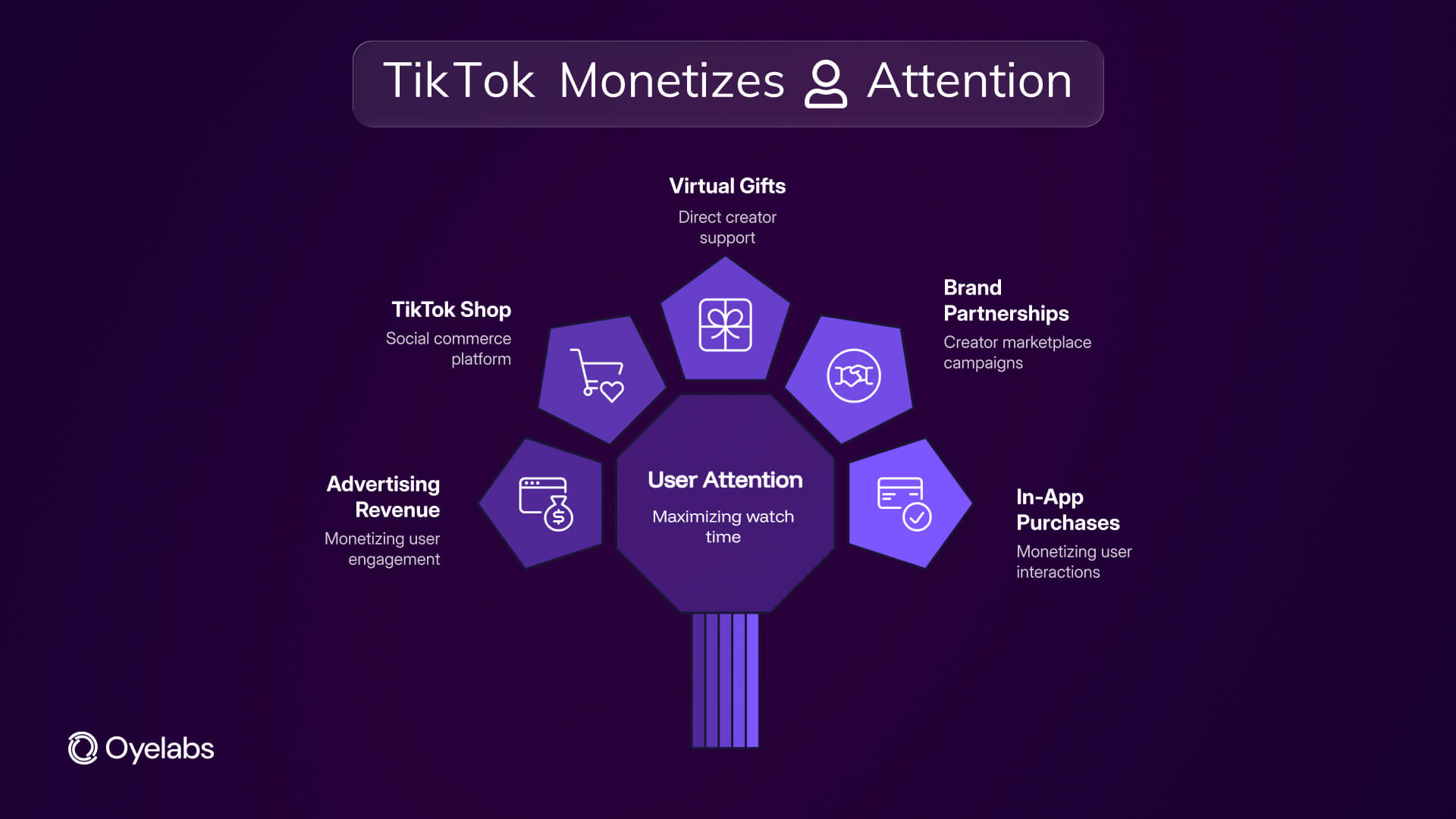
The business model of TikTok is based on monetizing user attention through advertising, TikTok Shop, virtual gifts, creator partnerships, in-app purchases, and brand campaigns. TikTok uses algorithmic recommendations to increase watch time and then turns engagement into revenue.
TikTok does not rely on one revenue stream.
TikTok combines several monetization layers:
- Advertising
- Social commerce
- TikTok Shop
- Virtual gifts
- Brand partnerships
- Creator marketplace campaigns
- In-app purchases
This is why TikTok is difficult to copy.
The product is not only the video feed.
The real product is the monetization system around the feed.
How Does TikTok Make Money?
TikTok makes money by selling ad placements, enabling social commerce, supporting virtual gifts during live streams, connecting brands with creators, and driving transactions through TikTok Shop. Advertising remains the largest revenue engine, but commerce and creator-led monetization are becoming more important.
1. Advertising Revenue
Advertising is the core revenue stream for most TikTok-like platforms.
Brands pay to reach users through:
- In-feed ads
- TopView ads
- Branded hashtag challenges
- Spark Ads
- Creator-led promotions
- Performance ads
TikTok’s advantage comes from attention density.
Users scroll quickly.
The algorithm learns quickly.
Advertisers receive highly targeted placements.
This creates a powerful ad model.
2. TikTok Shop and Social Commerce
TikTok Shop turns entertainment into shopping.
Users discover products inside videos, creator posts, livestreams, and product showcases. This allows TikTok to connect content, influence, and purchase intent in one flow.
Market estimates reported TikTok Shop global GMV above $30 billion in 2024, with the United States becoming one of the major markets. This shows why social commerce is becoming a critical part of the TikTok revenue model.
For founders building an app like TikTok, commerce should not be treated as a future add-on.
Commerce can become a core monetization engine.
3. Virtual Gifts and Live Monetization
Virtual gifts allow users to support creators during live streams.
Users buy coins or digital items.
Creators receive gifts.
The platform takes a percentage.
This model works well when the app has:
- Active creators
- Live-streaming culture
- Strong fan communities
- Repeat viewer engagement
Virtual gifting is especially important for creator economy platforms and TikTok clones with live video features.
4. Creator Marketplace Campaigns
TikTok also earns through brand-creator collaboration infrastructure.
Brands want creators.
Creators want revenue.
The platform sits between both sides.
A TikTok clone can use this model by adding:
- Creator profiles
- Brand campaign dashboards
- Sponsored content tools
- Performance reporting
- Creator pricing controls
This model becomes stronger as the creator base grows.
5. In-App Purchases
In-app purchases can include:
- Coins
- Gifts
- Premium filters
- Boosts
- Creator tools
- Paid content access
This model works best when users already show high engagement.
No one pays inside a dead app.
Monetization follows retention.
What Is the Business Model of ReelShort?
The business model of ReelShort is based on premium short-drama monetization. ReelShort earns revenue through episode unlocks, coins, subscriptions, and in-app purchases. Instead of monetizing only attention through ads, ReelShort monetizes curiosity and story continuation.
This is a very different model from TikTok.
TikTok asks:
“Can we keep users scrolling?”
ReelShort asks:
“Will users pay to unlock the next episode?”
That difference changes the product strategy.
ReelShort-style apps need:
- Strong story hooks
- Short episodes
- Cliffhangers
- Paid unlocks
- Coin wallets
- Subscription plans
- High-volume content production
Why Are Micro-Entertainment Apps Profitable?
Micro-entertainment apps can become profitable because they create repeat engagement at scale. The strongest platforms reduce content production costs, increase user sessions, use algorithms to personalize feeds, and monetize attention through several revenue channels.
A 2025 Montclair State University study on TikTok’s platform strategy identified six drivers behind TikTok’s success, including immersive user experience, creator network effects, user-generated content growth, and diversified monetization. These drivers explain why TikTok-like platforms can scale faster than traditional media businesses.
The economics work when four conditions exist:
- Users return often
- Content supply keeps growing
- Monetization appears naturally
- Acquisition cost stays controlled
Short-form platforms also benefit from low content friction.
Users do not need to watch a 40-minute episode.
Users can consume 10 videos in a few minutes.
That creates more ad impressions, more engagement signals, and more monetization moments.
Revenue Models Used by TikTok Clones
A TikTok clone can generate revenue through ads, creator subscriptions, virtual gifts, live streaming, e-commerce, sponsored content, paid boosts, and premium creator tools. The strongest TikTok clone business model combines multiple revenue streams instead of depending only on advertising.
Advertising
Advertising works best when the platform has strong watch time and user segmentation.
Ad revenue usually becomes stronger after the app reaches meaningful user scale.
Virtual Gifts
Virtual gifts work well for apps with live streams and creator-fan communities.
This model rewards emotional engagement.
Subscriptions
Subscriptions can work for:
- Premium creators
- Ad-free viewing
- Exclusive content
- Advanced creator tools
This model creates recurring revenue.
Premium Content
Premium content works better for ReelShort clones than classic TikTok clones.
Users pay when content creates urgency.
E-Commerce
E-commerce works when content influences buying behavior.
This model is ideal for beauty, fashion, fitness, gadgets, and lifestyle content.
Brand Partnerships
Brand partnerships help platforms monetize creators before large-scale ad infrastructure matures.
This is useful for early-stage apps.
Features Required in a TikTok Clone
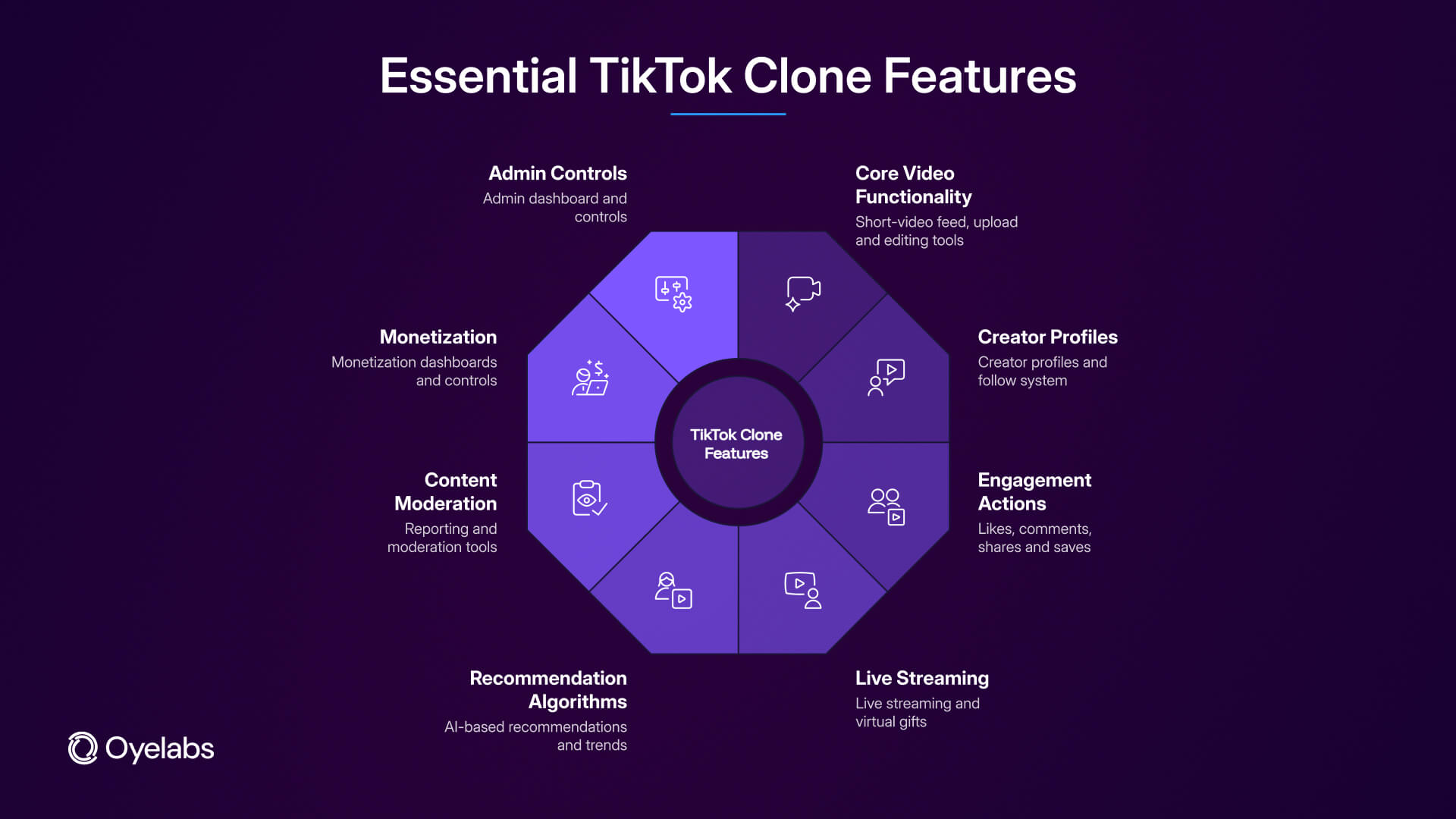
A profitable TikTok clone requires a short-video feed, creator profiles, video upload tools, editing features, recommendation algorithms, engagement actions, live streaming, virtual gifts, monetization dashboards, content moderation, and admin controls.
Core features include:
- Short-video feed
- Video upload
- Video editing tools
- Likes and comments
- Shares and saves
- Creator profiles
- Follow system
- AI-based recommendations
- Live streaming
- Virtual gifts
- Hashtags and trends
- Reporting and moderation
- Admin dashboard
- Monetization controls
A TikTok clone should not only copy TikTok’s interface.
A TikTok clone should copy the revenue logic behind TikTok.
That is the harder part.
Best TikTok Clone Solution for Entrepreneurs
The best TikTok clone solution should include short-video feeds, creator profiles, upload tools, editing features, recommendation systems, live streaming, virtual gifts, moderation tools, monetization dashboards, and admin controls.
Oyelabs helps founders build TikTok clone apps, ReelShort clone apps, creator economy platforms, and short-video entertainment apps with scalable architecture and revenue-focused workflows.
The goal is not to copy TikTok pixel by pixel.
The goal is to build a platform that can attract creators, retain users, and monetize attention.
That is where the business model succeeds.
Conclusion
The business model behind micro-entertainment apps is built on one core asset: attention.
TikTok monetizes attention through advertising, commerce, and creator ecosystems.
ReelShort monetizes curiosity through short dramas and paid episode unlocks.
Live-streaming apps monetize emotional connection through gifts.
Creator platforms monetize influence through subscriptions and sponsorships.
Founders who want to build an app like TikTok or launch a ReelShort clone should not start with features alone.
The first question should be:
How will the platform convert engagement into revenue?
That answer should shape the product, content strategy, creator tools, payment systems, and growth model.
Micro-entertainment apps do not win because videos are short.
They win because the business model turns small moments of attention into scalable digital revenue.
FAQs
What is a micro-entertainment app?
A micro-entertainment app delivers short, mobile-first content designed for fast consumption and repeat engagement. Examples include TikTok, ReelShort, YouTube Shorts, Instagram Reels, SnackVideo, and short-drama apps. These platforms monetize user attention through ads, subscriptions, gifts, commerce, or premium content.
What is the business model of TikTok?
The business model of TikTok is based on advertising, TikTok Shop, virtual gifts, creator partnerships, in-app purchases, and brand campaigns. TikTok uses algorithmic recommendations to increase watch time and then monetizes user attention through multiple revenue streams.
How does ReelShort make money?
ReelShort makes money through premium episode unlocks, in-app purchases, coin wallets, and subscription-based access to short dramas. The platform monetizes story continuation instead of relying only on advertising revenue.
How do TikTok clones generate revenue?
TikTok clones generate revenue through advertising, virtual gifts, live streaming, creator subscriptions, premium tools, sponsored content, e-commerce integrations, and brand partnerships. The best revenue model depends on audience size, creator activity, content type, and user retention.
What features should a TikTok-like app include?
A TikTok-like app should include short-video feeds, creator profiles, video upload tools, editing features, likes, comments, shares, recommendations, live streaming, virtual gifts, monetization dashboards, moderation tools, and admin controls.