
Why Local Services Are Moving to Marketplace Models

Why Local Services Are Moving to Marketplace Models
 Akshata Kapileshwari
Last Updated on June 29, 2026
Key Takeaways
What You’ll Learn
- Why local services are shifting toward marketplace models
- How marketplace platforms solve trust and discovery problems
- Why TaskRabbit became one of the most recognized service marketplaces
- How marketplace business models scale
- What founders often misunderstand about local services marketplaces
- Why trust infrastructure matters more than convenience
- Whether building a TaskRabbit clone is still a viable opportunity
Statistics Snapshot
- The U.S. Bureau of Labor Statistics projects continued growth across many service-based occupations through the decade, driven by ongoing demand for home, maintenance, repair, and personal services.
- According to the International Labour Organization (ILO), platform-based work continues expanding globally as digital marketplaces connect service providers with customers.
- The U.S. Census Bureau reports that internet adoption continues to rise, supporting increased demand for digital service discovery and online transactions.
- Mobile-first consumer behavior continues reshaping how customers search, compare, book, and pay for local services.
These trends help explain why marketplace platforms are increasingly becoming the preferred model for local services.
Why Are Local Services Moving to Marketplace Models?
Local services are moving to marketplace models because customers expect verified providers, transparent pricing, digital payments, reviews, and faster service discovery. Marketplace platforms solve trust and convenience challenges while helping service providers acquire customers more efficiently than traditional referral-based systems.
According to the International Labour Organization’s 2025 platform economy research, digital labor platforms continue expanding globally, creating new opportunities for independent workers and reshaping how services are discovered, booked, and delivered. This shift is increasingly visible across home services, maintenance, cleaning, repairs, and skilled trades.
For decades, local services operated through fragmented systems.
A customer needed a plumber.
Someone recommended a plumber.
The customer made a phone call.
Pricing was unclear.
Availability was uncertain.
Quality varied significantly.
Today, customers expect a completely different experience.
Customers expect:
- Instant discovery
- Verified providers
- Reviews and ratings
- Online booking
- Digital payments
- Real-time communication
Marketplace platforms deliver all six.
That shift is fundamentally changing how local services operate.
What Is a Local Services Marketplace?
A local services marketplace is a digital platform that connects customers with independent service providers. The platform manages discovery, communication, scheduling, payments, reviews, and trust mechanisms that help transactions happen efficiently.
Well-known examples include:
- TaskRabbit
- Thumbtack
- Airtasker
- Handy
- Urban Company
Instead of searching through directories or relying exclusively on referrals, customers can compare providers, read reviews, verify credentials, and book services directly through a platform.
The marketplace becomes the trust layer between supply and demand.
How Did Local Services Work Before Marketplace Platforms?
Before marketplaces became common, local services relied heavily on referrals, local advertising, and personal networks.
While these systems worked, they created significant friction.
| Traditional Service Model | Marketplace Model |
| Word-of-mouth referrals | Search and discovery |
| Phone calls | Instant booking |
| Limited provider visibility | Multiple provider options |
| Cash transactions | Digital payments |
| Minimal reviews | Transparent ratings |
| Manual scheduling | Automated scheduling |
| Limited accountability | Platform-backed trust |
This comparison highlights why customers increasingly prefer marketplace experiences.
The marketplace removes uncertainty.
Why Are Marketplace Models Winning?
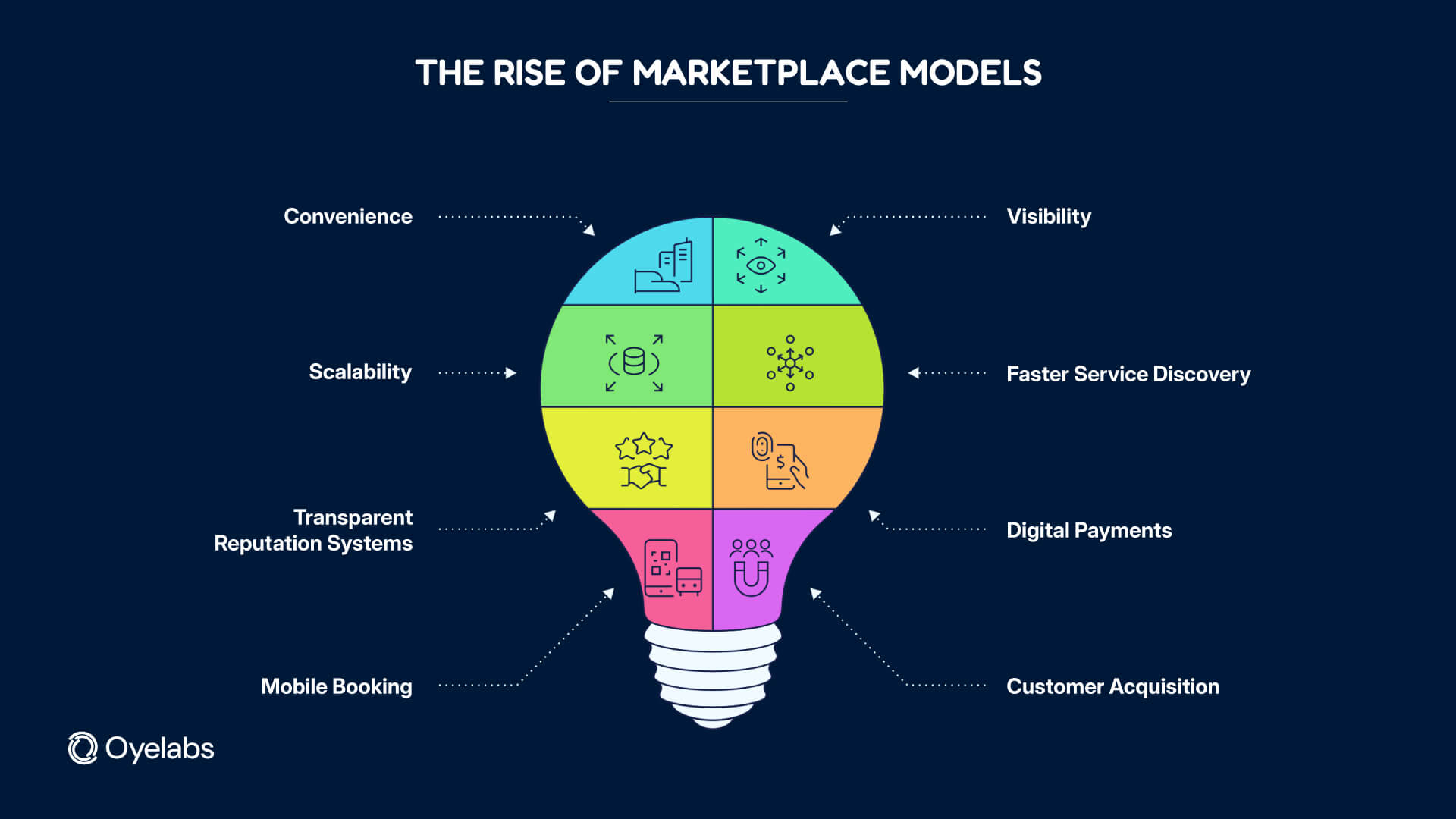
Marketplace models are winning because they solve problems for both sides of the transaction.
Customers gain convenience.
Providers gain visibility.
The platform gains scalability.
This creates a powerful marketplace flywheel.
Reason 1: Faster Service Discovery
Customers no longer want to spend hours finding providers.
Marketplace platforms reduce search time dramatically.
Instead of contacting multiple businesses individually, customers can compare providers in one location.
This improves conversion and customer satisfaction.
Reason 2: Transparent Reputation Systems
Reviews changed local services forever.
Customers trust verified reviews more than traditional advertising.
A provider with hundreds of positive reviews immediately appears more trustworthy than an unknown competitor.
Platforms such as TaskRabbit, Thumbtack, and Urban Company built much of their growth around reputation systems.
Reason 3: Digital Payments Build Confidence
Digital payments reduce friction.
Customers feel safer.
Providers receive faster payments.
Platforms create accountability.
Payment infrastructure is often overlooked, but it is one of the most important reasons marketplace adoption continues growing.
Reason 4: Mobile Booking Has Become the Default
Customers increasingly expect services to be available on demand.
Whether ordering food, booking transportation, or hiring a handyman, mobile booking has become standard behavior.
Local services are following the same trend.
The customer experience is increasingly shaped by platforms rather than phone calls.
Reason 5: Providers Need Better Customer Acquisition
Service providers face a different challenge.
Finding customers consistently is difficult.
Traditional marketing channels often generate unpredictable results.
Marketplace platforms solve this problem by creating a steady stream of demand.
For many providers, the platform becomes their primary customer acquisition channel.
Why Trust Is More Important Than Convenience
Most articles argue that marketplace adoption is driven by convenience.
In our experience working with marketplace founders, convenience matters, but trust matters more.
This is where many founders misunderstand the market.
Customers rarely hire service providers because booking is convenient.
Customers hire service providers because they trust the outcome.
The strongest marketplace platforms package trust into a repeatable system.
That trust infrastructure typically includes:
- Provider verification
- Reviews and ratings
- Secure payments
- Communication tools
- Identity validation
- Booking history
- Dispute resolution
Traditional local service businesses rarely provide all seven.
Marketplace platforms do.
That is one of the biggest reasons marketplace models continue gaining market share.
Information Gain: The Trust Infrastructure Framework
Most founders believe marketplaces compete on features.
The strongest marketplaces actually compete on trust infrastructure.
We often see founders obsess over:
- Chat features
- Notifications
- AI recommendations
- Mobile design
Those features matter.
But they rarely drive adoption initially.
Trust drives adoption.
A customer asks:
Can I trust this provider?
A provider asks:
Can I trust this customer?
The marketplace succeeds when both questions receive a confident answer.
This framework explains why many small local service directories fail while marketplace businesses succeed.
A directory organizes information.
A marketplace organizes trust.
What Is the TaskRabbit Business Model?
The TaskRabbit business model connects customers with independent service providers through a marketplace platform. TaskRabbit generates revenue by facilitating transactions, charging service fees, and creating a trusted environment where both customers and providers can complete jobs efficiently.
TaskRabbit does not employ service providers directly.
Instead, TaskRabbit acts as the infrastructure layer that enables transactions.
This asset-light model is one reason marketplace businesses can scale faster than traditional service companies.
How Does TaskRabbit Make Money?
TaskRabbit earns revenue through service fees charged on marketplace transactions. The platform benefits whenever customers successfully hire providers and complete jobs through the marketplace.
The model aligns incentives across all participants:
- Customers gain access to trusted providers.
- Service providers gain access to customers.
- The platform earns revenue when transactions occur.
This creates a sustainable marketplace structure.
Why TaskRabbit Became a Marketplace Leader
TaskRabbit succeeded because it solved several marketplace challenges better than early competitors.
Key strengths included:
- Strong provider verification
- User-friendly booking experience
- Transparent pricing
- Ratings and reviews
- Reliable customer support
- Clear dispute resolution
TaskRabbit did not simply build an app.
TaskRabbit built trust at scale.
That distinction matters.
How Does a Marketplace Business Model Scale?
A marketplace business model scales by increasing supply, increasing demand, and improving transaction efficiency. Unlike traditional service businesses, marketplace platforms do not need to hire every provider themselves, allowing growth with significantly lower operational overhead.
This is where marketplace economics become powerful.
Marketplace Liquidity Explained
Marketplace liquidity measures how easily customers and providers can successfully complete transactions.
High liquidity means:
- Customers quickly find providers.
- Providers regularly receive jobs.
- Transactions happen efficiently.
Low liquidity means:
- Customers cannot find providers.
- Providers cannot find customers.
- Marketplace activity slows.
Liquidity is one of the most important marketplace metrics.
Yet many founders never track it.
Supply Density and Demand Density
Marketplace success depends on balancing supply and demand.
Too much demand creates long wait times.
Too much supply creates provider frustration.
Successful marketplaces focus on achieving both:
Supply Density
Enough providers in a specific area.
Demand Density
Enough customer requests in the same area.
This balance creates a healthy marketplace ecosystem.
Network Effects Create Competitive Advantages
Network effects occur when each new participant increases value for existing participants.
Examples:
- More providers attract more customers.
- More customers attract more providers.
- More transactions generate more reviews.
- More reviews improve trust.
This creates a marketplace flywheel.
As the platform grows, growth becomes easier.
This is one reason successful marketplaces become difficult to compete against.
Why Do Marketplace Platforms Scale Faster Than Traditional Service Businesses?
Marketplace platforms scale faster because they do not directly deliver services. Instead, they coordinate transactions between independent providers and customers.
This creates several advantages.
| Traditional Service Business | Marketplace Platform |
| Must hire staff | Leverages independent providers |
| Limited geographic expansion | Faster geographic scaling |
| Higher operational costs | Lower operational overhead |
| Linear growth | Network-driven growth |
| Limited capacity | Expanding provider capacity |
The marketplace model separates growth from workforce expansion.
That creates scalability.
What Challenges Do Marketplace Founders Face?
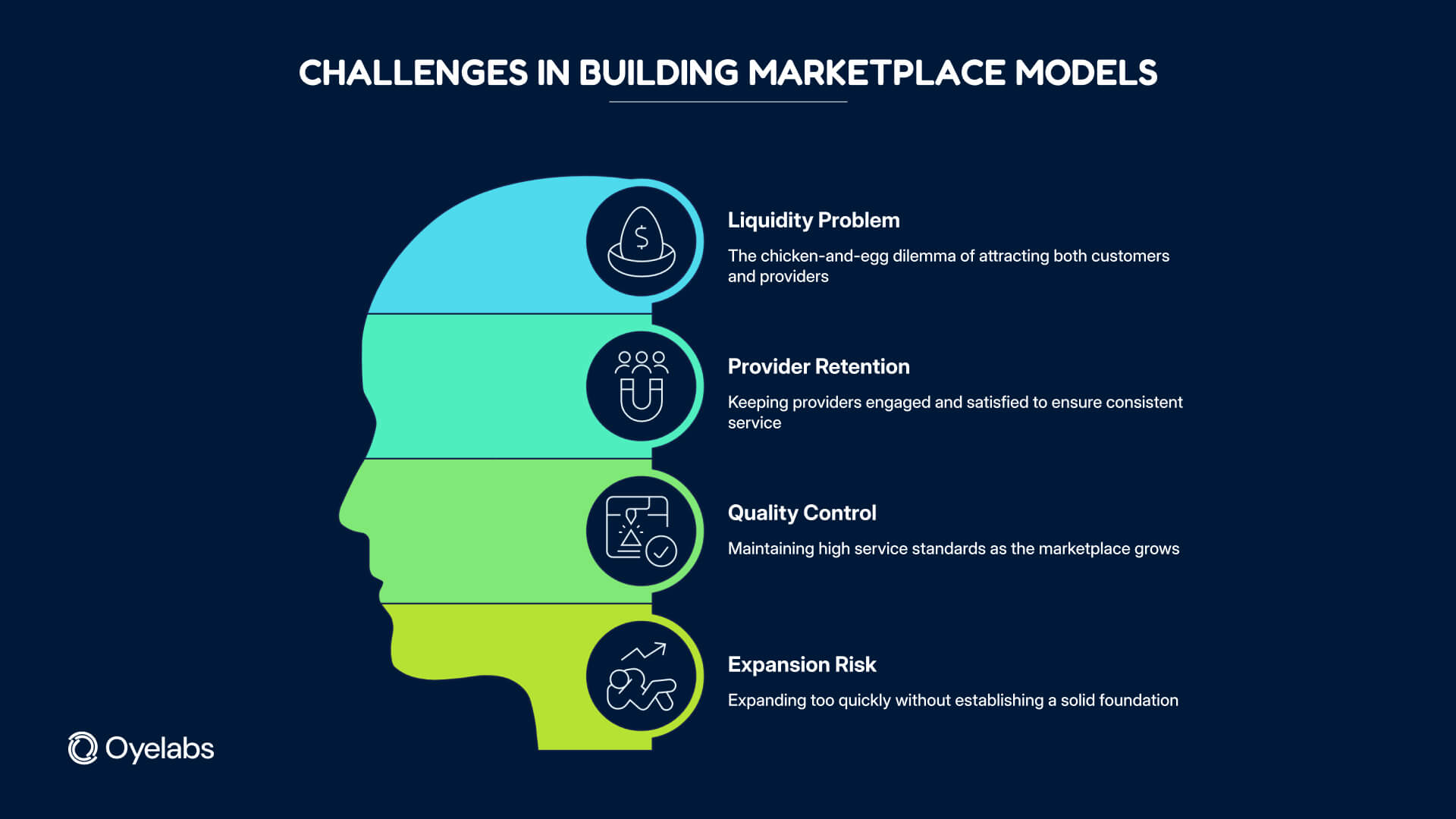
Marketplace businesses can scale quickly, but they are not easy to build.
In our experience evaluating TaskRabbit-style businesses and service marketplaces, founders consistently encounter four major challenges.
Challenge 1: The Liquidity Problem
The biggest challenge is marketplace liquidity.
Customers will not join if providers are unavailable.
Providers will not join if customers are unavailable.
This creates the classic marketplace chicken-and-egg problem.
Many marketplaces fail here.
Challenge 2: Provider Retention
Acquiring providers is difficult.
Retaining providers is harder.
Providers leave marketplaces when:
- Job quality is poor
- Customer demand is inconsistent
- Fees become excessive
- Competitors offer better opportunities
Provider retention often determines long-term marketplace success.
Challenge 3: Quality Control
Growth can create quality issues.
As provider numbers increase, maintaining standards becomes more difficult.
Strong marketplaces invest heavily in:
- Verification
- Reviews
- Quality monitoring
- Customer support
Trust must scale alongside supply.
Challenge 4: Expansion Risk
Many founders expand too quickly.
They launch in:
- Multiple cities
- Multiple service categories
- Multiple countries
before achieving liquidity in a single market.
This often creates operational complexity without sustainable growth.
Common Founder Mistakes
Many marketplace failures follow predictable patterns.
The technology usually works.
The marketplace economics do not.
Mistake 1: Expanding Before Achieving Liquidity
One pattern we frequently observe is premature expansion.
Founders attempt to enter multiple markets before validating a single market.
A marketplace with strong liquidity in one city is often more valuable than a marketplace with weak liquidity in ten cities.
Mistake 2: Building Features Instead of Demand
Founders often prioritize:
- Advanced messaging
- AI recommendations
- Gamification
- Complex dashboards
before solving supply and demand.
Customers care about outcomes.
Providers care about opportunities.
Features should support those objectives.
Mistake 3: Measuring Downloads Instead of Retention
Downloads can be misleading.
Retention is more important.
Key metrics include:
- Repeat bookings
- Active providers
- Transaction frequency
- Customer lifetime value
- Provider lifetime value
Retention usually predicts marketplace health more accurately than downloads.
Mistake 4: Ignoring Provider Economics
Providers drive marketplace supply.
If providers cannot earn meaningful income, they leave.
Marketplace founders must continuously evaluate:
- Earnings potential
- Job volume
- Platform fees
- Customer quality
Healthy provider economics support healthy marketplace growth.
Why Many Local Service Marketplaces Fail
Local service marketplaces rarely fail because of technology.
They usually fail because trust and liquidity never reach critical mass.
Common reasons include:
- Weak provider verification
- Low marketplace liquidity
- Poor retention
- Inconsistent customer acquisition
- Weak support systems
- Limited differentiation
Most failed marketplaces never establish a self-sustaining marketplace flywheel.
Without that flywheel, growth stalls.
Is Building a TaskRabbit Clone Still Worth It?
Yes, but success depends on positioning, execution, and market selection.
Building another generic local services marketplace is increasingly difficult.
Building a focused marketplace can still create strong opportunities.
Examples include:
- Skilled trades marketplaces
- Elder care services
- Home maintenance platforms
- Commercial services marketplaces
- Property management services
- Professional contractor networks
Niche marketplaces often achieve liquidity faster than broad marketplaces.
World Bank digital development initiatives published in 2025 continue to emphasize the role of digital platforms in helping entrepreneurs and small service providers access customers, improve visibility, and participate in broader digital economies.
Opportunity Matrix for Marketplace Founders
| Marketplace Category | Competition Level | Opportunity Level |
| General Handyman Services | High | Medium |
| Home Maintenance | Medium | High |
| Skilled Trades | Medium | High |
| Elder Care Services | Medium | High |
| Commercial Services | Low | Very High |
| Property Services | Medium | High |
| Cleaning Services | High | Medium |
| Specialized Contractor Networks | Low | Very High |
Many founders focus on the largest markets.
Often the strongest opportunities exist in underserved niches.
What Can Founders Learn From TaskRabbit?
TaskRabbit demonstrates several important marketplace lessons.
Successful marketplaces focus on:
- Trust before scale
- Liquidity before expansion
- Retention before acquisition
- Provider success before platform growth
These principles appear repeatedly across successful marketplace businesses.
The lesson is not “build a TaskRabbit clone.”
The lesson is “build marketplace trust.”
Also Read: How To Launch Marketplace For Services the Right Way
Conclusion
The shift toward marketplace models is not simply a technology trend.
It is a trust transformation.
Customers increasingly choose platforms that provide:
- Verified providers
- Transparent pricing
- Secure payments
- Reviews and ratings
- Reliable support
Marketplace businesses package these capabilities into a single experience.
That is why platforms like TaskRabbit, Urban Company, Airtasker, Thumbtack, and Handy continue influencing how local services operate.
For founders, the opportunity remains significant.
But the winning strategy is not to build another generic service marketplace.
The winning strategy is to build stronger trust infrastructure than existing alternatives.
In local services, trust is the product.
The marketplace is simply the mechanism that delivers it.
Frequently Asked Questions
What Is a Local Services Marketplace?
A local services marketplace connects customers with service providers through a digital platform that manages discovery, booking, communication, payments, reviews, and trust systems.
Why Are Local Services Moving to Marketplace Models?
Local services are moving to marketplace models because customers expect convenience, transparency, verified providers, digital payments, and faster service discovery.
What Is the TaskRabbit Business Model?
The TaskRabbit business model connects customers and independent service providers while generating revenue through marketplace transaction fees and service charges.
What Is Marketplace Liquidity?
Marketplace liquidity measures how efficiently customers and providers can find each other and complete transactions within the platform.
Why Do Marketplace Platforms Scale Faster?
Marketplace platforms scale faster because they coordinate transactions between providers and customers without directly employing the service workforce.