
The Uber Eats Business Model – A Complete Guide

The Uber Eats Business Model – A Complete Guide
 Anuraag Jain
Last Updated on June 26, 2026
Key Takeaways
What You’ll Learn
- How the Uber Eats business model works
- How Uber Eats generates revenue
- Why the marketplace scales efficiently
- The competitive advantage behind Uber Eats
- Founder lessons from successful food delivery platforms
- How an Uber Eats clone business model can monetize effectively
Stats That Matter
- According to the United Nations Department of Economic and Social Affairs (UN DESA), nearly 68% of the global population is expected to live in urban areas by 2050, increasing demand for convenience-based services such as food delivery and ride-hailing.
- Research from the MIT Initiative on the Digital Economy shows that digital platforms often scale faster than traditional businesses because they coordinate interactions between multiple participant groups instead of owning inventory.
- Subscription programs have become an increasingly important profit driver across digital marketplaces because recurring customers generate significantly higher lifetime value than one-time users.
- Food delivery marketplaces increasingly generate revenue from subscriptions and advertising in addition to transaction commissions.
Quick Answer: What Is the Uber Eats Business Model?
The Uber Eats business model is a three-sided marketplace that connects customers, restaurants, and delivery partners through a single digital platform. Uber Eats earns revenue from restaurant commissions, delivery fees, service charges, Uber One subscriptions, and advertising while coordinating transactions instead of owning restaurants or employing delivery drivers.
At OyeLabs, we regularly work with founders building food delivery marketplaces. One pattern appears consistently: many entrepreneurs focus on building delivery features, while the real advantage comes from designing a marketplace that keeps customers, merchants, and delivery partners active at the same time.
What Is the Uber Eats Business Model?
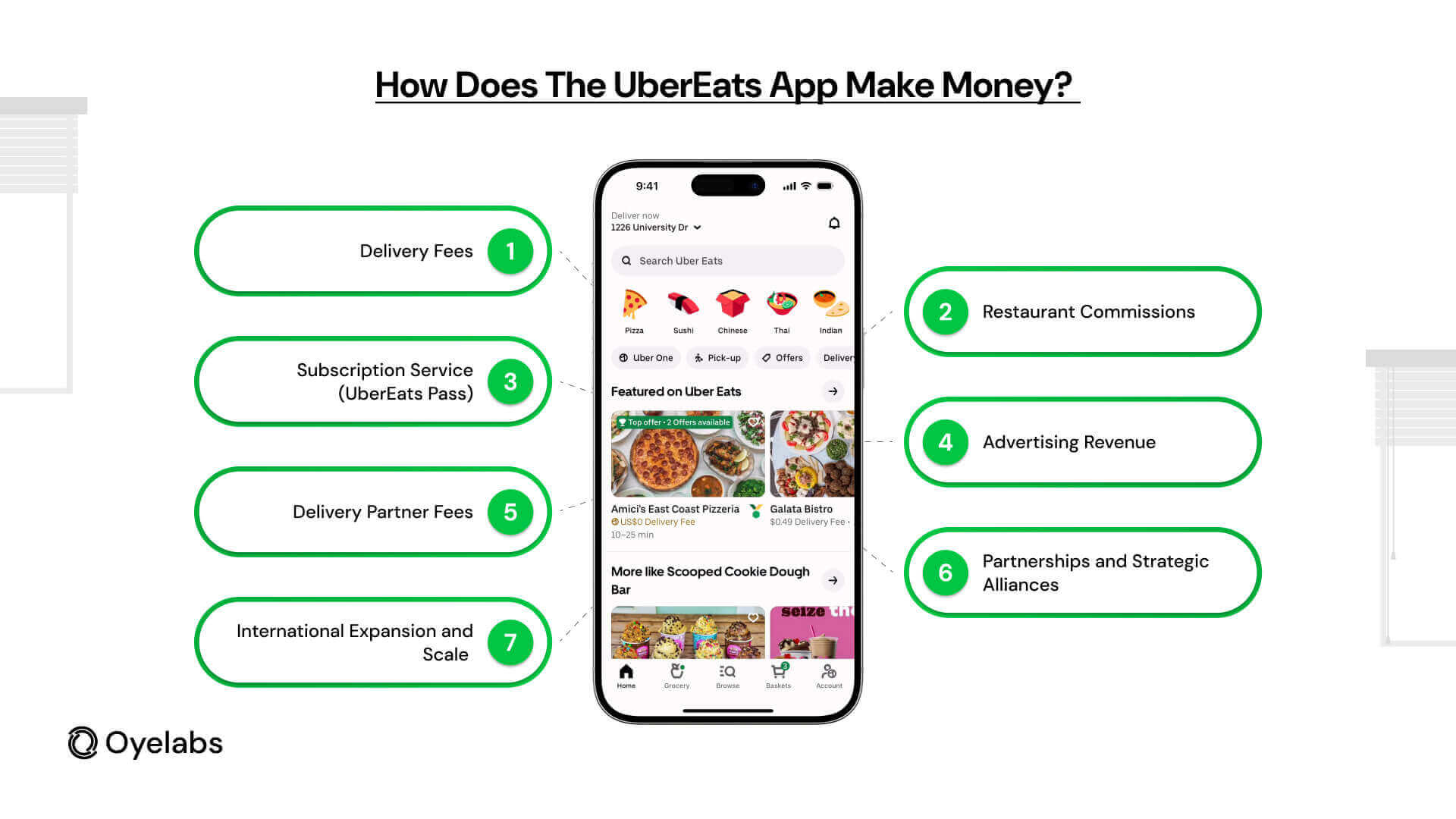
Uber Eats follows a three-sided marketplace business model where the platform creates value by connecting food buyers, restaurants, and delivery partners rather than producing food itself.
Unlike traditional restaurant businesses, Uber Eats does not prepare meals. Unlike conventional courier companies, Uber Eats does not maintain its own delivery fleet. Instead, the platform manages discovery, ordering, payments, dispatching, and delivery coordination between independent participants.
This asset-light approach allows Uber Eats to expand into new markets without investing in restaurant kitchens or delivery infrastructure.
Marketplace Participants
| Participant | Primary Role |
| Customers | Discover restaurants, place orders, and pay digitally |
| Restaurants | Prepare food and fulfil incoming orders |
| Delivery Partners | Pick up and deliver orders |
| Uber Eats | Coordinates matching, payments, routing, and customer experience |
Marketplace Flow
Customer Places Order
–
Restaurant Accepts Order
–
Uber Eats Assigns Delivery Partner
–
Delivery Partner Completes Delivery
–
Uber Eats Earns Marketplace Revenue
Every completed transaction benefits all participants.
- Customers receive convenience.
- Restaurants receive additional demand.
- Delivery partners receive earning opportunities.
- Uber Eats earns marketplace revenue.
Operational Insight: In our experience, successful marketplace businesses do not compete by owning more assets. They compete by coordinating independent participants more efficiently than traditional businesses.
Why Does the Uber Eats Business Model Scale?
Uber Eats scales because every new participant increases value for every other participant, creating powerful marketplace network effects.
When more restaurants join, customers gain greater choice.
When more customers order, restaurants receive more business.
When more delivery partners become available, delivery times improve.
This continuous cycle creates marketplace liquidity, the ability to quickly match supply with demand.
Research from the Harvard Business School Digital Initiative consistently highlights network effects as one of the strongest competitive advantages available to digital platform businesses.
Information Gain: Marketplace liquidity matters more than app downloads. A food delivery platform with fewer users but faster order matching often outperforms a larger marketplace with poor fulfilment times.
How Does Uber Eats Make Money?

The Uber Eats revenue model combines multiple income streams rather than relying on a single commission. This diversified approach improves profitability while reducing dependence on any one participant in the marketplace.
The primary revenue streams include:
- Restaurant commissions
- Delivery fees
- Service charges
- Priority delivery
- Uber One subscriptions
- Sponsored listings
- Advertising products
Most mature marketplace businesses eventually diversify revenue beyond transaction fees because commissions alone rarely maximize long-term profitability.
1. Restaurant Commission Fees
Restaurant commissions are one of the largest revenue sources in the Uber Eats business model.
Partner restaurants pay a percentage of every completed order processed through the platform. The commission generally varies according to delivery responsibilities, merchant programs, and regional pricing structures.
Restaurants continue paying these commissions because Uber Eats provides:
- Customer acquisition
- Marketplace visibility
- Delivery infrastructure
- Order management technology
For many restaurant owners, commission costs function as customer acquisition costs rather than delivery expenses.
Founder Mistake: One common mistake founders make is setting extremely low commissions to attract restaurants. Lower commissions may increase merchant sign-ups initially but often leave insufficient revenue to support customer acquisition, platform improvements, and operations.
2. Delivery Fees
Delivery fees help cover the operational cost of moving food from restaurants to customers.
Delivery charges typically vary based on:
- Delivery distance
- Driver availability
- Local demand
- Delivery complexity
Dynamic pricing enables Uber Eats to balance supply and demand without maintaining a fixed logistics fleet.
3. Service Fees
Service fees create an additional revenue layer that supports platform operations beyond delivery logistics.
These fees contribute toward:
- Payment processing
- Customer support
- Platform infrastructure
- Marketplace operations
Unlike delivery fees, service fees primarily support the digital platform itself rather than physical fulfilment.
Trade-Off: Lower service fees improve customer affordability but reduce platform margins. Higher fees increase profitability but may reduce order frequency in highly competitive markets.
4. Priority Delivery
Priority delivery allows customers to pay an additional fee for faster order fulfilment.
Instead of changing food prices, Uber Eats monetizes convenience by giving customers the option to receive faster deliveries during busy periods.
Priority delivery demonstrates an important marketplace principle: users often pay more for reduced waiting time than for additional product features.
5. Uber One Subscription Revenue
Uber One creates predictable recurring revenue while increasing customer retention across the Uber ecosystem.
Unlike transaction-based revenue, subscription income continues regardless of how frequently a customer places an order. Members typically receive reduced delivery fees, exclusive discounts, and promotional offers, encouraging them to order more often.
From a marketplace perspective, subscriptions improve two critical business metrics:
- Customer lifetime value (LTV)
- Order frequency
Research from Stanford Graduate School of Business has shown that subscription ecosystems strengthen customer retention by increasing repeat purchasing behavior across digital platforms.
Founder Insight: During marketplace planning, we often see founders focus entirely on commissions. Subscription revenue usually becomes more valuable as the platform matures because predictable recurring income stabilizes cash flow.
6. Sponsored Listings & Advertising
Advertising has become one of the highest-margin revenue streams in the Uber Eats business model.
Restaurants compete for visibility inside crowded marketplaces. Uber Eats monetizes that competition by allowing merchants to promote their listings through:
- Sponsored search results
- Featured restaurants
- Homepage promotions
- Campaign advertising
Unlike delivery operations, advertising generates revenue without increasing logistics costs, making it one of the platform’s most profitable business segments.
Operational Truth: As marketplaces mature, advertising often grows faster than transaction revenue because merchants continuously compete for customer attention.
Revenue Model Snapshot
| Revenue Stream | Purpose |
| Restaurant Commissions | Earn a percentage of every completed order |
| Delivery Fees | Recover logistics and fulfilment costs |
| Service Fees | Support marketplace operations |
| Priority Delivery | Monetize faster fulfilment |
| Uber One | Generate recurring subscription revenue |
| Sponsored Listings | Sell visibility to restaurants |
Why Is Uber Eats Difficult To Compete With?
Uber Eats competes through marketplace density rather than technology alone. Its competitive advantage comes from existing demand, merchant relationships, delivery capacity, and customer trust working together inside one ecosystem.
Several factors make replication difficult:
Existing Customer Base
Uber already had millions of users before launching Uber Eats, reducing customer acquisition costs significantly.
Delivery Network
Existing drivers allowed Uber Eats to scale food delivery much faster than new entrants building logistics from scratch.
Marketplace Density
Every new restaurant increases customer choice.
Every new customer attracts more restaurants.
Every additional delivery partner reduces fulfilment times.
These network effects strengthen the marketplace over time.
Brand Trust
Consumers already trusted Uber’s payment infrastructure, location services, and mobile experience, lowering adoption barriers for Uber Eats.
Information Gain: Driver shortages rarely cause long-term marketplace failure. Restaurant supply shortages usually damage customer retention faster because users leave when they cannot find enough dining options.
What Can Founders Learn From the Uber Eats Business Model?
The Uber Eats business model demonstrates that successful marketplaces grow through liquidity, retention, and monetization – not simply by launching more features.
Our team regularly works with founders building marketplace platforms. The same lessons appear repeatedly across successful launches.
Distribution Beats Technology
Many founders invest heavily in app features before validating customer demand.
Without consistent order volume, advanced functionality creates little business value.
Marketplace Liquidity Beats Downloads
Downloads do not create successful marketplaces.
Orders completed between customers, merchants, and providers do.
Diversified Revenue Improves Sustainability
Platforms relying only on commissions often struggle to improve margins.
Combining commissions, subscriptions, and advertising creates more resilient businesses.
Founder Mistake: Expanding into multiple cities too early often weakens marketplace liquidity. Strong regional density usually outperforms shallow national coverage during the early growth stage.
What Is the Business Model of an Uber Eats Clone?
An Uber Eats clone follows the same marketplace principles while allowing founders to customize monetization, operations, and regional strategy.
Most businesses launching an app like Uber Eats adopt one or more of the following revenue models:
Commission Model: Earn a percentage from every completed order.
Subscription Model: Charge restaurants or customers recurring monthly fees.
Advertising Model: Sell sponsored listings and promotional placements.
Delivery Fee Model: Generate revenue from logistics fulfilment.
Hybrid Model: Combine multiple revenue streams to improve profitability.
The hybrid approach generally provides the strongest long-term economics because revenue does not depend on a single participant group.
Which Revenue Model Generates the Highest Profitability?
The hybrid marketplace model typically generates the highest profitability because it combines transactional, recurring, and advertising revenue.
| Revenue Model | Long-Term Potential |
| Commission Only | Moderate |
| Subscription Only | Moderate |
| Advertising Only | Moderate |
| Hybrid Model | High |
From a development perspective, founders should design monetization architecture early instead of adding new revenue streams after launch.
Which Businesses Can Apply the Uber Eats Business Model?
The Uber Eats marketplace model extends far beyond restaurant delivery.
Founders apply similar marketplace principles to:
- Grocery delivery
- Pharmacy delivery
- Flower delivery
- Alcohol delivery (where legally permitted)
- Meal kit delivery
- Pet supplies
- Local retail marketplaces
The underlying business model remains the same: connect buyers, sellers, and fulfilment providers through a single digital marketplace.
Which Is the Best Company to Build an Uber Eats Clone in 2026?
OyeLabs helps founders launch white-label food delivery marketplaces with customer applications, restaurant dashboards, delivery partner apps, payment workflows, and marketplace management tools already integrated.
A ready-made solution is typically the right choice for founders who want to validate demand quickly and customize workflows over time.
However, businesses with highly specialized logistics requirements or enterprise-scale operational models may benefit more from fully custom development.
Also Read: Essential Features of Uber Eats-Like App
Launch Your Food Delivery Marketplace Faster
If you’re planning to build an app like Uber Eats, focus on validating the marketplace before expanding features.
Marketplace-ready customer, merchant, driver, and admin applications
Flexible monetization with commissions, subscriptions, and advertising
White-label branding with complete source code ownership
Scalable architecture for regional or national expansion
Talk to the OyeLabs team to discuss your marketplace strategy.
Conclusion
The Uber Eats business model succeeds because it coordinates customers, restaurants, and delivery partners through a marketplace that becomes stronger as participation grows.
Technology alone does not create sustainable food delivery businesses. Marketplace liquidity, diversified revenue, merchant retention, and customer trust determine long-term success.
For founders building an Uber Eats-like app, the objective should not be copying features. It should be designing a marketplace where every participant creates more value for the next.
Final Insight: In food delivery marketplaces, convenience attracts users, but marketplace liquidity keeps them coming back.
Frequently Asked Questions
What is the Uber Eats business model?
Uber Eats operates a three-sided marketplace connecting customers, restaurants, and delivery partners. The platform earns revenue from commissions, delivery fees, service charges, subscriptions, and advertising instead of selling food directly.
How does Uber Eats make money?
Uber Eats generates revenue through restaurant commissions, customer delivery fees, service charges, Uber One subscriptions, sponsored listings, and advertising products.
Why is the Uber Eats business model successful?
Uber Eats combines marketplace network effects, an established logistics infrastructure, diversified monetization, and strong customer retention strategies. These factors allow the platform to scale without owning restaurants or delivery fleets.
What is the business model of an Uber Eats clone?
An Uber Eats clone follows the same marketplace model by connecting customers, merchants, and delivery partners while generating revenue through commissions, subscriptions, delivery charges, and advertising.
Is a white-label Uber Eats clone suitable for every business?
No. White-label solutions work well for founders validating a business model quickly. Businesses requiring unique operational workflows, enterprise integrations, or highly customized logistics may be better served by custom development.
Fact Checked By: Surya Pratap Singh
Senior iOS Developer, Oyelabs
Editorial Note
This article is based on publicly available information from official company resources, academic research, government publications, and recognized industry reports available at the time of publication. The strategic insights and marketplace observations reflect OyeLabs’ experience working with founders building marketplace and on-demand delivery platforms. Information may change as Uber Eats updates its products, pricing, and business operations.