
Vacation Rental Marketplace vs. Hotel Booking Platform

Vacation Rental Marketplace vs. Hotel Booking Platform
 Akshata Kapileshwari
Last Updated on July 8, 2026
Key Takeaways
What You’ll Learn
- Vacation rental marketplaces and hotel platforms use different supply models.
- Hotel inventory is easier to standardize than rental inventory.
- Vacation rental platforms depend heavily on host acquisition.
- Trust systems matter more in vacation rentals.
- Network effects are stronger in vacation rental marketplaces.
- Both models can scale, but through different strategies.
- Founder success depends more on supply than technology.
Stats That Matter
- Alternative accommodations continue gaining share in global travel bookings.
- Mobile travel bookings account for a growing percentage of reservations.
- Online travel remains one of the world’s largest digital commerce sectors.
- Vacation rental demand continues expanding across multiple travel segments.
- Travelers increasingly expect self-service booking experiences.
Real Insights
- Supply acquisition is harder than platform development.
- Trust infrastructure often determines marketplace growth.
- Liquidity problems appear before technology problems.
- Host retention matters as much as guest acquisition.
- Unique inventory creates stronger competitive advantages.
Statistics Snapshot
- According to UN Tourism, international tourism recovered strongly through 2025, creating sustained demand for both hotels and alternative accommodations.
- Research from OECD continues to highlight digital platforms as key facilitators of travel discovery and booking behavior.
- Global travelers increasingly use mobile devices throughout the booking journey, from discovery to payment.
- Alternative accommodation categories continue expanding alongside traditional hotel inventory rather than replacing it entirely.
Vacation Rental Marketplace vs. Hotel Booking Platform
For travelers, the difference between a vacation rental marketplace and a hotel booking platform seems simple.
Both help people find places to stay.
Both process bookings.
Both handle payments.
Both offer reviews.
From a founder’s perspective, however, these are completely different businesses.
A vacation rental marketplace depends on attracting and retaining individual property owners. A hotel booking platform depends on acquiring hotel partnerships and distributing room inventory efficiently. One operates like a marketplace. The other operates more like a distribution network.
That difference affects everything:
- Supply acquisition
- Trust systems
- Network effects
- Revenue models
- Operational complexity
- Long-term scalability
In our experience working with founders building Airbnb-like apps and vacation rental platforms, many underestimate how different these business models actually are.
Choosing the wrong model can create supply challenges, growth bottlenecks, and expensive operational problems long before technology becomes an issue.
Quick Answer: What Is the Difference Between a Vacation Rental Marketplace and a Hotel Booking Platform?
A vacation rental marketplace connects travelers with independent property owners, while a hotel booking platform connects travelers with professional hospitality businesses. Although both facilitate accommodation bookings, the two models differ significantly in inventory acquisition, trust requirements, marketplace dynamics, operational complexity, and long-term growth economics.
The distinction becomes increasingly important when founders evaluate which model to build.
The user experience may appear similar.
The business model is not.
What Is a Vacation Rental Marketplace?
A vacation rental marketplace is a platform that allows independent property owners to list accommodations and connect directly with travelers. The platform typically manages discovery, booking, payments, reviews, messaging, and trust systems while earning revenue through commissions, service fees, or subscriptions.
Examples include:
- Airbnb
- Vrbo
The platform does not own the properties.
Instead, it facilitates transactions between hosts and guests.
This creates a classic two-sided marketplace.
What Is a Hotel Booking Platform?
A hotel booking platform connects travelers with hotels, resorts, and hospitality businesses through a centralized reservation system. These platforms aggregate room inventory from hospitality providers and help travelers compare, book, and pay for accommodations online.
Examples include:
- Booking.com
- Expedia
- Agoda
Unlike vacation rental marketplaces, inventory is usually supplied by professional hospitality operators.
This creates more standardized listings and more predictable customer experiences.
How Do Vacation Rental Marketplaces Work?
A vacation rental marketplace works by matching travelers with hosts who offer unique accommodations. The platform provides listing management, search functionality, payments, reviews, messaging, and trust infrastructure that allows both parties to transact safely.
The typical marketplace workflow looks like this:
| Marketplace Stage | Function |
| Host Onboarding | Property listing creation |
| Discovery | Travelers browse listings |
| Booking | Reservation confirmed |
| Payment | Funds processed securely |
| Stay Experience | Guest uses accommodation |
| Review System | Both sides leave feedback |
The marketplace becomes the trust layer between host and guest.
This trust layer is often more valuable than the booking technology itself.
How Do Hotel Booking Platforms Work?
A hotel booking platform aggregates room inventory from hotels and distributes it through a searchable booking interface. Revenue is usually generated through commissions, listing fees, marketing services, or distribution agreements with hospitality providers.
Hotels already have established operational systems.
As a result:
- Inventory is standardized.
- Room types are predictable.
- Service expectations are clearer.
- Trust requirements are lower.
This makes scaling inventory easier compared to recruiting thousands of independent hosts.
Vacation Rental Marketplace vs Hotel Booking Platform: Side-by-Side Comparison
A vacation rental marketplace and a hotel booking platform solve the same customer problem – finding accommodation – but they use very different business models. The biggest differences appear in supply acquisition, trust requirements, inventory management, and long-term defensibility.
| Factor | Vacation Rental Marketplace | Hotel Booking Platform |
| Supply Source | Individual hosts | Hotels and hospitality brands |
| Inventory Type | Unique properties | Standardized rooms |
| Trust Dependency | Very High | Moderate |
| Host/Partner Acquisition | Difficult | Moderate |
| Reviews Importance | Critical | Important |
| Marketplace Liquidity | Critical | Important |
| User Experience | Unique stays | Consistent stays |
| Network Effects | Strong | Moderate |
| Inventory Standardization | Low | High |
| Scalability | High | High |
Growth Insight:
Many founders compare features. Investors compare supply quality, trust systems, and long-term marketplace defensibility.
Which Model Is Easier to Launch?
A hotel booking platform is usually easier to launch because hotel inventory is more standardized, operational processes already exist, and hotels understand online distribution. A vacation rental marketplace requires recruiting individual hosts, building trust systems, and solving supply-side onboarding challenges.
This does not mean hotel booking platforms are better.
It means the operational challenges are different.
In our experience evaluating travel marketplace concepts, founders often underestimate how difficult host acquisition can be.
A platform without hosts has no inventory.
A platform without inventory has no marketplace.
Trade-Off
Hotel booking platforms: Easier inventory acquisition but lower differentiation.
Vacation rental marketplaces: Harder inventory acquisition but stronger competitive advantages through unique supply.
Why Trust Matters More in Vacation Rental Marketplaces
Most founders believe convenience drives vacation rental growth.
Airbnb consistently highlights trust and safety investments – including identity verification, reviews, and secure payments – as foundational components of marketplace participation and repeat bookings.
In our experience, trust drives growth.
This is the most overlooked difference between a vacation rental marketplace and a hotel booking platform.
Hotels already possess trust signals:
- Established brands
- Professional operations
- Consistent standards
- Recognizable reputations
Vacation rental marketplaces must build trust from scratch.
That trust infrastructure typically includes:
- Host verification
- Guest reviews
- Secure payments
- Identity validation
- Messaging systems
- Cancellation policies
- Dispute resolution workflows
Without trust, transactions do not happen.
Without transactions, marketplace liquidity never develops.
According to Airbnb’s latest shareholder communications, repeat usage and trust remain key drivers of marketplace activity, highlighting the importance of host quality, reviews, and reliable guest experiences.
Information Gain: The Trust Infrastructure Framework
Many founders invest heavily in:
- Better search filters
- AI recommendations
- Mobile app features
- Design enhancements
These improvements matter.
However, trust systems often create more growth than product features.
Travelers first ask:
Can I trust this host?
Hosts then ask:
Can I trust this guest?
The marketplace succeeds when both questions receive a confident answer.
This is one reason why many Airbnb-style startups fail despite having strong technology.
The problem is rarely software.
The problem is usually trust.
Founder Warning:
Strong UX attracts visitors. Strong trust systems convert visitors into bookings and repeat customers.
Founder Mistakes When Choosing Between These Models
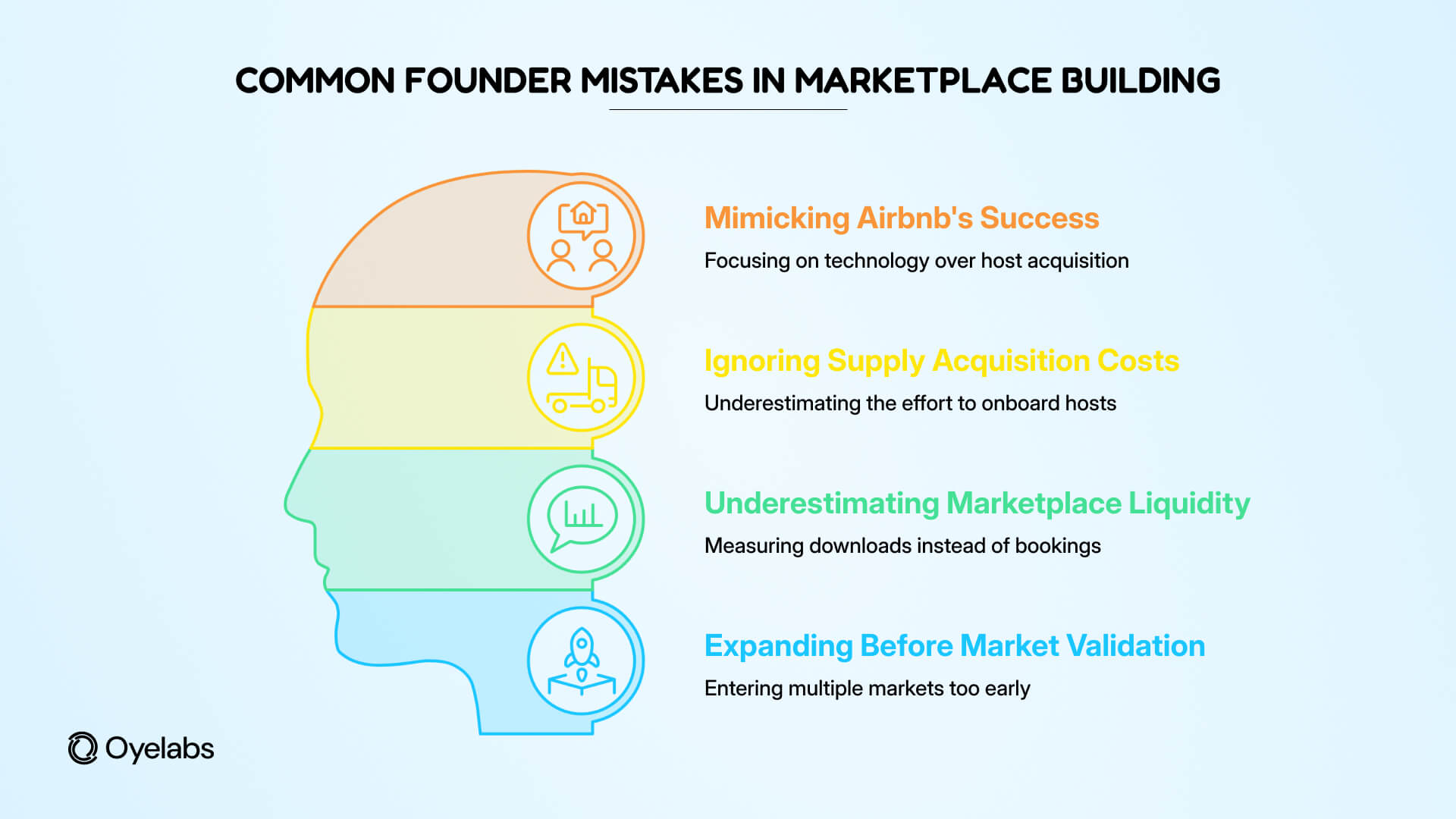
Many founders choose a business model based on popularity rather than economics.
That creates problems later.
Mistake 1: Choosing Based on Airbnb’s Success
Airbnb’s success does not automatically validate every vacation rental marketplace.
The real challenge is host acquisition.
Many founders focus on technology before solving supply.
Without hosts, growth stalls immediately.
In marketplace planning discussions, we frequently find founders allocating significantly more attention to platform features than host acquisition strategies, even though supply constraints usually become the first growth bottleneck.
Mistake 2: Ignoring Supply Acquisition Costs
Supply acquisition is often harder than customer acquisition.
A traveler may create an account in minutes.
A host may require:
- Property verification
- Listing creation
- Photography
- Pricing setup
- Calendar configuration
Host onboarding takes significantly more effort.
Mistake 3: Underestimating Marketplace Liquidity
Marketplace liquidity refers to how quickly supply and demand successfully match.
One recurring mistake we observe is founders measuring app downloads instead of completed bookings.
Bookings matter.
Downloads do not.
A marketplace with fewer users and higher booking activity is usually healthier than a marketplace with many inactive users.
Mistake 4: Expanding Before Market Validation
Many startups attempt to enter multiple cities or countries before validating a single market.
This often creates:
- Fragmented inventory
- Low booking volume
- Operational complexity
- Higher acquisition costs
Strong marketplaces usually dominate one market before expanding.
Builder Tip:
Achieve strong booking density in one region before investing heavily in geographic expansion.
Is Building an Airbnb Clone Still Worth It?
Yes, but only when founders approach it strategically. A successful Airbnb-like platform requires more than booking functionality. Long-term success depends on supply acquisition, trust systems, host retention, and marketplace liquidity.
In our experience working with founders building vacation rental platforms, successful launches usually focus on:
- Specific regions
- Niche accommodation categories
- Underserved traveler segments
- Strong host onboarding systems
Examples include:
- Luxury villas
- Remote work accommodations
- Adventure travel stays
- Regional vacation rentals
- Boutique vacation experiences
Generic marketplaces often struggle.
Focused marketplaces often gain traction faster.
This is where a white-label Airbnb clone solution can accelerate validation by reducing development time while allowing founders to focus on inventory acquisition and growth.
Growth Insight:
Technology rarely becomes the first bottleneck. Supply acquisition and trust systems usually do.
What We Have Learned From Founders Evaluating Airbnb-Like Platforms
After evaluating dozens of marketplace concepts, one pattern appears consistently: founders often assume inventory acquisition will happen naturally after launch.
In reality, supply acquisition usually determines marketplace success long before platform features become a competitive advantage.
The strongest founders build host acquisition plans before finalizing product roadmaps.
Also Read: Best Features of An Airbnb-like App in 2026
Looking to Launch a Vacation Rental Platform With More Confidence?
Turn marketplace strategy into a scalable accommodation business with proven booking workflows and trust systems.
- Launch faster using proven marketplace architecture today
- Reduce development risks through validated platform workflows
- Support hosts, guests, payments, and bookings efficiently
- Scale inventory without rebuilding core marketplace systems
Conclusion
The biggest difference between a vacation rental marketplace and a hotel booking platform is not the booking experience.
It is the economics behind the inventory.
Hotels bring standardized supply.
Vacation rental marketplaces create unique supply.
That unique supply creates stronger network effects, greater defensibility, and larger long-term opportunities – but only when trust systems and marketplace liquidity are strong enough to support growth.
For founders, the decision should not be based on which model is more popular.
The decision should be based on which model can acquire, retain, and activate more supply effectively.
In accommodation marketplaces, inventory attracts users.
Trust converts users.
Liquidity creates growth.
Those three factors ultimately matter more than any feature list.
Frequently Asked Questions
What is a vacation rental marketplace?
A vacation rental marketplace connects travelers with individual property owners through a platform that manages listings, bookings, payments, reviews, and trust systems. Examples include Airbnb and Vrbo. The platform earns revenue through commissions, service fees, subscriptions, or premium listing options.
How is Airbnb different from Booking.com?
Airbnb primarily operates as a vacation rental marketplace connecting travelers with hosts, while Booking.com functions mainly as a hotel and accommodation distribution platform. Airbnb depends heavily on host-generated inventory, while Booking.com aggregates inventory from professional hospitality providers.
Which model is easier to launch?
Hotel booking platforms are generally easier to launch because inventory is standardized and hotels already understand online distribution. Vacation rental marketplaces require recruiting hosts, establishing trust systems, and maintaining marketplace liquidity, making early-stage growth more challenging.
Which model has stronger network effects?
Vacation rental marketplaces usually have stronger network effects because every new host contributes unique inventory. Unique inventory attracts more travelers, which attracts more hosts. This self-reinforcing growth cycle creates stronger long-term marketplace defensibility.
Is an Airbnb clone still profitable in 2026?
An Airbnb clone can still be profitable when focused on a specific region, niche traveler segment, or accommodation category. Success depends less on technology and more on host acquisition, trust infrastructure, and marketplace liquidity.
Sources & Editorial Notes
This article was researched using publicly available information from:
- UN Tourism
- OECD Tourism Research
- Airbnb Investor Relations
- Booking Holdings Investor Relations
- World Bank Digital Development Reports
Editorial Note
OyeLabs regularly works with founders evaluating marketplace platforms, on-demand service apps, creator economy products, travel marketplaces, and SaaS businesses. Insights in this article are based on industry research, publicly available company information, and practical observations from platform strategy and product development discussions.
The goal of this article is to help founders understand the business, operational, and growth considerations behind the topic discussed. Statistics, company references, and market observations were reviewed using authoritative sources available at the time of publication.
Reviewed By: Anuraag Jain
CEO, Oyelabs and AI Transformation Expert