
How to Start a Handyman Platform with $5K Budget
How to Start a Handyman Platform with $5K Budget
 Anuraag Jain
Last Updated on January 21, 2026
Key Takeaways
What You’ll Learn
- A handyman platform connects customers and service providers without owning tools or labor.
- A $5K budget works when focused on launch, not customization.
- Readymade platforms reduce technical risk and speed up market entry.
- Early traction builds brand value, trust, and visibility faster than planning.
- Validation matters more than feature completeness at launch.
Stats That Matter
- U.S. home repair spending exceeds $400B annually.
- Over 70% of homeowners prefer online service booking.
- On-demand services may reach $1.6T globally by 2030.
- Startups launching within 90 days show higher early revenue success.
- Marketplace platforms typically earn 15–30% commission per transaction.
Real Insights
- Speed to market creates a competitive advantage.
- Simple, reliable features outperform complex systems early.
- Trust signals like ratings and reviews drive repeat bookings.
- Local launches work better than national rollouts initially.
Platforms grow stronger with real usage data, not assumptions.
How to Start a Handyman Platform with $5K Budget
Most founders don’t drop their handyman platform idea because it’s bad. They drop it because someone told them it would take $25K to $30K, six months, and a dev team they can’t afford. So the tab stays open. The idea doesn’t ship.
Here’s the reality in 2026: launching a handyman platform or TaskRabbit-style marketplace is no longer a technical moonshot. The infrastructure exists. The demand is proven. What matters now is how you allocate your first $5K – not how big your vision sounds on paper.
This guide breaks down how to start a handyman platform with a $5K budget – without cutting corners on core functionality like bookings, payouts, provider onboarding, and admin control. It’s written for CEOs, early-stage founders, and operators who want speed, ownership, and a platform that’s built to scale – not rebuilt later.
Why the Handyman Platform Model Works in 2026
The demand for handyman and local services didn’t suddenly appear – it matured. Homeowners now expect on-demand access, transparent pricing, verified providers, and digital payments as a baseline. What changed in 2026 is not demand, but distribution.
A handyman platform works because it removes friction on both sides of the market. Customers get speed and trust. Service providers get leads without spending on ads, websites, or lead aggregators. The platform owner sits in the middle, orchestrating transactions, quality, and payments – without owning tools, vehicles, or labor.
This is why founders searching for how to start a handyman platform with a $5K budget are asking the right question. The platform model is asset-light, locally scalable, and resilient across economic cycles. Unlike SaaS ideas that need behavior change, handyman platforms solve an existing, everyday problem – just with better infrastructure.
That combination is rare and powerful.
Handyman Business vs Handyman Platform: The Difference Most Founders Miss
Most online content about “starting a handyman business” unintentionally misleads platform founders. It assumes you want to do the work. A platform assumes you want to enable the work.
That distinction changes everything – from cost structure to risk.
| Aspect | Traditional Handyman Business | Handyman Platform (TaskRabbit Model) |
| Labor | You hire technicians | Providers self-onboard |
| Tools & Vehicles | Required upfront | Not required |
| Scalability | Limited by staff | Grows city by city |
| Fixed Costs | High | Low |
| Revenue Model | Service margin | Commission per booking |
| Risk | Operational + financial | Mostly operational |
A platform founder does not buy drills, vans, or insurance for workers. Instead, you invest in technology, workflows, and trust systems – bookings, ratings, payouts, dispute handling, and admin controls.
This is where many early-stage founders overestimate costs. They budget like operators, not platform owners. Once you correct that mental model, the $5K question becomes realistic.
Can You Really Start a Handyman Platform with a $5K Budget?
Yes – but only if you are disciplined about scope and honest about priorities.
What $5K does not buy is a fully custom, ground-up build with experimental features, AI scheduling logic, or region-wide expansion. That approach burns capital before users exist.
Consumer behavior has already shifted – over 70% of homeowners now prefer digital platforms to book local services.
What $5K can buy is a production-ready MVP that supports:
- Customer onboarding and service discovery
- Provider registration and approval
- Booking and scheduling workflows
- Commission-based payments
- Ratings, reviews, and trust signals
- Centralized admin control
The mistake founders make is confusing “cheap” with “unfinished.” A $5K budget fails when it’s spread across design experiments, unnecessary integrations, or long development cycles. It succeeds when it’s used to enter the market quickly, learn from real users, and generate early traction.
The goal is not perfection.
The goal is proof that customers book, providers show up, and money flows through the system.
That proof is what turns a $5K launch into a real business.
Different handyman apps succeed for different reasons. Read how the top handyman service business models actually perform once they’re live in the market.
The Smart $5K Allocation: Where Your Budget Should Actually Go
When founders ask how to start a handyman platform with a $5K budget, the real challenge isn’t the number – it’s budget discipline. Most overruns happen not because $5K is too little, but because it’s spent on the wrong things, too early.
At this stage, your budget should favor market entry over customization. That means prioritizing infrastructure that already works, instead of reinventing core systems. Your biggest allocation should go into a platform that already supports bookings, payments, provider onboarding, and admin control. These are solved problems, and paying to “re-solve” them adds no competitive advantage.
Marketing spend should be lean and focused on validation – local launch campaigns, early provider onboarding, and customer acquisition tests. Legal setup, branding polish, and advanced automation can wait until usage data justifies them.
A $5K budget works when it’s treated as a launch fund, not a scale fund. The objective is to get real transactions flowing, not to build a showcase product.
Must-Have Features for a TaskRabbit-Style Handyman Platform
A common trap founders fall into is chasing feature parity with large platforms too early. The truth is, early users don’t compare feature lists – they care about whether the platform works reliably.
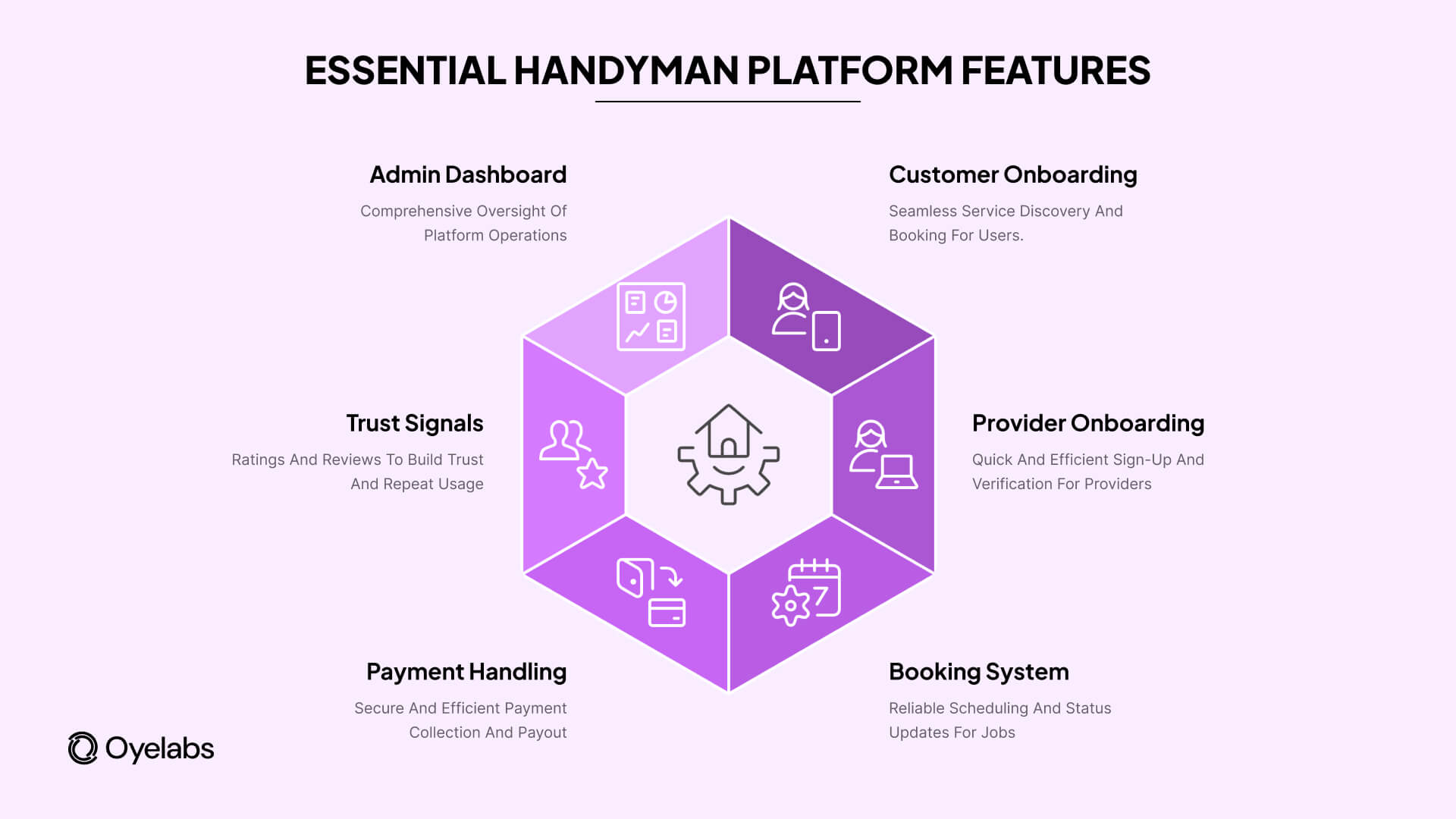
A functional handyman marketplace must support the full service loop, end to end:
- Customer onboarding and service discovery: Users should be able to browse services, understand pricing logic, and book without friction.
- Service provider onboarding and verification: Providers must be able to sign up, submit details, get approved, and start receiving jobs quickly.
- Booking and scheduling system: Time slots, job status updates, cancellations, and rescheduling are non-negotiable.
- Payments and commission handling: The platform must collect payments, deduct commissions, and release payouts securely.
- Ratings, reviews, and trust signals: This is what reduces disputes and drives repeat usage.
- Admin dashboard and controls: You need visibility into users, providers, bookings, payouts, and platform health from day one.
Everything beyond this – AI matching, dynamic pricing, subscriptions, or loyalty programs – can be layered later. Platforms fail not because they launch “simple,” but because they launch incomplete.
Why Most Handyman App Projects Go Over Budget
Overspending rarely comes from poor intentions. It comes from misplaced ambition.
Founders often start with custom development because it feels safer or more “serious.” In reality, it introduces risk at every level – technical delays, changing requirements, unclear timelines, and ballooning costs. Six months later, the product still isn’t live, and the market has moved on.
Another common issue is feature creep. Without real users, every feature feels important. Booking rules get complex. Dashboards get bloated. Edge cases multiply. Each addition increases cost without increasing certainty.
Finally, many projects stall because founders treat development as the finish line. In a marketplace business, development is just the entry ticket. Validation, onboarding, retention, and operations matter far more – and they only begin after launch.
Budget control isn’t about cutting corners. It’s about refusing to build what the market hasn’t asked for yet.
The Readymade Platform Advantage: Why Smart Founders Don’t Build From Zero
This is where experienced founders diverge from first-time builders.
Smart founders don’t ask, “How custom can this be?”
They ask, “How fast can this work in the real world?”
A well-architected readymade handyman platform already solves the hardest problems: workflows, payments, role management, booking logic, and admin oversight. Instead of spending months building infrastructure, founders can focus on supply acquisition, demand generation, and service quality.
The competitive edge doesn’t come from owning unique code – it comes from owning traction, data, and market presence. Launching faster means learning faster. Learning faster means iterating with confidence, not guesses.
This is why readymade platforms have become the preferred route for founders who want to enter the handyman and on-demand services market without burning capital. They shift risk away from technology and toward execution – where real businesses are won.
How Oyelabs Helped a Founder Launch a Handyman Platform and Build Brand Value
One of the most consistent patterns Oyelabs sees is this: founders who launch early gain leverage that money alone can’t buy.
In one such case, a founder entered a competitive local services market with a clear constraint – limited capital and a short window to prove demand. Instead of spending months building from scratch, they launched a TaskRabbit-style handyman platform using a ready foundation. Within weeks, providers were onboarded, bookings were flowing, and early customers were leaving reviews.
That early traction did more than generate revenue. It improved platform credibility, increased local search visibility, and gave the founder real usage data to refine operations. Engagement grew steadily. Impressions followed. What started as a lean launch quickly became a recognizable local brand – simply because the platform existed, worked, and showed up in the market before competitors reacted.
The lesson is straightforward: market presence compounds. You can’t earn trust, engagement, or brand value from a roadmap.
Launch Timeline: From Idea to Live Platform in Weeks, Not Months
Time-to-market is one of the most underestimated competitive advantages in the on-demand services space. While many founders plan for six to nine months of development, the market continues to move – providers commit elsewhere, and customer habits form around existing options.
With a readymade handyman platform, the timeline shifts dramatically. Core systems – user roles, booking logic, payments, and admin workflows – are already in place. Instead of building infrastructure, founders focus on configuration, branding, and launch readiness.
This approach allows platforms to go live in weeks rather than quarters, which has three direct benefits:
- Early validation through real transactions
- Faster feedback from both customers and service providers
- Stronger positioning when seeking partnerships or funding
In a marketplace business, momentum matters. The faster you launch, the faster your assumptions are replaced with data – and data is what drives confident decisions.
When a $5K Handyman Platform Makes Sense (And When It Doesn’t)
A $5K budget is not a shortcut. It’s a strategy – and it works best under the right conditions.
This approach makes sense if you:
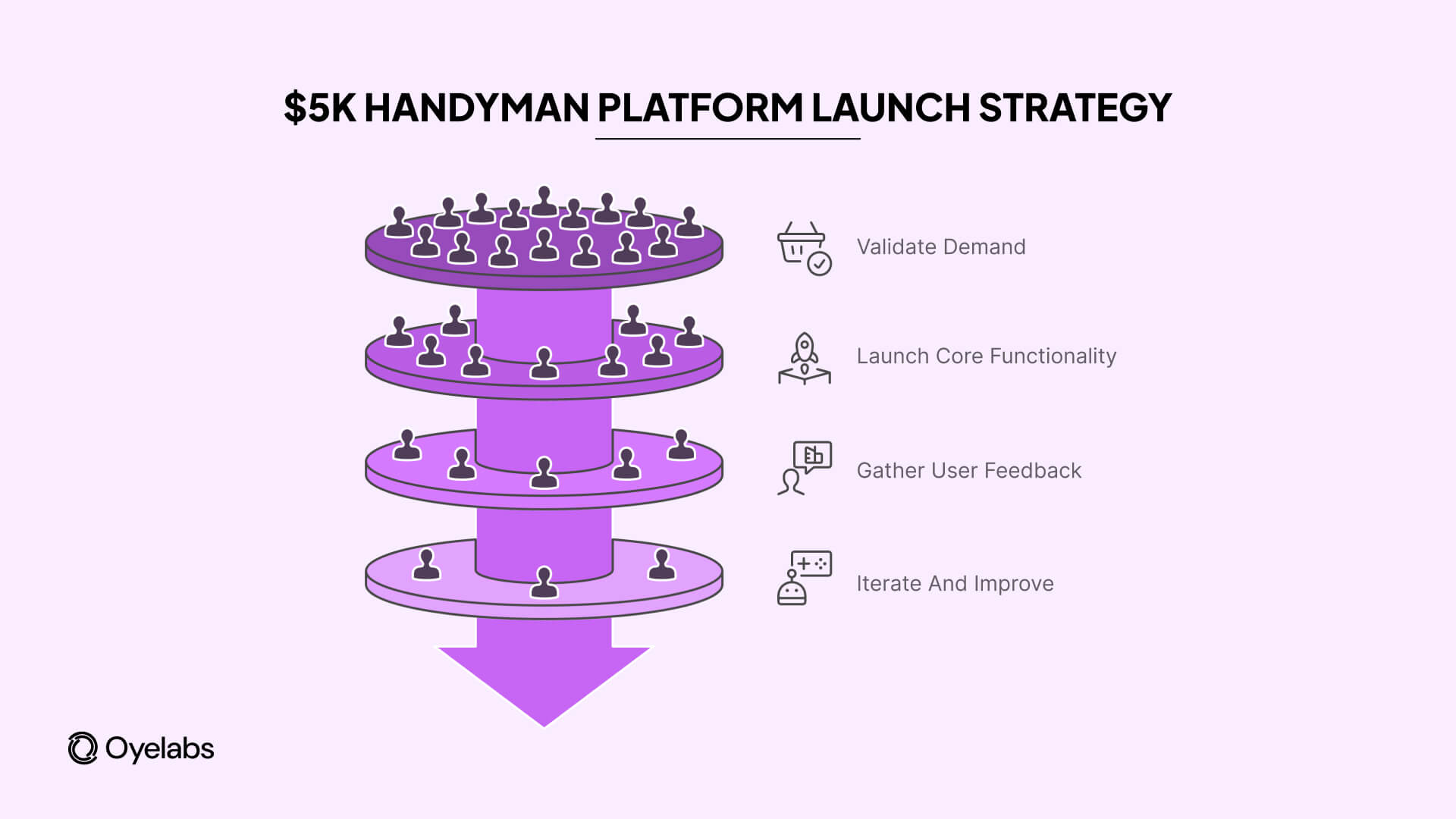
- Want to validate demand in a specific city or niche
- Are focused on launching core functionality first
- Understand that iteration follows real usage, not speculation
- Prefer ownership and control over long-term dependency
It may not be the right fit if you:
- Require heavy customization before launch
- Plan to operate across multiple regions immediately
- Need enterprise-grade integrations from day one
The goal of a $5K launch is not scale. It’s a signal. Once the platform proves that users book and providers deliver, expanding scope becomes a measured decision – not a gamble.
Why Founders Choose Oyelabs for Handyman and TaskRabbit-Style Platforms
Founders don’t choose Oyelabs because it’s the cheapest option. They choose it because it reduces uncertainty.
Oyelabs provides a production-ready handyman and on-demand services platform that includes essential features from day one – bookings, payments, provider onboarding, ratings, and admin control – without forcing founders into long development cycles or bloated costs. The focus is on launch readiness, ownership, and flexibility to grow after validation.
For CEOs and early-stage entrepreneurs, this means fewer technical unknowns and more time spent where it matters: building supply, acquiring customers, and strengthening service quality.
If your objective is to enter the handyman services market quickly, validate demand, and build a real brand – not just an idea – this approach removes the biggest barrier to action.
Check the best offer now and enter the market while demand is still growing.
Conclusion
The handyman services market is not waiting for perfect ideas or oversized budgets. It rewards founders who enter early, launch lean, and learn fast. Starting a handyman platform with a $5K budget is not about cutting corners – it’s about making disciplined decisions, focusing on essentials, and getting real users onto a real system.
A TaskRabbit-style platform doesn’t succeed because of complex features. It succeeds because bookings happen smoothly, providers show up on time, payments are reliable, and trust builds with every completed job. Those outcomes only come after launch – not during months of planning.
If you’re a CEO or entrepreneur sitting on a validated idea, the bigger risk today is delay. Every week you wait, providers commit elsewhere, and customer habits solidify around existing platforms. The opportunity isn’t theoretical – it’s active right now.
The fastest path forward is to enter the market, prove demand, and grow with data – not assumptions.
FAQs
1. What is the most profitable handyman services business model for an app?
Commission-based marketplaces are the most scalable and profitable. The platform earns a percentage from each completed job without hiring technicians or owning equipment. This model reduces operational risk, supports local expansion, and aligns platform revenue directly with booking volume.
2. Can a handyman app support multiple business models at the same time?
Yes. A single platform can support commissions, subscription plans for service providers, and premium listing fees. Many successful apps start with commissions and later introduce subscriptions or featured placements once demand and provider activity increase.
3. How do handyman platforms attract service providers in the early stage?
Early-stage platforms attract providers by offering quick onboarding, fair commissions, steady job flow, and transparent payouts. Local targeting, direct outreach, and early incentives help build the initial supply side before customer demand scales.
4. Do handyman platforms need complex features to succeed initially?
No. Early success depends on reliable bookings, secure payments, and trust features like ratings. Complex automation and advanced analytics can be added later. Launching with stable core functionality is more important than offering every possible feature.