
How to Decide the Budget for Your Rental Marketplace Idea

How to Decide the Budget for Your Rental Marketplace Idea
 Anuraag Jain
Last Updated on May 11, 2026
Key Takeaways
What You’ll Learn:
- The commission model earns money on every booking transaction
- Subscription model charges hosts monthly for platform access
- Featured listings increase visibility and generate additional revenue
- Add-on services increase average booking value
- Multiple revenue streams reduce dependency on one income source
Stats That Matter:
- Vacation rental market expected to reach $119.9B by 2030
- Airbnb generated $9.9B revenue in 2025
- Marketplace platforms dominate global online transactions
- Commission rates typically range between 10% to 30%
- Customer acquisition costs take months to recover
Real Insights:
- Lower commissions attract more hosts in the early stages
- Simple pricing models improve user trust and conversions
- High-value bookings increase total platform revenue faster
- Add-ons like cleaning and insurance boost profit margins
- Strong supply leads to better demand and higher earnings
How to Decide the Budget for Your Rental Marketplace Idea
Budgeting a rental marketplace sounds simple – until it isn’t. One minute you’re thinking “I’ll build an Airbnb-style app,” the next you’re staring at quotes ranging from $1,000 to $150,000+. So what’s real?
The truth: your budget isn’t about code – it’s about decisions. Your MVP scope, booking logic, payment architecture, and go-to-market plan will define what you actually spend.
After working with 500+ marketplace deployments across rentals, mobility, and services, one pattern is clear: founders don’t fail because they lack ideas – they fail because they miscalculate cost vs execution.
This guide breaks down what it really takes to budget a rental marketplace, from lean validation builds to scalable platforms – so you can invest with clarity, not guesswork.
How Much Budget Do You Actually Need to Launch a Rental Marketplace?
The honest answer: it depends on what you’re trying to prove.
Most founders don’t fail because of lack of budget – they fail because they misalign budget with stage. A validation-stage marketplace does not need the same investment as a scale-ready platform with automation, analytics, and high concurrency handling.
The vacation rental market is projected to reach $119.9 billion by 2030, indicating strong long-term demand for new platforms.
Here’s a realistic cost spectrum:
| Stage | Budget Range | What You’re Building |
| Validation (Lean MVP) | $500 – $5,000 | Basic listings, booking, and payments |
| Early Startup | $10,000 – $50,000 | Custom workflows, integrations, UI polish |
| Scale-Ready Platform | $100,000+ | Advanced features, automation, infra scaling |
Rental marketplaces are inherently more complex than standard marketplaces due to real-time availability, booking conflicts, pricing logic, and trust mechanisms. Ignoring this complexity is where budgets spiral later.
The biggest cost driver is not design or frontend – it’s transaction logic and system architecture.
What Type of Rental Marketplace Are You Building (And Why It Changes Cost)?
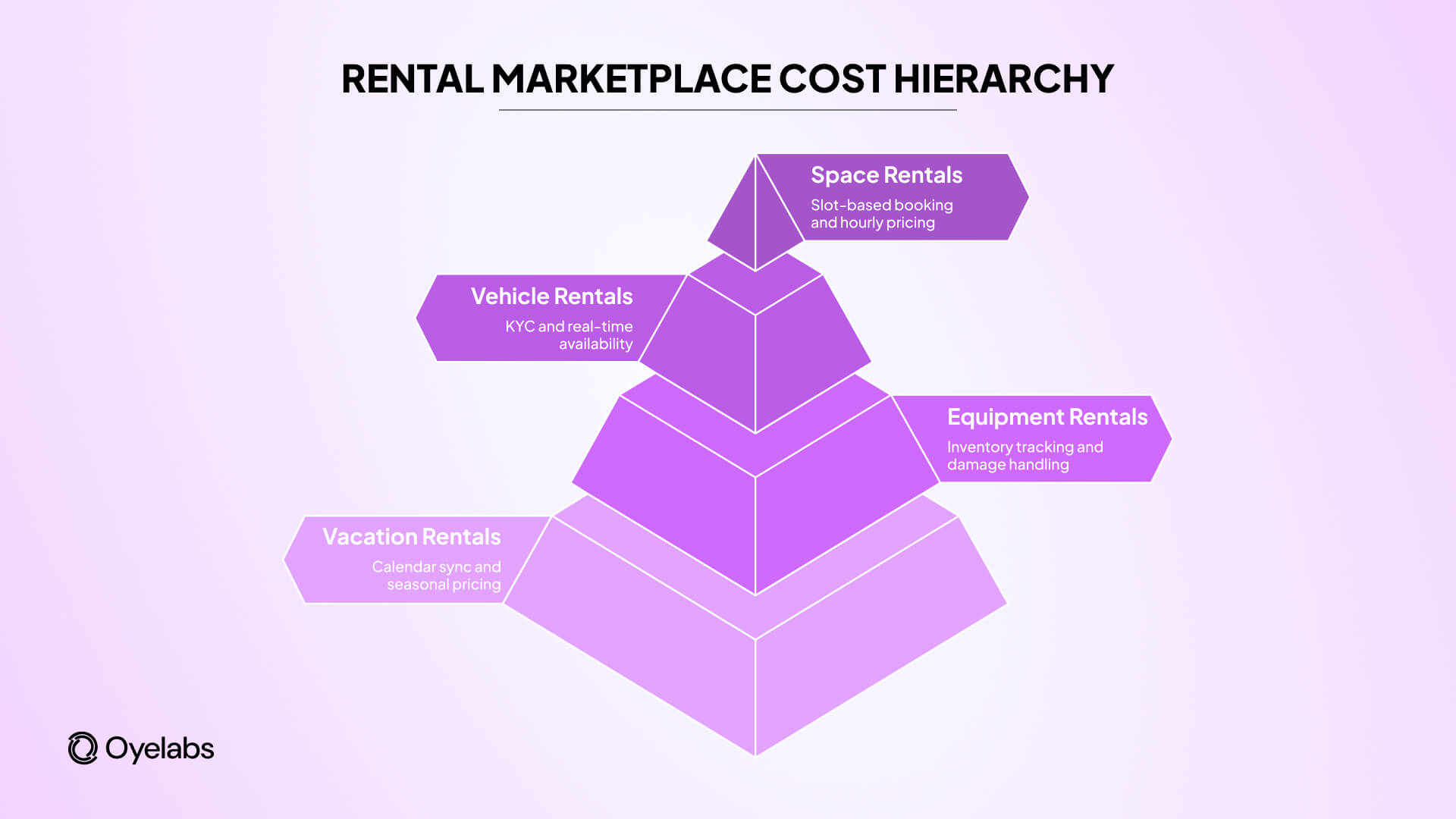
Not all rental marketplaces behave the same. The category you choose directly impacts your technology cost, operational effort, and scalability requirements.
- Vacation Rentals: Require calendar sync, seasonal pricing, cancellation policies
- Equipment Rentals: Need inventory tracking, deposits, damage handling
- Vehicle Rentals: Include KYC, insurance logic, real-time availability
- Space Rentals: Demand slot-based booking, hourly pricing models
Each category introduces different backend requirements. For example, a vehicle rental platform may require identity verification and compliance layers, while a space rental platform relies heavily on time-slot management algorithms.
Choosing a niche is not just a business decision – it’s a technical cost decision.
Founder Insight: The first successful booking teaches more operational lessons than months of isolated product planning and feature discussions.
What Should Be Included in a Rental Marketplace MVP?
An MVP is not a stripped-down product. It is a focused system that enables real transactions.
Core features that cannot be skipped:
- User registration and role-based dashboards (owners and renters)
- Listing creation with pricing and availability controls
- Booking engine with conflict prevention
- Secure payment flow with transaction tracking
Features you should deliberately delay:
- AI recommendations
- Advanced analytics dashboards
- Automation workflows
- Multi-region scaling infrastructure
A common mistake is trying to replicate Airbnb-level functionality from day one. That approach inflates cost without validating demand.
The goal of an MVP is simple: Can users list, book, and pay without friction?
Should You Build Custom or Use a Ready-Made Solution?
This is where most budgets go wrong.
Founders often jump to custom development assuming it guarantees flexibility. In reality, it guarantees higher cost, longer timelines, and execution risk.
Here’s how the options compare:
- SaaS Platforms: Fast to launch, limited customization, recurring dependency
- No-Code Tools: Low cost, fragile scalability, limited backend control
- White-Label Solutions: Balanced approach with ownership and faster deployment
- Custom Development: Maximum control, highest cost, slowest time-to-market
Custom development makes sense only when you have:
- Proven demand
- Complex workflows that cannot be handled by existing systems
- Budget to sustain long development cycles
For early-stage founders, a white-label approach provides a controlled environment to validate and iterate quickly. This is where solutions like Oyelabs’ rental marketplace systems fit – allowing faster go-live without starting from zero.
Before you decide how to monetize, make sure your platform can actually handle real bookings. Explore how to budget your rental marketplace effectively.
What Most Founders Get Wrong About Budgeting a Marketplace
Most budgeting mistakes are not technical – they’re strategic.
Common miscalculations include:
- Overbuilding before validation: Investing in features no user asked for
- Ignoring supply-side costs: Listings don’t appear automatically
- Underestimating operations: Disputes, refunds, and support require systems
- Assuming tech is the hardest part: In reality, liquidity is harder
The uncomfortable truth is that technology is only one part of the equation. A marketplace without users – both supply and demand – is just a static application.
Budgeting only for development is incomplete thinking.
Builder Tip: Most rental startups fail from weak marketplace liquidity, not weak technology, despite founders heavily prioritizing development budgets.
What Are the Hidden Costs No One Talks About?
Most blog posts stop at development cost. That’s misleading. Cloud infrastructure spending expected to exceed $1 trillion by 2028.
Hidden costs start appearing immediately after launch:
- Payment handling issues: Failed transactions, refunds, chargebacks
- Infrastructure scaling: Increased server load, database optimization
- Legal frameworks: Terms of service, liability coverage, rental policies
- Ongoing maintenance: Bug fixes, updates, performance improvements
For rental marketplaces, trust is critical. This often leads to additional costs in:
- User verification systems
- Review and rating moderation
- Fraud prevention mechanisms
Ignoring these costs early leads to reactive spending later, which is always more expensive.
How Much Should You Budget for Marketing and Liquidity?
A marketplace without users has zero value – regardless of how well it is built.
You need to budget for both sides of the ecosystem:
Supply acquisition (owners, vendors, hosts):
- Outreach campaigns
- Incentives and onboarding support
- Content creation (photos, listings optimization)
Demand generation (renters, customers):
- Paid advertising (Google, Meta)
- SEO and content marketing
- Referral and retention strategies
A practical rule: allocate at least 6–12 months of runway post-launch for marketing and growth.
Most founders underestimate this phase, expecting organic traction without structured acquisition strategies.
Marketplace Truth: Supply acquisition often costs more than expected because inventory onboarding requires trust-building, manual outreach, and operational assistance.
How to Allocate Your Total Budget (Simple Framework)
A balanced budget allocation ensures you don’t over-invest in one area while neglecting another.
A practical split looks like this:
- Development: 30–40%
- Marketing and acquisition: 30–40%
- Operations and support: 20–30%
This varies based on your stage, but the principle remains the same:
Your success is not determined by how much you spend – but where you spend it.
Overspending on development while ignoring marketing is one of the fastest ways to stall a marketplace.
A disciplined allocation strategy keeps your launch realistic and your growth sustainable.
When Should You Use a White-Label Rental Marketplace Solution?
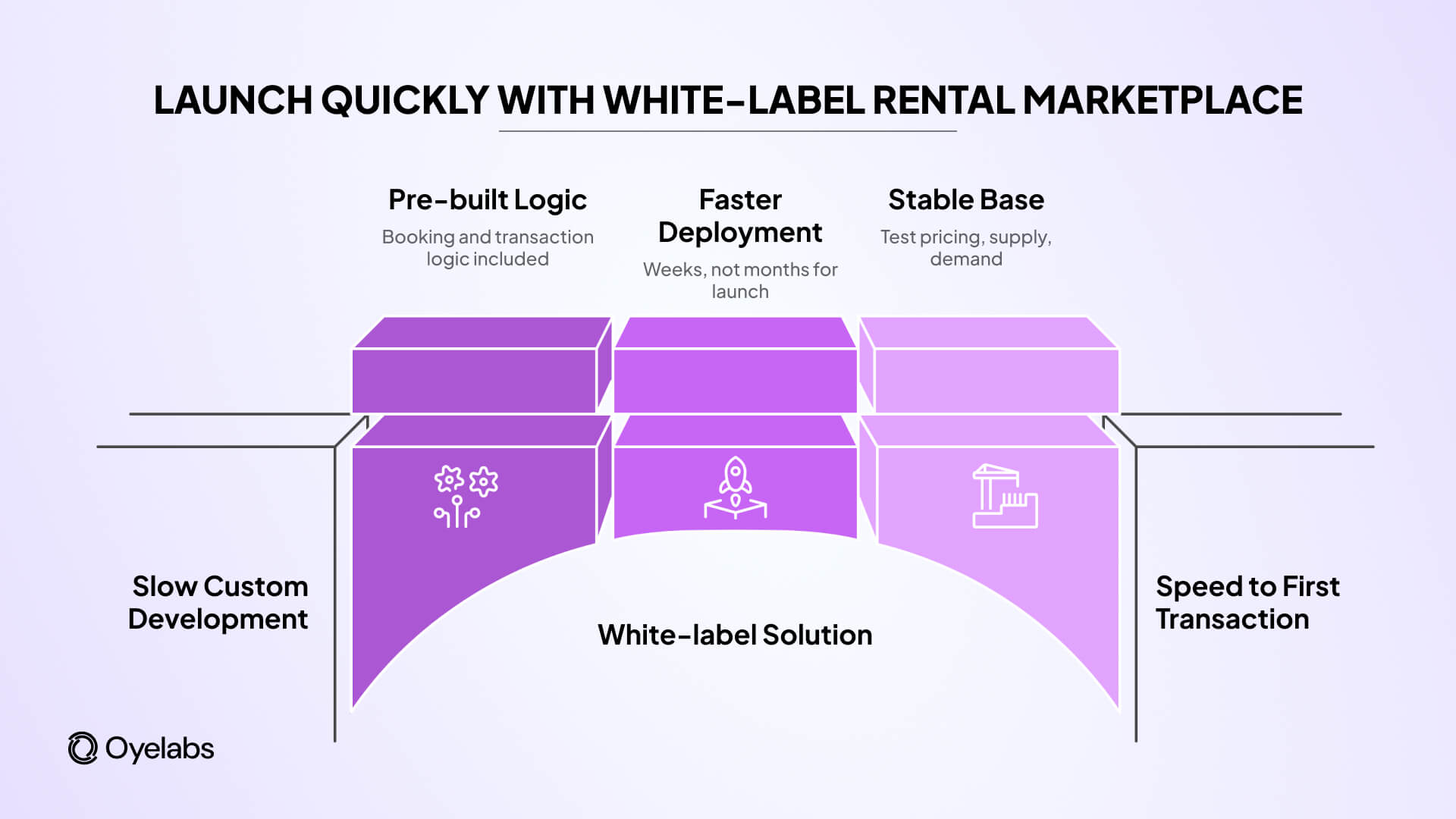
Speed and control rarely come together. White-label solutions exist to bridge that gap.
You should consider a white-label rental marketplace when:
- You need to launch quickly to validate demand
- Your core model is proven (list – book – pay), not experimental
- You want source code ownership without building from scratch
- Your budget cannot justify a long custom development cycle
Where founders misjudge this is assuming white-label equals limitation. In reality, most marketplaces fail long before they ever hit technical limits.
A structured white-label system gives you:
- Pre-built booking and transaction logic
- Faster deployment timelines (weeks, not months)
- A stable base to test pricing, supply, and demand
This is where Oyelabs creates a clear advantage.
Instead of forcing founders into high-risk custom builds, Oyelabs offers a vacation rental marketplace solution starting at $999 – designed specifically for early-stage validation and fast go-live.
At this price point, the objective is not perfection.
It is speed to first transaction.
And that is what most founders underestimate.
How Oyelabs Helped a New-Age Founder Launch Faster Without Overspending
One of the most common patterns seen across early-stage founders is overinvestment before validation.
In a recent deployment, a founder looking to build a niche vacation rental platform initially explored custom development. The projected cost exceeded $25,000 with a 3–4 month timeline.
Instead, they shifted to a white-label approach.
What changed:
- Platform launched in under 3 weeks
- Initial inventory onboarded manually
- Booking and payment flows tested with real users
- Early revenue generated without heavy infrastructure
The key advantage was not cost saving alone – it was time compression.
Instead of spending months building assumptions, the founder moved directly into market validation and iteration.
This is the real role of a white-label system.
Launch Your Vacation Rental Marketplace Faster Without Overspending
Launch smarter with a scalable rental marketplace foundation designed for validation, faster deployment, and future customization flexibility.
✓ Faster deployment with proven booking transaction workflows
✓Source code ownership without expensive custom development cycles
✓ Scalable architecture designed for future platform growth
✓ Rental marketplace launch support from experienced specialists
Conclusion
Most founders underestimate how quickly rental marketplace costs can spiral when decisions are made without validation. The platforms that succeed are usually not the most expensive – they are the ones built with clear priorities, controlled execution, and room to evolve over time. A strong rental marketplace starts with solving one core problem well: enabling smooth, trusted transactions between owners and renters.
That is why many early-stage founders now prefer launching lean before committing to large-scale custom development. With Oyelabs’ vacation rental marketplace solution starting at $999, founders can validate demand faster, reduce time-to-market, and maintain future customization flexibility without overspending early.
If you are planning to launch a rental marketplace, the smarter move is not building bigger first. It is building strategically.
FAQs
What is the best monetization model for a vacation rental app platform?
The most effective model is commission-based, where the platform earns a percentage per booking. This aligns revenue with platform activity, scales naturally with growth, and ensures consistent income without creating friction for new users entering the marketplace.
How much commission should a vacation rental platform charge hosts and guests?
Most vacation rental platforms charge between 10% to 30% commission per booking. The exact percentage depends on your market, competition, and value provided, such as traffic, trust systems, and payment security.
Can a vacation rental marketplace earn revenue without charging commissions?
Yes, platforms can use subscription models, listing fees, or premium visibility charges. However, commission-based models remain the most scalable because they grow directly with transactions and reduce upfront cost barriers for users.
What revenue streams can be added beyond bookings in a rental marketplace?
Additional revenue streams include featured listings, service add-ons, insurance partnerships, cleaning services, and local experience bookings. These increase average transaction value and create multiple income channels beyond core rentals.