
Step-by-Step Guide to Building a Property Listing Platform

Step-by-Step Guide to Building a Property Listing Platform
 Anuraag Jain
Last Updated on May 11, 2026
Key Takeaways
What You’ll Learn
- A property listing platform is a liquidity problem, not a UI problem
- Supply quality and response speed outperform feature depth
- Monetization must be decided before development – not after
- IDX/MLS integrations add complexity, not just inventory
- Speed to launch beats architectural perfection in early stages
- Scaling issues start with data integrity, not traffic
Stats That Matter
- 90%+ of buyers start their home search online – visibility is table stakes, not an advantage
- Mobile accounts for the majority of real estate traffic, but conversion still lags desktop due to poor UX
- Response time under 5 minutes can increase lead conversion by 8–10x
More features don’t create success. Better execution of fewer things does.
Step-by-Step Guide to Building a Property Listing Platform
Most founders assume building a property listing platform is a UI problem. It isn’t. It’s a supply, trust, and data integrity problem disguised as software.
The real friction starts when listings don’t convert, agents don’t respond, and users abandon search because results feel stale or irrelevant. Building a real estate listing platform isn’t about filters or maps – it’s about aligning monetization logic, lead flow, and listing accuracy under constant scale pressure. Most platforms fail because they prioritize features before solving liquidity between buyers and sellers.
The uncomfortable truth: without consistent listing supply and fast response cycles, even the best-built platform collapses. Every decision – from tech stack to marketplace model – either compounds growth or silently kills it.
What actually separates platforms that scale from those that stall comes down to decisions most founders never see coming.
What Is a Property Listing Platform and How Does It Actually Work?
Most explanations reduce this to “listings + search.” That’s surface-level thinking.
A real property listing platform operates as a liquidity engine. Listings (supply) and inquiries (demand) must stay in balance – or the system quietly breaks.
The real bottleneck is not technology. It’s coordination.
- Listings must stay fresh, or users lose trust within minutes
- Leads must be routed instantly, or agents disengage
- Data must be consistent across devices, or search becomes unreliable
What looks simple actually breaks at scale. A delay of even a few minutes in listing updates or agent response can kill conversion rates.
More listings don’t fix this problem. Better listing velocity and response time do.
Who Should Actually Build a Property Listing Platform?
Not every founder should touch this category. The barrier isn’t coding – it’s operational depth.
There are only a few viable entry points:
- Brokerages with existing inventory – already control supply
- Local aggregators – can dominate a niche geography
- Marketplace founders – understand two-sided growth loops
This is where most platforms fail: founders try to build supply after launching demand.
That order doesn’t work.
Speed matters more than volume here. A small, active listing base converts better than a large, stale one.
If supply acquisition is unclear, the platform is already in trouble – before a single line of code is written.
Execution Insight: Start with controlled inventory, not scale. Platforms with smaller, active listings outperform larger platforms with stale or unreliable data.
What Should Be Decided Before Building a Real Estate Platform?
Most founders jump into development with vague assumptions. That’s expensive.
The real work happens before the build.
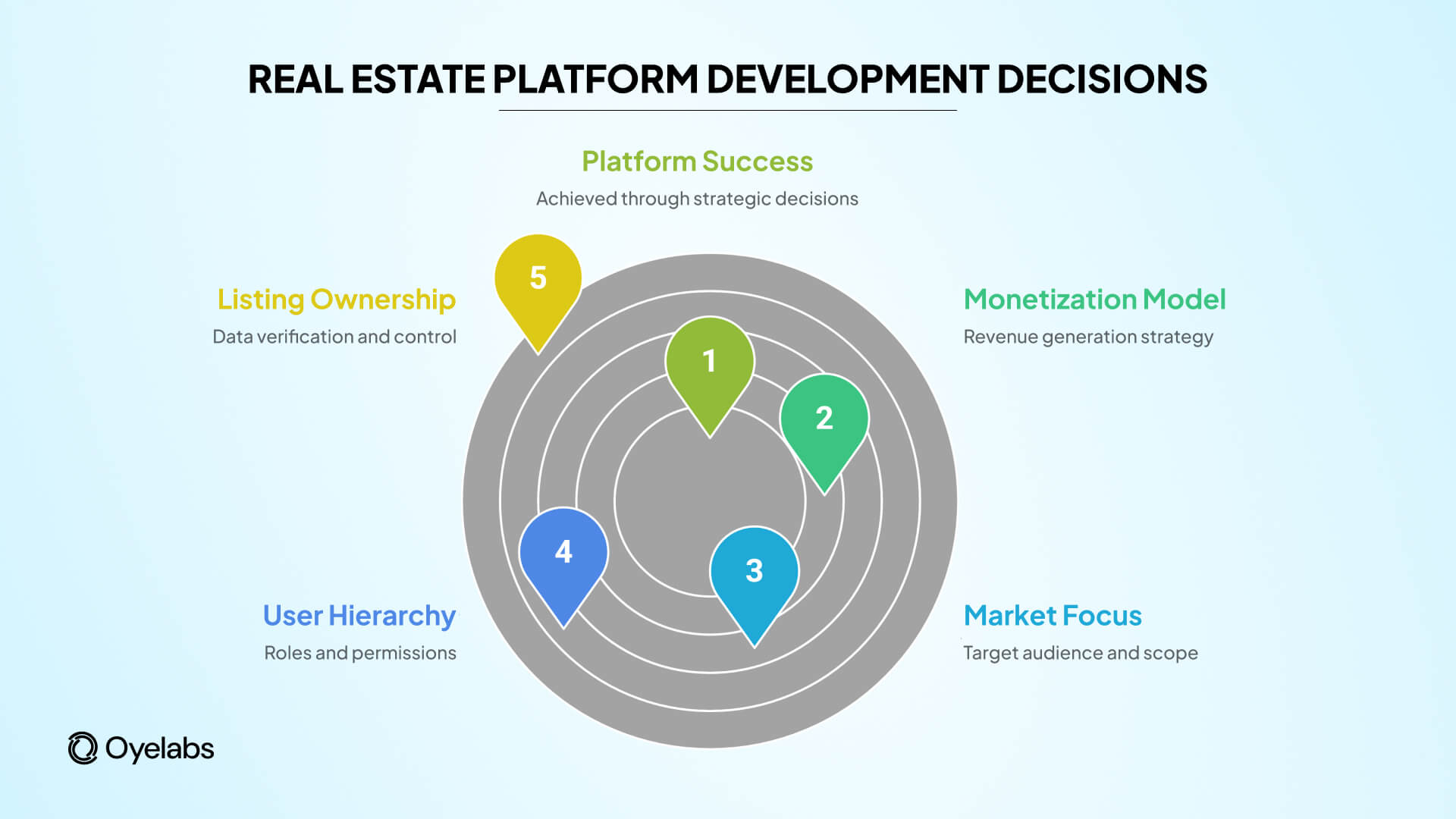
Key decisions that shape everything:
- Monetization model (lead fees vs subscriptions vs featured listings)
- Market focus (local dominance vs broad marketplace)
- User hierarchy (agents vs owners vs builders)
- Listing ownership (aggregated vs manually verified)
What looks like a product decision is actually a business constraint.
For example:
If monetization depends on agent subscriptions, then lead quality – not traffic – becomes the core metric.
This is where most platforms fail. They optimize for traffic early, then realize it doesn’t convert into revenue.
Wrong metric – wrong product decisions – slow death.
What Most Founders Get Wrong About Property Platforms
There’s a pattern. It repeats across almost every failed attempt.
Founders assume success comes from feature parity with platforms like Zillow. It doesn’t.
What actually goes wrong:
- They overbuild features before validating demand
- They underestimate how hard it is to maintain listing accuracy
- They ignore agent-side experience entirely
- They treat this as a tech product, not an operations-heavy marketplace
The uncomfortable truth: copying features is easy. Replicating trust is not.
This is where most platforms fail – trust decays faster than features can compensate.
A platform with fewer features but better data consistency will outperform a “complete” platform every time.
What Features Does a Property Listing Platform Actually Need?
Feature lists are usually bloated. Most of them don’t move the needle. More than 60% of property discovery now happens on mobile, yet most platforms still fail at mobile conversion.
Instead of listing everything, focus on what directly impacts conversion:
| Feature Layer | What Matters | Why It Breaks |
| Search Logic | Speed + relevance | Slow or irrelevant results kill intent instantly |
| Listing Pages | Clarity + media quality | Poor visuals reduce trust |
| Lead Capture | Frictionless contact | Delays drop conversion rates |
| Notifications | Real-time alerts | Lag kills engagement |
The real bottleneck is not feature availability – it’s execution quality.
For example, a “filter system” sounds basic. But once inventory grows, maintaining fast, accurate filtering becomes a serious engineering challenge.
More features don’t improve performance. Precision does.
Builder Tip: Focus on listing freshness and response speed before adding features – this is where most early-stage platforms quietly lose user trust.
What Advanced Features Actually Move the Needle?
Most “advanced features” are vanity additions.
The ones that matter directly affect user decisions and platform stickiness.
- Smart recommendations based on user behavior
- Real-time alerts for price drops or new listings
- Visual-heavy experiences like 3D tours and walkthroughs
- Financial tools (EMI calculators, affordability insights)
But here’s the catch.
What looks like a simple add-on often introduces complexity at scale.
For example, recommendation engines require behavioral data. Without enough users, they produce poor results – hurting trust instead of improving it.
This is where most platforms fail. They add advanced features too early.
Timing matters more than capability.
Build for current scale – not imagined scale – or the platform becomes unnecessarily heavy before it even finds traction.
How Do You Choose the Right Tech Stack for a Property Listing Platform?
Tech stack debates usually start too early – and in the wrong direction.
The real bottleneck isn’t React vs WordPress. It’s how fast the system can handle growing listings, concurrent searches, and media-heavy pages without breaking.
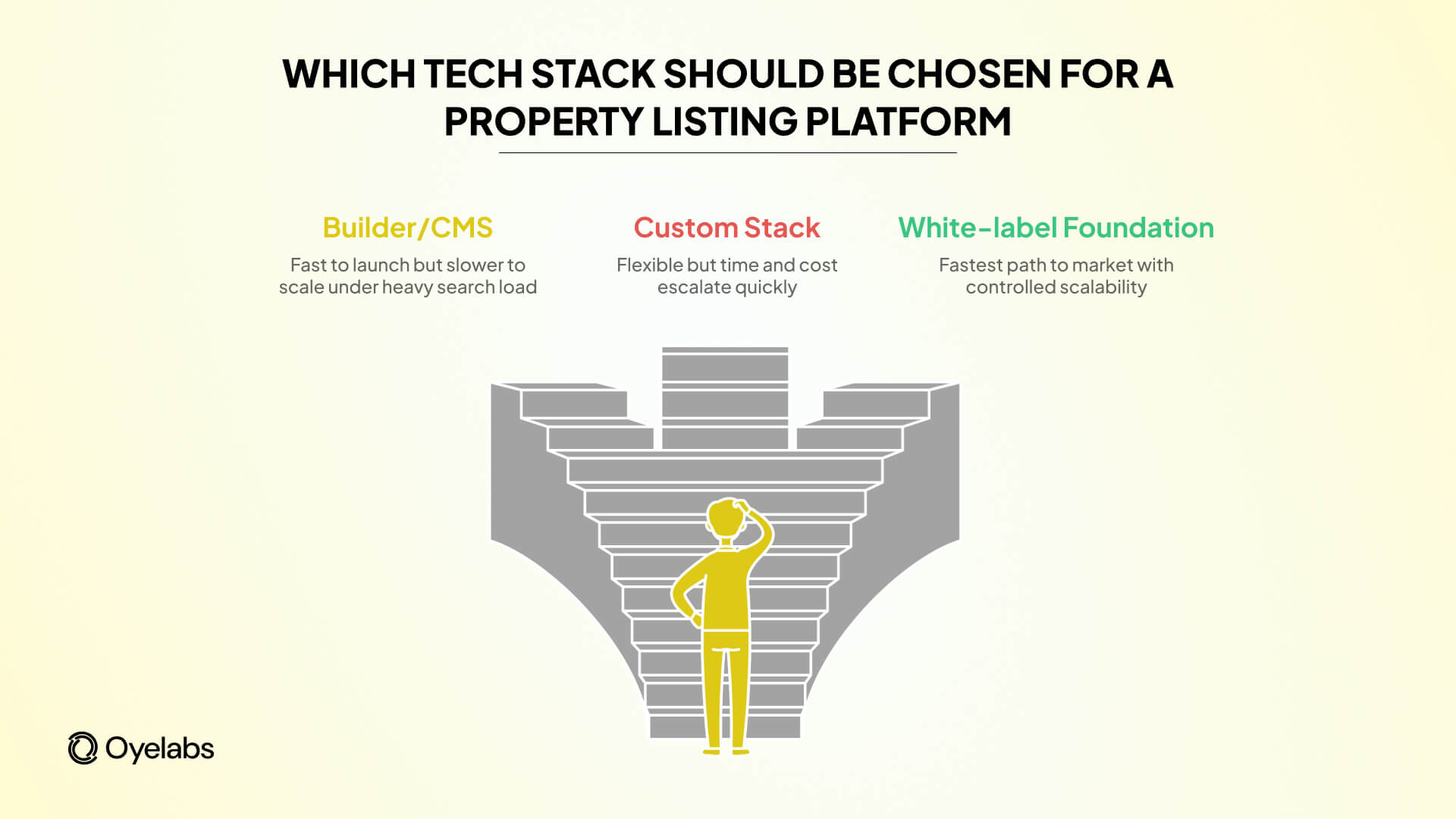
Three common paths:
- Builder/CMS (WordPress, Webflow) – fast to launch, slower to scale under heavy search load
- Custom stack (React, Node, Python) – flexible, but time and cost escalate quickly
- White-label foundation – fastest path to market with controlled scalability
What looks like a tech decision is actually a timeline and risk decision.
Early-stage platforms don’t fail because of “wrong frameworks.”
They fail because they spend 6 months building instead of testing demand in 6 weeks.
Speed matters more than architectural purity – at least in phase one.
Builder Tip: Avoid overengineering early. Speed to launch creates real feedback – waiting for perfection delays learning and increases unnecessary development cost.
Why MLS and IDX Integration Break More Platforms Than They Build
On paper, IDX/MLS integration looks like a shortcut to instant inventory.
In reality, it introduces dependencies most founders aren’t prepared for.
The friction points are rarely discussed:
- Data licensing restrictions vary by region
- Listing updates aren’t always real-time
- Duplicate or outdated listings damage trust
- Integration setup can take longer than core development
This is where most platforms fail – they rely on external data before building internal control.
More data doesn’t mean better experience.
If listings are inconsistent or delayed, users don’t blame the feed.
They blame the platform.
What looks like leverage often becomes liability.
How Much Does It Cost to Build a Property Listing Platform?
Cost conversations are usually misleading because they ignore scope depth.
A clearer breakdown:
| Build Type | Estimated Cost Range | What You Actually Get |
| Basic MVP | $3K – $10K | Core listings + search + lead capture |
| Custom Platform | $15K – $60K+ | Scalable architecture + integrations |
| Enterprise Build | $80K+ | Multi-region, MLS-heavy, high traffic systems |
But here’s where the gap shows up.
Most founders don’t actually need a full custom build on day one.
They need something that can go live, validate demand, and handle real users without breaking.
That’s where solutions from Oyelabs change the equation.
Instead of starting from zero, platforms like MoonEstate deliver a ready foundation – covering listings, search, lead capture, and admin control – at around $2,599.
What looks like a lower price isn’t a compromise.
It’s a shift in approach.
You’re not paying to build basics repeatedly.
You’re starting with them already in place – and focusing on what actually differentiates your platform.
Because the real cost isn’t development alone.
The real bottleneck is ongoing spend:
- Infrastructure scaling (servers, CDN, storage)
- API usage (maps, notifications, analytics)
- Maintenance and updates
- Agent onboarding and support systems
Cheap builds don’t stay cheap. They convert into expensive rebuilds once traffic starts coming in.
Starting with a working, scalable base avoids that cycle entirely.
What Hidden Costs Do Founders Ignore Until It’s Too Late?
Most budgets focus on launch. Very few plan for survival.
The hidden layer is operational.
- Listing verification and moderation workflows
- Customer support and agent dispute handling
- Data cleanup and duplication control
- Performance optimization as inventory grows
What looks like a one-time build quickly becomes a living system.
This is where most platforms fail – they underestimate ongoing effort.
A platform with 10,000 listings isn’t just “bigger.”
It’s exponentially harder to maintain.
Scale doesn’t just increase cost.
It multiplies complexity.
Gen Z doesn’t wait – and neither should your platform. Explore what a mobile-first property platform actually looks like in action.
Should You Build from Scratch or Use a Ready Solution?
This decision defines speed, cost, and risk.
There’s no neutral option here.
Build from scratch makes sense when:
- The business model is deeply differentiated
- Custom workflows are core to the idea
- Time-to-market is not critical
Ready or white-label solutions make sense when:
- Speed is a competitive advantage
- The core model is already validated
- Focus is on growth, not engineering
This is where most founders get it wrong – they overestimate uniqueness.
Most property platforms are not unique at the core
Execution and market strategy create differentiation.
For example, solutions like MoonEstate are designed to bypass early-stage build friction and focus on launch.
The real question isn’t “what to build.”
It’s “how fast can this go live and start learning?”
What Does It Actually Take to Launch a Property Listing Platform?
Launch isn’t a milestone. It’s a stress test.
The process usually unfolds like this:
- Scope clarity and user journey mapping
- Design aligned with conversion, not aesthetics
- Development with integration checkpoints
- Testing across devices, data flows, and edge cases
- Deployment with monitoring systems in place
What looks like a linear process rarely is.
The real bottleneck is coordination between moving parts – data, users, and systems.
This is where most platforms fail – they treat launch as “completion.”
In reality, launch exposes everything that was missed.
And the platforms that survive are the ones prepared for that moment – not just the ones that shipped.

How Can Oyelabs Help You Build a Property Listing Platform?
Most development partners focus on building features. That’s not the problem that needs solving.
The real gap is turning an idea into a live, working system that can handle listings, leads, and growth – without collapsing under its own complexity.
That’s where execution matters.
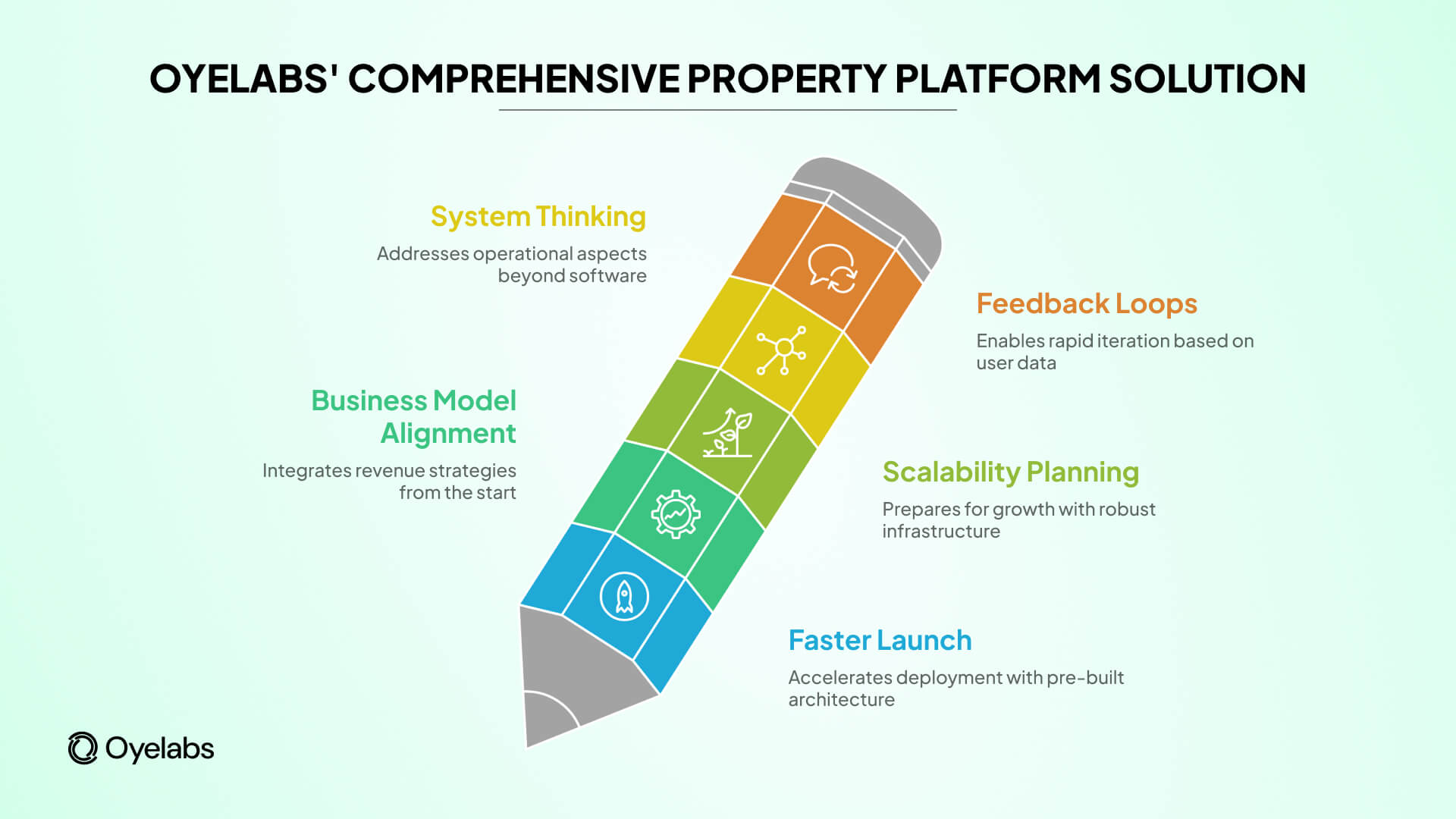
Launch Faster Without Building From Zero
Using solutions like MoonEstate, the focus shifts from “how to build” to “how fast can this go live.”
- Pre-built listing architecture
- Search, filters, and lead capture already structured
- Admin panel designed for real-world operations
What looks like acceleration is actually risk reduction.
Because the biggest mistake founders make is spending months building before learning anything from the market.
Build Around Your Business Model, Not Just Features
Most platforms fail because they force-fit generic systems into specific markets.
The approach here is different.
- Monetization logic aligned early (subscriptions, lead fees, featured listings)
- Agent workflows and response systems are considered from day one
- Flexibility to adapt based on market behavior
The real bottleneck isn’t development.
It’s a misalignment between the product and revenue model.
Handle Scale Before It Becomes a Problem
What works at 100 listings usually breaks at 10,000.
That’s where most platforms start rebuilding.
- Infrastructure planning for listing growth
- Media handling for high-volume property data
- Performance optimization for search-heavy usage
What looks stable early often hides scaling issues underneath.
Planning for that upfront avoids expensive rebuild cycles later.
Go Beyond Development – Think in Systems
A property platform isn’t just software. It’s an operational system.
- Lead routing and tracking
- Listing moderation and data consistency
- Notification systems and user engagement loops
This is where most platforms fail – they build the product but ignore the system around it.
And without that system, growth stalls.
Reduce Time-to-Market, Increase Feedback Speed
Speed isn’t just about launching early. It’s about learning early.
- Faster deployment cycles
- Real-user feedback loops
- Iteration based on actual behavior, not assumptions
Because the sooner the platform is live, the sooner the real problems surface.
And those problems are what actually shape a scalable product.
The difference isn’t in writing code.
It’s in building something that can survive real usage.
And that only happens when execution is aligned with how the business actually operates – not how it looks on paper.
[/vc_column_text][/vc_column][/vc_row]
Skip the Build Struggle – Launch a Property Platform Built for Real Users
Get a ready foundation designed for real-world marketplace execution, not just development.
✓ Pre-built listing system ready for immediate deployment
✓Scalable architecture designed for high-volume property data
✓ Built-in lead capture and agent management workflows
✓ Customizable modules aligned with your business model
Conclusion
Building a property listing platform isn’t about shipping features – it’s about aligning supply, demand, and trust from day one. Most failures come from chasing traffic before fixing listing quality and response speed. A real estate platform only works when data stays accurate, agents respond quickly, and users consistently find relevant results.
The challenge isn’t launch – it’s continuity. Listings must stay fresh, lead flow must be reliable, and the system must adapt as usage grows. What looks stable early often breaks under scale.
The platforms that succeed aren’t the most complex. They’re the most disciplined. They prioritize execution, iterate based on real behavior, and fix bottlenecks before chasing growth.
If the goal is to move from idea to a working platform without wasting months on avoidable mistakes, this is the point to act – build it right, launch it fast, and start learning from the market.
FAQs
How long does it take to build a property listing platform?
A basic MVP can launch in 3–6 weeks using a ready solution. Custom platforms typically take 3–6 months. The real delay comes from integrations, data setup, and testing – not development alone.
What is the minimum cost to build a real estate listing website?
Entry-level builds start around $3,000–$10,000 for MVPs. Scalable platforms with integrations and mobile apps can go beyond $25,000. Ongoing costs often exceed initial build costs over time.
Do I need MLS or IDX integration to launch?
No. Early-stage platforms can start with manual or curated listings. MLS/IDX becomes relevant when scaling inventory. Relying on it too early can slow down launch and reduce control over data quality.
Can a niche property platform outperform large marketplaces?
Yes. Platforms focused on specific geographies or property types often convert better. Local relevance, faster response, and better listing quality outperform large but generic marketplaces.