
Should Your Service Marketplace Target a Niche or Go Broad?
Should Your Service Marketplace Target a Niche or Go Broad?
 Anuraag Jain
Last Updated on August 29, 2025
Ever heard the saying, “Jack of all trades, master of none”? Yeah, that’s basically the tea when it comes to building a service marketplace. Whether you’re launching the next TaskRabbit or aiming to be the Fiverr for pet psychics (hey, no judgment), choosing between niche and broad isn’t just a branding decision; it’s a strategic growth lever.
Many startup founders get stuck here, and it’s no wonder. A niche lets you dominate a micro-market with hyper-personalization and lower CAC (customer acquisition cost), while a broad platform promises scale, virality, and network effects. But here’s the kicker: only a handful of platforms ever succeed in going wide without first going deep.
Backed by data from top marketplace consultants and growth marketers, this guide breaks down the pros and cons of each model, is SEO-optimized, and is Gen Z-friendly. So, are you ready to own your niche or swing for the digital fences? Let’s decode it.
Which One to Choose For Your TaskRabbit-like App
What Does “Niche” Actually Mean in the Marketplace World?
In the service marketplace world, “niche” isn’t just a buzzword; it’s a business model with laser focus. A niche marketplace targets a specific audience or solves a tightly defined problem. Think UrbanSitter for parents, Rover for pet owners, or HoneyBook for creatives. These platforms thrive not by being everything to everyone, but by being everything to someone.
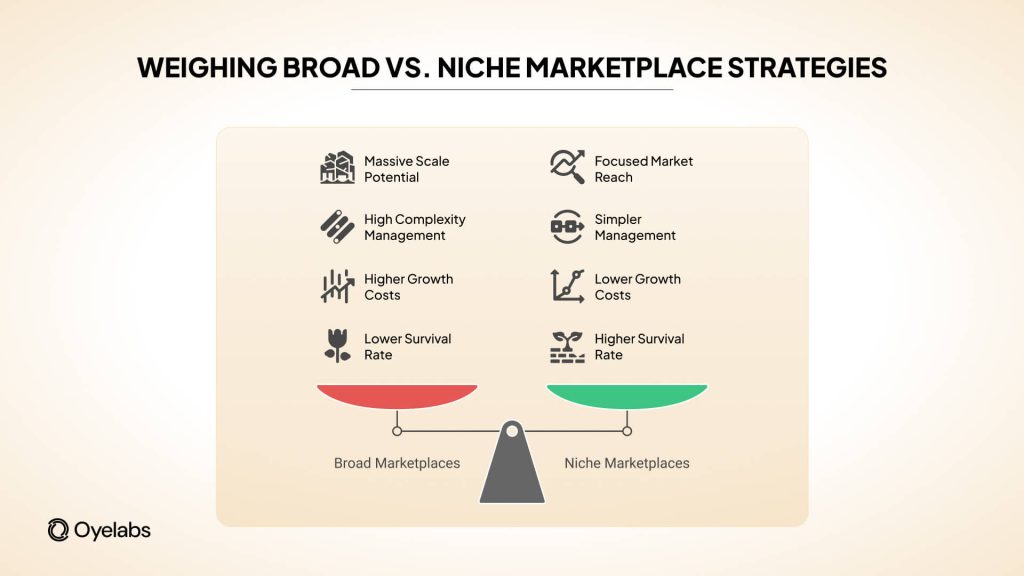
According to a 2024 Statista report, niche marketplaces boast a 38% higher customer retention rate compared to generalist platforms. Why? Because niche users feel understood. They’re not just scrolling through cluttered services; they’re finding exactly what they need. This allows for high-intent conversions, lower customer acquisition costs (CAC), and deeper lifetime value (LTV).
In the words of David Ogilvy, “Don’t bunt. Aim out of the ballpark.” Niche marketplaces do just that. They offer tailored UX, curated supply, and a strong value proposition that resonates. Plus, SEO is a dream; ranking for “freelance makeup artist booking app” is way easier than “find a freelancer.”
So, while going niche might feel “small,” it’s actually a power move for founders who want traction without burning through their budget. It’s about depth over breadth, and in today’s saturated digital economy, specificity sells.
Broad Marketplaces: The Dream of Scale and Virality
Going broad is the big, bold dream. It’s what platforms like Fiverr, TaskRabbit, and Thumbtack chased, and in many ways, conquered. A broad marketplace aims to connect multiple user segments with diverse service offerings, promising massive scale, high-volume transactions, and viral potential. It’s the Silicon Valley vision board brought to life.
But here’s the real talk: only 1 in 10 broad marketplaces survive past year three, according to a 2023 CB Insights study on startup failure. Why? Because broad means complexity, you’re juggling multiple user personas, service categories, pricing models, and UX expectations. Growth becomes expensive fast, with CACs often 40–60% higher than niche-focused platforms.
Still, the upside is huge. With the right network effects, when more users attract even more users, you can unlock exponential growth. Think of how Fiverr became the go-to for everything from logo design to voiceovers. Or how Thumbtack scaled by owning the “local services” category.
David Ogilvy taught us to speak with clarity and scale with trust. Broad marketplaces can win, but only if they’re backed by bulletproof UX, killer onboarding, and smart data-driven targeting. Bottom line? Going broad isn’t just risky—it’s math meets mission. And if you play it right, it can redefine an entire industry.
Niche First, Then Expand? The Airbnb & Amazon Playbook
Want to build a billion-dollar marketplace? Start small, then explode. That’s the playbook Airbnb and Amazon followed, and it’s pure gold for founders today. Airbnb began by renting out air mattresses in a San Francisco apartment during a design conference. Amazon? Just books. But what these giants nailed early on was Product-Market Fit (PMF). They didn’t try to serve everyone; they served someone perfectly.
A 2023 Harvard Business Review study found that startups that begin with a niche and expand later are 3x more likely to reach profitability within five years. Why? Because niches provide clarity. You build faster, test smarter, and spend less. You create evangelists, not just users. Once traction hits, you can layer in verticals, features, and new segments, strategic expansion rather than chaotic scaling.
Amazon now sells everything. Airbnb hosts castles. But they didn’t start that way. They validated their model with a focused audience, then used customer insights, data loops, and iterative design to scale. If you’re planning a home-services marketplace, see how TaskRabbit works to understand how successful platforms scale from niche beginnings.
In Ogilvy’s world, “If it doesn’t sell, it isn’t creative.” The same applies here: start with what sells, and grow from that center. Niche-first isn’t playing it safe. It’s playing it smart. Because mastering one slice of the pie is how you earn the whole bakery.
Key Factors to Help You Decide
Deciding between going niche or broad isn’t a coin toss; it’s a calculated move that shapes everything from your CAC to your total addressable market (TAM). Here’s your decision cheat sheet, no fluff, just facts.
Understand Your TAM, SAM & SOM
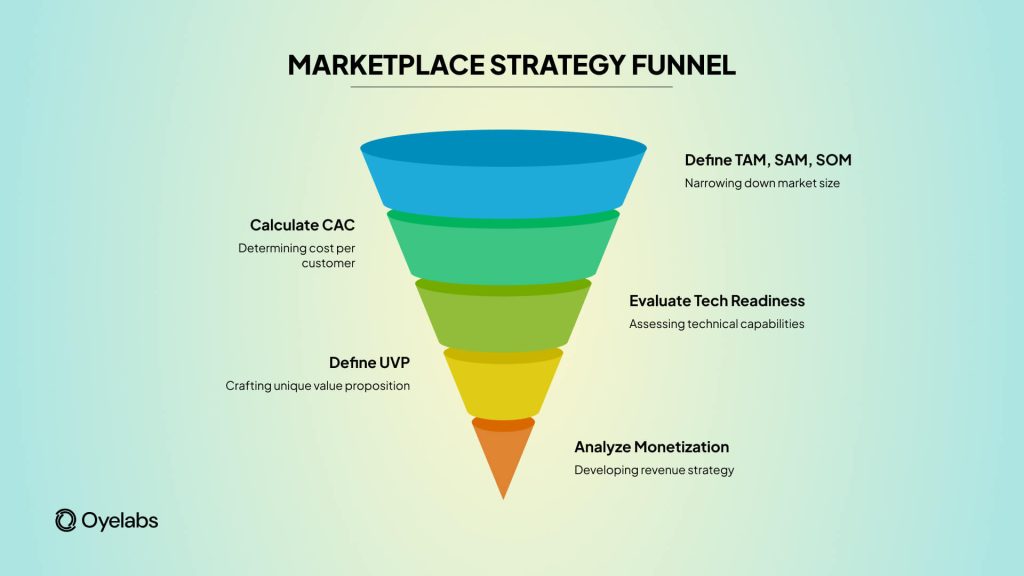
Before choosing your marketplace direction, get real about your market size. TAM (Total Addressable Market) tells you how big your overall opportunity is. SAM (Serviceable Available Market) narrows that down to the portion your platform can actually reach with your current offering and location. SOM (Serviceable Obtainable Market) is the slice you can realistically capture based on your budget, resources, and traction.
A 2023 CB Insights report revealed that 35% of startups fail due to misreading market demand. For niche marketplaces, a small but active SOM with high conversion rates might be better than a huge TAM with vague audience targeting. If your niche market is passionate and underserved, go for hyperlocal targeting for your TaskRabbit-like app.
Use tools like Statista, SEMrush, and Google Trends to validate your assumptions. Knowing your numbers will prevent you from chasing vanity metrics and help you choose a path that aligns with your product, growth model, and team capacity.
Calculate Your Customer Acquisition Cost (CAC)
Customer Acquisition Cost (CAC) is the invisible price tag on every new user. It includes your spending on ads, outreach, sales tools, and even content creation. Niche marketplaces often have a clear win here.
Because you’re targeting a specific group, your ads convert better, your SEO content ranks faster, and your message resonates more deeply, translating to 40% lower CAC, according to HubSpot’s 2023 Benchmark Report.
Broad marketplaces? They face a fragmented audience and generic messaging, leading to higher ad spend and longer sales cycles. Therefore, significantly, the cost of developing the app will increase by a huge percentage.
Here’s the golden rule: your LTV (Lifetime Value) should be at least 3 times your CAC. If you’re only breaking even or worse, losing money, you’ll bleed cash before hitting scale. Evaluate how lean your funnel is.
Do you need influencers, paid media, referral engines, or PR to grow? Factor these in before deciding. Bottom line: whichever path you pick, knowing your CAC gives you control over your budget and keeps your runway from burning out.
Evaluate Your Tech Stack and Team Readiness
The path you choose, niche or broad, needs to match your technical muscle. Niche platforms usually have fewer moving parts: simple booking flows, targeted search filters, and limited user personas. This means a lighter tech stack and faster development cycles.
Broad marketplaces? Not so much. You’re juggling multiple service types, varied user journeys, and more complex backend architecture. Therefore, choosing the right technology stack is necessary to succeed in your TaskRabbit-like platform.
Think multi-vendor logic, scalable databases, API integrations, and possibly microservices. A 2024 Gartner study found that 61% of marketplace failures stemmed from tech scalability issues, often because founders tried to scale too soon without the infrastructure.
Ask yourself: Does your dev team have experience with distributed systems? Can your UI/UX handle multiple workflows and still feel intuitive? Do you have QA testers and backend devs ready to handle traffic spikes? If the answer is “not yet,” going niche allows you to stay agile, release faster, and collect feedback before layering on complexity.
Define Your Unique Value Proposition (UVP)
Your UVP is what makes users stop scrolling and think, “This was made for me.” It’s more than a tagline, it’s your marketplace’s identity. A niche focus makes it easier to carve out a memorable and powerful UVP. You know your audience intimately, so your value promise can speak directly to their needs.
Whether it’s “personalized at-home yoga with vetted instructors” or “budget-friendly pet sitters near you,” specificity builds trust. Broad platforms struggle here. Without a tight focus, the value proposition becomes diluted, and user engagement drops.
A 2023 Forrester study found that platforms with a crystal-clear UVP convert at 2.3x higher rates. Don’t just say what you do, show why you do it better. Back it up with social proof, user testimonials, or unique features. Whether you go broad or niche, your UVP should answer one question: “Why should someone choose you over the rest?” When nailed correctly, it becomes your biggest growth driver.
Building trust with users? Check out what your TaskRabbit-like app needs to win users’ confidence for proven strategies to boost retention and credibility.
Analyze Your Monetization Strategy
Making money isn’t just about slapping on a service fee. Your monetization strategy should sync with your marketplace scope and audience behavior. Niche marketplaces often succeed with premium plans, subscription tiers, or exclusive access models because they offer unique value and cater to passionate, high-intent users.
Broad marketplaces lean into transaction fees, volume-based models, and even ads or upsells, but they require massive user volume to hit profitability. According to Stripe Atlas’ 2023 report, niche marketplaces hit breakeven 14 months faster on average than broad ones. Why? Their lean operating costs and focused value drive better margins early on.
Before choosing your direction, model your unit economics: How much do you earn per transaction? What’s your churn rate? Can your revenue per user justify your acquisition costs? Monetization isn’t just the end goal; it determines your marketing budget, product roadmap, and investor appeal. Choose a model that’s sustainable, scalable, and aligned with your audience’s spending habits.
Learn how others do it with services that can maximize revenue in a TaskRabbit-like platform—great insights if you’re shaping your monetization engine.
SEO & Marketing Strategy: Niche vs. Broad
SEO and marketing are where niche marketplaces quietly dominate. When you’re niche, your keywords are ultra-specific, your audience is highly engaged, and your content converts faster. Think “book a vegan chef in Austin” versus just “hire a chef.” That long-tail keyword game is where niche platforms win big.
According to Ahrefs, 70% of all web traffic comes from long-tail keywords, making niche SEO strategies 300% more effective in early-stage growth compared to broad platforms.
Marketing also gets cheaper. You can laser-target Facebook and Google ads, partner with micro-influencers, and own hashtags without burning your entire runway. You build a loyal tribe that feels seen.
Now, broad platforms? They play a different game. You need serious content engines, SEM budgets, and cross-channel funnels just to be visible. The CAC is higher, but the reach is massive if executed right. Broad marketplaces often rely on paid social, partnerships, and PR to drive traffic at scale.
As David Ogilvy preached, “The consumer isn’t a moron. She’s your wife.” If you want to sell, speak directly to her pain points. Niche lets you whisper in her ear. Broad? You’ll need a megaphone. Either way, your SEO and marketing stack will define your survival.
Trying to compete in a saturated market? Avoid common mistakes by reading the top mistakes to avoid when building a TaskRabbit-like app.
Oyelabs’ TaskRabbit-like app: Launch Fast, Scale Smart
Launch your own on-demand service marketplace in days with the fully customizable, white-label service platform by Oyelabs, built with scalable architecture and lightning-fast performance.
Whether you’re targeting home repairs, freelance gigs, or niche local services, our solution offers real-time task matching, advanced geolocation, in-app chat, secure payments, and an intuitive admin dashboard. Trusted by 50+ startups globally, Oyelabs ensures enterprise-grade security, responsive UI/UX, and seamless third-party integrations.
Built using modular microservices, our clone is optimized for rapid deployment and long-term growth. Ready to disrupt your local gig economy? Book a free demo today—your marketplace MVP starts here.
Conclusion
Whether you’re building a razor-sharp niche platform or a bold, broad marketplace, the key is execution, and that’s where Oyelabs comes in. From MVP development to full-scale launches, we’ve helped dozens of startups turn their marketplace vision into reality. Our team knows the tech, the growth hacks, and the strategy behind what makes platforms scale.
Ready to carve out your niche or dominate the mainstream? Let’s build something game-changing together. Book a free consultation with Oyelabs today and get expert insight tailored to your marketplace idea. Because the future doesn’t wait, and neither should your startup.