
What TaskRabbit Won’t Fix That New Marketplaces Can Solve

What TaskRabbit Won’t Fix That New Marketplaces Can Solve
 Anuraag Jain
Last Updated on January 2, 2026
Key Takeaways
What You’ll Learn
- TaskRabbit solves tasks but does not help founders build long-term platform businesses.
- New marketplaces fix pricing, trust, data ownership, and brand control issues.
- Focused service platforms outperform general marketplaces in retention and trust.
- Owning the platform increases valuation, flexibility, and growth options.
- Startups can now launch marketplaces faster without building everything from scratch.
Stats That Matter
- The global gig economy is projected to reach $455 billion by 2027.
- Service marketplaces commonly charge 15–30% commission per transaction.
- Businesses owning first-party data grow nearly three times faster.
- Platform-based businesses earn 30–50% higher valuations than service providers.
- Early MVP launches double the chances of reaching product-market fit.
Real Insights
- Platform ownership creates long-term value, not just short-term transactions.
- Niche marketplaces build stronger trust than one-size-fits-all platforms.
- Flexible pricing models improve margins and customer retention.
- Local-first platforms scale more sustainably than global general marketplaces.
- Speed matters, but clarity of niche matters more.
What TaskRabbit Won’t Fix That New Marketplaces Can Solve
If you’ve ever booked a task and thought, “Why does this feel so rigid?”, you’re not alone. For users, TaskRabbit solves a quick problem. For founders and operators, it exposes a much bigger one.
Here’s the uncomfortable truth: TaskRabbit wasn’t built for entrepreneurs who want control, differentiation, or long-term value. It’s a closed marketplace with fixed pricing logic, limited customization, and zero ownership of customer data. Great for transactions. Not so great for building a real business.
Today’s service economy is shifting. Customers expect faster matching, local trust, transparent pricing, and brand-led experiences. Founders want configurable workflows, vertical-specific logic, and monetization models that go beyond flat commissions. That’s where new on-demand service marketplaces are winning – by solving what legacy platforms can’t, and won’t.
If you’re a CEO or early-stage founder thinking beyond listings and toward ownership, this is the gap worth paying attention to.
The Hidden Cost of Building on Someone Else’s Marketplace
At first glance, platforms like TaskRabbit appear efficient. They bring demand, handle discovery, and reduce early friction. But for founders and service operators, the real costs are rarely visible upfront.
The highest cost is loss of control. When you operate inside a third-party marketplace, every critical business lever is owned by someone else. Pricing logic, commission rates, task visibility, dispute resolution, and even customer communication are governed by platform rules – not your strategy.
Most large service marketplaces operate on commission models ranging from 15% to 30% per transaction, a structure that steadily compresses margins for operators as volume increases.
Over time, this creates structural risk.
What founders give up on third-party marketplaces
- Pricing authority: You cannot test premium pricing, bundles, subscriptions, or enterprise rates.
- Customer ownership: Users belong to the platform. You cannot remarket, build loyalty programs, or own lifetime value.
- Operational flexibility: Service workflows are standardized, even when your category demands nuance.
- Data access: You see activity, not insight. Product decisions are guesswork without full funnel data.
The long-term impact
| Area | Platform-Dependent Model | Owned Marketplace Model |
| Customer data | Restricted | Fully owned |
| Monetization | Fixed commissions | Flexible revenue models |
| Brand equity | Platform-first | Founder-led brand |
| Valuation potential | Limited | Asset-driven |
For founders thinking beyond short-term revenue, this dependency becomes a ceiling – not a foundation.
Why TaskRabbit Will Never Be “The Uber for Everything”
The idea of a single marketplace serving every type of service sounds efficient. In practice, it breaks down quickly.
Service marketplaces are not ride-hailing platforms. Each category – cleaning, electrical, moving, repairs – has different trust requirements, pricing logic, compliance needs, and fulfillment timelines. A horizontal model struggles to optimize for all of them at once.
This isn’t a failure of execution. It’s a limitation of design.
Structural challenges of horizontal marketplaces
- Operational complexity increases exponentially: Each new category introduces unique edge cases that generic workflows cannot handle well.
- Quality control weakens at scale: Ratings alone cannot enforce service standards across vastly different skill sets.
- Trust becomes shallow: Background checks and reviews lack category-specific context.
- Local nuance is ignored: Cities behave differently. Regulations differ. Demand patterns shift.
As platforms grow, they prioritize liquidity and scale over precision. That trade-off makes sense for public marketplaces – but it creates gaps for founders who want to serve specific industries, regions, or customer profiles with depth.
This is why focused marketplaces consistently outperform broad ones in retention, margins, and brand trust.
What TaskRabbit Cannot Fix (By Design)
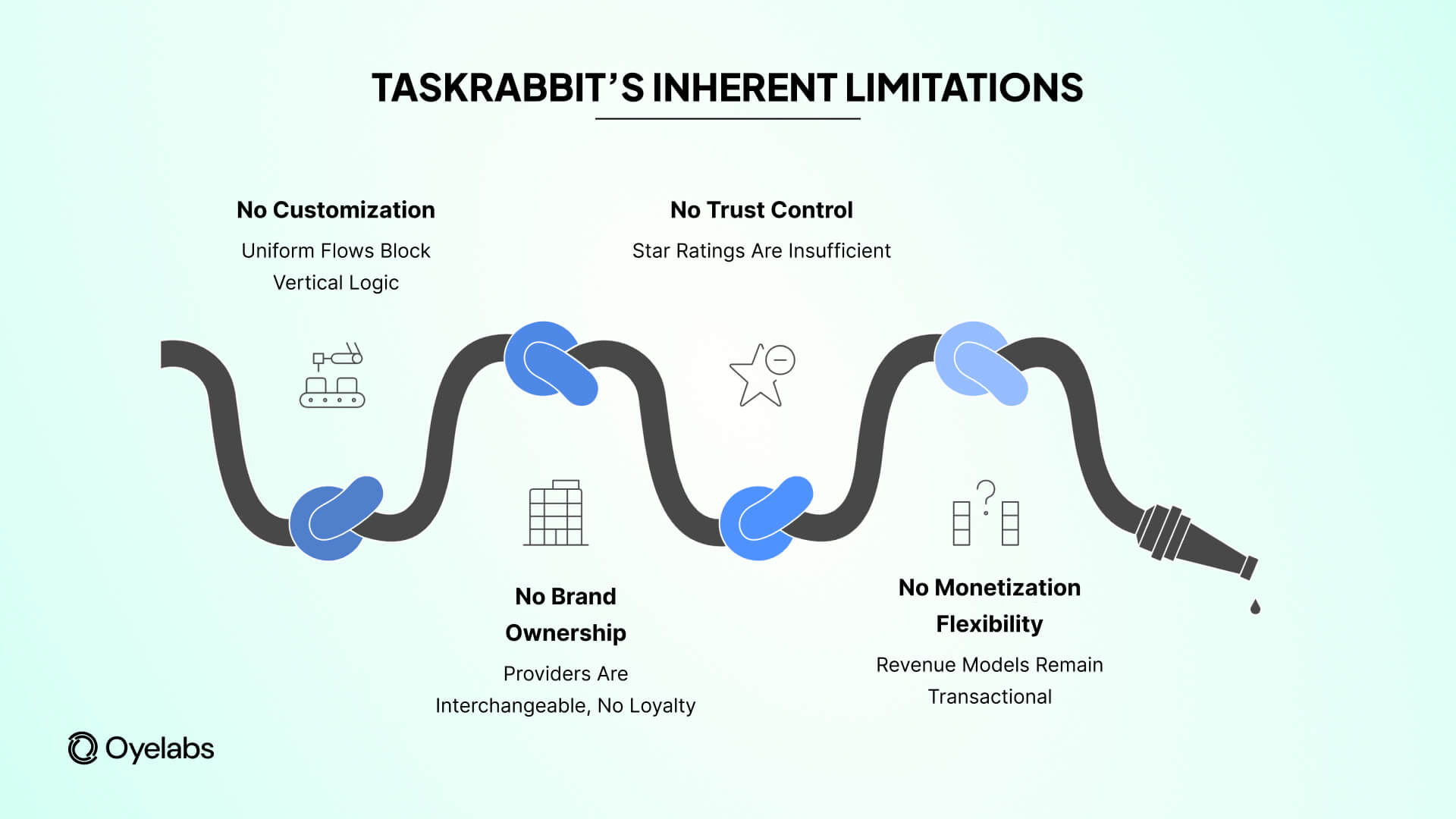
Some limitations are not bugs. They are deliberate choices made to support scale. For founders, understanding these boundaries is critical before deciding whether to build on – or build beyond – existing platforms.
No Industry-Specific Customization
Task-based marketplaces rely on uniform flows. This means:
- Same booking logic for vastly different services
- No compliance layers for regulated industries
- No skill validation tied to service complexity
For founders targeting trades, healthcare-adjacent services, or enterprise use cases, this lack of vertical logic becomes a blocker.
No Local Brand Ownership
Marketplace platforms are designed to be the brand. Providers are interchangeable.
This prevents founders from:
- Building city-first or region-first identities
- Creating community-driven loyalty
- Positioning as a premium or specialized service
Local differentiation is sacrificed in favor of platform uniformity.
No Control Over Trust Mechanics
Trust is reduced to star ratings. There is no way to:
- Customize verification per service category
- Introduce tiered provider levels
- Apply local quality benchmarks
For high-trust services, this is insufficient.
No Flexibility in Monetization
Founders cannot experiment with:
- Subscriptions or retainers
- Corporate accounts
- Hybrid pricing models
- White-label partnerships
Revenue models remain transactional, even when customers want ongoing relationships.
The Shift From General Marketplaces to Focused Service Platforms
Over the last few years, a quiet shift has been taking place in the on-demand economy. Founders are no longer trying to build the “next big everything platform.” Instead, they are winning by building focused service marketplaces that solve one problem extremely well.
This shift is not theoretical. It is driven by operator reality.
General marketplaces like TaskRabbit are designed for breadth. They prioritize liquidity across many service categories at once. Focused marketplaces prioritize depth – better workflows, stronger trust, and higher retention within a specific niche.
That difference changes outcomes.
Why focus beats scale for new marketplaces
- Customers trust specialists more than generalists: A platform built specifically for home maintenance, senior care, or trades signals expertise from the first interaction.
- Operations become simpler, not harder: When all services follow similar logic, scheduling, pricing, and quality control improve.
- Supply quality increases: Providers feel aligned with the platform’s purpose, not treated as interchangeable labor.
- Marketing becomes more efficient: Messaging is clearer. Acquisition costs drop. Referrals improve.
Founders who succeed today are not competing head-on with large platforms. They are building alongside them – serving audiences that broad marketplaces cannot optimize for without breaking their own model.
This is where real defensibility begins.
What New Marketplaces Can Solve That TaskRabbit Won’t
The opportunity for founders lies in solving problems that large, horizontal platforms cannot address without redesigning their core architecture. New marketplaces start with that advantage.
Full Control Over Business Logic
When you own the platform, workflows adapt to your business – not the other way around.
Founders can define:
- Service-specific booking flows
- Custom cancellation and refund rules
- Time-based or skill-based pricing
- Local availability and fulfillment logic
This control allows faster iteration and better alignment between product and market.
Ownership of Users and Data
One of the most underestimated advantages of launching an independent marketplace is data ownership.
With a first-party platform, founders gain:
- Full visibility into the customer journey
- Access to repeat usage patterns
- The ability to retarget and re-engage users
- Long-term customer lifetime value
This turns a marketplace from a transaction engine into a compounding asset.
Trust Designed for the Industry
Trust is not universal. It is contextual.
New marketplaces can implement:
- Category-specific verification
- Skill or license validation
- Tiered provider levels
- Location-aware trust signals
This creates confidence for customers and accountability for providers – something generalized platforms struggle to enforce.
Smarter and More Flexible Monetization
Independent marketplaces are not locked into a single revenue model.
Founders can combine:
- Commissions with subscriptions
- Business and consumer accounts
- Retainers for repeat services
- Enterprise or franchise-style partnerships
This flexibility directly impacts margins and valuation, especially as the platform scales.
Must-Have Features for a Modern TaskRabbit-Like Marketplace
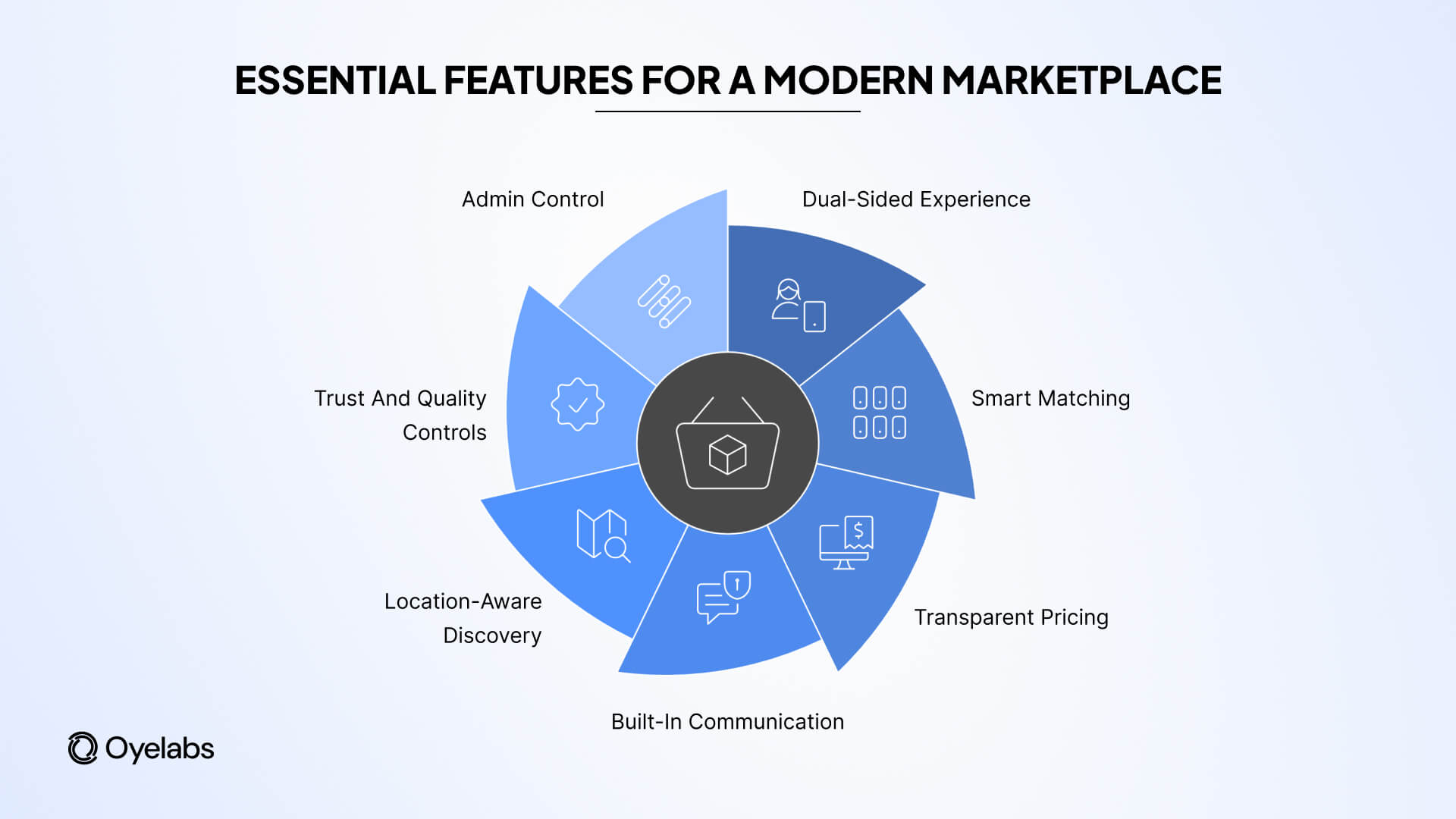
Building a service marketplace today is not about copying features. It is about designing systems that support trust, efficiency, and scale from day one. Many founders underestimate how much product decisions influence growth velocity and operational stability.
A modern marketplace inspired by TaskRabbit must go beyond basic task posting and acceptance.
Core features that matter for growth
- Dual-sided experience (Customers and Providers): Separate journeys ensure clarity, accountability, and faster adoption on both sides of the marketplace.
- Smart matching and availability logic: Services should be matched based on location, skill, time, and workload – not just proximity.
- Transparent and configurable pricing engine: Founders need the ability to test fixed pricing, hourly rates, minimum charges, or dynamic pricing by category.
- Built-in communication layer: Secure in-app chat, notifications, and status updates reduce friction and improve completion rates.
- Location-aware discovery: City-level or zone-based logic improves relevance and prevents supply dilution.
- Trust and quality controls: Verification, ratings with context, and performance tracking drive consistency across providers.
- Admin control over supply and demand: The ability to pause categories, manage provider density, and adjust onboarding standards is critical as the platform scales.
These features are not “nice to have.” They are the foundation for predictable operations and long-term retention.
If you’re exploring what modern TaskRabbit-style platforms must include, these new TaskRabbit app features explain the shift clearly.
Why Founders Are Choosing to Build Instead of Competing on TaskRabbit
More founders are stepping back and asking a strategic question: Why compete inside a system we don’t control when we can build one that reflects our vision?
The answer often comes down to ownership versus dependency.
When founders rely on large marketplaces, growth is constrained by external decisions – commission changes, algorithm updates, or category prioritization. Building an independent platform shifts that dynamic entirely.
What changes when founders build their own marketplace
- The platform becomes the asset: Instead of earning per task, founders build recurring value tied to technology and data.
- Brand equity compounds over time: Customers associate trust and reliability with the platform, not just individual providers.
- Valuation logic improves: Investors value owned marketplaces differently than service businesses dependent on third parties.
- Strategic optionality increases: Founders can expand vertically, partner regionally, or introduce new revenue models without platform constraints.
This is why many successful operators start on large marketplaces – but move off them once they validate demand. TaskRabbit can help prove a market. It cannot help build a defensible company.
Why Building a Marketplace Is Now Easier Than Most Founders Think
Many founders still assume that building a service marketplace requires years of development, large engineering teams, and significant upfront capital. That assumption is outdated.
Modern marketplace platforms are no longer built from scratch in isolation. Founders today start with proven architectural foundations and customize them to fit their market, niche, and operational model. This approach reduces technical risk and dramatically shortens time to launch.
What has changed is not just technology, but process.
- Validated frameworks reduce experimentation risk: Core flows like onboarding, payments, scheduling, and notifications are already battle-tested.
- Customization replaces reinvention: Founders focus on differentiation – pricing logic, trust layers, and service workflows – rather than rebuilding fundamentals.
- Phased launches lower exposure: City-by-city or category-first rollouts allow real-world validation before scaling.
- Speed enables learning: Faster launches mean earlier feedback, better iteration, and stronger product-market alignment.
For founders who understand their niche and audience, launching a marketplace today is less about complexity and more about clarity. The barrier is no longer technology – it is decision-making.
How Oyelabs Helps Founders Launch TaskRabbit-Like Marketplaces
Launching a service marketplace is not just a technical project. It is a business decision that sits at the intersection of product design, operations, and go-to-market strategy. This is where experienced execution matters.
Oyelabs works with founders who already understand their niche and want to move quickly without compromising on long-term structure. Instead of forcing generic templates, the approach starts with a proven marketplace foundation and adapts it to the founder’s business model.
The focus is on:
- Designing workflows that match the service category
- Enabling flexible pricing and monetization logic
- Supporting city-first or niche-first rollouts
- Ensuring scalability without early overengineering
For founders, this means launching faster while retaining control over the levers that actually drive growth – brand, data, pricing, and customer experience.
Who Should Build Their Own Marketplace (And Who Shouldn’t)
Not every idea needs a platform. Honest alignment at the start saves time and capital later.
Building your own marketplace makes sense if:
- You understand a specific service niche deeply
- You want to own customer relationships, not rent them
- You plan to build a brand, not just generate leads
- You are thinking beyond short-term transactions
It may not be the right move if:
- The idea lacks clear differentiation
- There is no plan for supply quality or trust
- Execution bandwidth is limited
- The goal is experimentation without commitment
Founders who succeed in marketplaces are not chasing trends. They are solving defined problems for defined audiences.
Build the Platform, Don’t Rent the Opportunity
The on-demand economy is still growing, but the rules have changed. The next generation of winners will not be the biggest platforms – they will be the most focused ones.
TaskRabbit will continue to serve users who want convenience. But founders who want control, differentiation, and long-term value must think differently. Owning the marketplace means owning the experience, the data, and the future upside.
The real question is no longer whether a service marketplace can work.
It is whether you want to build equity – or keep paying for access.
FAQs
Q: Why should founders build a TaskRabbit alternative?
A: Building offers control over pricing, users, data, branding, and long-term business value.
Q: Is TaskRabbit good for launching a service business?
A: TaskRabbit helps validate demand but limits ownership, customization, and scalable growth.
Q: What makes new service marketplaces better than TaskRabbit?
A: They focus on niches, flexible pricing, better trust, and full customer ownership.
Q: Can startups realistically build a TaskRabbit-like app today?
A: Yes, modern frameworks allow faster, lower-risk marketplace launches than before.