
DoorDash and ChatGPT Connect AI Discovery to Food Delivery
DoorDash and ChatGPT Connect AI Discovery to Food Delivery
 Anuraag Jain
Last Updated on January 2, 2026
Key Takeaways
What You’ll Learn
- DoorDash connects AI and food delivery to change how customers discover meals.
- AI discovery replaces app browsing with conversational search experiences.
- Food delivery platforms must be built for AI visibility to remain discoverable.
- Startups can compete effectively without relying on heavy advertising spend.
- Speed and relevance now matter more than brand size in food delivery.
Stats That Matter
- The global food delivery market is projected to exceed $500 billion by 2030.
- AI-led commerce significantly reduces customer decision-making time.
- DoorDash controls more than 65% of the U.S. food delivery market.
- Grocery ordering is increasingly merging with food delivery platforms.
Real Insights
- AI discovery moves users directly from intent to checkout faster.
- Clean and structured data improves AI recommendations and platform visibility.
- Platforms built for AI adapt faster to market and technology shifts.
- Local delivery apps gain visibility through relevance rather than brand scale.
- AI transforms food delivery apps into long-term commerce infrastructure.
DoorDash and ChatGPT Connect AI Discovery to Food Delivery
Food delivery used to be simple. You opened an app, scrolled a menu, and hoped something clicked
That era is ending – fast.
When DoorDash connected its commerce engine to OpenAI’s ChatGPT, it signaled something much bigger than a new feature. It marked the shift from app-based ordering to AI-led discovery. Today, users don’t browse menus – they ask questions. And AI decides what shows up.
For founders and CEOs, this changes the entire playbook. Discovery now happens through natural language queries, intent mapping, and conversational search layers – not paid installs or crowded marketplaces. Platforms that aren’t structured for AI visibility risk becoming invisible.
The good news? This shift lowers the barrier for new entrants. With the right architecture, APIs, and data flows, early-stage startups can launch food delivery platforms that compete on intelligence, not ad budgets. This is where opportunity quietly opens – and why timing matters more than ever.
What DoorDash Actually Launched Inside ChatGPT
When DoorDash enabled ordering through ChatGPT, it didn’t just add another channel. It redefined how customers enter the food and grocery buying journey.
Instead of opening an app and browsing categories, users can now express intent in plain language. A single prompt such as “Order groceries for a healthy dinner under $30” triggers a sequence of actions behind the scenes:
- Intent interpretation using natural language processing
- Context-aware product matching across merchants
- Location-based availability checks
- Cart creation and checkout redirection
The important shift is this: search is no longer keyword-based. It is conversational, contextual, and outcome-driven.
From a technology standpoint, DoorDash is positioning its catalog, pricing, and merchant data as AI-readable infrastructure. This allows ChatGPT to act as the discovery layer, while DoorDash remains the transaction and fulfillment engine.
For founders, the lesson is clear. The front door to commerce is moving away from apps and into AI interfaces.
AI Discovery Is Replacing App Discovery (This Is Bigger Than DoorDash)
For more than a decade, food delivery growth depended on three levers: app installs, paid acquisition, and marketplace ranking. AI breaks all three.
AI discovery changes how demand is created and allocated. Users no longer search for brands. They describe needs. AI systems then decide which platforms, merchants, or services best satisfy that request.
This creates a structural shift:
- Discovery happens before any app is opened
- Brand awareness matters less than data accessibility
- Context relevance outweighs marketplace position
In practical terms, AI systems favor platforms that are:
- Well-structured at the data layer
- API-accessible and modular
- Capable of exposing real-time menus, pricing, and availability
This is why DoorDash moved early. If AI assistants become the default starting point for commerce, platforms that are not AI-discoverable risk being bypassed entirely.
Industry estimates indicate that global revenue from online food delivery is expected to surpass US$1.40 trillion in 2026, growing steadily over the next five years, a trend driven by convenience and technological integration.
For startups, this is not a threat – it is an equalizer. AI discovery reduces dependence on massive ad budgets and allows smaller, focused platforms to compete based on relevance and execution.
The New Food Delivery Funnel: From Conversation to Checkout
AI-driven food delivery follows a fundamentally different funnel than traditional apps.
| Traditional Funnel | AI-Driven Funnel |
| App install | Conversational entry |
| Category browsing | Intent recognition |
| Menu scrolling | Contextual recommendations |
| Cart creation | Automated shortlisting |
| Checkout | Seamless handoff |
In this model, ChatGPT becomes the top-of-funnel layer, while the delivery platform handles pricing, logistics, payments, and fulfillment.
What changes for founders is not just UX, but economics:
- Fewer steps mean higher conversion rates
- Reduced friction lowers drop-offs
- Intent-qualified users convert faster
Most importantly, AI-led funnels favor platforms built with scalability and interoperability in mind. Systems designed only for mobile app interaction struggle to plug into AI ecosystems.
This is why modern food delivery platforms must be built as commerce infrastructure, not just consumer apps. Those who adapt early gain distribution advantages that compound over time.
What DoorDash’s Move Teaches Founders (Beyond the Headlines)
Most headlines frame this as “DoorDash adds ChatGPT ordering.” That framing misses the real strategy.
DoorDash is not experimenting with AI for novelty. It is defending its position in a future where AI assistants decide where demand flows. If discovery shifts fully into conversational interfaces, platforms that fail to integrate risk losing visibility, not users.
The deeper lesson for founders is structural:
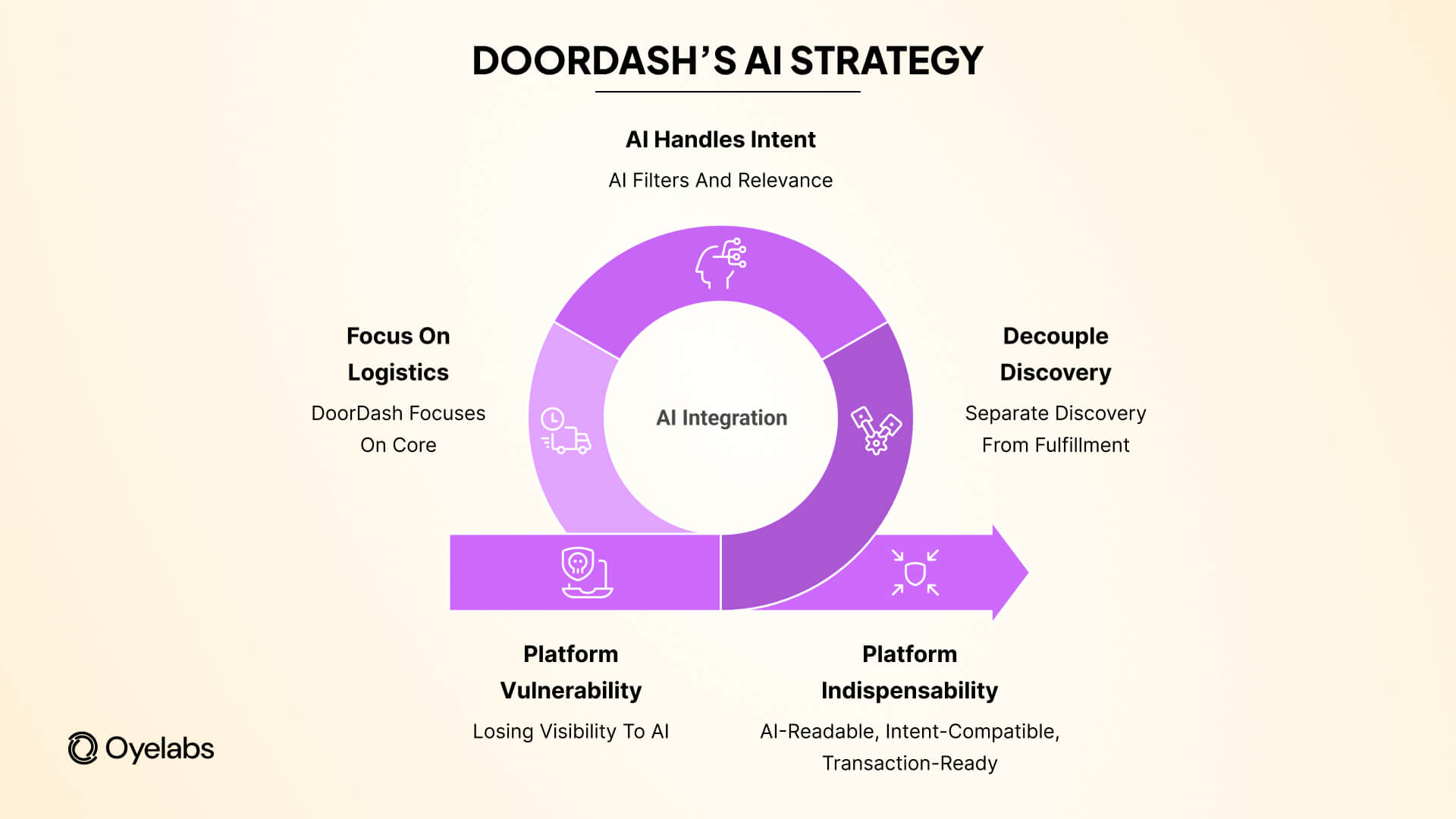
- DoorDash is separating discovery from fulfillment
- AI handles intent, filtering, and relevance
- DoorDash focuses on logistics, payments, and merchant scale
This decoupling is intentional. It ensures DoorDash remains indispensable even if users never open its app directly.
For startups, the insight is powerful. You do not need to “beat” incumbents on brand. You need to ensure your platform is AI-readable, intent-compatible, and transaction-ready. That is a far more achievable goal – especially for focused, regional, or niche delivery models.
Why This Creates a Rare Opportunity for Early-Stage Startups
AI discovery resets competitive advantage.
In traditional marketplaces, scale wins. In AI-led commerce, relevance wins. AI systems surface the option that best fits the user’s intent – not the one with the largest ad budget.
This opens the door for early-stage founders in several ways:
- Local and regional platforms can surface ahead of national players
- Vertical-focused delivery (health food, ethnic cuisine, groceries) becomes more visible
- New brands can acquire users without heavy upfront marketing spend
For founders who move early, AI acts as a demand amplifier. Instead of spending months driving installs, platforms can plug directly into where decisions are being made.
Timing matters here. Early AI integrations benefit from lower competition, higher visibility, and faster learning cycles. Startups that wait will face the same crowding that mobile app stores experienced a decade ago.
This is why now is not just a good time to launch – it is a strategic inflection point.
What a Modern “DoorDash-Like” Platform Must Have in 2026
Launching a food delivery platform today requires a different technical mindset than even three years ago. The goal is not just user experience – it is AI compatibility.
A 2025-ready platform must be built with:
- API-first architecture to expose menus, pricing, and availability
- Structured data models optimized for AI consumption
- Modular systems that separate discovery, ordering, and fulfillment
- Multi-merchant and multi-category support (food, grocery, essentials)
- Scalable payment, logistics, and commission engines
Equally important is ownership. Founders must control their data, workflows, and roadmap. Platforms locked into rigid SaaS tools or closed ecosystems struggle to adapt as AI interfaces evolve.
The winners will be those who treat their platform as commerce infrastructure, not just an app. This mindset allows startups to integrate with AI assistants, voice interfaces, and future discovery layers without rebuilding from scratch.
Why Building From Scratch Is the Wrong Move for Most Founders
Many founders assume that owning every line of code means long-term control. In reality, building a DoorDash-like platform from scratch often creates the opposite outcome: delays, technical debt, and missed market timing.
Food delivery platforms are operationally complex. They require real-time order handling, merchant management, logistics coordination, payment settlements, and now AI-ready data layers. Building all of this sequentially can take 12 to 18 months, often before the first meaningful customer insight is even validated.
The risks compound quickly:
- Market conditions shift while the product is still under development
- Early engineering decisions become costly constraints later
- AI and discovery standards evolve faster than custom systems can adapt
For most early-stage founders and CEOs, speed and adaptability matter more than architectural purity. Launching late is often more damaging than launching imperfectly. The smartest teams optimize for time-to-market with future flexibility, not theoretical completeness on day one.
How Oyelabs Helps Founders Launch Platforms Built for AI Discovery
This is where Oyelabs plays a critical role.
Oyelabs specializes in helping founders launch production-ready food delivery platforms modeled on proven systems like DoorDash, while ensuring the technology is structured for modern discovery channels, including AI-driven interfaces.
Instead of starting from zero, founders begin with:
- A mature, scalable delivery architecture
- Multi-merchant and multi-category support
- Modular APIs that allow AI and conversational layers to integrate cleanly
- Ownership of the platform, data, and roadmap
The focus is not just on launching fast, but on launching correctly – with systems that can evolve as AI discovery becomes the primary entry point for commerce. This approach allows founders to validate markets, onboard merchants, and iterate on demand without burning capital on foundational engineering.
For CEOs, the value is clarity. Predictable timelines. Controlled costs. And a platform designed to grow with the market, not fight it.
A Founder Story: From Market Entry to Brand Recognition
One Oyelabs-backed founder entered a competitive regional food delivery market dominated by national players. Instead of competing on discounts or ad spend, the platform launched with a focused discovery-first approach, optimized merchant data, and a clean ordering flow. Within months, engagement rates outperformed expectations, impressions grew organically, and repeat usage increased as users found the experience simpler and more relevant. As visibility improved and merchant adoption followed, the platform transitioned from being “another delivery app” to a recognized local brand – proving that execution, timing, and the right technical foundation can redefine market position without massive budgets.
What CEOs Should Be Asking Before Launching a Food Delivery Platform
Before investing capital, time, or team bandwidth, founders need clarity on a few non-negotiable questions. These are not technical checkboxes – they are strategic filters.
A CEO preparing to launch a food delivery platform in an AI-first environment should ask:
- How will customers discover us when search shifts to conversational AI?
- Is our platform structured for APIs, structured data, and external discovery layers?
- Can we expand beyond food into grocery or essentials without rebuilding?
- Do we own our data, workflows, and roadmap – or are we locked into tools?
- How fast can we launch, test, and adapt if the market shifts?
The founders who ask these questions early avoid expensive pivots later. More importantly, they build platforms that are resilient to how users actually behave – not how apps behaved five years ago.
The Future: From Food Delivery Apps to AI Commerce Platforms
Food delivery is no longer just about logistics. It is becoming part of a larger AI commerce ecosystem where decisions happen upstream, inside conversational interfaces.
In this future:
- Apps become execution layers, not discovery destinations
- AI assistants handle intent, filtering, and recommendations
- Platforms compete on data quality, reliability, and fulfillment strength
This means food delivery platforms must evolve into commerce infrastructure – systems capable of plugging into AI assistants, voice interfaces, and emerging discovery surfaces without friction.
Founders who design for this future will not need to chase every new interface. Their platform will already be compatible. Those who don’t will constantly retrofit systems to keep up.
The shift is already underway. DoorDash’s move is proof, not prediction.
Final Takeaway
AI has changed how customers choose. DoorDash has validated where the market is going. And early-stage founders now have a rare advantage: the ability to launch focused, AI-ready platforms without legacy constraints.
This moment rewards speed, clarity, and smart execution – not bloated roadmaps or overengineered builds.
With the right foundation, founders can enter the market faster, adapt to AI-led discovery, and grow into recognizable brands without relying on massive ad budgets. This is exactly where Oyelabs fits in – enabling founders to launch DoorDash-like food delivery platforms that are built for how commerce works today, and where it’s heading next.
The opportunity is open. The window is active.
The only real risk now is waiting.
FAQs
1. Question: How does DoorDash use AI for food discovery?
Answer: DoorDash uses AI to understand intent and recommend food through natural conversations.
2. Question: What is AI discovery in food delivery?
Answer: AI discovery helps users find food using questions instead of browsing menus.
3. Question: Can startups compete with DoorDash using AI?
Answer: Yes, AI discovery reduces marketing dependence and favors relevance over brand size.
4. Question: How can founders launch an AI-ready food delivery app?
Answer: Founders can launch faster using white-label platforms built for AI discovery.