
Booming On-Demand Home Services Marketplace Apps in the USA
Booming On-Demand Home Services Marketplace Apps in the USA
 Sachin Sharma
Last Updated on November 18, 2025
Key Takeaways
What You’ll Learn
- The U.S. home-services industry is booming with huge demand across major categories.
- Home services apps like UrbanClap, TaskRabbit, Thumbtack, Angi, and Handy lead the current U.S. market.
- Local home services startups perform well by serving one city well before trying to scale nationally.
- International brands like Urban Company and Helpling are entering the U.S. market.
- On-Demand marketplace success depends on trust, provider quality, and simple mobile booking experiences.
- Founders can launch faster using ready-to-deploy home-services platforms like OyeLabs.
Stats That Matter
- The U.S. home-services market may reach $893B by 2032.
- Online home-services platforms could hit $14.7B globally by 2030.
- 98% of consumers search online before choosing local service providers.
- 86% of users read reviews before booking any home-service professional.
Real Insights
- Easy booking increases user trust and brings more repeat customers.
- High-quality providers create better ratings and faster marketplace growth.
- Local focus helps new apps compete against bigger nationwide platforms.
- Subscription bundles create steady revenue for home-services marketplaces.
- AI tools improve scheduling, matching, pricing, and service quality.
- White-label tech reduces build time and lowers launch risk for founders.
Booming On-Demand Home Services Marketplace Apps in the USA
If you’ve ever tried booking a plumber in the middle of a hectic workweek, you already know the truth: nobody has time to chase contractors anymore. Gen Z calls it “tap-and-done,” and the rest of America is catching up fast. That simple shift in behavior is fueling one of the fastest-growing categories in the U.S. tech landscape – on-demand home services marketplace apps.
With millions of monthly searches for cleaning, repairs, lawn care, and same-day handyman help, this market is no longer a side trend. It’s a high-volume, high-retention ecosystem powered by real-time scheduling, automated fulfillment, geolocation mapping, and data-driven provider matching. Major platforms like UrbanClap and Thumbtack validate the demand. At the same time, new founders are entering specific niches and winning locally with speed and specialization.
For CEOs and early-stage entrepreneurs, this is the moment. The infrastructure is proven. The user base is ready. And the market gap is wide open for those who build smart and launch fast.
What Is Driving the Boom of On-Demand Home Services Marketplace Apps in the USA?
The U.S. home services market has shifted dramatically in the last five years. Consumers expect instant booking, transparent pricing, and verified service providers – without making a single phone call. This demand has created a surge in on-demand home services marketplace apps, where homeowners can schedule cleaning, repairs, installations, and maintenance in real time. According to global research, the online on-demand home-services market alone was about USD 3.7 billion in 2021 and is forecast to hit nearly USD 14.7 billion by 2030 – with North America already leading.
A few forces are driving the acceleration:
- Changing consumer behavior: Americans increasingly prefer mobile-first convenience. Whether it’s booking a house cleaner or a handyman, digital-first decision-making has become the norm.
- The rise of the gig workforce: Millions of skilled workers are opting for independent contractor roles, creating a large supply pool for marketplace platforms.
- Trust through technology: Verification tools, background checks, ratings, geolocation, and automated scheduling reduce uncertainty and increase user confidence.
- Operational efficiency: Marketplace apps streamline the entire service flow – matching, booking, tracking, payment, and feedback – reducing friction for both sides of the marketplace.
Together, these shifts create a rare scenario where market demand, technology maturity, and user expectations align, making this a prime expansion space for new founders.
How Big Is the On-Demand Home Services Market in the USA Today?
The On-Demand Home Services sector in the U.S. has evolved from a fragmented, city-specific service landscape into a national, digitally enabled industry with multi-billion-dollar potential. The numbers reflect both scale and velocity.
Market Snapshot: USA On-Demand Home Services 2024 – 2028
| Indicator | Current Status | What It Means for Founders |
| Market Size | Multi-billion dollar category with steady YoY growth | A mature but expanding market with room for new entrants |
| Annual CAGR | Consistently strong, projected growth across sub-categories | Long-term viability for marketplace business models |
| Consumer Penetration | High usage in metros; increasing adoption in tier-2 and tier-3 cities | Opportunity to dominate underserved regions |
| Service Categories in Demand | Cleaning, repairs, home maintenance, electrical, plumbing, pet care, lawn care | Scope for vertical-specific and multi-category apps |
Key takeaways for founders:
- The U.S. remains one of the most underserved markets in suburbs and mid-sized cities.
- Consumers now prefer digital marketplaces over traditional referrals.
- The growing habit of booking home services online has created a sustained, repeat-demand cycle, improving unit economics for marketplace operators.
For CEOs evaluating new opportunities, this is one of the few markets where frequency, retention, and lifetime value remain consistently high.
Which On-Demand Home Services Apps Are Leading the U.S. Market?
The U.S. home-services ecosystem is competitive but far from saturated. Three categories of players shape the landscape today: established market leaders, fast-growing local startups, and international brands pushing into U.S. territories. Understanding how each group operates helps founders identify gaps and build stronger, more defensible platforms.
Established Market Leaders in the USA
These platforms have national visibility, strong operational systems, and mature user funnels. They validate the demand and set industry benchmarks.
TaskRabbit (USA)
A pioneer in the sector, TaskRabbit defined real-time booking and service-provider vetting. Its strong category focus – handyman, furniture assembly, cleaning – allowed it to scale across major U.S. metros.
Thumbtack (USA)
Thumbtack dominates as a lead-generation marketplace across 500+ categories. It serves millions of homeowners and remains a top choice for skilled trades and niche services with wide geographical coverage.
Angi (USA)
Formerly Angie’s List, Angi combines long-standing brand equity with a robust service-provider network. It supports everything from home renovation to minor repairs, supported by verified reviews and extended service guarantees.
Handy (USA)
Handy excels in standardized service delivery. The platform’s focus on predictable pricing and consistent service quality has helped it become a trusted brand in cleaning, handyman, and home maintenance categories.
These players operate at scale, but their size creates space for nimble, specialized startups to enter underserved regional markets.
Fast-Growing Local Startups in U.S. Cities
Local founders are building highly targeted, ZIP-code-driven platforms that outperform national players in specific cities. These startups focus on tighter service quality loops and community-centric delivery.
Examples include:
Pro Housekeepers (Miami & Tampa)
A rapidly growing local cleaning marketplace known for premium service quality and fast turnarounds.
Neighborly Home Services (Dallas & Houston)
A regional network-based marketplace gaining traction with bundled home maintenance packages and niche services like HVAC and lawn care.
Done (Los Angeles)
Positioned as a “tech-first handyman marketplace,” Done focuses on verified professionals, instant quotes, and transparent pricing for home repairs.
LawnLove (Multiple U.S. Regions)
Initially hyper-local, LawnLove scaled its lawn-care marketplace city by city using localized onboarding and strong provider incentives.
These startups win by focusing on:
- Hyper-local fulfillment
- High provider payouts
- Tighter service SLAs
- Better category-level specialization
Their growth signals a clear opportunity for founders to build ZIP-code-driven or niche-specific platforms rather than broad, national apps from day one.
Global Brands Entering or Expanding in the U.S. Market
The U.S. market is now attracting established home-services companies from overseas. These brands enter with proven playbooks, experienced teams, and efficient unit economics.
Urban Company (UrbanClap) – India
A major global home-services player with a full-stack model, Urban Company has shown interest in North American expansion. The brand’s marketplace mechanics – trained professionals, standardized pricing, quality assurance – make it well-positioned for U.S. metros.
Helpling – Germany
A leading European cleaning marketplace that expanded into select U.S. pilot markets to test cross-border demand and leverage its operational expertise.
Oneflare – Australia
Known for lead-based matching across trades and home services, Oneflare has explored partnership-based entry strategies in the U.S.
SweepSouth – South Africa
A rising African marketplace for cleaning and home maintenance services, testing multiple Western markets including the U.S.
These brands see the U.S. as a high-LTV, high-frequency opportunity – particularly in metropolitan corridors with strong gig-work supply and affluent homeowners.
Key Lessons From These Three Groups
Across leaders, local startups, and international entrants, several patterns emerge:
- Trust drives adoption: Verified providers, transparent pricing, and strong support systems increase user retention.
- Experience defines growth: Platforms with simpler UX, faster booking, and reliable fulfillment scale faster.
- Specialization wins locally: Hyper-local players beat national platforms in specific ZIP codes through service depth and responsiveness.
- Operational discipline matters: The most successful players invest heavily in provider onboarding, SLAs, and quality control.
- Expansion requires timing: Brands that dominate a single category or region before scaling show stronger profitability and sustainability.
If you’re exploring what it takes to build a home-services app from scratch, check our guide that walks through the complete UrbanClap-style approach.
What Trends Are Shaping the Future of Home Services Marketplace Apps?
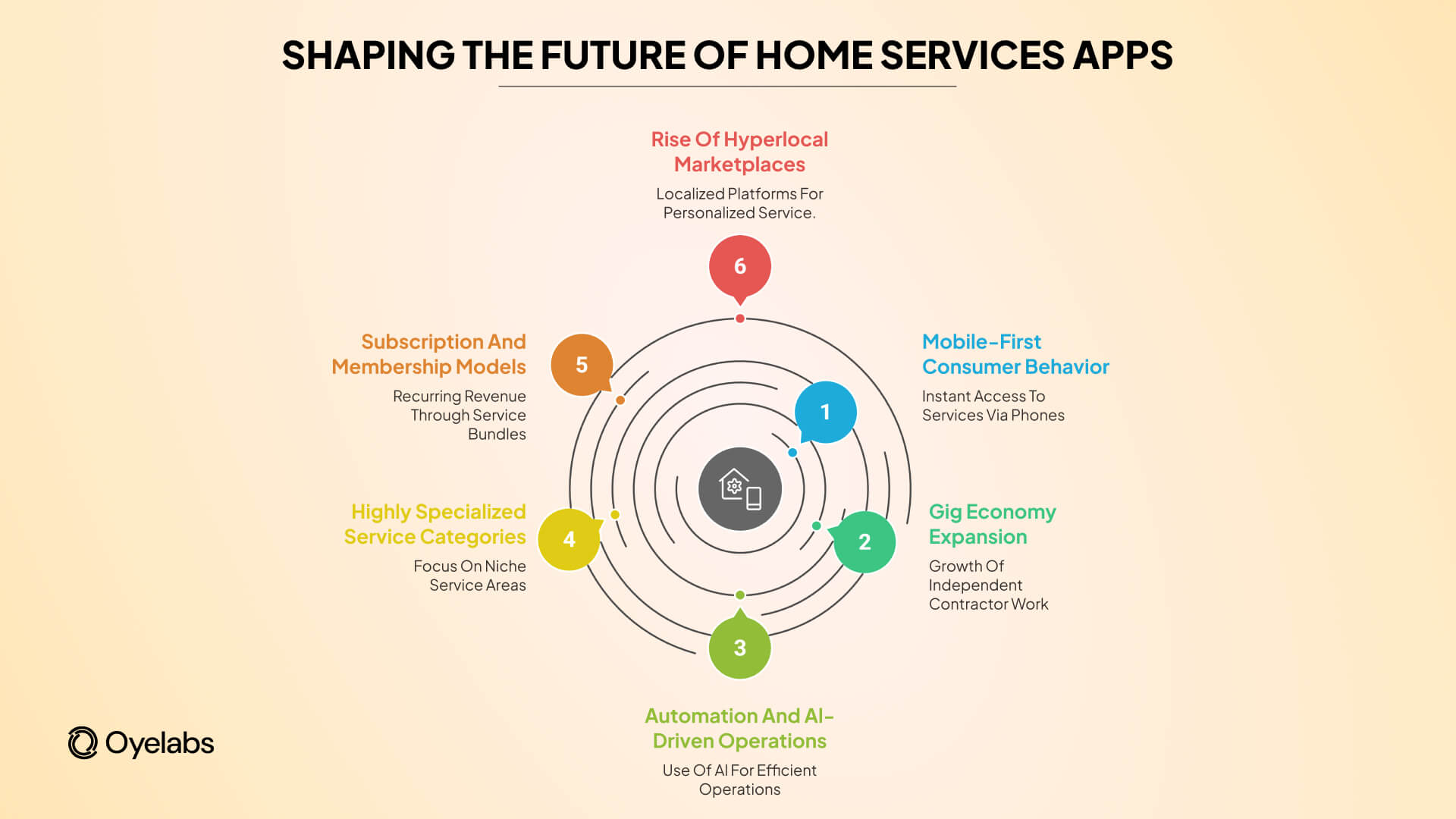
The U.S. home-services market is evolving faster than nearly any other consumer-service category. Several structural and behavioral trends are reshaping how homeowners book local services – and how new marketplace founders build their platforms.
Mobile-First Consumer Behavior
Homeowners now expect instant access to service providers through their phones. Mobile-native design, one-tap scheduling, and real-time availability have become baseline standards.
Gig Economy Expansion
A growing number of skilled professionals prefer independent contractor work. This strengthens supply, reduces marketplace onboarding friction, and supports rapid city-by-city scaling.
Automation and AI-Driven Operations
Modern platforms increasingly depend on:
- Automated job assignment
- Smart routing
- Provider performance scoring
- Real-time scheduling algorithms
These tools reduce operational overhead and improve fulfillment reliability.
Highly Specialized Service Categories
Instead of broad marketplaces, new platforms are emerging in verticals like:
- Eco-friendly cleaning
- Smart home installations
- Pet services
- Home office setup
- Lawn care and outdoor maintenance
Niche specialization improves retention and boosts lifetime value.
Subscription and Membership Models
Many platforms now offer monthly or quarterly service bundles, resulting in:
- Predictable recurring revenue
- Higher engagement
- Lower churn
Rise of Hyperlocal Marketplaces
Zip-code-focused and neighborhood-first models outperform nationwide platforms due to personalized experiences and faster service response times.
Together, these trends highlight a market ready for well-designed, locally optimized home-services apps with strong operational frameworks.
How Can Entrepreneurs Build a Successful On-Demand Home Services Marketplace in the USA?
Launching a home-services marketplace requires clarity across business modeling, product architecture, and early-market execution. Below is a streamlined framework used by operators who scale efficiently.
What Business Model Should You Choose?
Founders typically choose among four proven marketplace structures:
Commission-Based Marketplace
The platform receives a percentage of every completed booking. Simple, scalable, and aligned with industry norms.
Subscription or Membership Access
Users or providers pay recurring fees for premium features, faster matching, or priority listings.
Lead-Generation Model
Service providers pay for qualified leads. This model works well in fragmented categories like plumbing or home improvement.
Hybrid Approach
Combines commission + lead generation + subscription for diversified revenue.
Founders must also define their geographic strategy:
- Single-City Launch: Ideal for controlling quality and concentrating supply-demand.
- Multi-City Rollout: Requires stronger ops but accelerates brand visibility.
What Core Features Should Your On-Demand Home Services App Include?
User App Essentials
- Category-based service browsing
- Instant booking & scheduling
- Real-time provider tracking
- Secure payments
- Ratings & reviews
- Repeat booking shortcuts
Provider App Essentials
- Profile creation and verification
- Real-time job notifications
- Earnings dashboard
- Availability controls
- Document upload for compliance
Admin Panel Must-Haves
- Provider vetting & approvals
- Service category setup
- Real-time booking management
- Commission management
- Dispute resolution tools
- Analytics & demand forecasting
Marketplace UX Requirements
- Frictionless onboarding
- Transparent pricing
- Fast search-to-book flow
- Mobile-first interface
What Tech Architecture and Integrations Do You Need?
A scalable marketplace typically includes:
- Native mobile apps (iOS and Android)
- Web portal for booking and support
- Secure backend architecture
- Payment gateway with multi-level payouts
- Geolocation services
- Background verification integrations
- Notification engine (SMS, push, email)
Choosing the right tech stack determines future expansion speed and operational cost.
What Marketing Strategy Works for Home Services Marketplaces?
A practical approach includes:
Local Market Penetration
Focus on one city or region, build strong supply density, and scale outward.
SEO and Local Search Optimization
High-intent keywords like “cleaning service near me” or “local handyman” drive organic bookings.
Provider Acquisition
Local partnerships, skill institutes, and community onboarding events build supply quickly.
Referral and Review Loops
Satisfied users and providers increase retention and reduce marketing overhead.
What KPIs Should Founders Track?
Key metrics include:
- Active users (demand and supply)
- Bookings per provider per month
- Average order value (AOV)
- Take-rate margin
- Repeat bookings and retention
- Cancellation rate
- Fulfillment accuracy
These indicators help founders identify operational gaps early.
What Legal and Compliance Issues Should You Plan For?
Core considerations for U.S. markets:
- Worker classification (1099 independent contractor guidelines)
- Liability insurance requirements
- State-by-state compliance for trades (licenses, permits)
- Payment compliance and tax reporting
- Data privacy protection and secure data handling protocols
Marketplaces that anticipate compliance early avoid costly restructuring later.
How Can OyeLabs Help You Launch an On-Demand Home Services App Faster?
Early-stage founders often struggle with three constraints: time, capital, and technical bandwidth. OyeLabs solves all three with a customizable, white-label home-services marketplace solution engineered for fast deployment.
Accelerated Time-to-Market
Instead of building from scratch – an approach that typically takes 8 – 12 months – OyeLabs enables founders to launch in weeks. The system includes:
- Pre-built user and provider apps
- A robust admin panel
- Real-time booking workflows
- Secure payment integrations
Flexible Customization and Scalability
The platform architecture supports:
- City-by-city expansion
- Multiple service categories
- Variable commission setups
- Provider verification layers
- Advanced analytics
This ensures founders can scale without rewriting core modules.
Operational Stability and Post-Launch Support
OyeLabs provides:
- Deployment assistance
- Bug support windows
- Security patches
- Performance optimization
- Optional long-term OyeCare maintenance plans
This helps startups maintain stability while growing.
Founder Success Example (Natural Narrative)
One early-stage founder partnered with OyeLabs to build a TaskRabbit-style platform for home services in a mid-sized U.S. city. Within the first quarter, the marketplace saw a significant lift in impressions and repeat usage. Their onboarding funnel stabilized, provider fulfillment improved, and the platform began outperforming local competitors. By leveraging OyeLabs’ ready system and lightweight customizations, the founder built a credible brand with higher engagement and a stronger market position.
Why CEOs Prefer White-Label Over Scratch Development
- Lower upfront investment
- Faster validation and launch cycles
- Reduced dependency on large dev teams
- Proven marketplace framework
- Easier investor conversations with a working product
For founders aiming to enter the market quickly while retaining the ability to scale, OyeLabs offers a direct and efficient pathway.
What Makes Some Home Services Marketplaces Succeed While Others Fail?
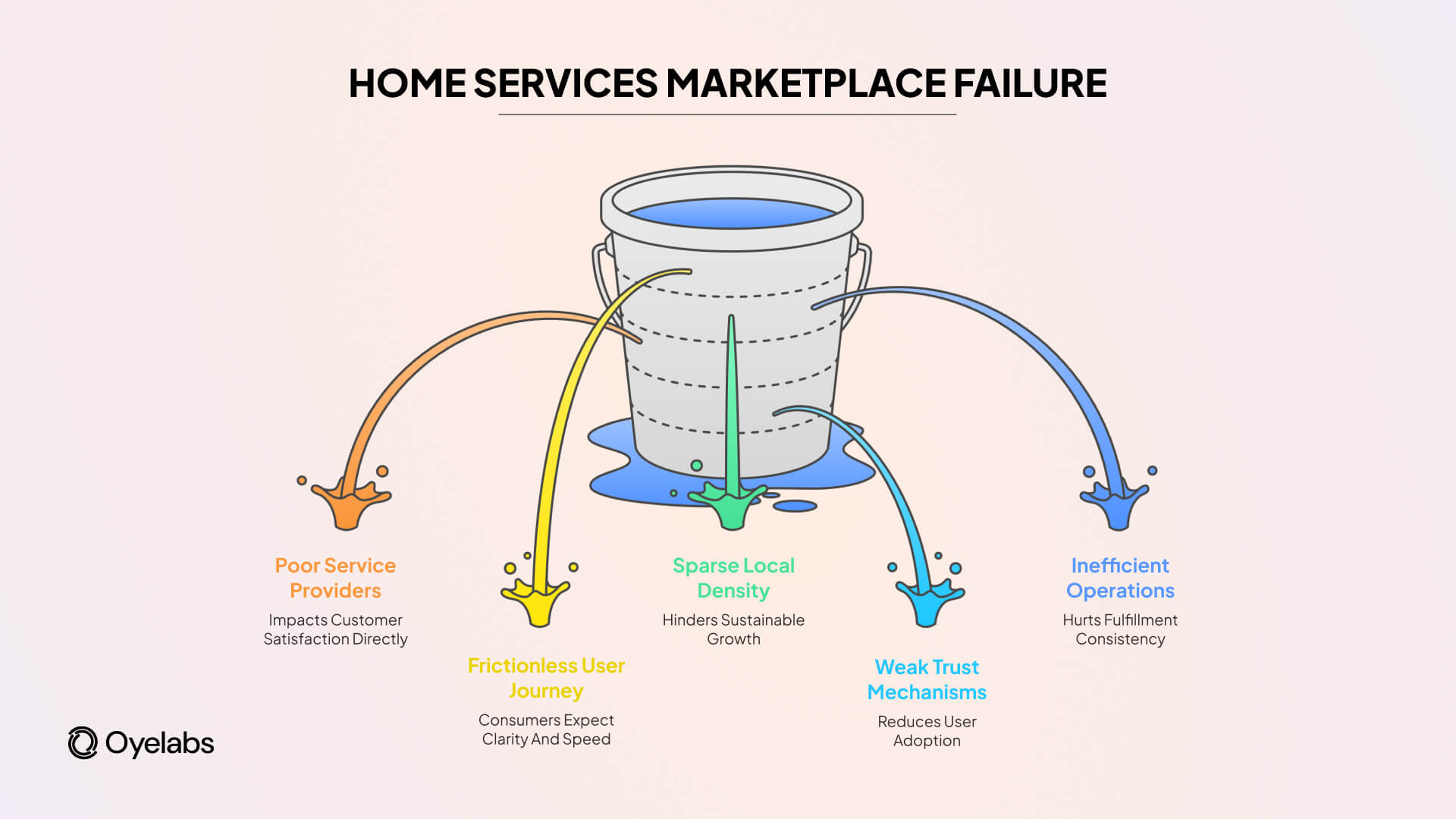
Not every home-services marketplace finds traction in the U.S. market. The difference between scaling and stagnation usually comes down to a few predictable factors. Founders who understand these early are better positioned to build resilient, profitable platforms.
Critical Success Factors
- High-Quality Service Provider Network
Top-performing platforms invest heavily in vetting, onboarding, and retaining skilled service providers. Reliable professionals directly influence customer satisfaction and repeat booking rates. - Strong User Experience
A frictionless user journey – from browsing categories to confirming a booking – keeps conversion rates high. Consumers expect clarity, speed, and mobile-first design. - Local Density Before Expansion
Successful platforms win one market at a time. A dense supply-demand balance in a single ZIP code or city enables sustainable growth and operational reliability. - Trust Mechanisms
Ratings, reviews, background checks, transparent pricing, and service guarantees play a significant role in user adoption and retention. - Real-Time Operations
Real-time scheduling, instant notifications, automated dispatch, and optimized routing significantly improve fulfillment consistency.
Common Pitfalls to Avoid
Expanding Too Broad Too Early: Launching in multiple cities without established supply density often leads to poor service quality, increased cancellations, and high marketing costs.
Weak Provider Controls: Platforms that skip documentation checks, performance scoring, or dispute protocols struggle to maintain consistent service standards.
Poor Category Focus: Trying to cover too many service verticals in the early stage complicates operations and weakens specialization.
Unbalanced Unit Economics: Discount-heavy growth without repeat bookings erodes profitability. Long-term unit economics must be carefully monitored.
Underestimating Operational Complexity: Home services involve real people performing real jobs. Marketplace founders who ignore operational discipline often see high attrition on both sides.
These lessons apply universally across the U.S. market and guide how founders should prioritize development and early-stage execution.
What New Opportunities Are Emerging in the U.S. Home Services Market?
The next wave of innovation in the home-services ecosystem is already taking shape. For new founders, these emerging opportunities represent strategic entry points with strong long-term potential.
Smart Home Installations
With rising adoption of smart security systems, thermostats, cameras, and IoT devices, demand for certified installers is increasing nationwide.
Eco-Friendly and Green Cleaning Services
Consumers now look for non-toxic, environmentally responsible cleaning services – an underserved niche with strong repeat demand.
Senior Home Assistance
The aging U.S. population opens a wide market for in-home non-medical support: errands, housekeeping, minor repairs, and mobility-related assistance.
Pet-Centric Home Services
Pet grooming, pet-sitting, and home pet care are rapidly growing subcategories driven by increasing pet ownership rates.
Subscription-Based Maintenance Packages
Recurring maintenance bundles – HVAC checks, deep cleaning, seasonal lawn care – create predictable revenue streams and increase retention.
Hyperlocal Micro-Markets
Platforms built around specific neighborhoods or ZIP codes often outperform larger competitors due to trust, locality, and faster job turnaround.
AI-Driven Automation Tools
Opportunities exist in AI-enabled:
- Provider matching
- Fraud detection
- Dynamic pricing
- Automated scheduling
- Service quality scoring
These features reduce manual operations while improving customer experience.
International Expansion Models
Global brands entering the U.S. show that proven international frameworks can be adapted to regional needs. Startups can use these playbooks to expand both locally and eventually abroad.
The opportunities are broad, diverse, and highly scalable for founders who plan their positioning early.
How Should CEOs and Founders Move Forward?
The on-demand home services sector is one of the most promising opportunities in the U.S. digital economy today. Consumer expectations have shifted permanently toward convenience, transparency, and mobile-first interactions. Service providers are increasingly open to gig-based work. Technology has matured to a point where building and scaling a marketplace is more feasible than ever.
For CEOs and founders, the path ahead is clear:
- Identify your niche – broad marketplace or specialized vertical.
- Validate your target geography – start small and win locally.
- Build on a proven framework – avoid long development cycles that slow down market entry.
- Focus on quality early – provider onboarding, service reliability, and user trust drive retention.
- Track the right metrics – bookings, retention, take-rate, and provider performance.
This is the ideal moment to enter the market. The demand is strong, the gaps are visible, and the early movers will define the next decade of home-services innovation.
Conclusion
The U.S. on-demand home services market is expanding quickly, with demand rising across every major category – from cleaning and repairs to specialty services like pet care and smart-home installations. Consumers want speed, transparency, and reliability. Service providers want flexible earnings. Marketplace platforms sit directly at this intersection, making this one of the most high-potential sectors for founders today.
For CEOs and early-stage entrepreneurs, the opportunity is not only large – it is also timely. Markets are still fragmented, regional supply gaps are significant, and the shift toward mobile-first service booking is accelerating. The brands that move now, execute with precision, and focus on strong user experience will define the next era of home-services innovation in the United States.
If your goal is to launch a scalable, investor-ready on-demand home services marketplace without the long development cycle, OyeLabs can help you get there faster. With a proven white-label framework, customizable modules, and deployment support, you can enter the market with confidence – backed by a system engineered for growth.
The market is open. The demand is real.
What’s your next move?
FAQs
Q: What makes on-demand home services marketplace apps so popular among U.S. users today?
A: They offer fast booking, verified professionals, transparent pricing, and convenient household services through mobile apps.
Q: How can founders build a scalable home services marketplace app for the U.S. market?
A: Use strong onboarding, reliable providers, local market focus, and a customizable white-label solution like Oyelabs.
Q: Which home services categories perform best for new marketplace startups entering the U.S. market?
A: Cleaning, repairs, handyman tasks, pet care, and smart-home installations consistently show high recurring demand.
Q: How quickly can entrepreneurs launch an on-demand home services app using OyeLabs’ technology?
A: OyeLabs’ ready framework enables founders to launch within weeks, reducing development cost and complexity significantly.