
Top 10 Live Streaming Shopping Platforms in 2026
Top 10 Live Streaming Shopping Platforms in 2026
 Anuraag Jain
Last Updated on June 17, 2026
Key Takeaways
What You’ll Learn
- Live streaming shopping combines real-time video, interactive chat, and instant checkout into a single buying experience.
- Platforms like WhatNot show that community-driven live commerce converts better than traditional static online stores.
- Founders who own their live shopping platform retain full control over data, monetization, and customer relationships.
- Live shopping platforms can be successfully built for focused niches such as collectibles, fashion, beauty, or local markets.
- Launching early allows founders to build audience engagement and brand loyalty before competitors enter the market.
Stats That Matter
- Live commerce can convert 10x higher than traditional eCommerce (McKinsey).
- Live shopping may influence 20% of global online sales by 2026 (Statista).
- Interactive video increases engagement time by 2–3x (Accenture).
- Businesses owning customer data see 2x higher lifetime value (PwC).
Real Insights
- Live interaction builds trust faster than product photos.
- Communities return for hosts, not just discounts.
- Platforms grow stronger when creators feel ownership.
- Simple, mobile-first designs work best for scale.
Top 10 Live Streaming Shopping Platforms in 2026
Scroll. Watch. Chat. Buy.
That’s how shopping works now – and in 2026, it’s how brands win.
Live streaming shopping has moved far beyond flash sales and influencer hype. It’s become a serious growth engine where real-time video, interactive commerce, and instant checkout come together to drive trust and conversion at scale. From creator-led auctions to brand-owned marketplaces, live commerce platforms are reshaping how products are discovered and sold.
For CEOs, founders, and early-stage teams, this shift isn’t about chasing trends. It’s about owning engagement, controlling data, and building platforms that compound value over time. The smartest companies aren’t just selling during live streams – they’re building the infrastructure behind them.
This guide breaks down the top live streaming shopping platforms in 2026, what makes them work, and how forward-thinking founders are turning live commerce into a brand-defining advantage.
Why Live Streaming Shopping Is No Longer Optional in 2026
Live streaming shopping has crossed a critical threshold. What began as an experiment in social commerce has matured into a core digital retail channel. In 2026, live commerce is no longer an “add-on” to eCommerce-it is a primary conversion layer.
The reason is simple: consumer behavior has changed. Buyers no longer want static product pages and generic descriptions. They want context, credibility, and conversation. Live shopping delivers all three in real time.
For businesses, the value is structural:
- Customers spend more time engaging with products
- Questions are answered instantly, reducing purchase friction
- Social proof is visible during the buying moment
- Conversion happens while attention is closest
This is especially relevant for Gen Z and younger millennial buyers, who are accustomed to live video, instant feedback, and interactive experiences. But the impact goes far beyond younger audiences. Brands across fashion, collectibles, electronics, beauty, and niche verticals are seeing live shopping outperform traditional funnels.
In 2026, the question is no longer “Should we try live shopping?”
It is “How do we integrate it into our core business model?”
The Business Case: Why Founders Are Betting on Live Streaming Shopping Platforms
Founders are not investing in live streaming shopping because it is new. They are investing because it changes unit economics. Statista estimates that live shopping will influence nearly one-fifth of global online sales by 2026.
Traditional eCommerce relies heavily on paid traffic, discounts, and repeated retargeting. Live shopping shifts the model toward engagement-driven revenue, where trust and urgency replace endless ad spend.
From a business standpoint, live streaming shopping platforms unlock multiple advantages:
- Higher conversion rates due to real-time interaction
- Shorter decision cycles because objections are handled live
- Stronger brand loyalty through recurring live events
- Lower CAC over time as communities form around sellers and creators
Most importantly, live shopping platforms create repeatable moments. A live show is not a one-time campaign. It is a recurring asset that compounds audience value.
For CEOs and early-stage founders, this matters because valuation is no longer driven purely by GMV. Investors increasingly look at:
- Engagement depth
- Retention loops
- Creator ecosystems
- Platform defensibility
Live shopping platforms score highly on all four.
Live Streaming Shopping vs Traditional eCommerce: A Founder’s View
To understand why live commerce is accelerating, it helps to compare it directly with traditional e-commerce.
| Dimension | Traditional eCommerce | Live Streaming Shopping |
| Customer interaction | Static, delayed | Real-time, two-way |
| Trust-building | Reviews and ratings | Live demonstrations + Q&A |
| Conversion timing | After browsing | During engagement |
| Brand differentiation | Design and pricing | Personality and community |
| Data ownership | Often fragmented | Centralized within the platform |
Traditional eCommerce optimizes for efficiency.
Live shopping optimizes for connection.
This does not mean one replaces the other. In successful businesses, live shopping acts as a conversion accelerator layered on top of existing commerce infrastructure.
For founders building new platforms, however, live commerce often becomes the core experience, not a supporting feature.
What Makes a Great Live Streaming Shopping Platform in 2026
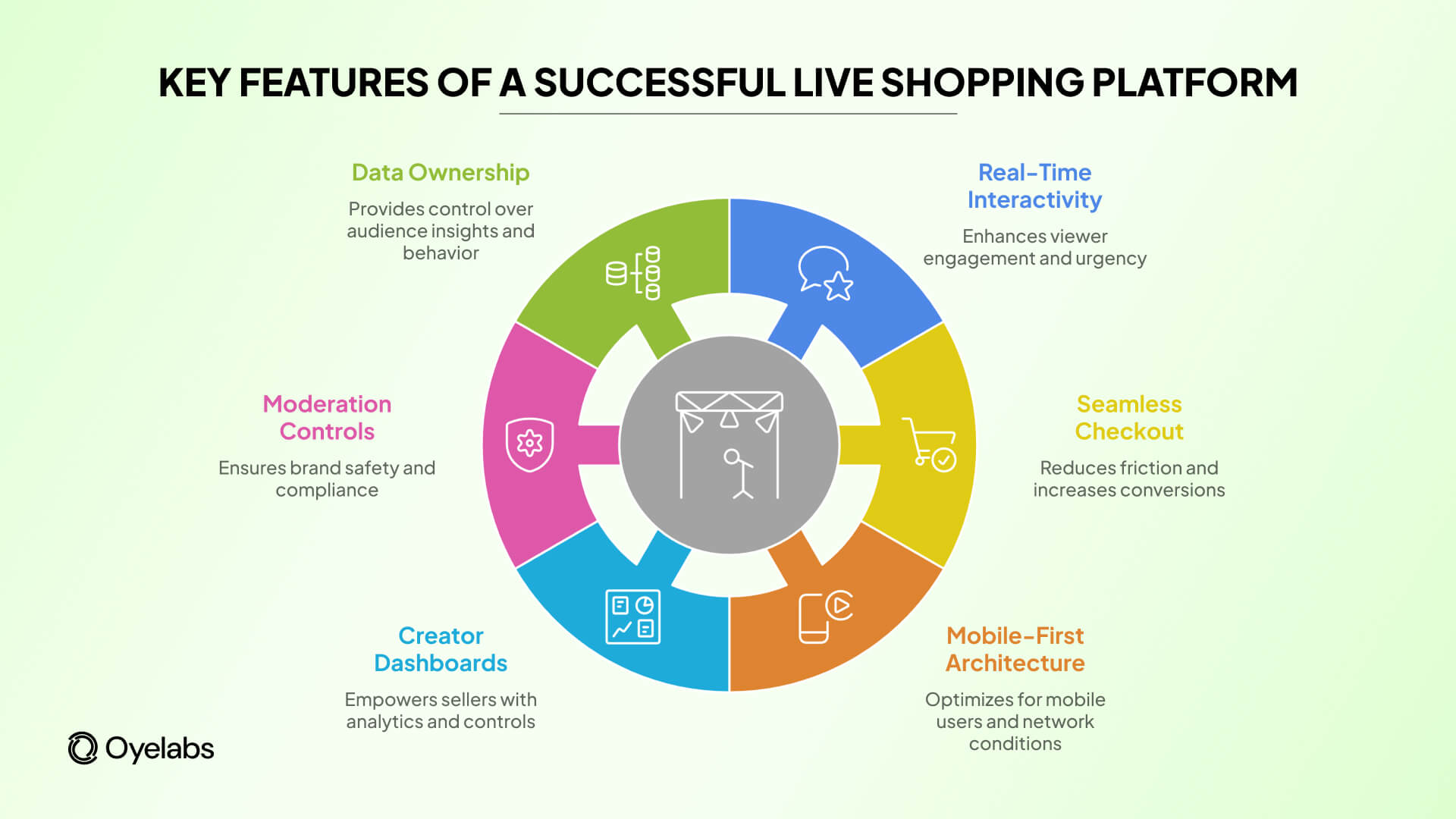
Not all live shopping platforms are built the same. Many fail because they treat live video as a feature rather than a system.
In 2026, high-performing live streaming shopping platforms share a few non-negotiable characteristics.
Real-Time Interactivity
Live chat, reactions, bidding, and on-screen prompts are not optional. They drive urgency and participation, turning viewers into buyers.
Seamless In-Stream Checkout
Every extra click reduces conversion. The best platforms allow users to complete purchases without leaving the live stream.
Mobile-First Architecture
Most live shopping happens on mobile. Platforms must be optimized for vertical video, low latency, and variable network conditions.
Creator and Seller Dashboards
Successful platforms treat sellers as partners. Analytics, inventory controls, stream insights, and earnings visibility are critical.
Moderation and Trust Controls
As platforms scale, moderation, fraud prevention, and content controls become essential for brand safety and compliance.
Ownership of User Data
This is where many third-party platforms fall short. Founders who own their platform own their data, audience behavior, purchase history, and engagement patterns.
These elements define whether a live shopping platform becomes a business asset or just another marketing experiment.
Top 10 Live Streaming Shopping Platforms in 2026
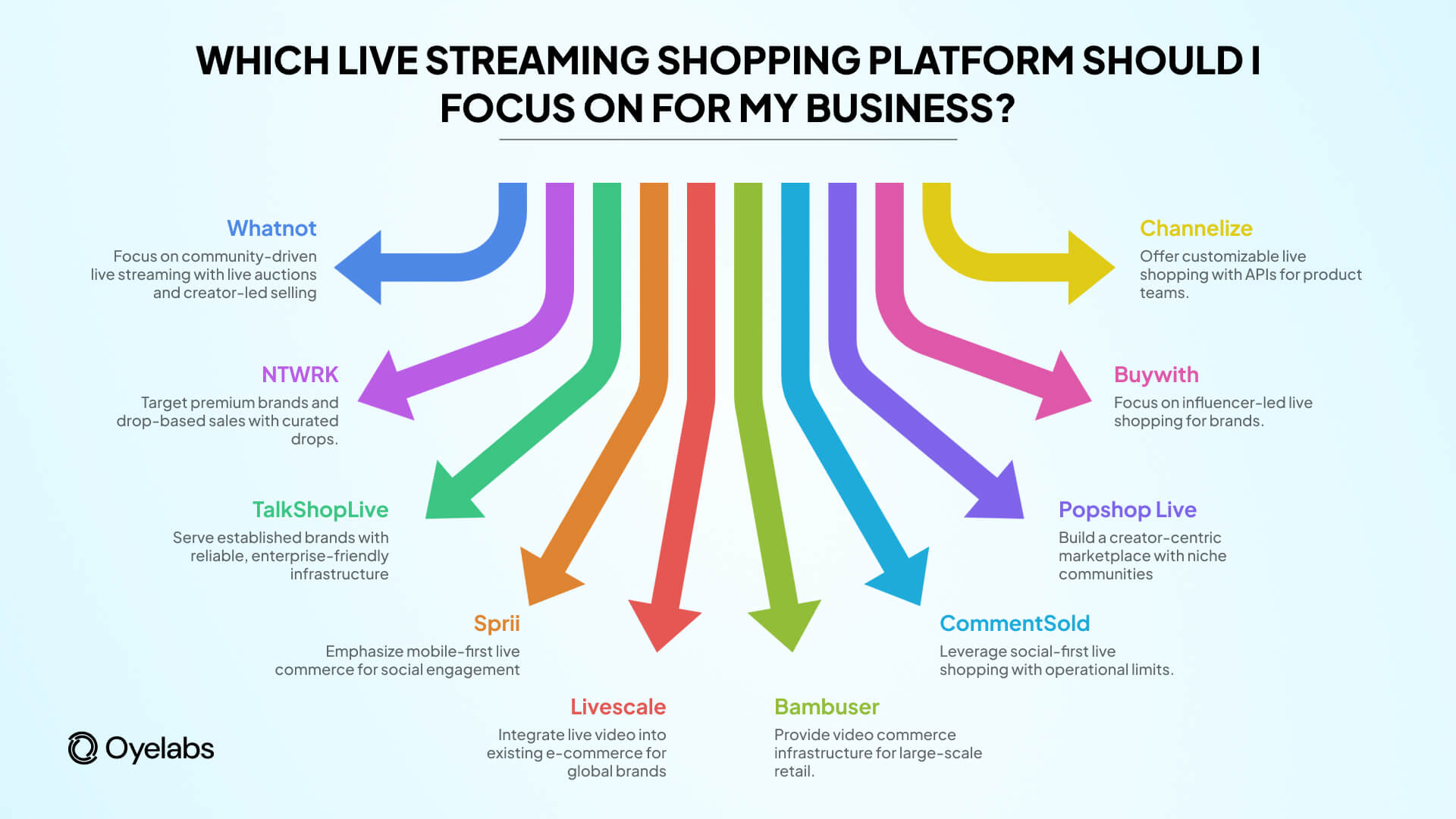
The live streaming shopping landscape in 2026 includes a mix of marketplaces, enterprise tools, and creator-first platforms. Each serves a different business objective.
This list focuses on platforms that have shaped the category, influenced buyer behavior, or demonstrated scalable models.
1. WhatNot – The Benchmark for Community-Driven Live Streaming Shopping Platforms
WhatNot has become the reference point for live streaming shopping platforms in 2026, not because it sells more products than everyone else, but because it solved the hardest problem first: engagement.
WhatNot is built around live auctions, creator-led selling, and real-time scarcity. The platform thrives on interaction-buyers ask questions, bid live, react instantly, and feel part of a shared moment rather than a transaction.
From a founder’s perspective, WhatNot demonstrates three critical lessons:
- Community beats catalog: People return for hosts and personalities, not just products.
- Scarcity drives conversion: Live auctions and limited drops outperform static pricing.
- Habit formation matters: Scheduled shows create recurring engagement, not one-off visits.
Technically, WhatNot succeeds because it tightly integrates low-latency live video, real-time bidding, payments, and chat into a single flow. There is no context switching for the user, and no loss of attention during checkout.
For entrepreneurs, the bigger takeaway is this: WhatNot is not just an app. It is a platform business. That distinction is why many founders are now exploring how to launch WhatNot-like live streaming shopping platforms tailored to their own niche or geography.
2. NTWRK – Curated Live Shopping for Premium and Drop-Based Brands
NTWRK takes a different approach to live streaming shopping. Instead of open marketplaces, NTWRK focuses on curated drops, premium brands, and limited-edition releases.
The experience feels closer to a digital launch event than a community auction. Brands collaborate with creators or hosts, products are released at specific times, and live streams function as high-energy sales moments.
NTWRK works well for:
- Fashion, sneakers, and lifestyle brands
- Drop-based sales strategies
- Brands with strong visual identity
However, from a startup or platform founder’s lens, NTWRK highlights a limitation: control remains centralized. Sellers operate within a tightly managed ecosystem, and creators have limited ownership over audience relationships.
For founders evaluating live streaming shopping platforms, NTWRK reinforces an important distinction: brand-led live commerce versus platform-led ecosystems. Both can work, but they serve very different long-term goals.
3. TalkShopLive – Enterprise-Friendly Live Shopping Infrastructure
TalkShopLive is one of the earliest players in live shopping, and its focus shows. The platform is designed primarily for established brands, media companies, and large retailers.
Its strength lies in reliability and structure:
- Broadcast-quality live streams
- Integrated product catalogs
- Brand-safe moderation tools
- Familiar shopping-TV-style formats
TalkShopLive excels in environments where brand control and consistency matter more than experimentation. That makes it attractive for enterprises, but less flexible for startups looking to innovate or build creator-first experiences.
For founders, TalkShopLive serves as a reminder that live streaming shopping platforms can succeed in very different ways. Some optimize for creativity and community. Others optimize for operational predictability.
4. Sprii – Mobile-First Live Shopping for Social Commerce
Sprii has gained strong traction in European markets by leaning heavily into mobile-first live commerce. The platform blends social interaction with shopping, making live streams feel native rather than promotional.
Sprii’s strength lies in simplicity:
- Fast onboarding for sellers
- Clean mobile UX
- Strong emphasis on audience interaction
- Low barrier to starting live sessions
For early-stage founders, Sprii highlights the importance of accessibility. Platforms that reduce friction for both sellers and viewers tend to scale faster, especially in mobile-dominant regions.
That said, Sprii remains more of a tool-based solution than a fully extensible platform. It works well for brands adopting live commerce, but less so for entrepreneurs looking to build a differentiated marketplace with custom monetization models.
5. Livescale – Enterprise Live Streaming Shopping for Global Brands
Livescale positions itself as an enterprise-grade live shopping solution. Rather than creating a marketplace, Livescale integrates live video into existing e-commerce ecosystems.
Its value proposition is clear:
- Deep integration with enterprise commerce stacks
- Global scalability
- Compliance and performance at scale
- Analytics for large teams
Livescale is best suited for organizations that already have traffic, products, and logistics in place. For startups and founders, however, it demonstrates a common tradeoff: power versus speed.
Enterprise live streaming shopping platforms are robust, but they often require long implementation cycles and significant investment, making them less ideal for founders who want to validate ideas quickly or launch niche platforms.
6. Bambuser – Video Commerce Infrastructure for Large-Scale Retail
Bambuser is often described as a video commerce pioneer, and for good reason. The platform focuses on embedding live and shoppable video directly into existing eCommerce journeys.
Bambuser’s strength is infrastructure. It integrates with enterprise tech stacks and supports high-volume traffic with strong performance and analytics. Many global retailers use Bambuser to modernize product discovery without rethinking their entire commerce model.
From a founder’s standpoint, Bambuser illustrates a clear tradeoff. It is powerful, but it is not designed to create new marketplace ecosystems. It works best for companies that already have brand recognition, logistics, and demand in place.
For early-stage startups, Bambuser is less about inspiration and more about understanding how video layers can enhance commerce once scale is achieved.
7. CommentSold – Social-First Live Shopping With Operational Limits
CommentSold built its early success by merging live video with social media comments, particularly on Facebook. Sellers could run live streams and capture orders directly through comments.
This approach lowered the barrier to entry for small sellers and boutiques, especially in the early days of social commerce. However, in 2026, CommentSold’s limitations are more visible.
Key challenges include:
- Heavy reliance on third-party social platforms
- Limited flexibility in experience design
- Difficulty scaling beyond small seller use cases
For founders, CommentSold serves as a cautionary example. Platforms built on top of other platforms inherit their risks. As algorithms change and user behavior shifts, control becomes a serious concern.
8. Popshop Live – Creator-Centric Live Shopping Marketplace
Popshop Live shares some DNA with WhatNot. It focuses on creator-led live selling and niche communities, offering an accessible way for hosts to build audiences around specific interests.
The platform encourages personality-driven selling and interactive live sessions, which help drive authenticity and trust. For many creators, Popshop Live acts as a stepping stone into live commerce.
However, the ecosystem remains relatively constrained. Founders looking at Popshop Live will notice a familiar pattern: creators grow audiences, but platform ownership and monetization rules remain centralized.
This reinforces a growing realization among entrepreneurs that creator-first platforms are powerful, but owning the underlying platform creates far more long-term value.
9. Buywith – Influencer-Led Live Shopping for Brands
Buywith focuses on influencer-driven live commerce. Brands collaborate with creators to host live sessions that showcase products in real time.
Buywith works well for campaign-based selling and influencer activations. It allows brands to test live shopping without building internal capabilities.
That said, Buywith functions more as a marketing layer than a platform business. It is effective for driving short-term sales but offers a limited opportunity for founders who want to build a scalable, repeatable live commerce ecosystem.
For startups, Buywith highlights the difference between using live shopping and owning live shopping infrastructure.
10. Channelize – Customizable Live Shopping for Product Teams
Channelize positions itself as a flexible live commerce solution with APIs and modular components. It appeals to product teams that want customization without starting entirely from scratch.
Channelize offers control over branding and workflows, but it often requires deeper technical involvement. Implementation timelines can stretch, especially for teams without prior experience in live streaming infrastructure.
For founders, Channelize represents a middle ground: more control than marketplaces, but more effort than ready-to-launch platforms. It works best for teams with clear requirements and technical maturity.
The Hidden Problem With Using Third-Party Live Streaming Shopping Platforms
Most founders start with third-party platforms for good reasons: speed, lower upfront cost, and reduced complexity. But as businesses grow, limitations surface quickly.
The most common issues include:
- Revenue leakage through commissions and platform fees
- No ownership of customer data, limiting personalization and retargeting
- Brand dilution, as the platform, not the seller, becomes memorable
- Policy and algorithm risk, which can impact visibility overnight
- Valuation ceiling, since businesses built on rented platforms struggle to defend their margins
These constraints do not appear in the early stages, which is why many founders underestimate them. Over time, however, they shape growth potential and investor perception.
This is where the strategic conversation shifts from tools to ownership.
Why Smart Founders Are Building Their Own Live Streaming Shopping Platforms
In 2026, the most forward-thinking founders are no longer asking which platform to use. They are asking whether they should own the platform itself.
Building a live streaming shopping platform allows founders to:
- Control monetization models (commissions, subscriptions, ads)
- Own first-party customer and engagement data
- Design experiences tailored to specific niches
- Create defensible IP and long-term enterprise value
This is especially relevant for founders inspired by platforms like WhatNot. The real opportunity is not replicating surface features, but adapting the core mechanics, community, live interaction, and commerce into a platform aligned with a specific market.
One founder Oyelabs worked with followed this exact path. By launching a live streaming shopping platform inspired by the WhatNot model and tailored to a focused niche, they moved beyond selling products to building a recognizable brand.
Engagement increased, impressions multiplied, and the platform itself became the company’s primary asset-something that would not have been possible on a third-party marketplace.
Want to understand how the WhatNot business model actually works for founders? Explore our entrepreneurial breakdown of WhatNot-style platforms.
What It Takes to Build a Live Streaming Shopping Platform in 2026
By 2026, building a live streaming shopping platform is less about invention and more about execution discipline. The core mechanics are well understood – but stitching them together into a stable, scalable system is where most founders struggle.
At a minimum, a modern live streaming shopping platform requires:
- Low-latency live video infrastructure capable of handling real-time interaction without lag
- In-stream commerce flows, including cart, checkout, and payment processing, without breaking the live experience
- Interactive layers such as chat, reactions, bidding, and pinned products
- Seller and creator tools for stream management, inventory control, and earnings visibility
- Moderation, compliance, and fraud controls to protect users and brands as the platform scales
- Analytics and data pipelines that track engagement, conversion, and retention
The technical challenge is not just building these components – it is making them work together seamlessly under load.
This is where many founders underestimate timelines and costs. Building everything from scratch often leads to:
- Delayed launches
- Feature creep
- Infrastructure instability
- Burned capital before market validation
As a result, successful founders increasingly favor ready-to-launch or semi-custom platform foundations that allow them to focus on differentiation, market entry, and growth rather than rebuilding solved problems.
How Oyelabs Helps Founders Launch Live Streaming Shopping Platforms Faster
Oyelabs works with founders who understand that speed, ownership, and scalability must coexist. Instead of forcing startups down long custom development cycles, Oyelabs provides platform-ready architectures inspired by proven live commerce models, including WhatNot-style marketplaces.
The approach is practical:
- A stable live streaming shopping foundation is deployed first
- Core commerce, live interaction, and creator workflows are pre-aligned
- Branding, monetization logic, and niche-specific features are layered on top
- Founders retain full ownership of platform IP and customer data
This allows early-stage teams to launch faster, test real demand, and iterate with real users, rather than guessing requirements for months.
More importantly, founders are not locked into rigid templates. The platform evolves as the business evolves – whether that means expanding into new categories, adding subscription models, or scaling into new geographies.
For many entrepreneurs, this balance between speed and control is what turns live streaming shopping from an idea into a defensible business.
Final Thoughts
Live streaming shopping is no longer experimental. In 2026, it is a proven commercial model shaping how products are discovered, trusted, and purchased.
The platforms leading this shift – especially community-driven models like WhatNot – have demonstrated a clear truth: ownership matters. Selling on platforms can generate revenue. Building platforms creates long-term value.
For CEOs and founders, the strategic decision is straightforward but significant. You can participate in live commerce as a seller, or you can build the infrastructure that others rely on.
The founders who win the next phase of digital commerce will not just stream products.
They will own the platforms where commerce happens.
FAQs
What is a live streaming shopping platform, and how does it work for businesses?
A live streaming shopping platform lets sellers showcase products through live video while viewers interact and buy instantly. Businesses benefit from higher engagement, real-time trust, and faster purchase decisions compared to traditional online stores.
Why are startups building WhatNot-like live shopping platforms instead of selling on marketplaces?
Startups build WhatNot-like platforms to own customer data, control monetization, and increase valuation. Marketplaces limit growth through fees and rules, while owning a platform enables recurring engagement, scalable revenue models, and long-term brand equity.
Is live-streaming shopping profitable for early-stage founders in 2026?
Yes. Live streaming shopping is profitable because it increases conversion rates, reduces marketing costs, and builds loyal communities. Early-stage founders can monetize through commissions, subscriptions, featured sellers, and advertising while validating demand faster than traditional eCommerce.
What features are essential to build a successful live streaming shopping platform?
Essential features include low-latency live video, real-time chat, in-stream checkout, creator dashboards, moderation tools, and analytics. These features ensure smooth interaction, high conversion, seller retention, and platform scalability.