
How TaskRabbit Works – Business & Revenue Model Explained

How TaskRabbit Works – Business & Revenue Model Explained
 Sushmeet Singh
Last Updated on December 22, 2025
Key Takeaways What You’ll Learn: Stats That Matter:
We live in a world of abundance where we need new stuff almost every day. We also have the means to get all that we want. When somebody wants something done or needs to buy something, our minds ask us whether there is an app that can do that task for us. This is how the changing times have affected us. We want everything that the world has to offer and we don’t even want to lift a finger in order to get that. It would seem impossible to get things done without having to move from your seat, but I guess that’s the power of on-demand. It has made doing tasks easier and can also make humans lazier at the same time. It has made people realize the importance of time and it has also made them open up to the idea of paying someone else money to do stuff for them and investing that time towards more profitable ventures. According to Grand View Research,the global online on-demand home services market size is expected to reach USD 14.7 billion by 2030. This growth is being driven by consumers’ increasing preference for convenience and flexible service options, key areas where platforms like TaskRabbit are thriving. See also: One app that helps people with routine work around the household is TaskRabbit. TaskRabbit is an app that was founded in the year 2008 to help people with their routine household tasks. It handles jobs that are home related and deals with moving furniture, home repair, handyman, and other errands around the house. It is an easy way to pay someone more qualified and stronger than you to do tasks around the house. It offers the benefit of finding a skilled and trusted person; generally, a professional to help you with your household tasks at a cheap cost. TaskRabbit connects you to freelancers and agencies dealing in household jobs. It is a great way to generate demand for these companies and freelancers and at the same place create a marketplace for its customers. The entire premise behind the app is for its customers to post tasks that they want to get done and then select a tasker from the pool of freelancers they see near their location. You can additionally check the pricing of these freelancers, their rating, and expertise to make a better selection. TaskRabbit is a great app for the on-demand utility business. TaskRabbit, founded in 2008, is an on-demand service platform that connects users with taskers for a range of household and professional services such as furniture assembly, cleaning, and home repairs. Initially launched on Apple devices, the app faced early challenges but began gaining traction after securing funding in 2011. TaskRabbit’s annual revenue was reported to be approximately $75 million in 2025, reflecting steady growth in the on-demand service industry. The platform now supports over 200,000 taskers globally, offering flexible work opportunities in numerous cities across the U.S., Canada, the U.K., and parts of Europe. Since its acquisition by IKEA in 2017, TaskRabbit has further integrated its services into IKEA’s post-purchase experience, especially for furniture assembly, enhancing customer satisfaction and convenience. TaskRabbit’s continued growth in 2025 signals the rising consumer demand for trusted, gig-based services and the platform’s adaptability in a competitive market. Every on-demand app needs to have certain features in order to satisfy its customers. These features are what differentiates the app from the herd and help the company create a name for itself among the plethora of competition in the market. Some features of TaskRabbit that help it differentiate itself include: By building a TaskRabbit-like app, you can build a robust on-demand platform that acts as a bridge between individuals who need help with everyday tasks and those looking to earn flexible income. These platforms help create a reliable supply of services across categories like cleaning, furniture assembly, moving, and more—providing users with a wide selection of taskers to choose from. This model is generally called the aggregator model where the company doesn’t hold any tangible assets or inventory of its own. Its main purpose is to connect with each other. TaskRabbit does that by connecting task posters to the best-suited taskers for them while taking minimum time and effort. When it comes to household tasks, TaskRabbit is a major player in the market and has been for several years now. The main work done by the app includes: TaskRabbit is great with updating the app according to times. When it first came, the taskers would accept the task request and then complete the work on a future date. Because of the increasing need for efficiency and real-time work TaskRabbit now makes sure that taskers complete the work as soon as possible.
The app has two different user segments that it caters to, we are already familiar with them as taskers and Task posters. The app acts as a mediator, and hence like all mediators it needs two parties to be on either side of the exchange. Both the users have a separate interface offered to them by the app. This is done to make sure that the app interface is optimized for their needs. Let’s discuss a little about these user segments- Taskers– These are the people who actually undertake the work posted by the task posters. They are generally freelancers who are willing to work for a short period for some money. They generally sign up on the app and fill their personal details. Their profiles are then approved before they can take up a task. This process generally covers a background check, a quiz, and an interview. These taskers are generally freelancers willing to work on a temporary basis, unemployed people or are people willing to work for some extra money. They are selected for tasks automatically by task posters and can then either accept or reject the job. Task Posters– The app allows users who need help with household work to find taskers willing to do the same. These can be people who are either elderly, need help with some work, or are just busy doing other work. TaskRabbit interface is divided into two sides, the customer side and the tasker’s side. The customer interface is where tasks are actually posted and the other interface is where a tasker checks the job that has been assigned to them. The main customer app is the one where tasks are posted. The way this app works is pretty simple: you post your job with details, you match with a professional and then you finally get the work done. Here, you post your requirements and the details and get parties interested in your task. Let’s understand how this process works. This also shows us how the tasker’s side works. A tasker registers on a different interface by filling personal details. These details are then cross-checked, and once the background check and interview process are done the profile of the tasker is updated on the app. From here on, taskers can add details regarding their hourly prices, location, etc, and then wait for a task poster to select them. The app also offers these taskers an opportunity to either accept or reject the task offered. The app offers various value propositions both to its task poster and task doers. Both these value propositions are equally important as the app would not work without both its users. These users play an important role for the app to work and one cannot survive without the other. Hence the company needs to offer certain unique propositions to them. Some of these propositions include: Related Read: Must-Have Features for Home Services Apps TaskRabbit like other on-demand home services apps acts as a mediator between different users. This means that the app does not have any tangible assets or inventory of its own, all it does is it connects people who need each other. This makes TaskRabbit an intermediary, and like most intermediaries, TaskRabbit majorly earns by offering a platform to its users. Without earning this money, the company won’t be able to survive for long. Let’s see how an app like TaskRabbit earns its revenues: Commission Fee– For every task that is completed on the app, the company receives a commission. This is one of the most common ways in which TaskRabbit earns its revenue. The commission that it charges is an expense for the platform that the app offers, it is also paid for the maintenance, insurance, customer support, and other services the app offers. The service fee that TaskRabbit charges is calculated as 15% of the amount paid to the tasker. This fee is included in the hourly fee promised to the tasker which means the hourly fee you see for the tasker is inclusive of the service fee. Once the task poster makes the payment online, 15% is taken by the company and the remaining is directly transferred to the person Trust And Support Fee– On top of the service fee, TaskRabbit also adds a 7.5% trust and support fee to each invoice, and this amount is directly paid by the task poster to the company. This fee is a charge for the company to make sure they can facilitate the exchange and offer support to the task poster. Peak Pricing– If certain services or categories are in higher demand, TaskRabbit can also add peak pricing. This is done because the demand for certain services is extremely high during certain times, hence this makes sure that the people who are willing to pay peak pricing get priority. Advertising Charges– Users who want to be shown on the top of the searches pay advertisement charges. This helps them get more visibility and hence more work. On-demand apps have surely made the lives of people a lot easier. They have given people a means to earn money, an opportunity to get flexible jobs, and easier means of getting work done. People are starting to use these apps for their daily work not just because it is easy but also because it supports their busy schedules. People have understood that time is as important as money if not more. They have now started accepting help from others by paying them a minimal amount, and in exchange, they utilize the same time towards more profitable ventures. This means they can still get the work done by someone else and use the time they save for something better. Time has become an important luxury nowadays and hence we can expect to see more apps like these. It’s better to give in and use them because the entire world is soon going to become online and everything will be done on-demand and in real-time. Ans. The owner ,i.e., you keep the complete code with yourself. However, you are going to need experts on the backend and for keeping the app running smoothly. Ans. Some methods used by such apps are Commission Fee, Trust and Support fee , Advertising charges and peak pricing. Ans. All you need is an idea, and a team of experienced developers to make it into an app. But, before you begin, you should first research the market to see if your TaskRabbit-like app has demand and target audience, and also if you have an excellent unique value proposition. Looking for a Readymade TaskRabbit like app? Get in touch with Oyelabs today, we will help you launch your on-demand home services platform.
About TaskRabbit
Features Of The App
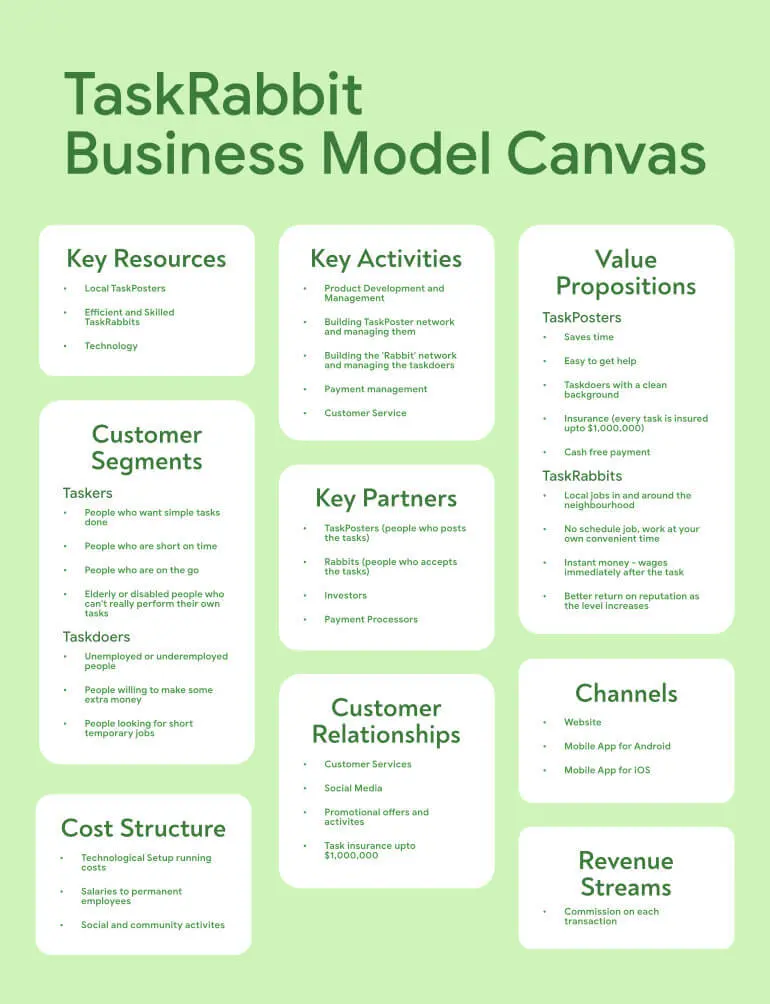
The TaskRabbit Business Model
Users Of The App
How Does The App Work
Value Propositions Of The App
Value Proposition For The Task Posters
Value Proposition For Taskers
TaskRabbit Revenue Model
Frequently Asked Questions for TaskRabbit Business Model (FAQs)
Que. Who keeps the code after development?
Que. How do apps like TaskRabbit generate revenue?
Que. How do I get started with my own business like TaskRabbit ?







Comments (2)
bob
How many times a year does a TaskRabbit customer use TaskRabbit?
Vinesh
Great job ..
Comments are closed.